Made by Design · Chapter 5: Design for Everyone
Cover
Made by Design · Chapter 5
Design for Everyone
From a curb cut to the right to repair
A curb cut built for wheelchairs turns out to help almost everyone. Rio and Milo follow that idea into broken gadgets, glued-in batteries, and the right to repair, then close the book together.
12 panels · ~6 min read
Panel 1
Panel 2
Panel 3
Panel 4
Panel 5
Panel 6
Panel 7
Panel 8
Panel 9
Panel 10
Panel 11
Panel 12
Read chapter text: Design for Everyone
A curb cut built for wheelchairs turns out to help almost everyone. Rio and Milo follow that idea into broken gadgets, glued-in batteries, and the right to repair, then close the book together.
Panel 1
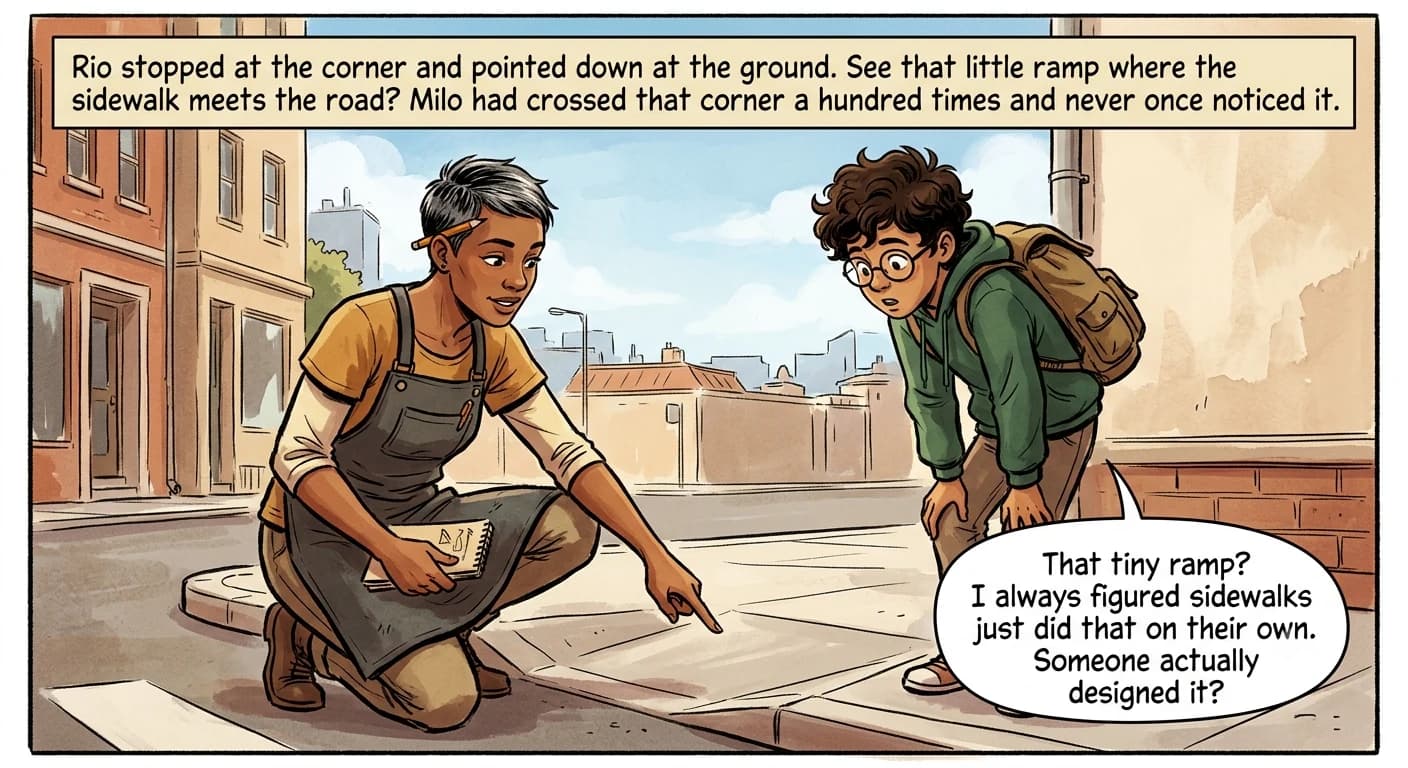
A designer crouches and points at a curb ramp on a sunny city sidewalk while a curious kid looks down at it in surprise.
Rio stopped at the corner and pointed down at the ground. See that little ramp where the sidewalk meets the road? Milo had crossed that corner a hundred times and never once noticed it.
Milo: That tiny ramp? I always figured sidewalks just did that on their own. Someone actually designed it?
Panel 2
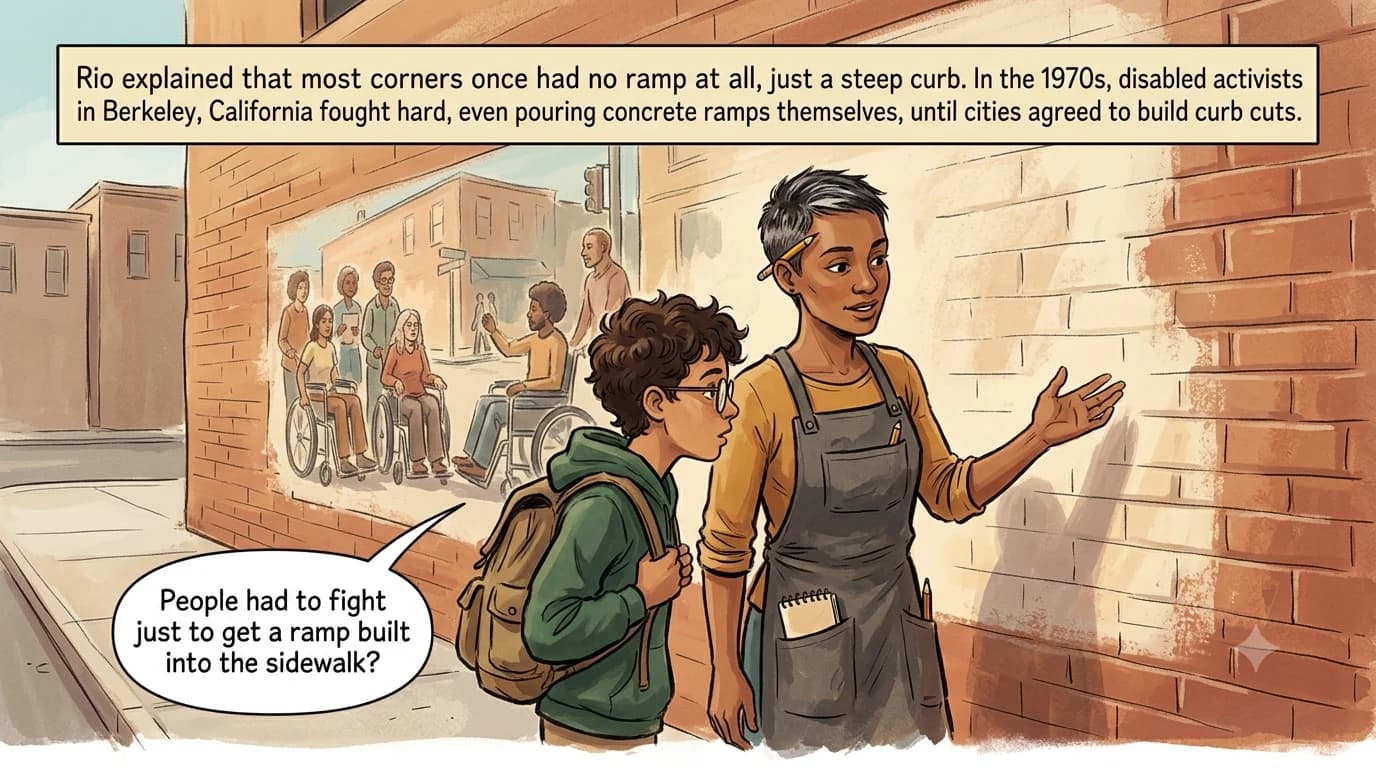
A flashback mural shows disabled activists in wheelchairs gathered at a 1970s Berkeley street corner, determined to win safe curb ramps.
Rio explained that most corners once had no ramp at all, just a steep curb. In the 1970s, disabled activists in Berkeley, California fought hard, even pouring concrete ramps themselves, until cities agreed to build curb cuts.
Milo: People had to fight just to get a ramp built into the sidewalk?
Panel 3
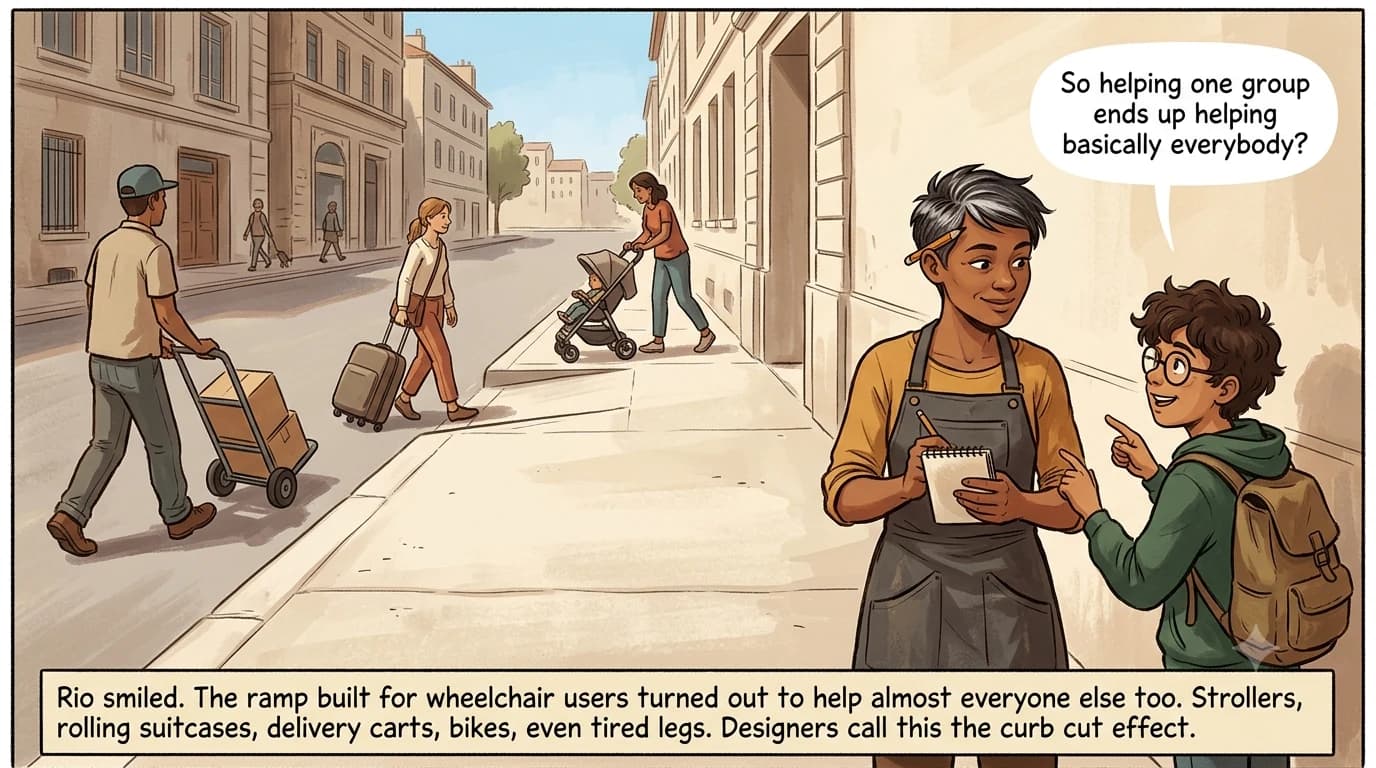
Several different people, a parent with a stroller, a traveler with luggage, and a delivery worker with a cart, use the same curb ramp one after another on a city sidewalk.
Rio smiled. The ramp built for wheelchair users turned out to help almost everyone else too. Strollers, rolling suitcases, delivery carts, bikes, even tired legs. Designers call this the curb cut effect.
Milo: So helping one group ends up helping basically everybody?
Panel 4
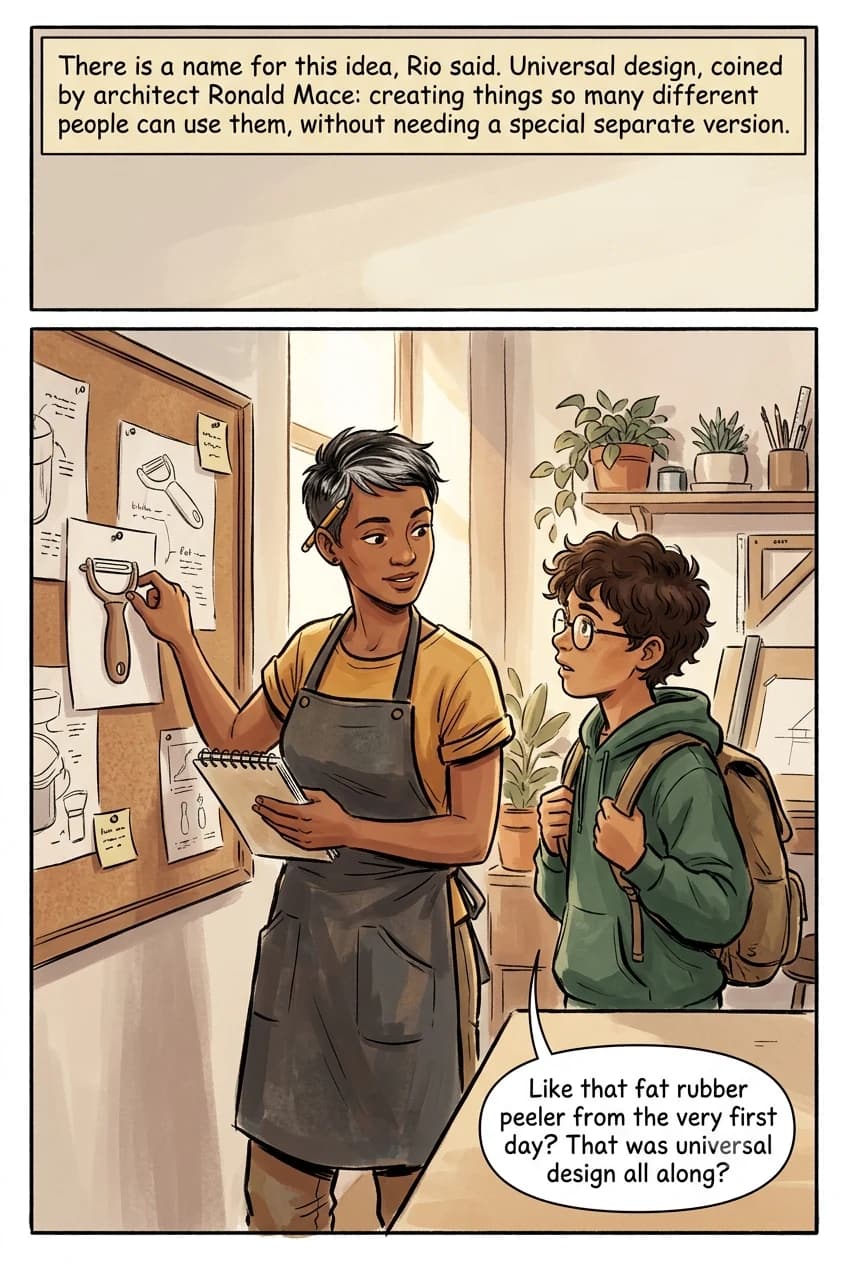
A designer taps a pinned sketch of a fat-handled peeler on a corkboard while a kid looks back and forth, connecting the idea to universal design.
There is a name for this idea, Rio said. Universal design, coined by architect Ronald Mace: creating things so many different people can use them, without needing a special separate version.
Milo: Like that fat rubber peeler from the very first day? That was universal design all along?
Panel 5
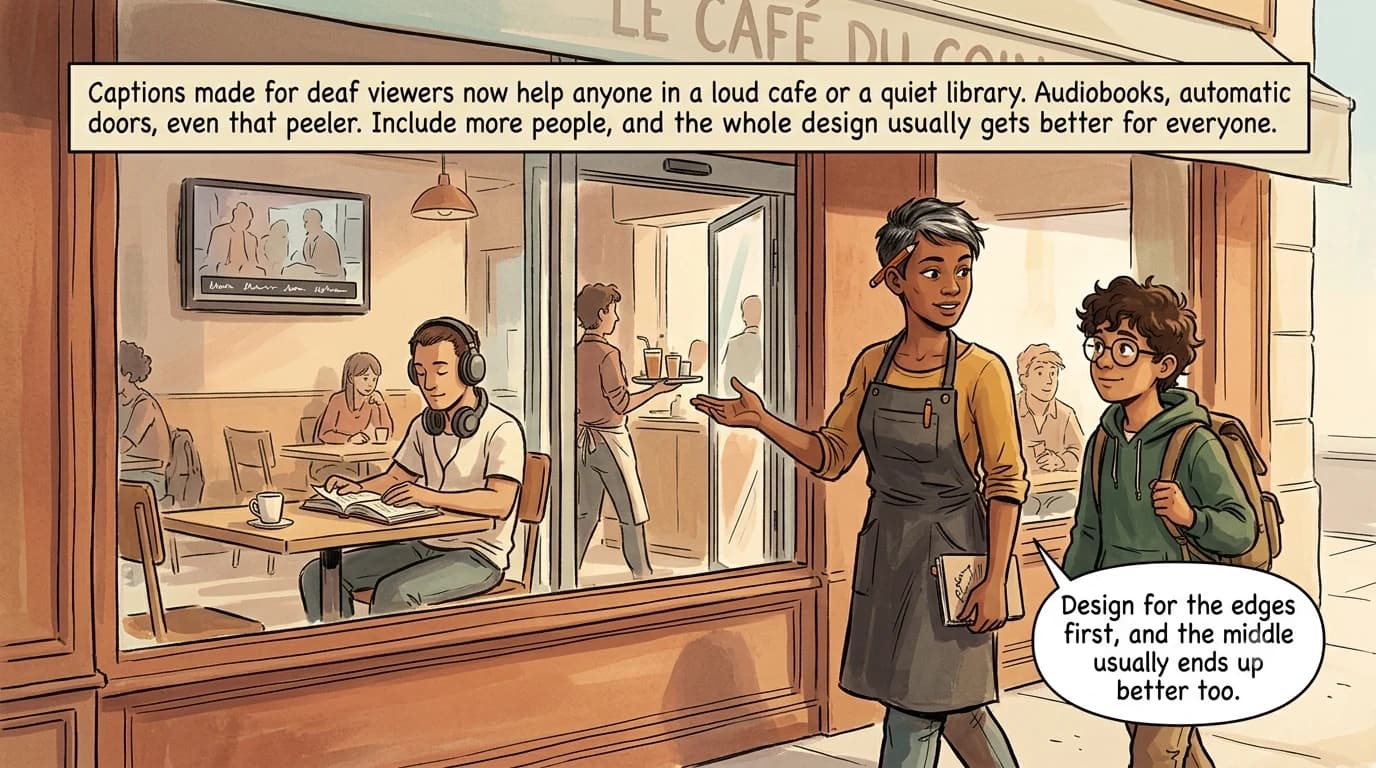
A cafe window shows a captioned television, a customer listening to an audiobook, and an automatic door swinging open, while a designer and a kid walk past.
Captions made for deaf viewers now help anyone in a loud cafe or a quiet library. Audiobooks, automatic doors, even that peeler. Include more people, and the whole design usually gets better for everyone.
Rio: Design for the edges first, and the middle usually ends up better too.
Panel 6
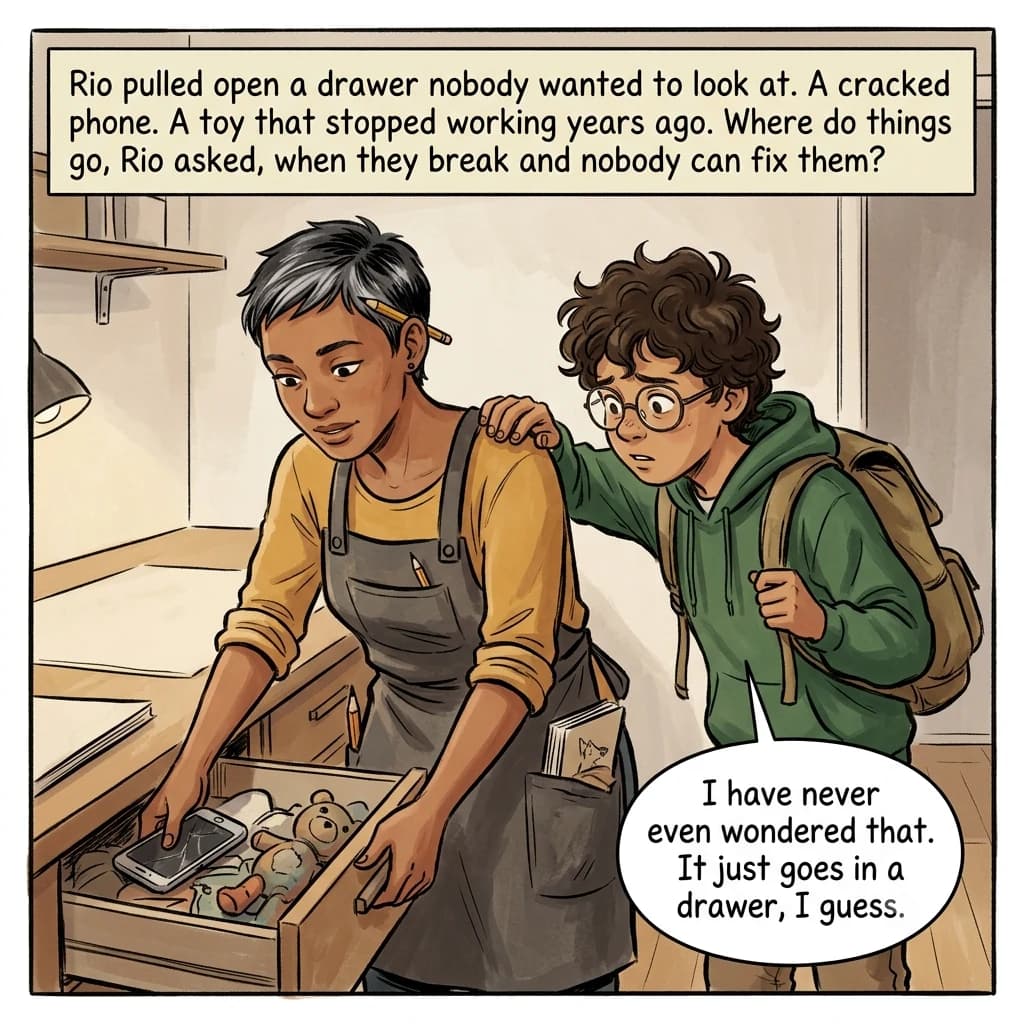
A designer opens a cluttered drawer full of broken gadgets, a cracked phone and an old toy, while a kid peers in with curiosity.
Rio pulled open a drawer nobody wanted to look at. A cracked phone. A toy that stopped working years ago. Where do things go, Rio asked, when they break and nobody can fix them?
Milo: I have never even wondered that. It just goes in a drawer, I guess.
Panel 7
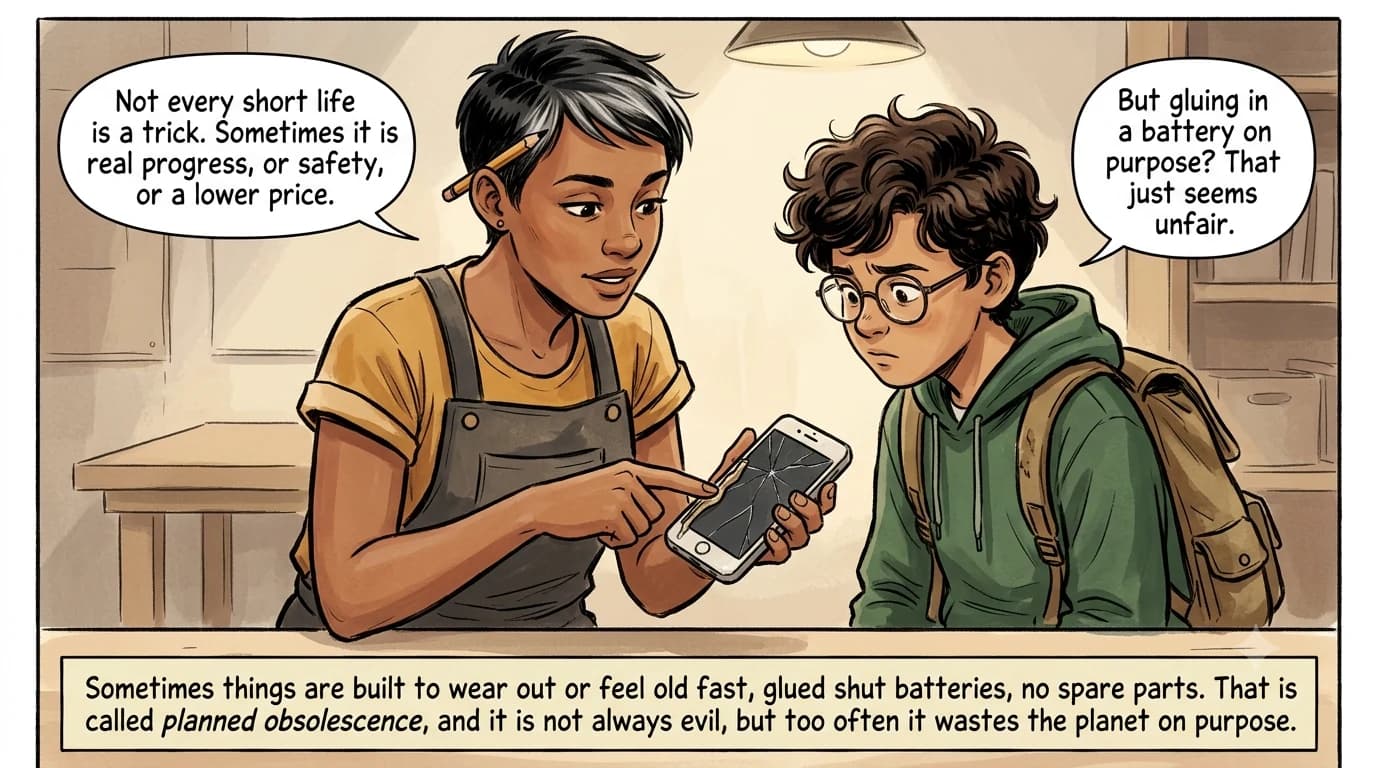
A designer holds up a cracked phone pointing to its glued-shut battery while a kid studies it closely, starting to understand planned obsolescence.
Sometimes things are built to wear out or feel old fast, glued shut batteries, no spare parts. That is called planned obsolescence, and it is not always evil, but too often it wastes the planet on purpose.
Rio: Not every short life is a trick. Sometimes it is real progress, or safety, or a lower price.
Milo: But gluing in a battery on purpose? That just seems unfair.
Panel 8
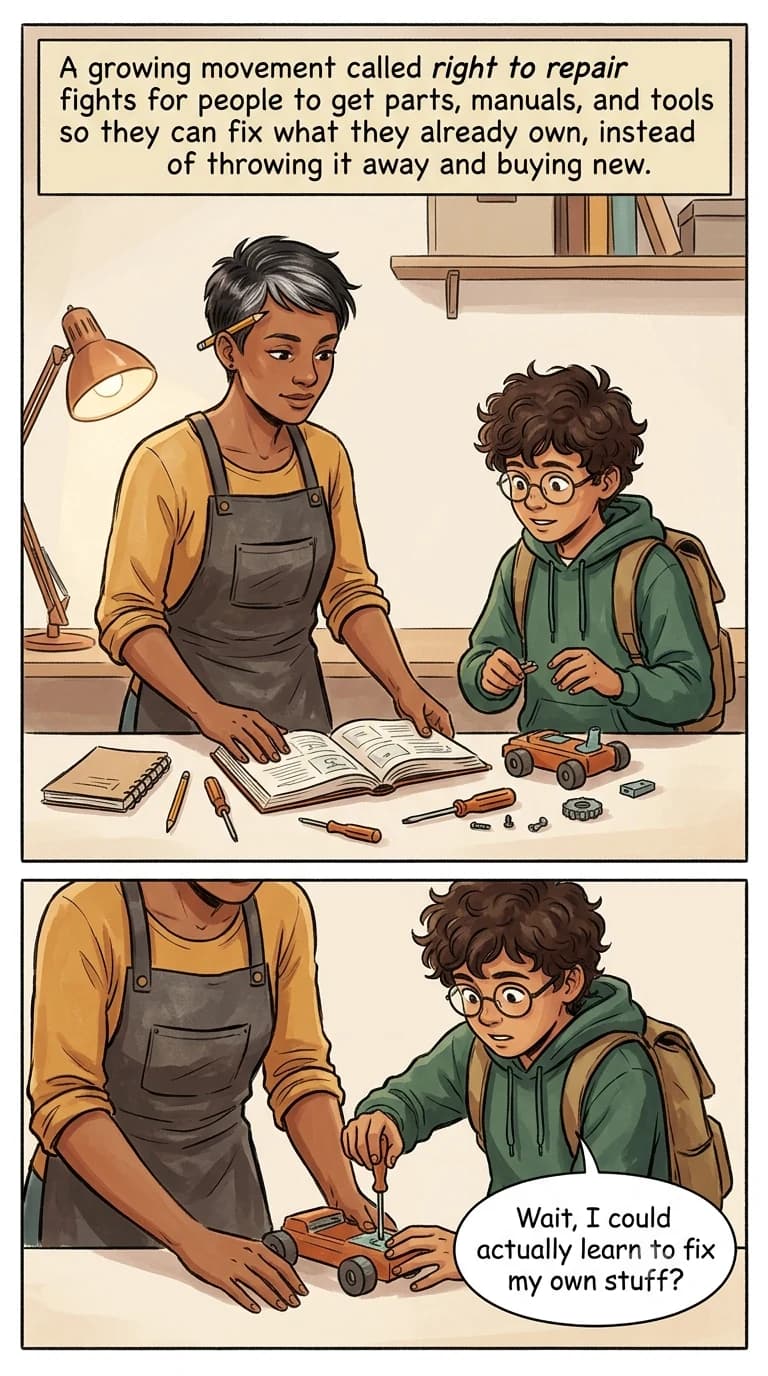
A designer spreads a repair manual, screwdrivers, and spare parts on a workbench while an eager kid picks up a screwdriver to try fixing an old toy.
A growing movement called right to repair fights for people to get parts, manuals, and tools so they can fix what they already own, instead of throwing it away and buying new.
Milo: Wait, I could actually learn to fix my own stuff?
Panel 9
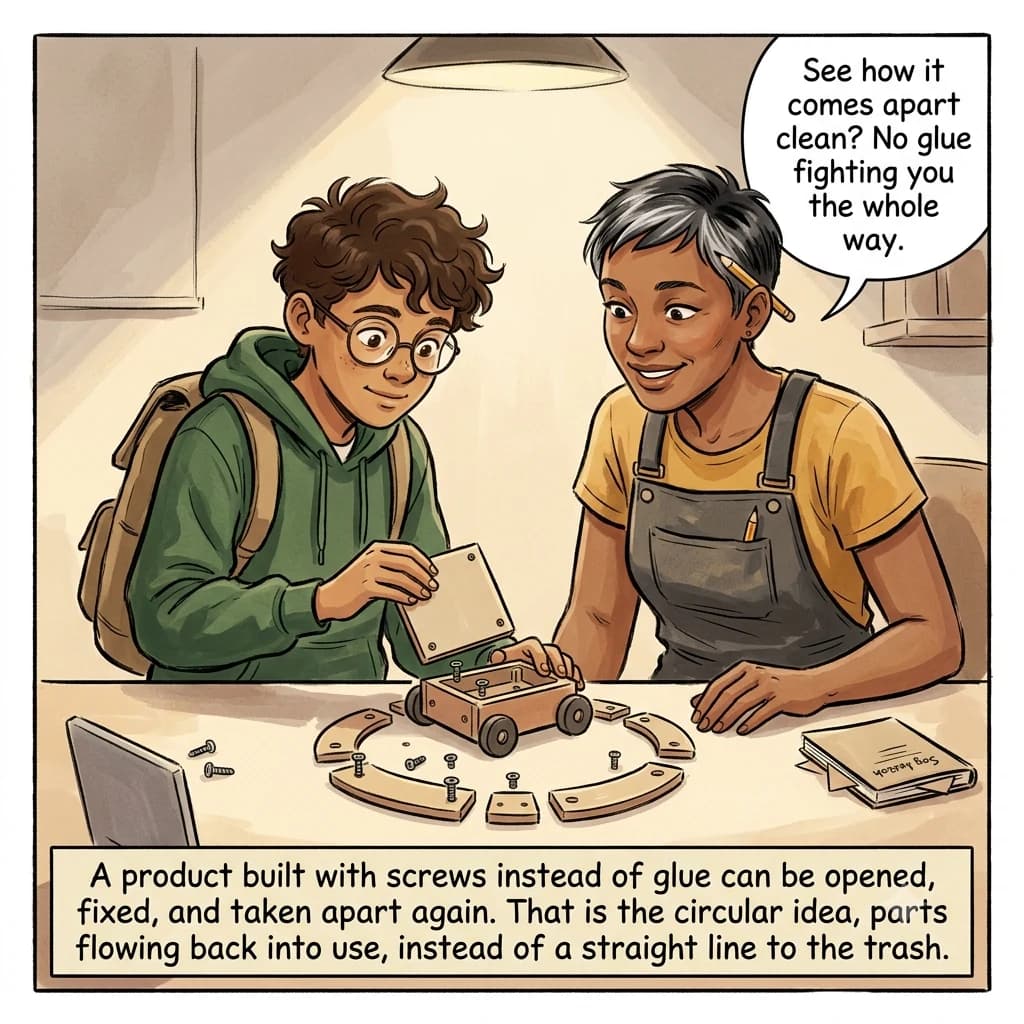
A kid carefully disassembles an old toy on a workbench, its screws letting each part come free cleanly, while a designer watches, pleased.
A product built with screws instead of glue can be opened, fixed, and taken apart again. That is the circular idea, parts flowing back into use, instead of a straight line to the trash.
Rio: See how it comes apart clean? No glue fighting you the whole way.
Panel 10
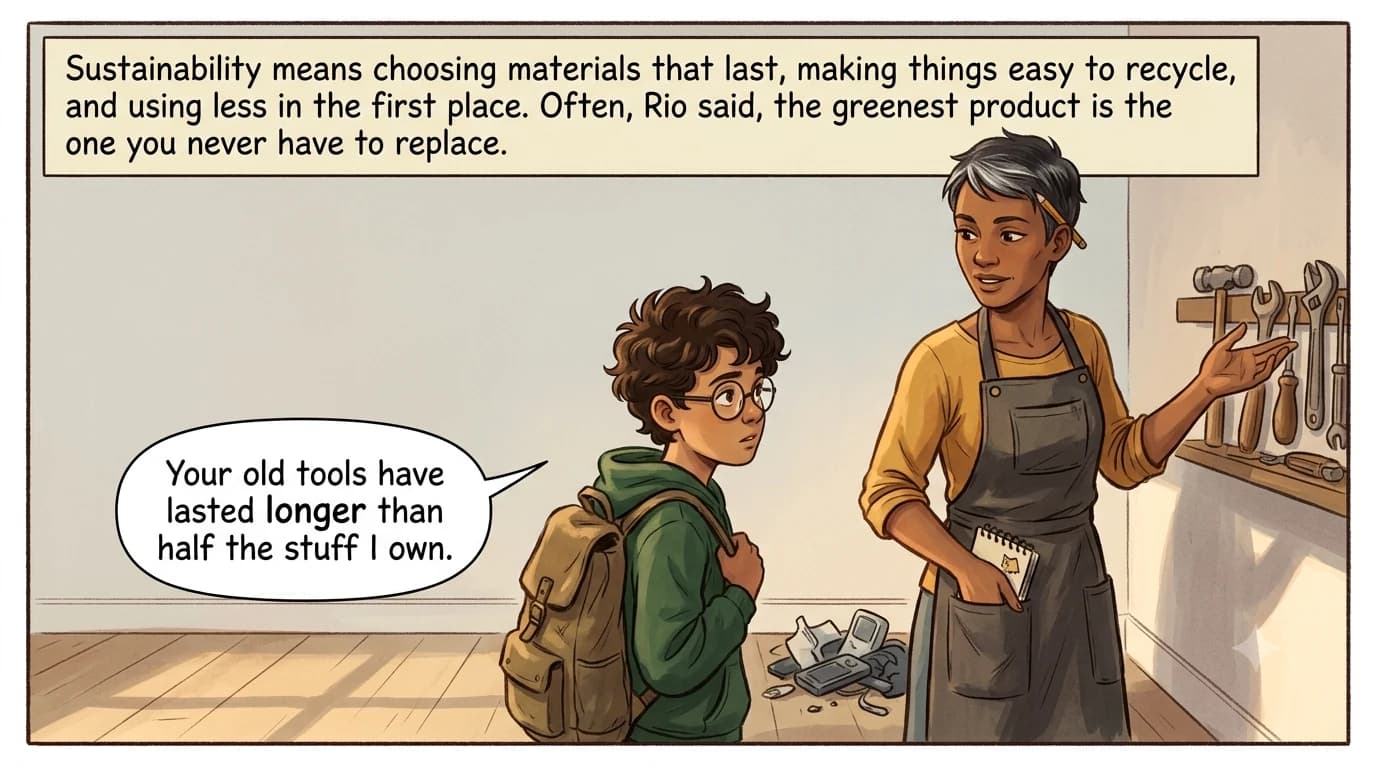
A designer gestures to a shelf of her own worn but working tools beside a small pile of cheap broken plastic gadgets, while a kid compares the two.
Sustainability means choosing materials that last, making things easy to recycle, and using less in the first place. Often, Rio said, the greenest product is the one you never have to replace.
Milo: Your old tools have lasted longer than half the stuff I own.
Panel 11
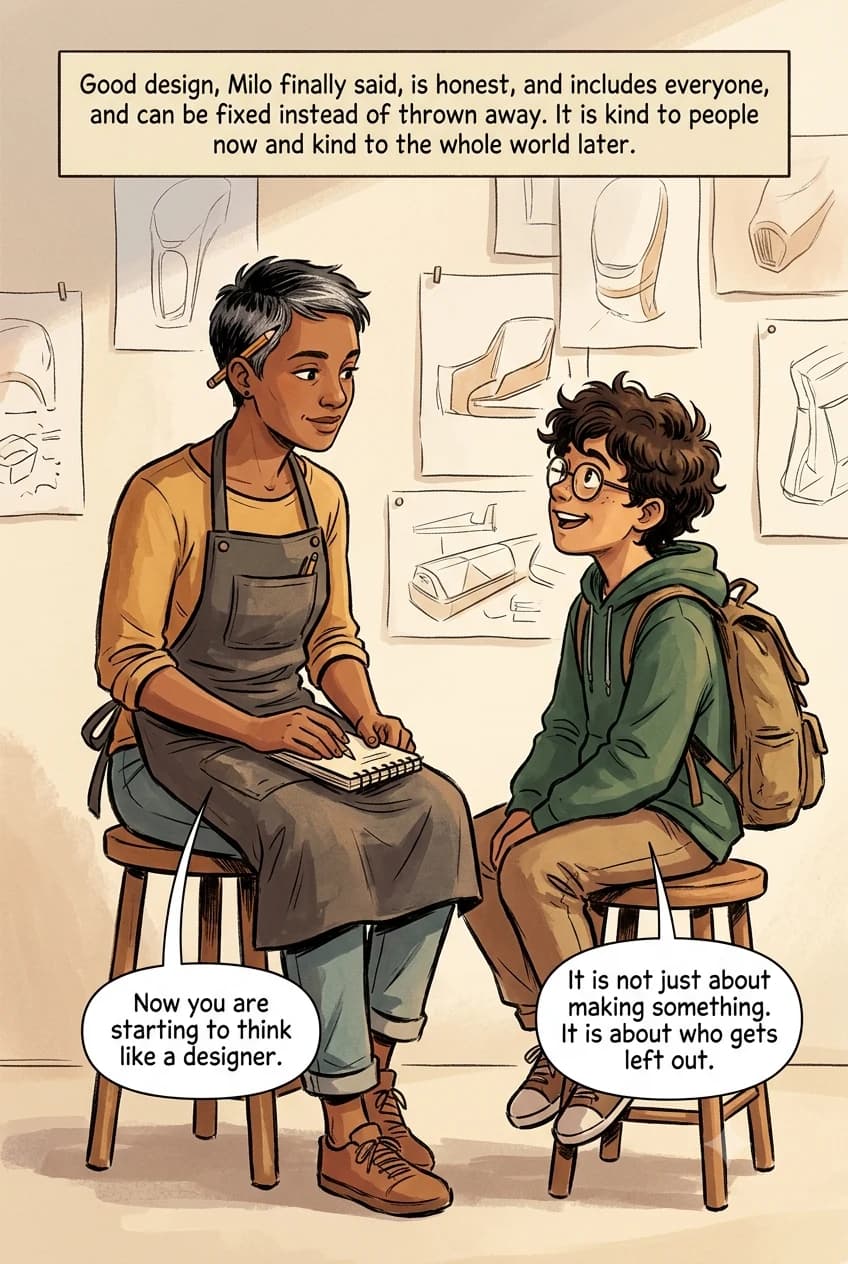
A designer and a kid sit together on stools surrounded by old sketches, the kid grinning with a wide look of understanding.
Good design, Milo finally said, is honest, and includes everyone, and can be fixed instead of thrown away. It is kind to people now and kind to the whole world later.
Milo: It is not just about making something. It is about who gets left out.
Rio: Now you are starting to think like a designer.
Panel 12
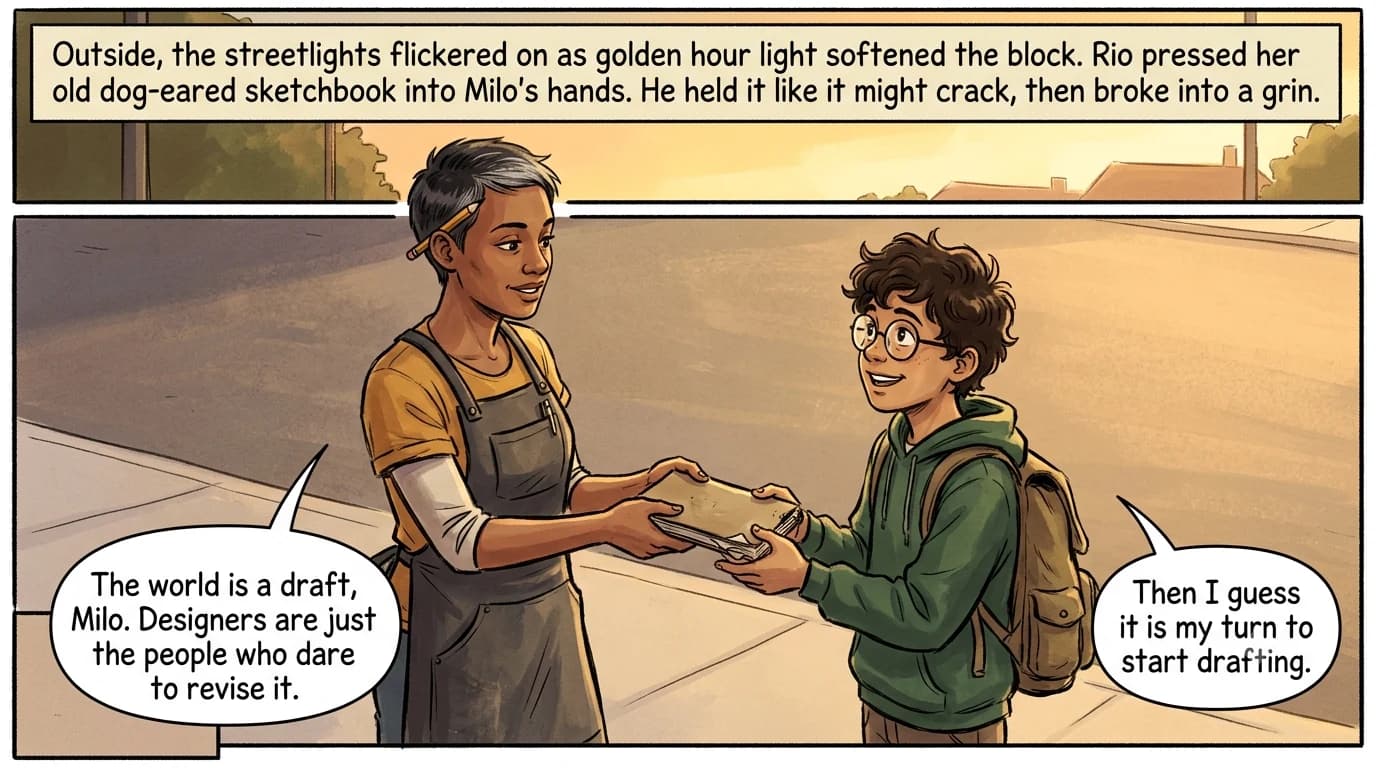
A designer hands her worn, dog-eared sketchbook to a delighted kid at golden hour, both smiling as the moment closes the story.
Outside, the streetlights flickered on as golden hour light softened the block. Rio pressed her old dog-eared sketchbook into Milo's hands. He held it like it might crack, then broke into a grin.
Rio: The world is a draft, Milo. Designers are just the people who dare to revise it.
Milo: Then I guess it is my turn to start drafting.