Made by Design · Chapter 3: Material World
Cover
Made by Design · Chapter 3
Material World
Why things are made of what they are made of
Every material is a bundle of trade-offs, and every shape starts as a process. Rio and Milo compare metal, plastic, wood, and glass, then head into a real factory to watch molds, presses, extrusion lines, and 3D printers turn raw material into objects you can hold.
12 panels · ~6 min read
Panel 1
Panel 2
Panel 3
Panel 4
Panel 5
Panel 6
Panel 7
Panel 8
Panel 9
Panel 10
Panel 11
Panel 12
Read chapter text: Material World
Every material is a bundle of trade-offs, and every shape starts as a process. Rio and Milo compare metal, plastic, wood, and glass, then head into a real factory to watch molds, presses, extrusion lines, and 3D printers turn raw material into objects you can hold.
Panel 1
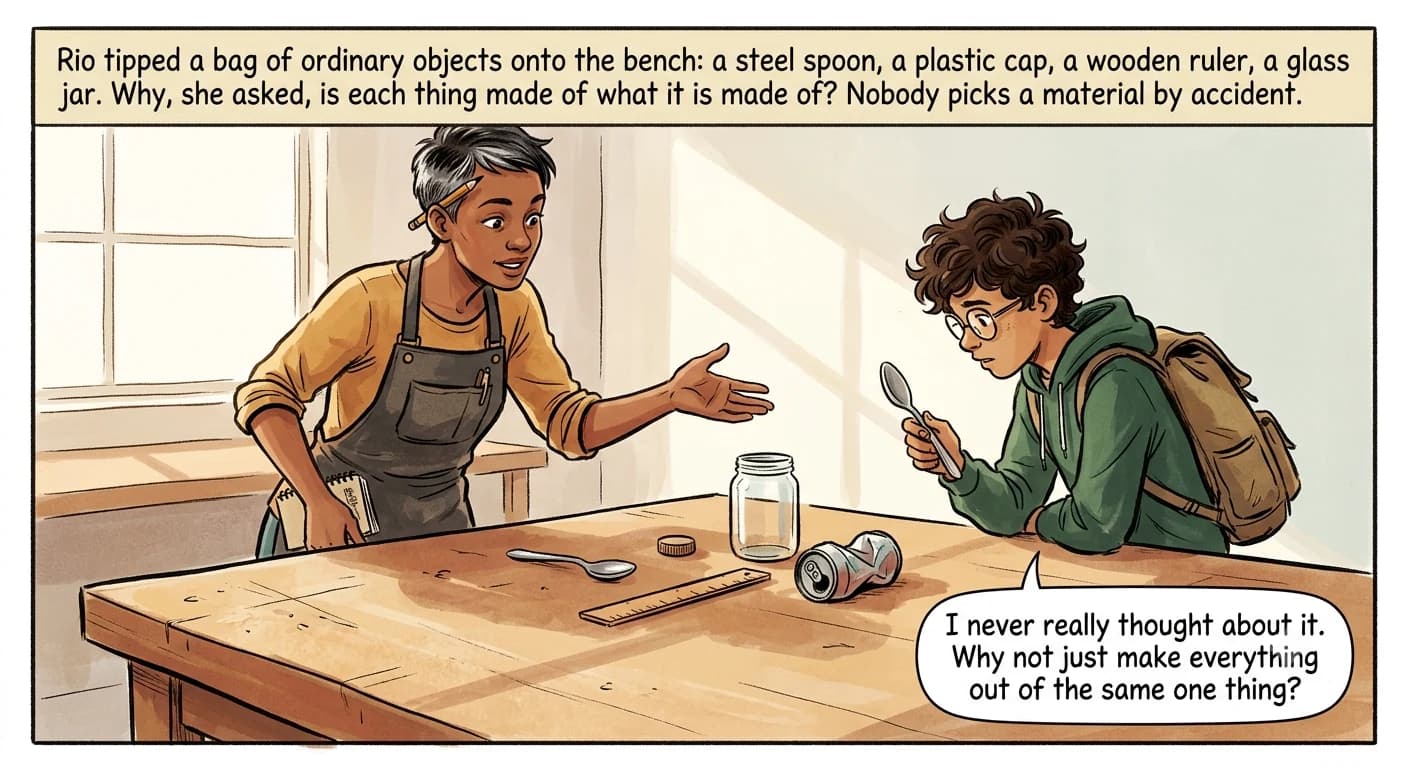
A designer tips a bag of everyday objects made from different materials onto a workbench while a curious kid leans in to look.
Rio tipped a bag of ordinary objects onto the bench: a steel spoon, a plastic cap, a wooden ruler, a glass jar. Why, she asked, is each thing made of what it is made of? Nobody picks a material by accident.
Milo: I never really thought about it. Why not just make everything out of the same one thing?
Panel 2
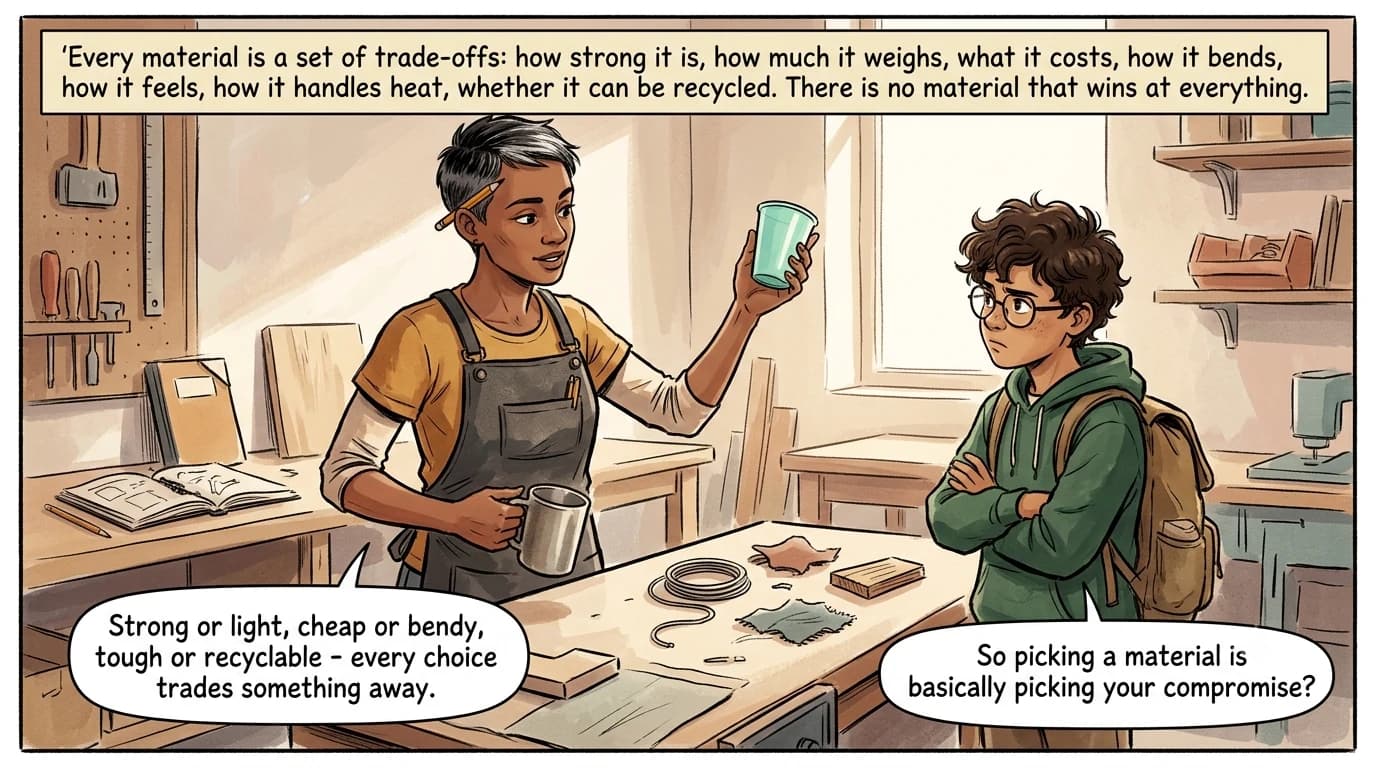
A designer balances a metal cup and a plastic cup like a scale to show a weight trade-off while a kid looks on with arms crossed.
Every material is a set of trade-offs: how strong it is, how much it weighs, what it costs, how it bends, how it feels, how it handles heat, whether it can be recycled. There is no material that wins at everything.
Rio: Strong or light, cheap or bendy, tough or recyclable - every choice trades something away.
Milo: So picking a material is basically picking your compromise?
Panel 3
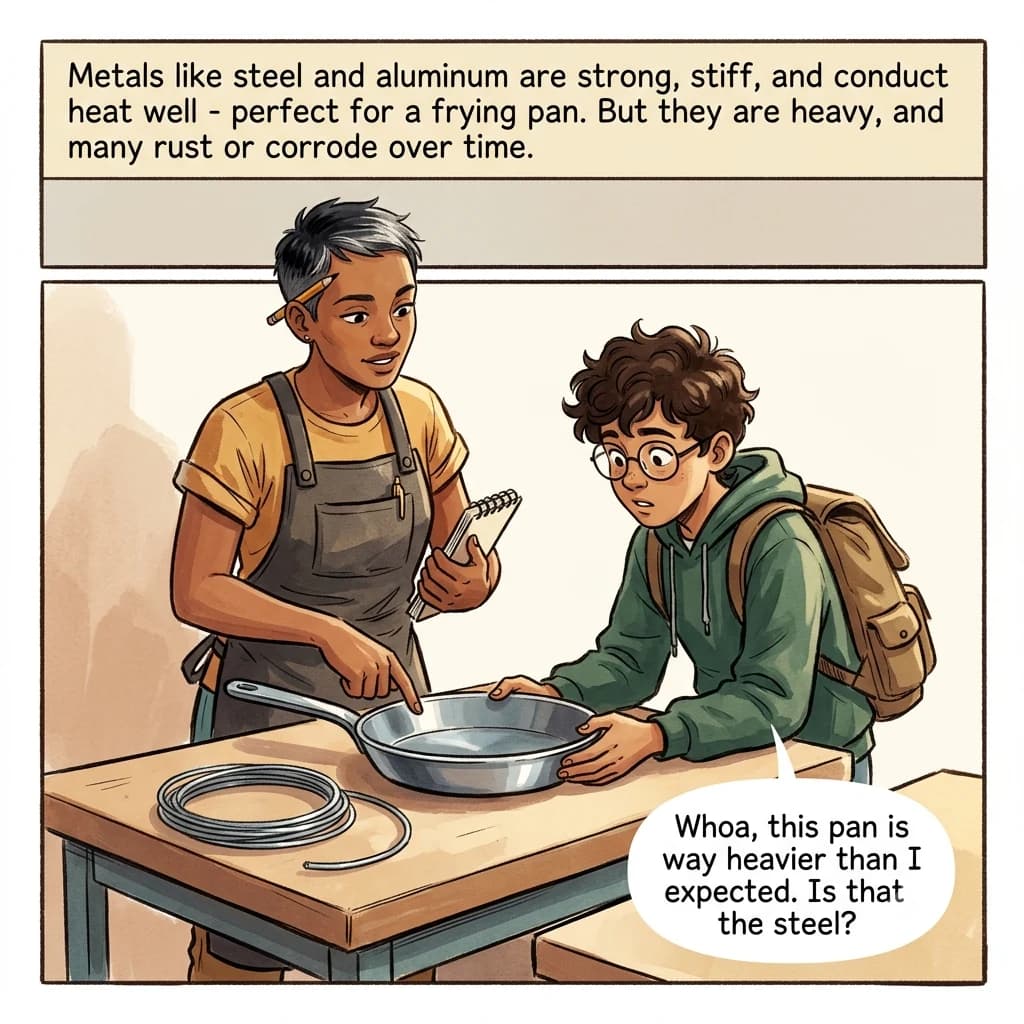
A designer sets a heavy stainless-steel frying pan and a coil of steel wire on a workbench while a kid touches the pan's rim.
Metals like steel and aluminum are strong, stiff, and conduct heat well - perfect for a frying pan. But they are heavy, and many rust or corrode over time.
Milo: Whoa, this pan is way heavier than I expected. Is that the steel?
Panel 4
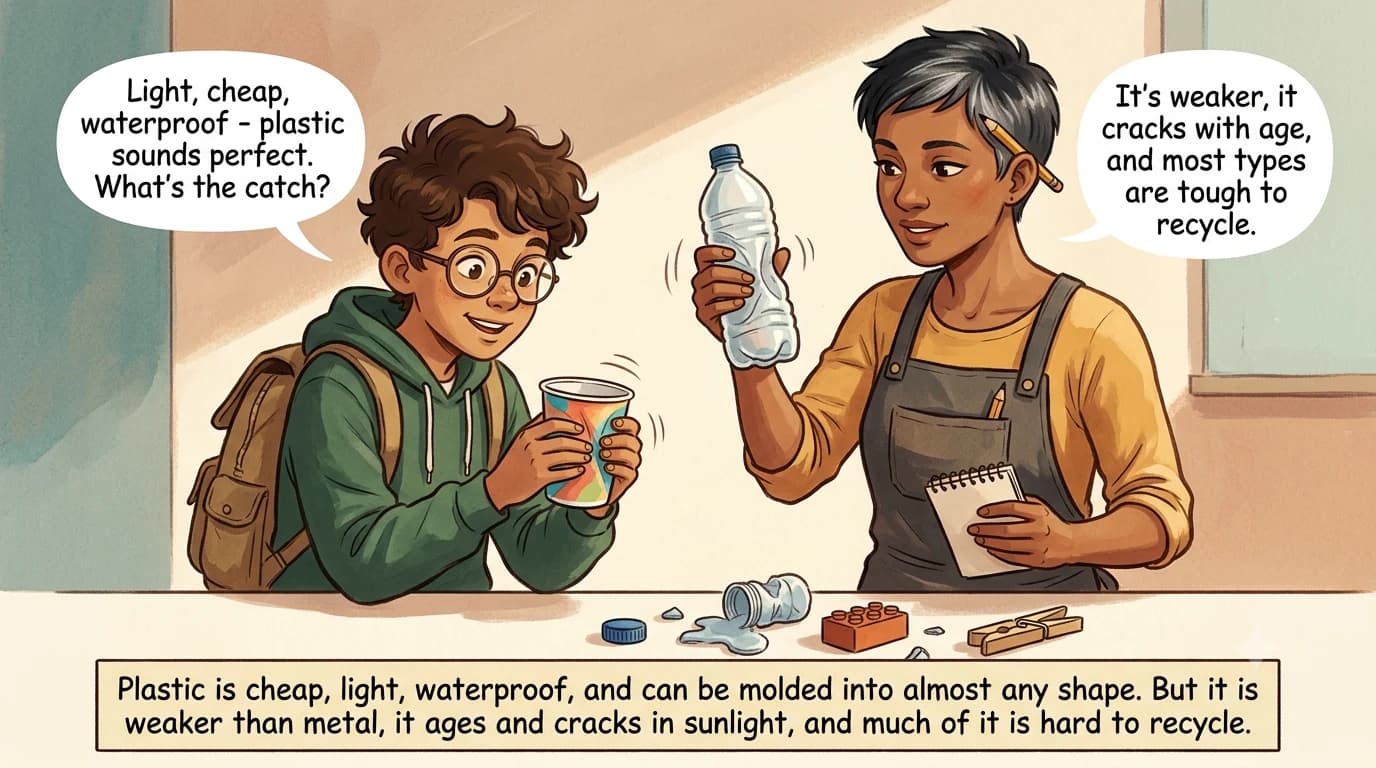
A designer flexes a lightweight plastic bottle while a kid squeezes a plastic cup and watches it spring back into shape.
Plastic is cheap, light, waterproof, and can be molded into almost any shape. But it is weaker than metal, it ages and cracks in sunlight, and much of it is hard to recycle.
Milo: Light, cheap, waterproof - plastic sounds perfect. What's the catch?
Rio: It's weaker, it cracks with age, and most types are tough to recycle.
Panel 5
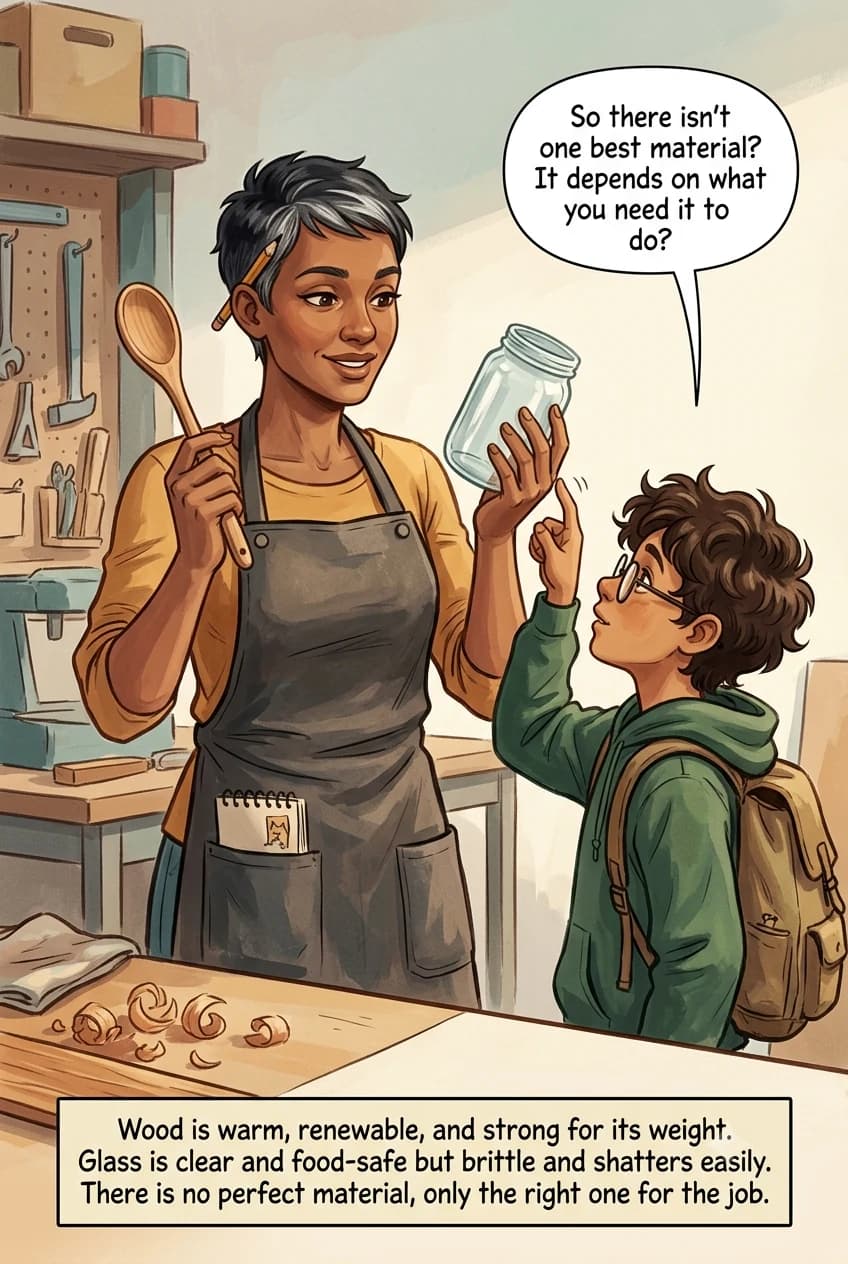
A designer holds up a wooden spoon and a glass jar side by side while a kid taps the jar and listens to it ring.
Wood is warm, renewable, and strong for its weight. Glass is clear and food-safe but brittle and shatters easily. There is no perfect material, only the right one for the job.
Milo: So there isn't one best material? It depends on what you need it to do?
Panel 6
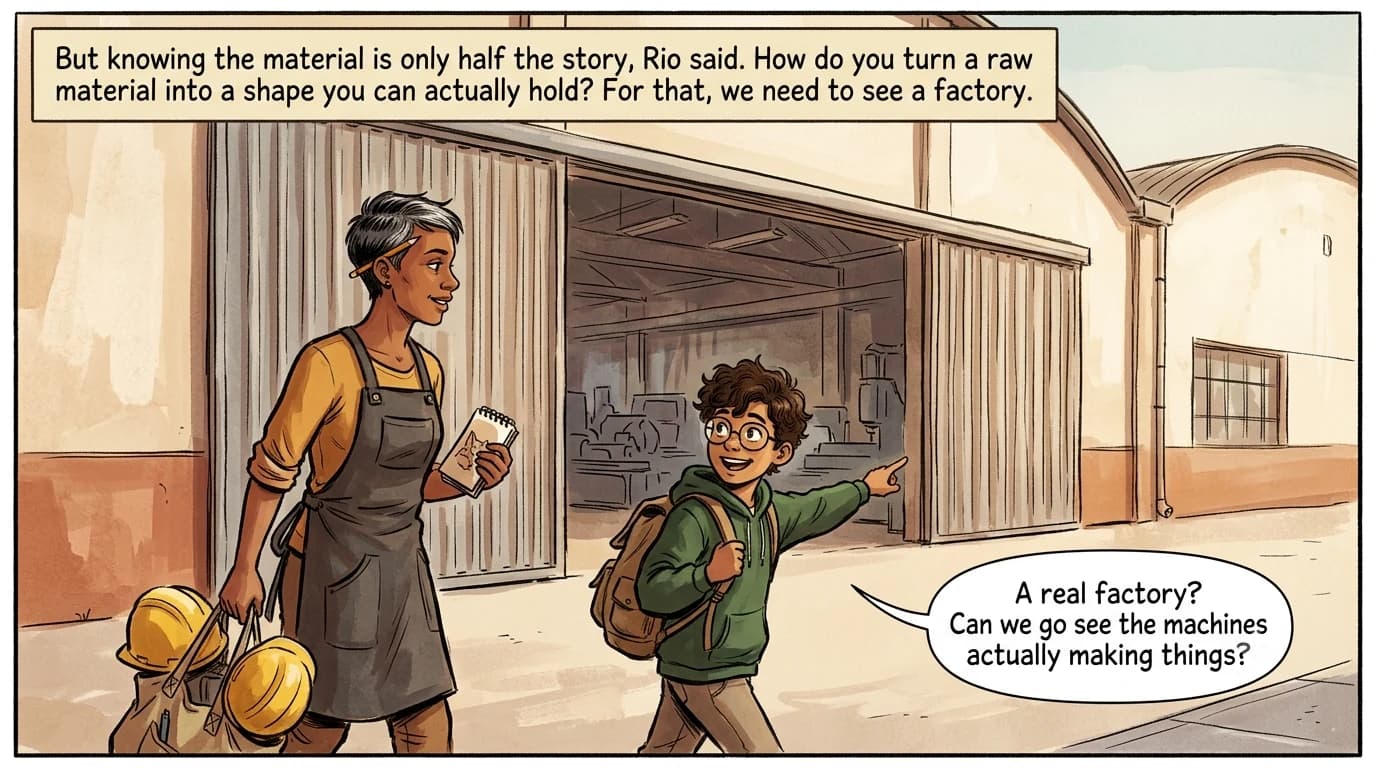
A designer and a curious kid walk toward the entrance of a large factory building, hard hats in hand.
But knowing the material is only half the story, Rio said. How do you turn a raw material into a shape you can actually hold? For that, we need to see a factory.
Milo: A real factory? Can we go see the machines actually making things?
Panel 7
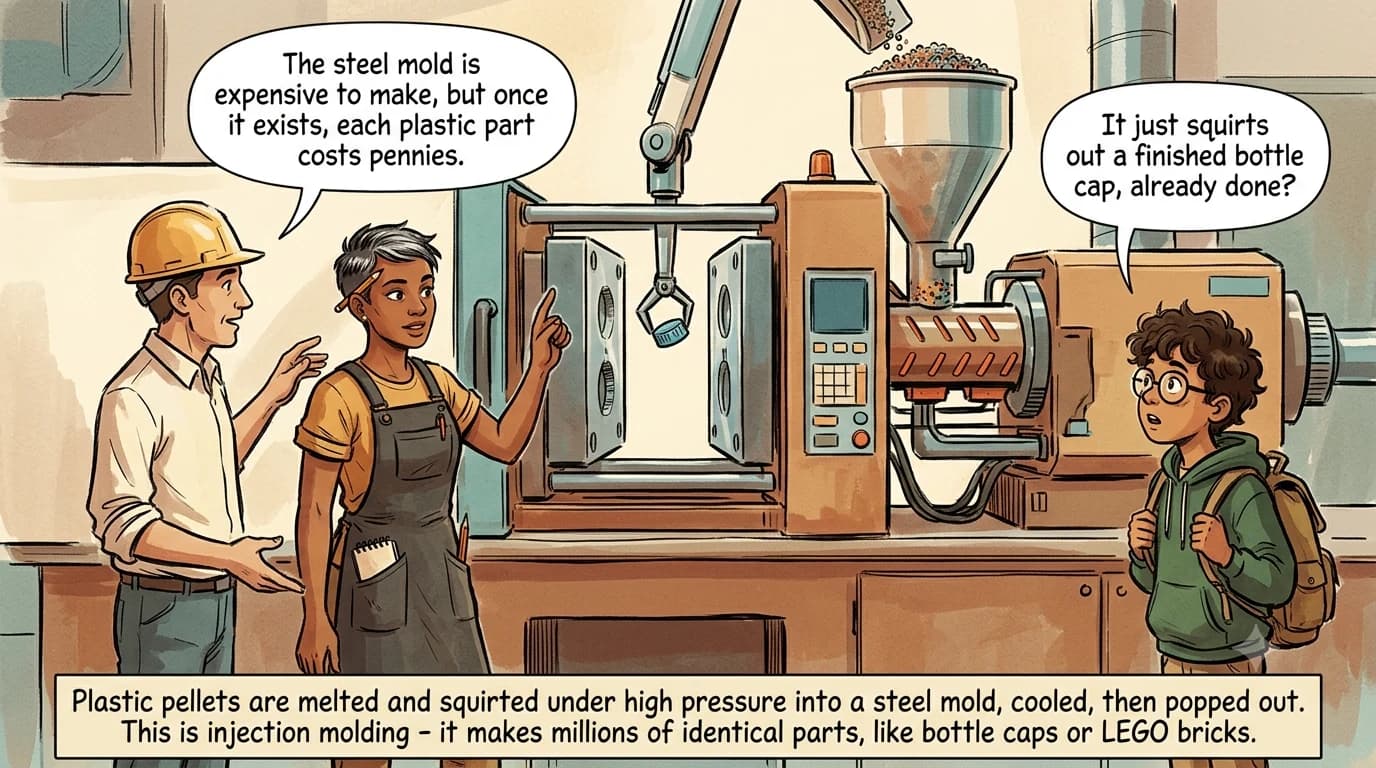
An injection molding machine stands with its steel mold halves open while a robot arm reaches between them to lift out a freshly molded bottle cap.
Plastic pellets are melted and squirted under high pressure into a steel mold, cooled, then popped out. This is injection molding - it makes millions of identical parts, like bottle caps or LEGO bricks.
Factory guide: The steel mold is expensive to make, but once it exists, each plastic part costs pennies.
Milo: It just squirts out a finished bottle cap, already done?
Panel 8
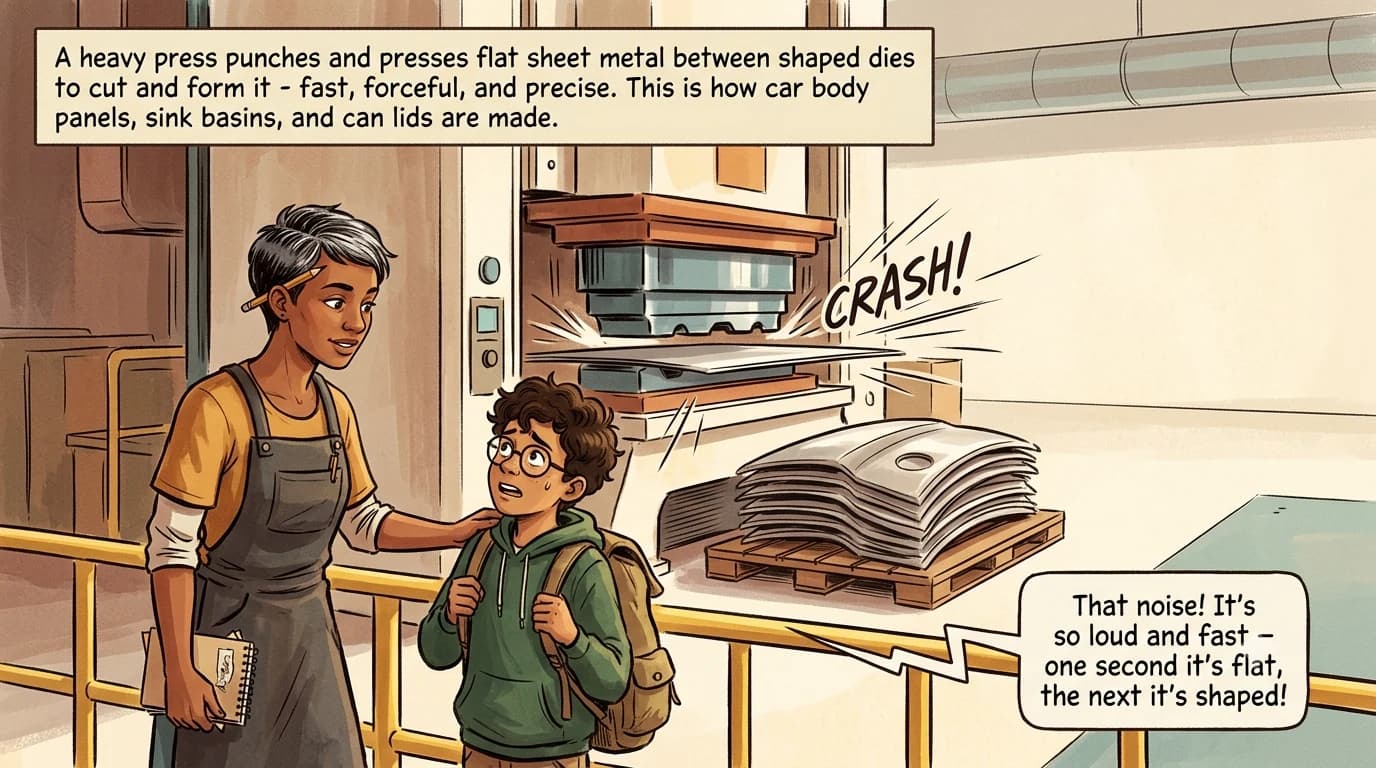
A massive stamping press slams down on a sheet of metal between shaped dies, watched by a designer and a kid behind a safety rail.
A heavy press punches and presses flat sheet metal between shaped dies to cut and form it - fast, forceful, and precise. This is how car body panels, sink basins, and can lids are made.
Milo: That noise! It's so loud and fast - one second it's flat, the next it's shaped!
Panel 9
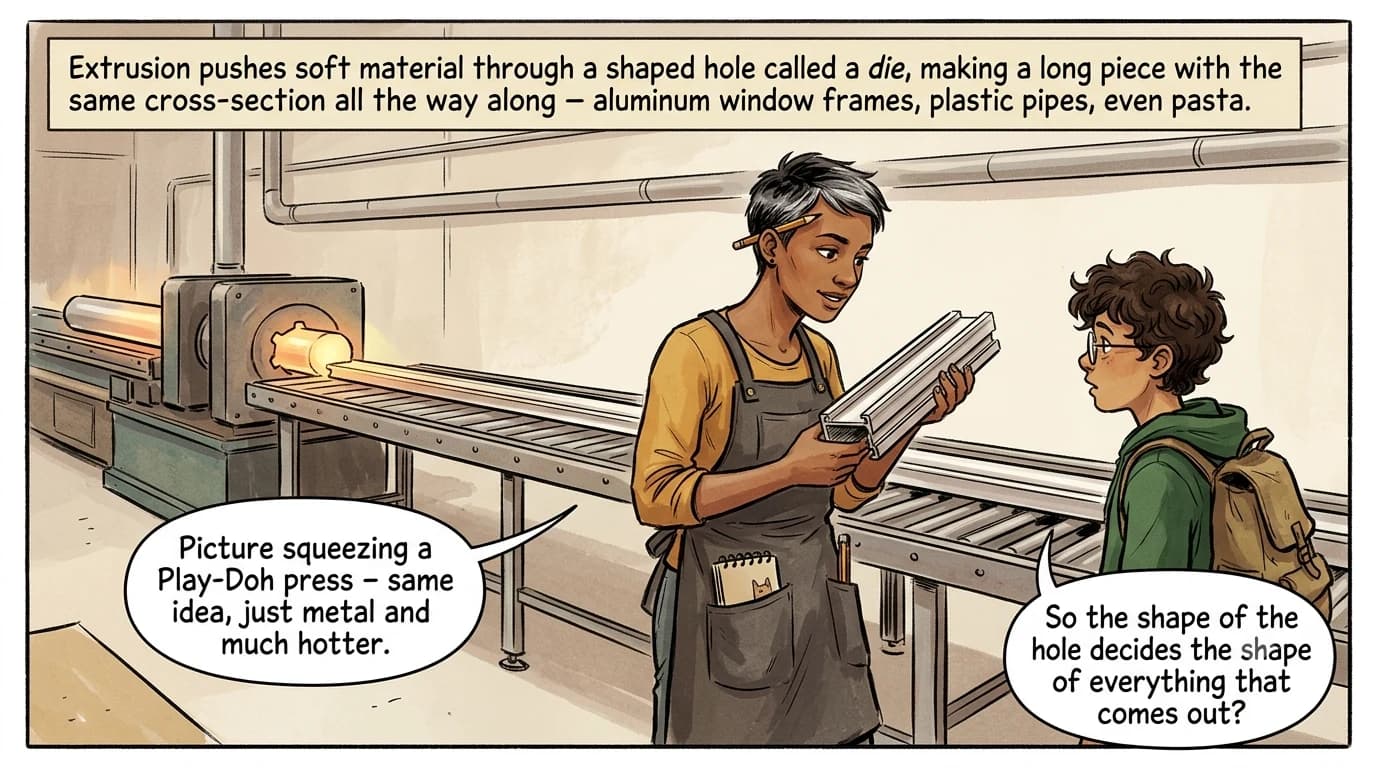
An extrusion line pushes glowing soft aluminum through a shaped die to form a continuous window frame profile while a designer holds up a finished length for a kid to see.
Extrusion pushes soft material through a shaped hole called a die, making a long piece with the same cross-section all the way along - aluminum window frames, plastic pipes, even pasta.
Rio: Picture squeezing a Play-Doh press - same idea, just metal and much hotter.
Milo: So the shape of the hole decides the shape of everything that comes out?
Panel 10
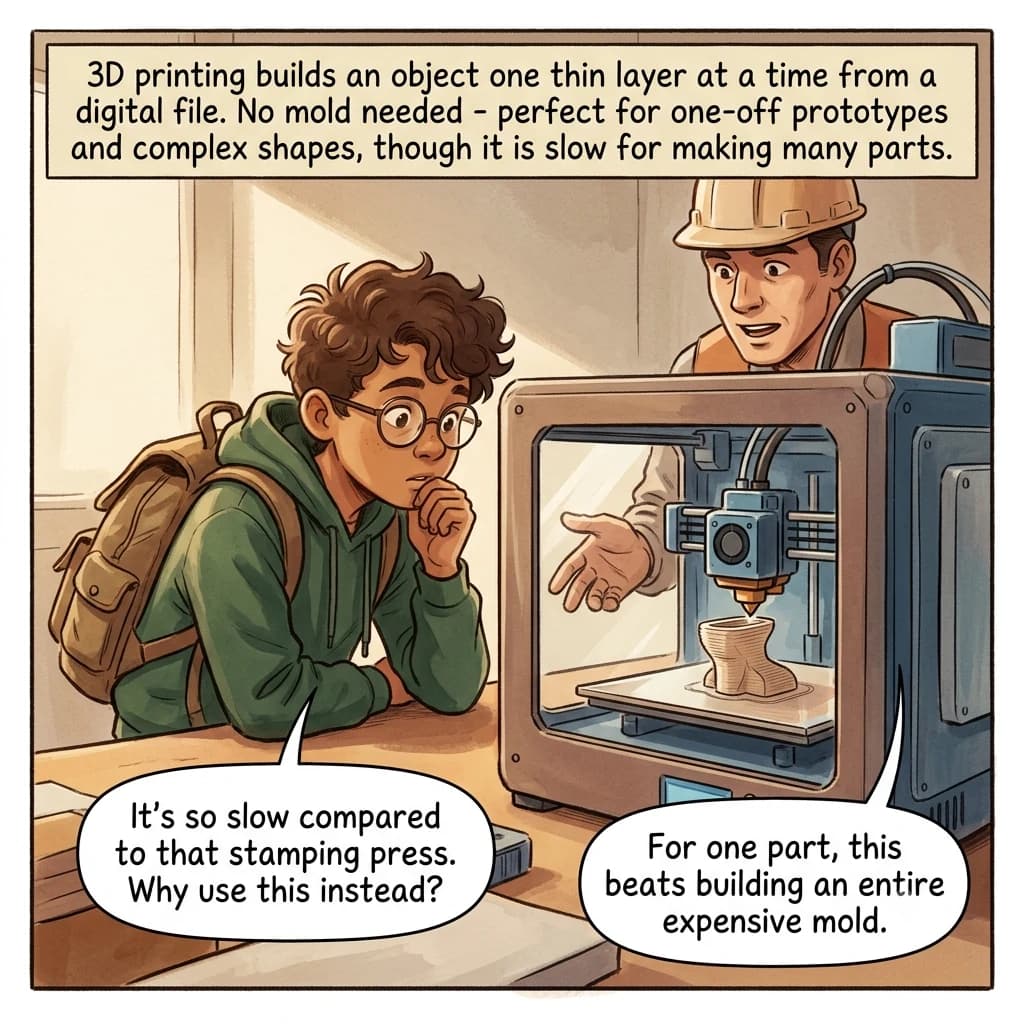
A 3D printer nozzle builds up a small plastic prototype layer by layer while a kid watches closely, chin in hand.
3D printing builds an object one thin layer at a time from a digital file. No mold needed - perfect for one-off prototypes and complex shapes, though it is slow for making many parts.
Milo: It's so slow compared to that stamping press. Why use this instead?
Factory guide: For one part, this beats building an entire expensive mold.
Panel 11
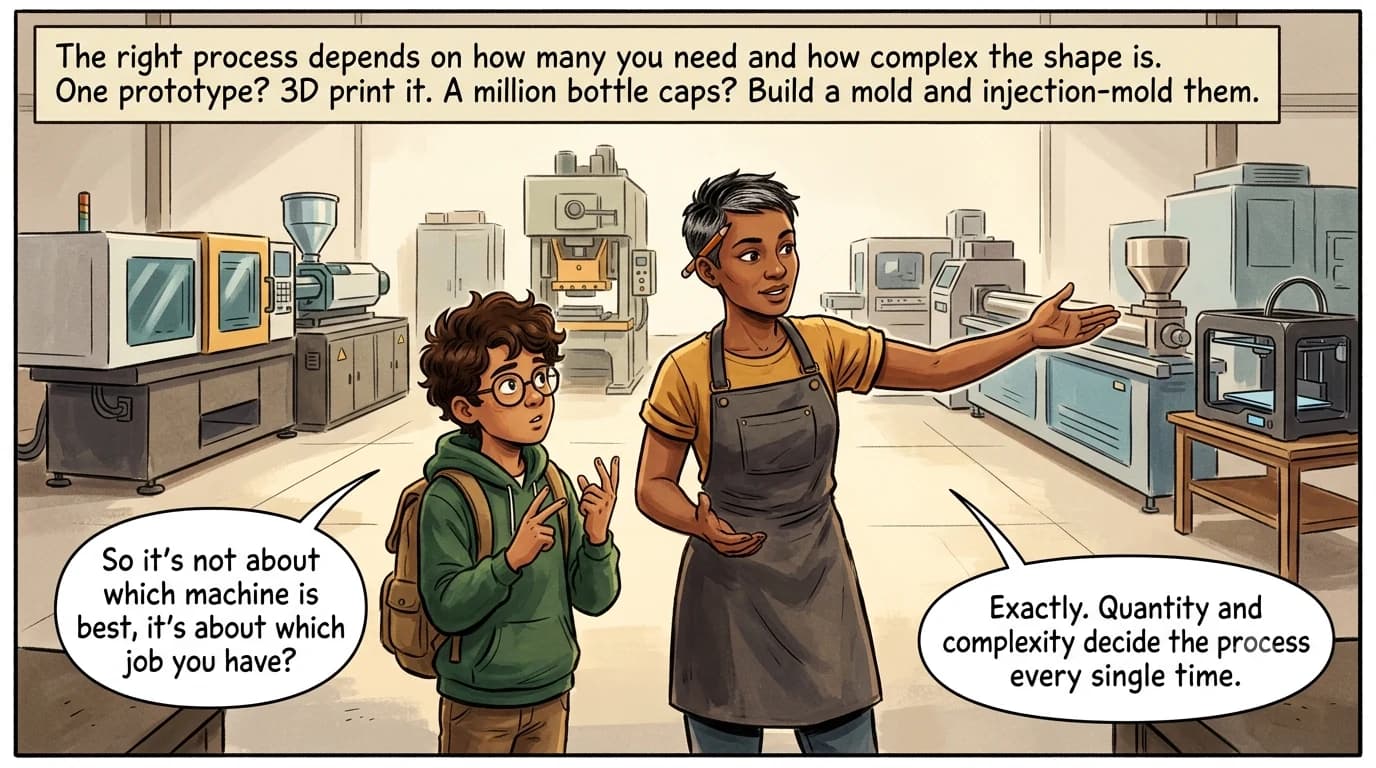
A designer gestures between an injection molding machine, a stamping press, an extrusion line, and a 3D printer on a factory floor while a kid counts on his fingers.
The right process depends on how many you need and how complex the shape is. One prototype? 3D print it. A million bottle caps? Build a mold and injection-mold them.
Milo: So it's not about which machine is best, it's about which job you have?
Rio: Exactly. Quantity and complexity decide the process every single time.
Panel 12
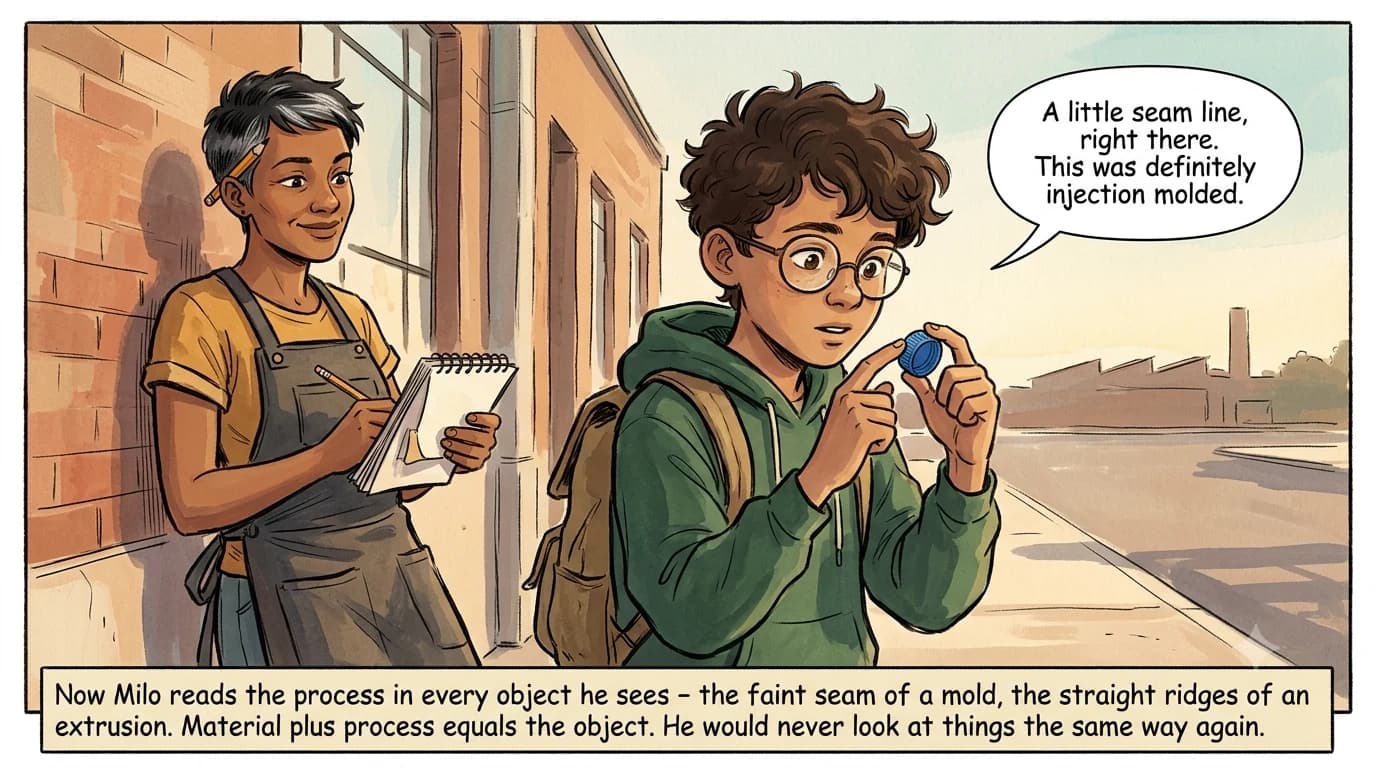
A kid examines a plastic bottle cap and traces its faint seam line while a designer smiles beside him with her sketchbook, warm late-day light around them.
Now Milo reads the process in every object he sees - the faint seam of a mold, the straight ridges of an extrusion. Material plus process equals the object. He would never look at things the same way again.
Milo: A little seam line, right there. This was definitely injection molded.