Made by Design · Chapter 1: Everything Is Designed
Cover
Made by Design · Chapter 1
Everything Is Designed
How a peeler, a chair, and a doorknob quietly explain themselves
Nothing around you got made by accident - not the door handle, not the chair, not the toothbrush in your bag. This chapter follows one ordinary kitchen tool, the OXO peeler, to show how good design solves real problems for real hands.
12 panels · ~6 min read

Panel 1
Panel 2

Panel 3
Panel 4
Panel 5

Panel 6
Panel 7
Panel 8
Panel 9
Panel 10
Panel 11
Panel 12
Read chapter text: Everything Is Designed
Nothing around you got made by accident - not the door handle, not the chair, not the toothbrush in your bag. This chapter follows one ordinary kitchen tool, the OXO peeler, to show how good design solves real problems for real hands.
Panel 1
A designer and a curious kid stand on a morning sidewalk while the designer gestures at everyday street objects around them.
Look around. Every object near you was shaped by a decision someone made. The bench, the lamp post, the bottle in your bag - none of it fell from the sky. People designed all of it.
Milo: Wait. Somebody actually sat down and decided what a mailbox should look like?
Panel 2
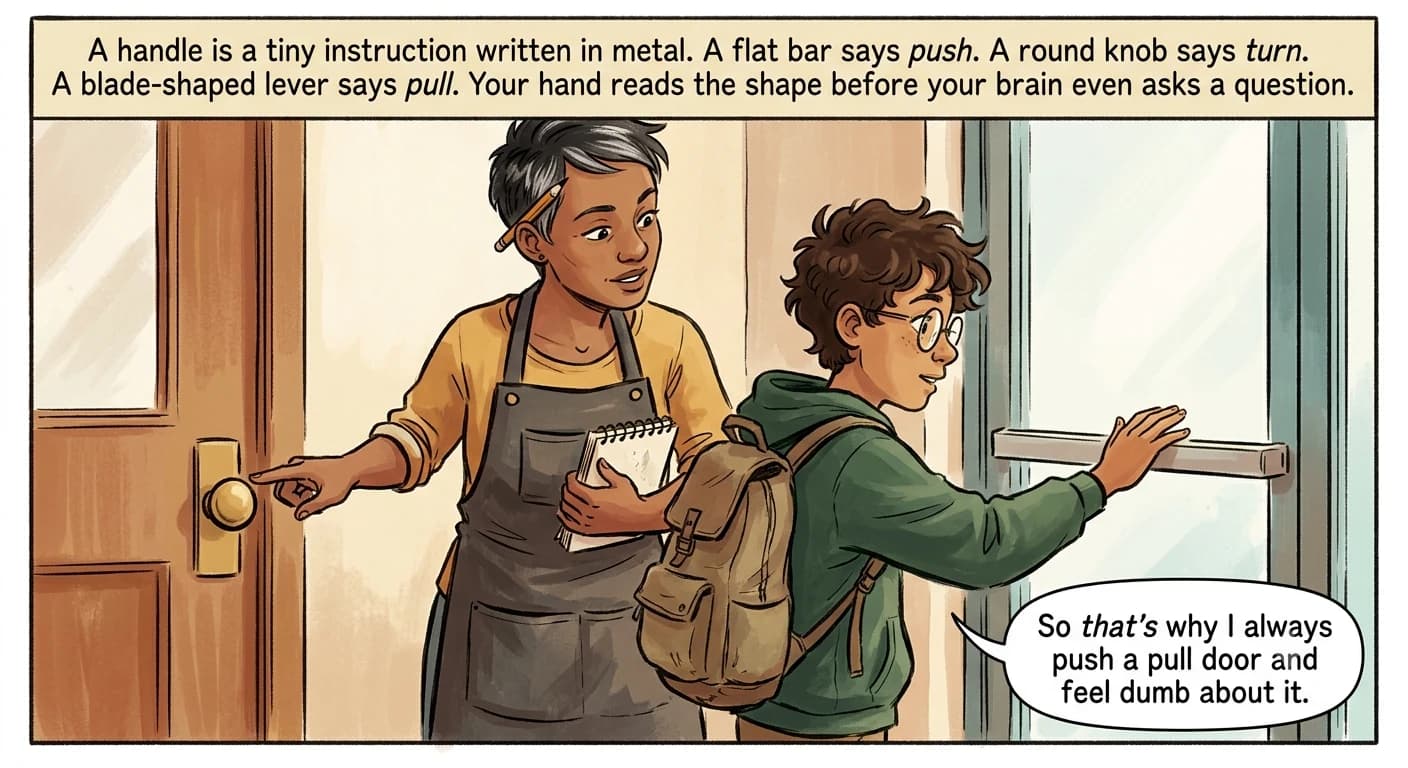
A close view of a hand reaching toward a door handle while a designer points out the different shapes of push bars and knobs.
A handle is a tiny instruction written in metal. A flat bar says push. A round knob says turn. A blade-shaped lever says pull. Your hand reads the shape before your brain even asks a question.
Milo: So that's why I always push a pull door and feel dumb about it.
Panel 3
A boy sits testing a wooden chair in a sunny studio while a designer kneels beside him pointing out how its shape fits his body.
Chairs are not just four legs and a seat. The height matches your knees. The backrest leans just enough to hold your spine without swallowing it. Every angle is measured against a human body.
Milo: This one fits me perfectly. Why does that office chair over there feel wrong?
Rio: Because it was built for a different body than yours. Fit is not one size.
Panel 4
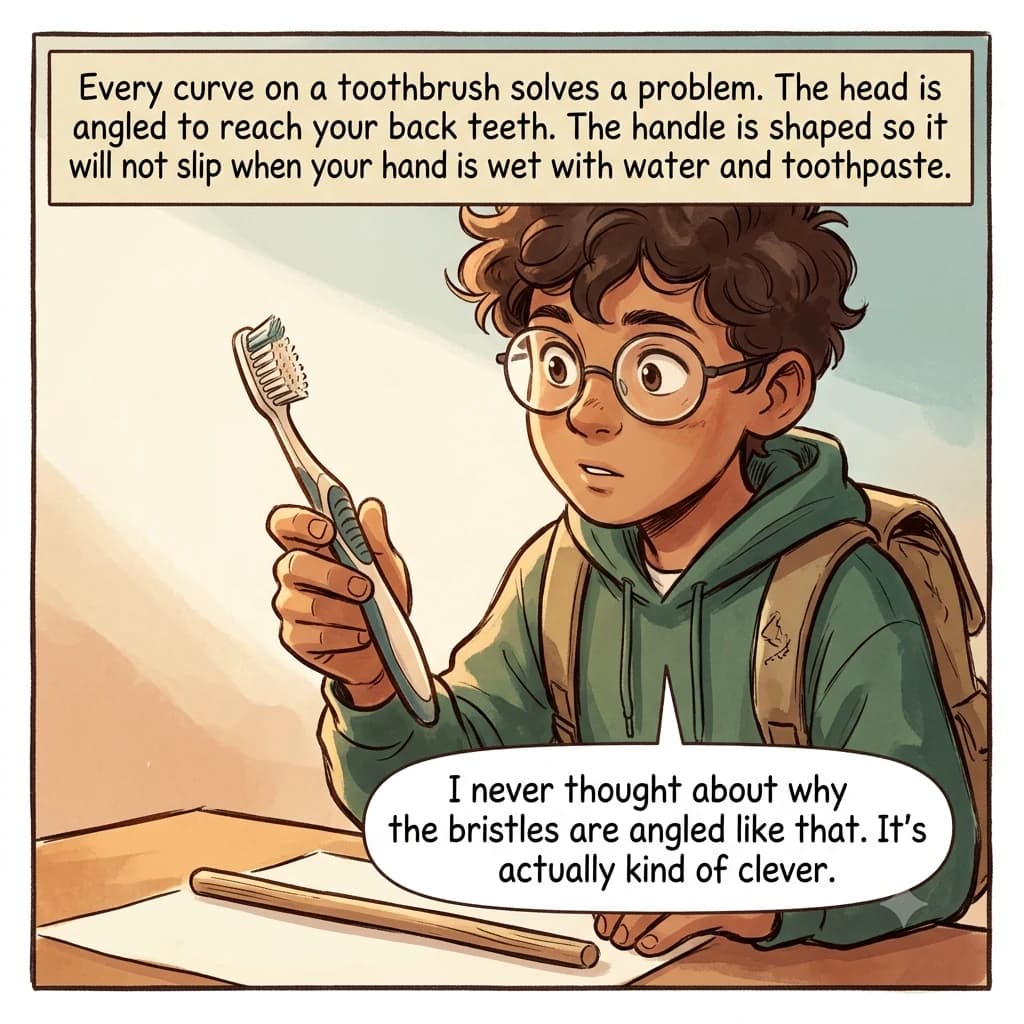
A close view of a hand holding a modern toothbrush with an angled head and grippy handle beside a plain wooden stick.
Every curve on a toothbrush solves a problem. The head is angled to reach your back teeth. The handle is shaped so it will not slip when your hand is wet with water and toothpaste.
Milo: I never thought about why the bristles are angled like that. It's actually kind of clever.
Panel 5
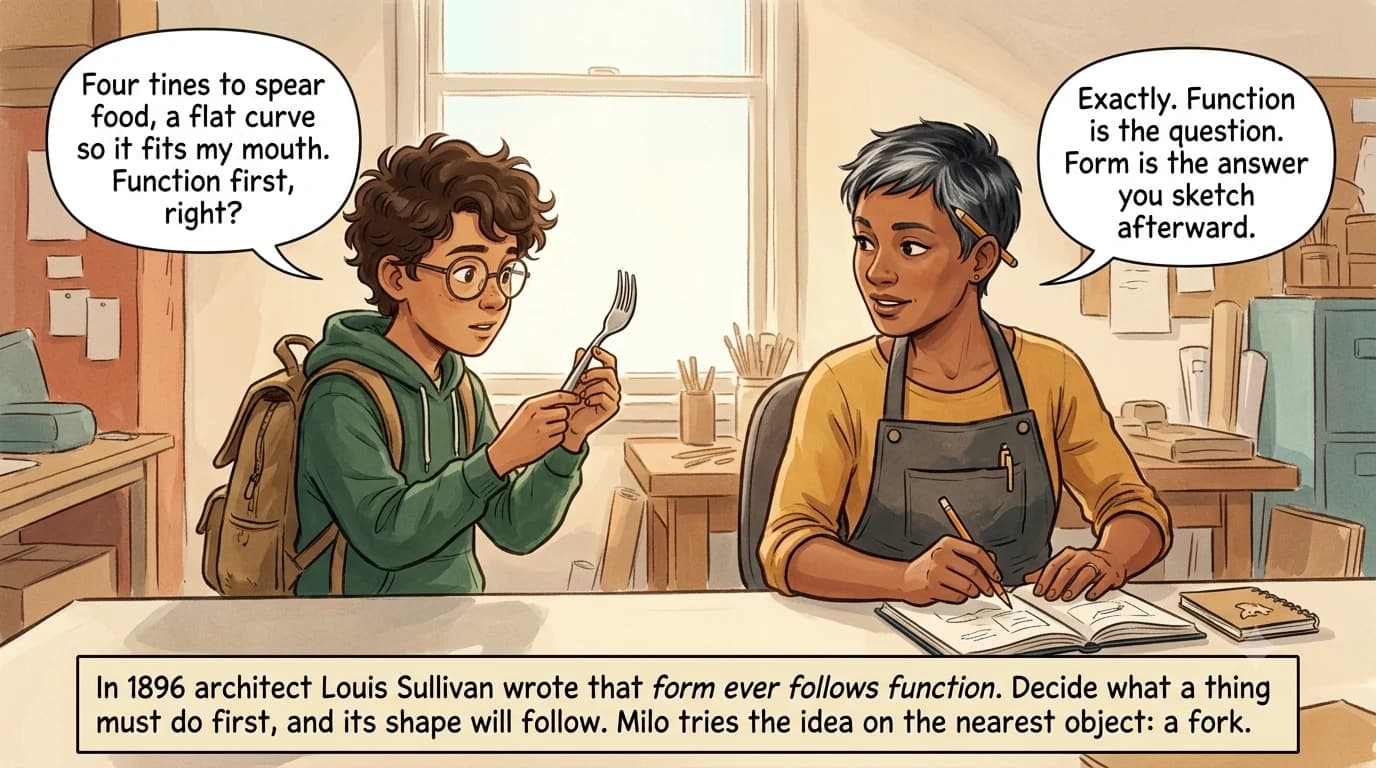
A designer sketches diagrams in a notebook while a boy examines a dinner fork, testing how its shape fits its purpose.
In 1896 architect Louis Sullivan wrote that form ever follows function. Decide what a thing must do first, and its shape will follow. Milo tries the idea on the nearest object: a fork.
Milo: Four tines to spear food, a flat curve so it fits my mouth. Function first, right?
Rio: Exactly. Function is the question. Form is the answer you sketch afterward.
Panel 6
A boy reaches instinctively for a ridged wooden knob on a cabinet while a designer watches with a knowing smile.
Function is not the whole story. Objects also send quiet signals. A ridged knob seems to whisper turn me. A soft curve invites your hand before your mind decides to move.
Milo: I didn't even think about it. My hand just went right for it.
Panel 7
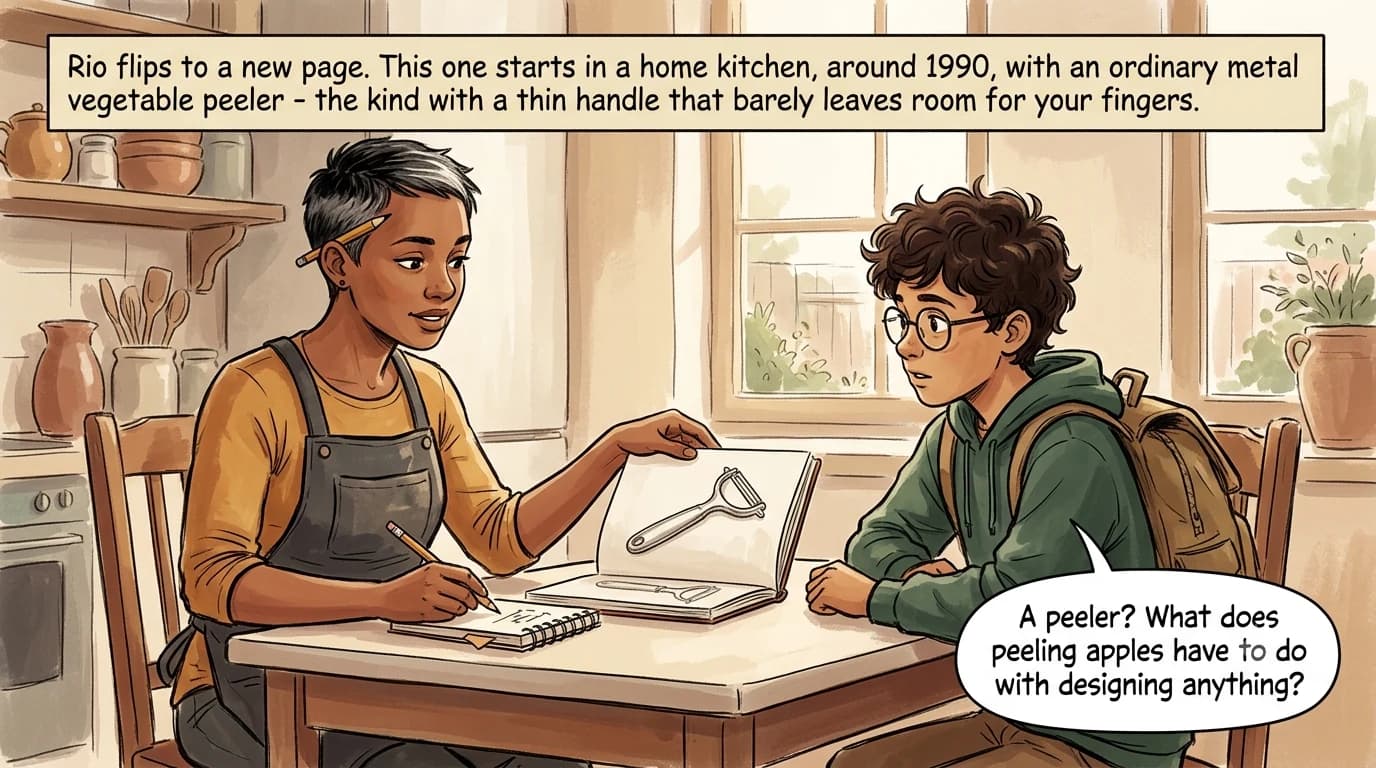
A designer opens her sketchbook to a drawing of an old metal peeler and shows it to a curious boy across a small kitchen table.
Rio flips to a new page. This one starts in a home kitchen, around 1990, with an ordinary metal vegetable peeler - the kind with a thin handle that barely leaves room for your fingers.
Milo: A peeler? What does peeling apples have to do with designing anything?
Panel 8
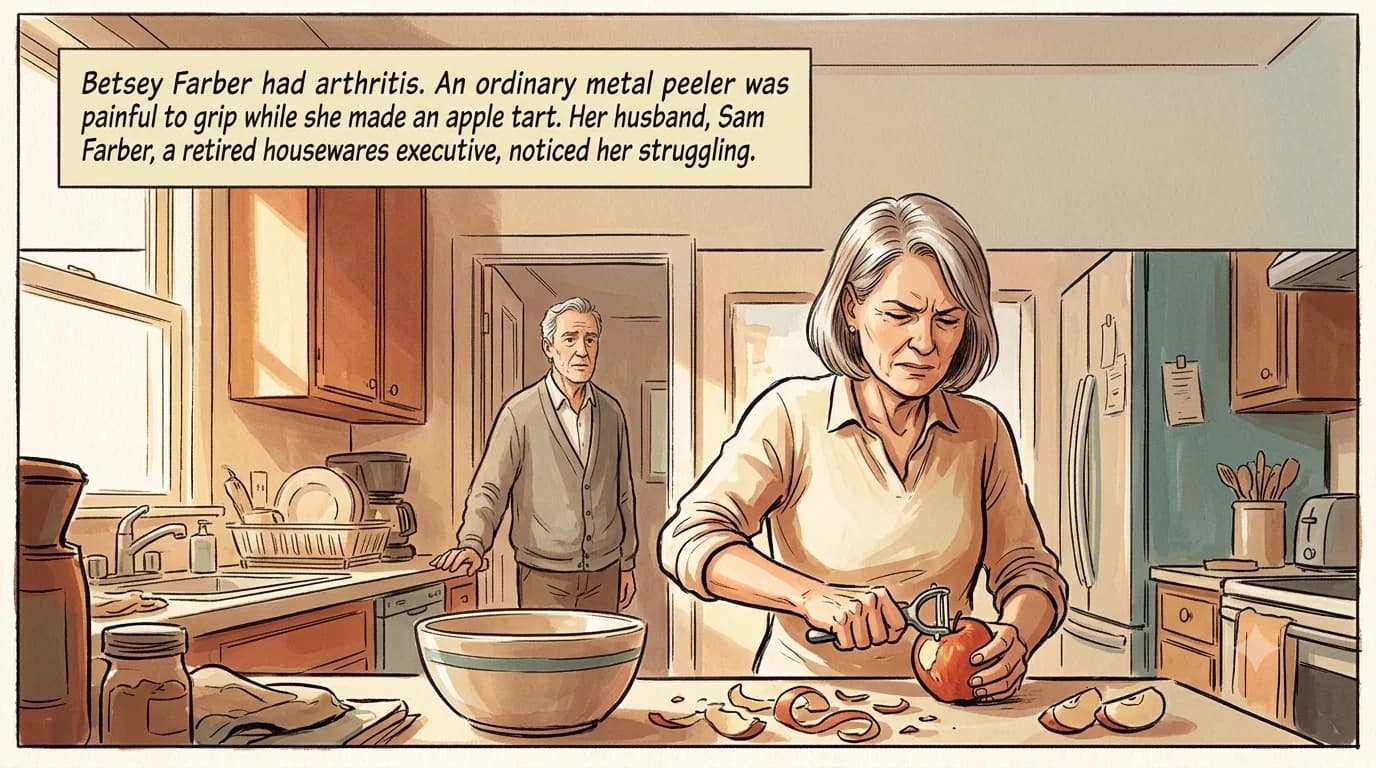
A woman with arthritis winces while struggling to grip an ordinary metal peeler at a kitchen counter as her husband notices her difficulty.
Betsey Farber had arthritis. An ordinary metal peeler was painful to grip while she made an apple tart. Her husband, Sam Farber, a retired housewares executive, noticed her struggling.
Panel 9
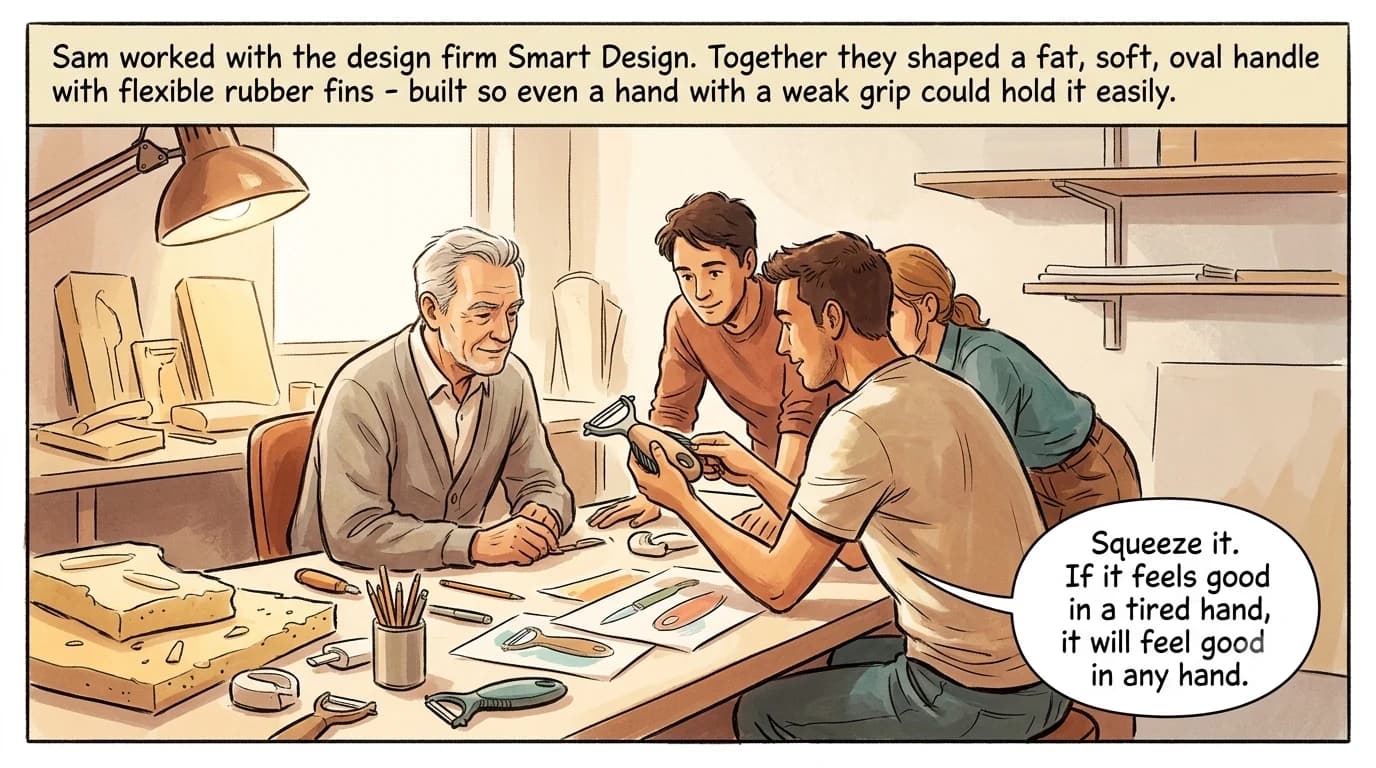
A small team of designers in a workshop test an early rubber peeler handle prototype with soft flexible fins, checking its grip.
Sam worked with the design firm Smart Design. Together they shaped a fat, soft, oval handle with flexible rubber fins - built so even a hand with a weak grip could hold it easily.
A Designer: Squeeze it. If it feels good in a tired hand, it will feel good in any hand.
Panel 10
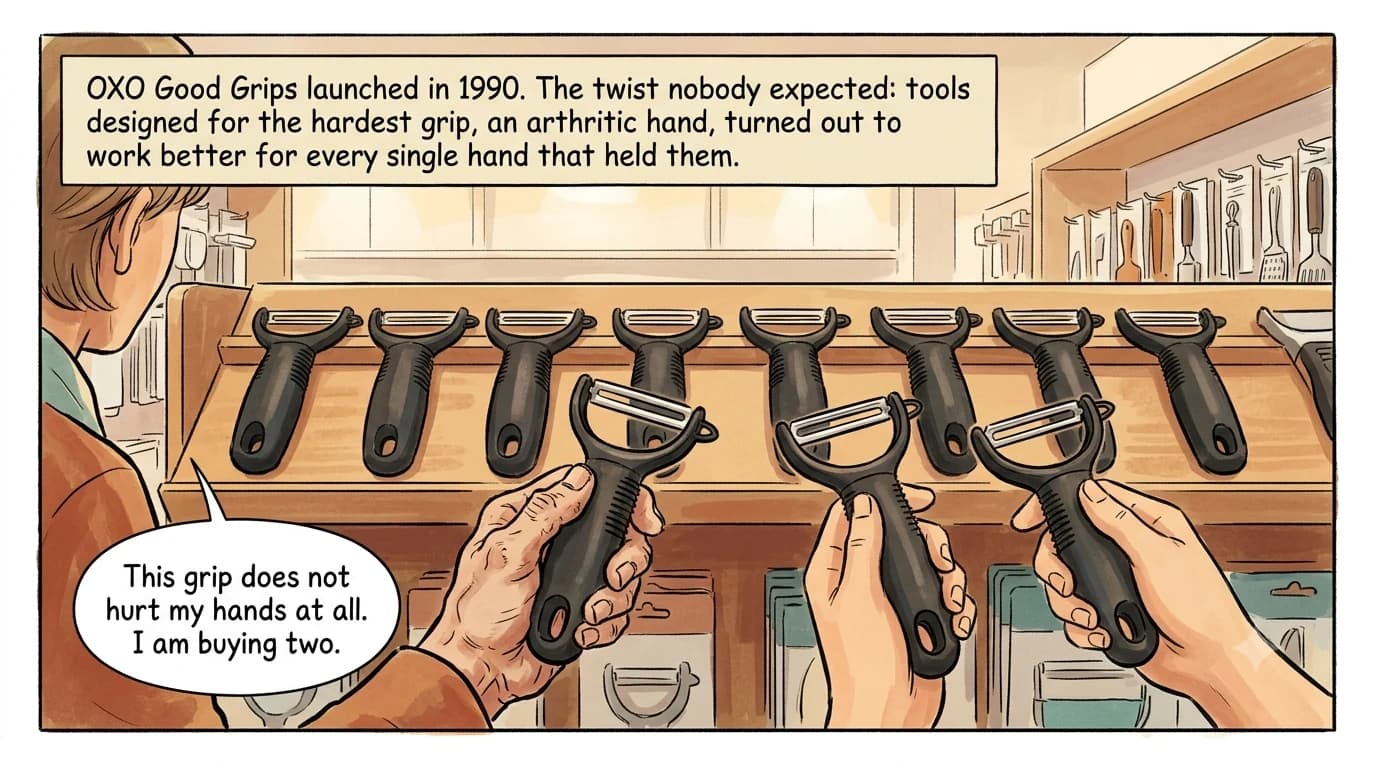
A finished black rubber-handled peeler on a store shelf in 1990 while two different hands, one older and one younger, each hold identical peelers comfortably.
OXO Good Grips launched in 1990. The twist nobody expected: tools designed for the hardest grip, an arthritic hand, turned out to work better for every single hand that held them.
A Shopper: This grip does not hurt my hands at all. I am buying two.
Panel 11
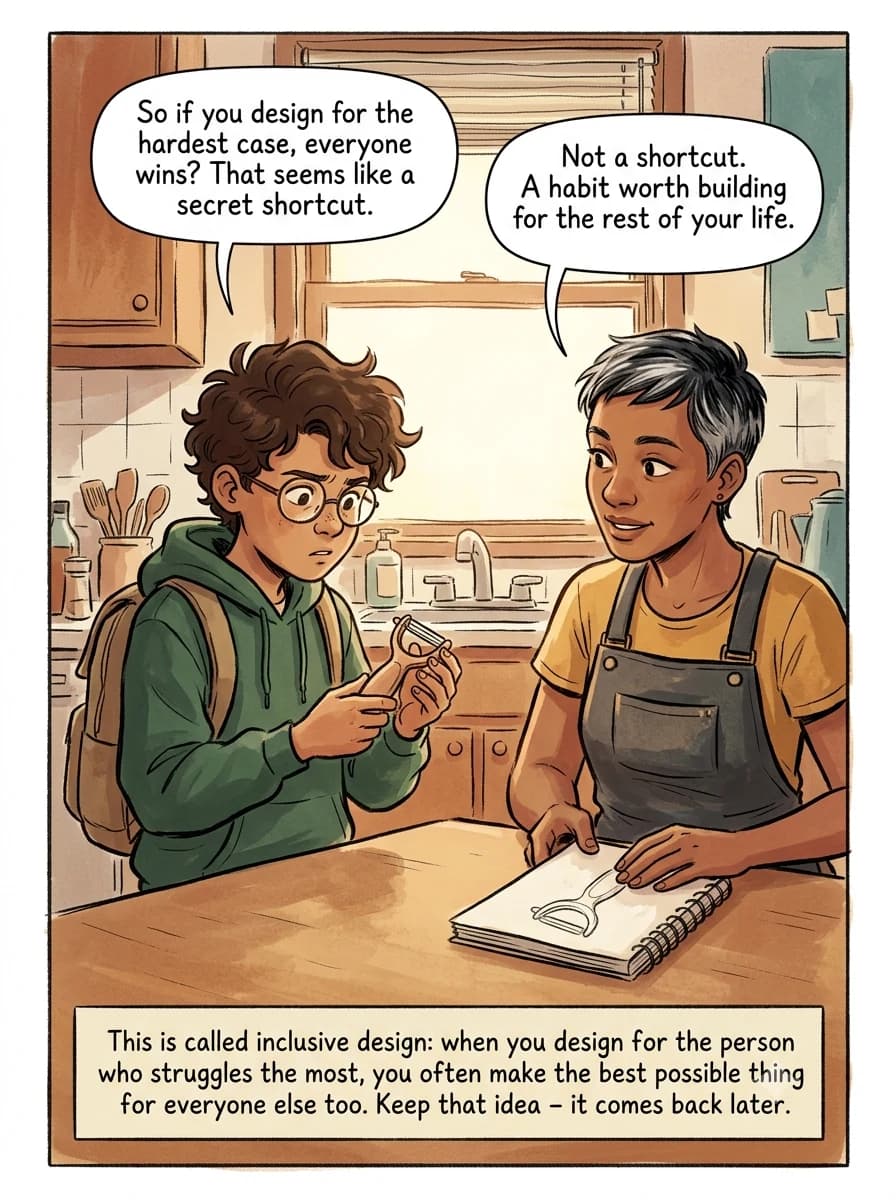
A designer closes her sketchbook while a boy turns a soft-handled peeler over in his hands, thinking about what he just learned.
This is called inclusive design: when you design for the person who struggles the most, you often make the best possible thing for everyone else too. Keep that idea - it comes back later.
Milo: So if you design for the hardest case, everyone wins? That seems like a secret shortcut.
Rio: Not a shortcut. A habit worth building for the rest of your life.
Panel 12
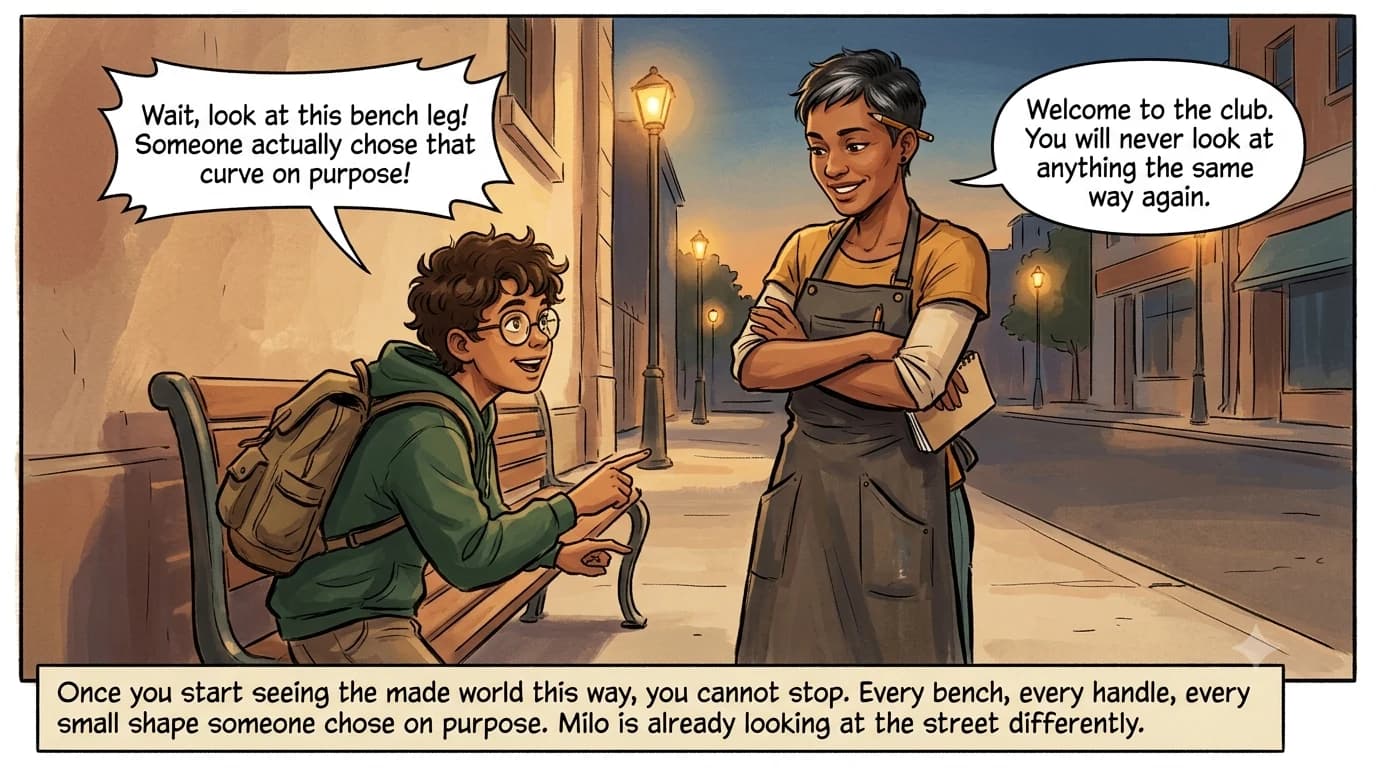
A boy crouches to examine a park bench while a designer smiles beside him on an evening street as the streetlights begin to glow.
Once you start seeing the made world this way, you cannot stop. Every bench, every handle, every small shape someone chose on purpose. Milo is already looking at the street differently.
Milo: Wait, look at this bench leg! Someone actually chose that curve on purpose!
Rio: Welcome to the club. You will never look at anything the same way again.