Made by Design · Chapter 2: The Design Process
Cover
Made by Design · Chapter 2
The Design Process
Empathize, define, ideate, prototype, test, and then do it again
Rio and Milo redesign a water bottle for a long-distance hiker, and nothing works on the first try. Along the way they learn the five modes of design: empathize, define, ideate, prototype, and test, a loop you walk again and again.
12 panels · ~6 min read
Panel 1
Panel 2
Panel 3
Panel 4
Panel 5
Panel 6
Panel 7
Panel 8
Panel 9
Panel 10
Panel 11
Panel 12
Read chapter text: The Design Process
Rio and Milo redesign a water bottle for a long-distance hiker, and nothing works on the first try. Along the way they learn the five modes of design: empathize, define, ideate, prototype, and test, a loop you walk again and again.
Panel 1
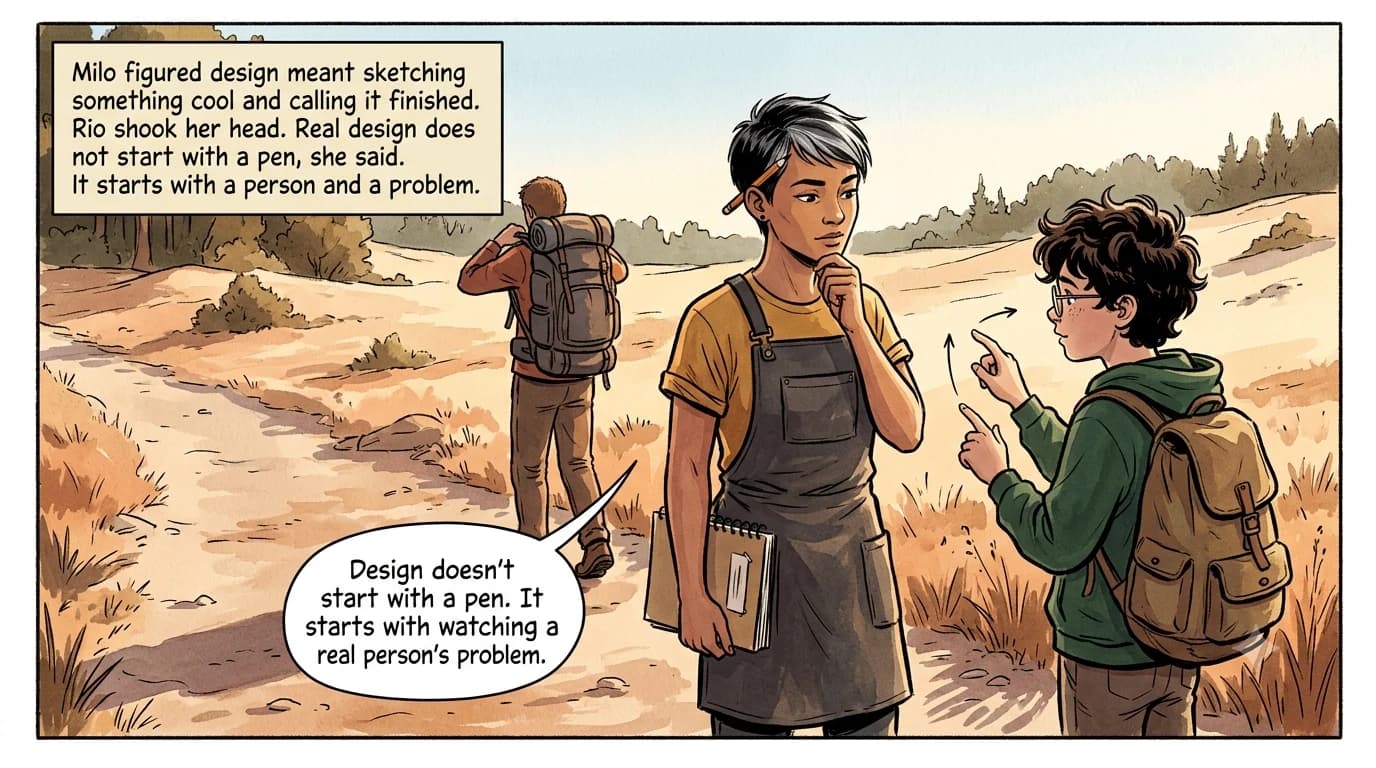
Rio and Milo stand with a hiker at a mountain trailhead in morning light, about to begin watching her instead of sketching.
Milo figured design meant sketching something cool and calling it finished. Rio shook her head. Real design does not start with a pen, she said. It starts with a person and a problem.
Rio: Design doesn't start with a pen. It starts with watching a real person's problem.
Panel 2
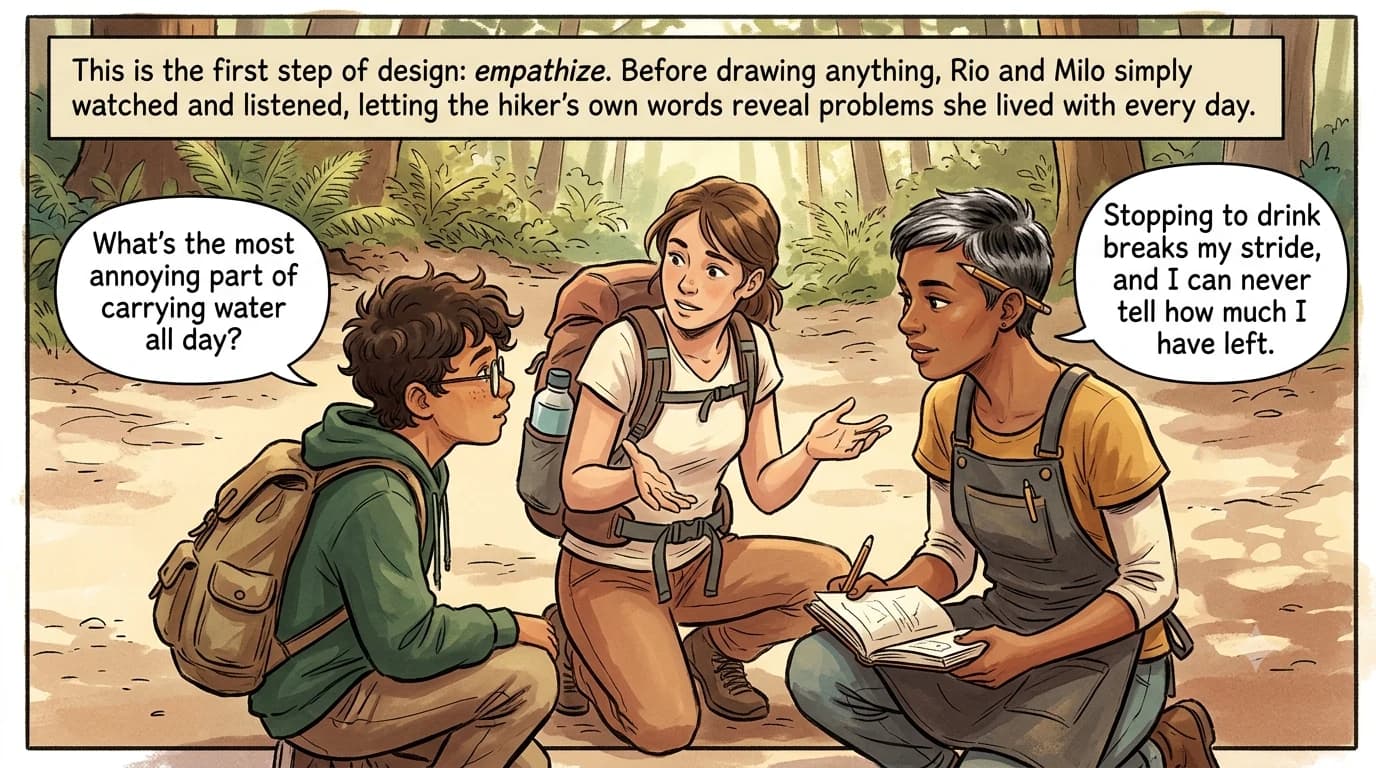
Rio and Milo crouch beside a hiker on a sunny trail, listening as she describes the struggles of drinking water while walking.
This is the first step of design: empathize. Before drawing anything, Rio and Milo simply watched and listened, letting the hiker's own words reveal problems she lived with every day.
Milo: What's the most annoying part of carrying water all day?
Hiker: Stopping to drink breaks my stride, and I can never tell how much I have left.
Panel 3
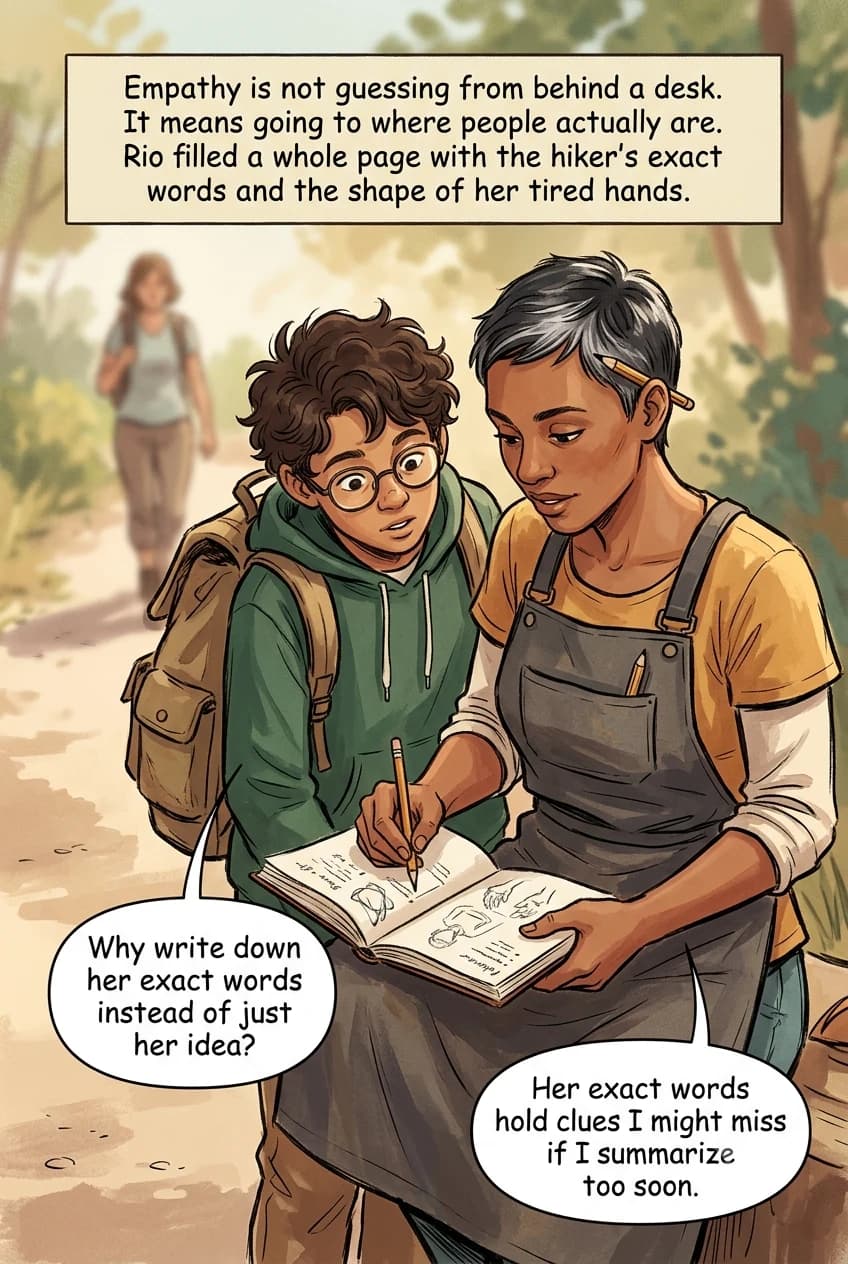
A close view of hands sketching in a notebook, capturing a hiker's words and gestures, while a boy leans in to watch.
Empathy is not guessing from behind a desk. It means going to where people actually are. Rio filled a whole page with the hiker's exact words and the shape of her tired hands.
Milo: Why write down her exact words instead of just her idea?
Rio: Her exact words hold clues I might miss if I summarize too soon.
Panel 4
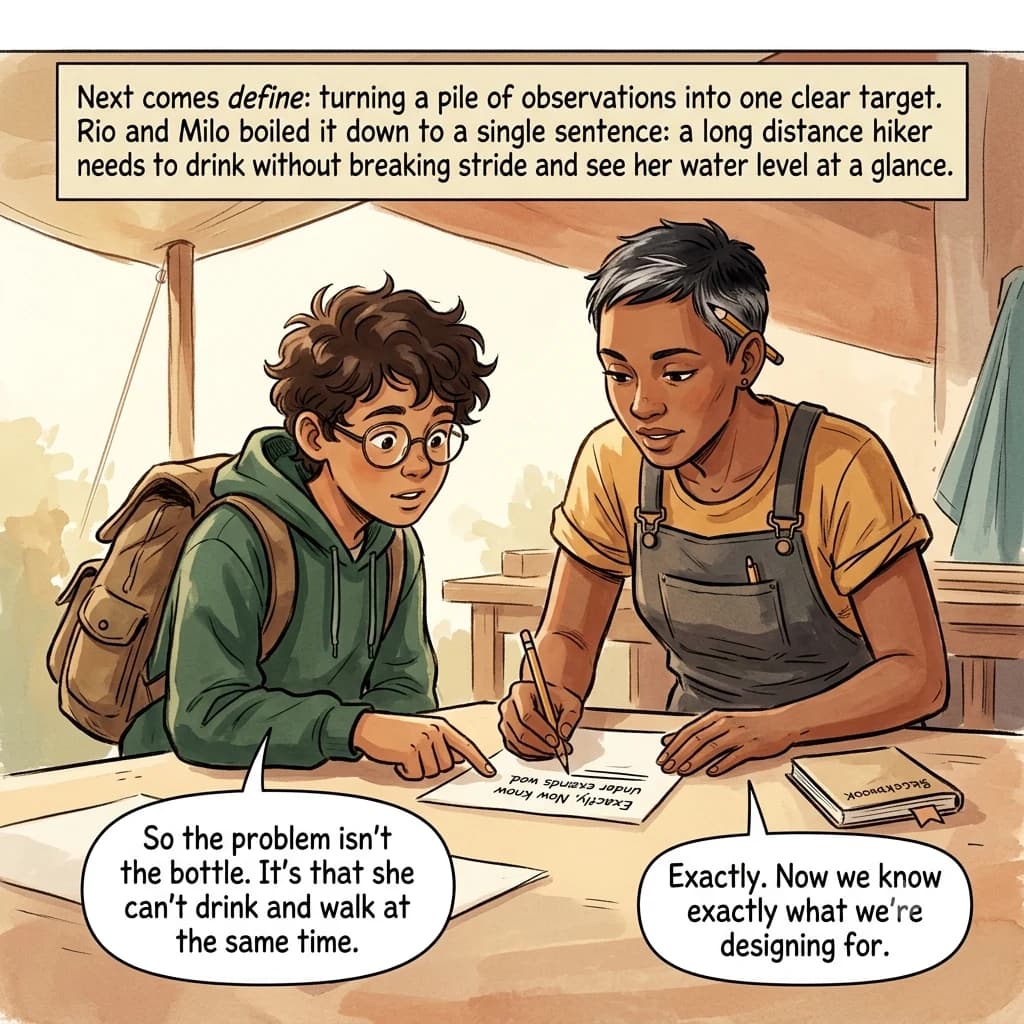
Rio and Milo lean over a workbench, writing a single clear problem statement distilled from their notes.
Next comes define: turning a pile of observations into one clear target. Rio and Milo boiled it down to a single sentence: a long distance hiker needs to drink without breaking stride and see her water level at a glance.
Milo: So the problem isn't the bottle. It's that she can't drink and walk at the same time.
Rio: Exactly. Now we know exactly what we're designing for.
Panel 5
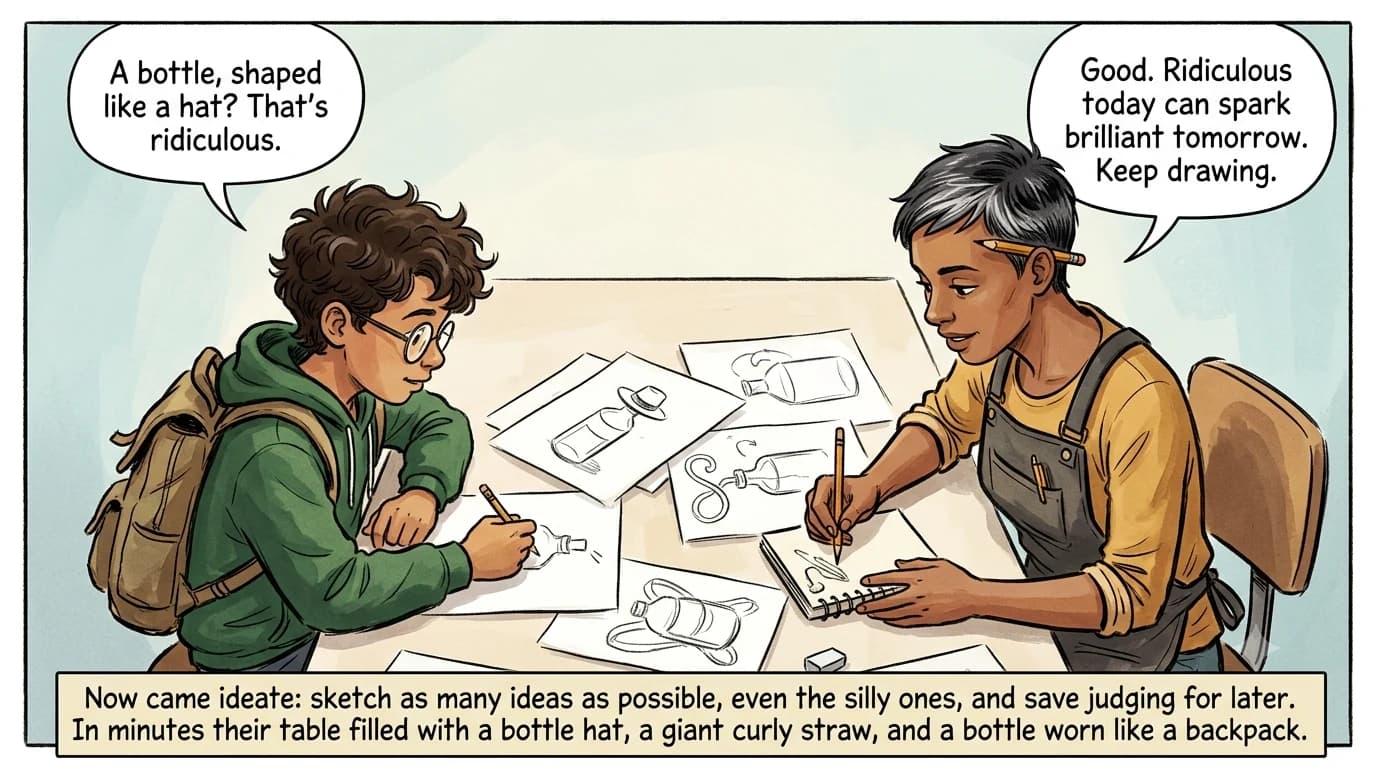
A tabletop covered in silly rough sketches of water bottle ideas, including one shaped like a hat and one with a giant curly straw.
Now came ideate: sketch as many ideas as possible, even the silly ones, and save judging for later. In minutes their table filled with a bottle hat, a giant curly straw, and a bottle worn like a backpack.
Milo: A bottle, shaped like a hat? That's ridiculous.
Rio: Good. Ridiculous today can spark brilliant tomorrow. Keep drawing.
Panel 6
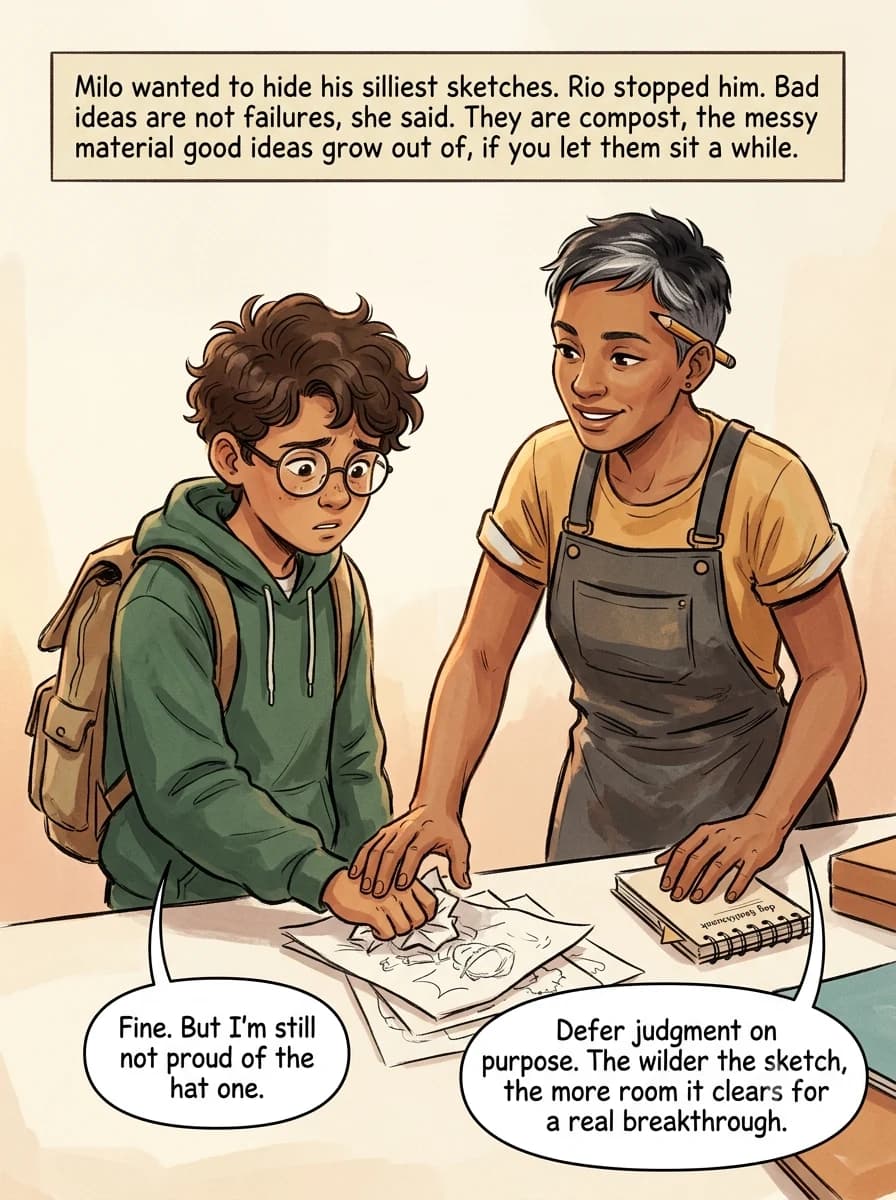
Milo reaches to crumple an embarrassing sketch while Rio gently stops his hand, smiling.
Milo wanted to hide his silliest sketches. Rio stopped him. Bad ideas are not failures, she said. They are compost, the messy material good ideas grow out of, if you let them sit a while.
Milo: Fine. But I'm still not proud of the hat one.
Rio: Defer judgment on purpose. The wilder the sketch, the more room it clears for a real breakthrough.
Panel 7
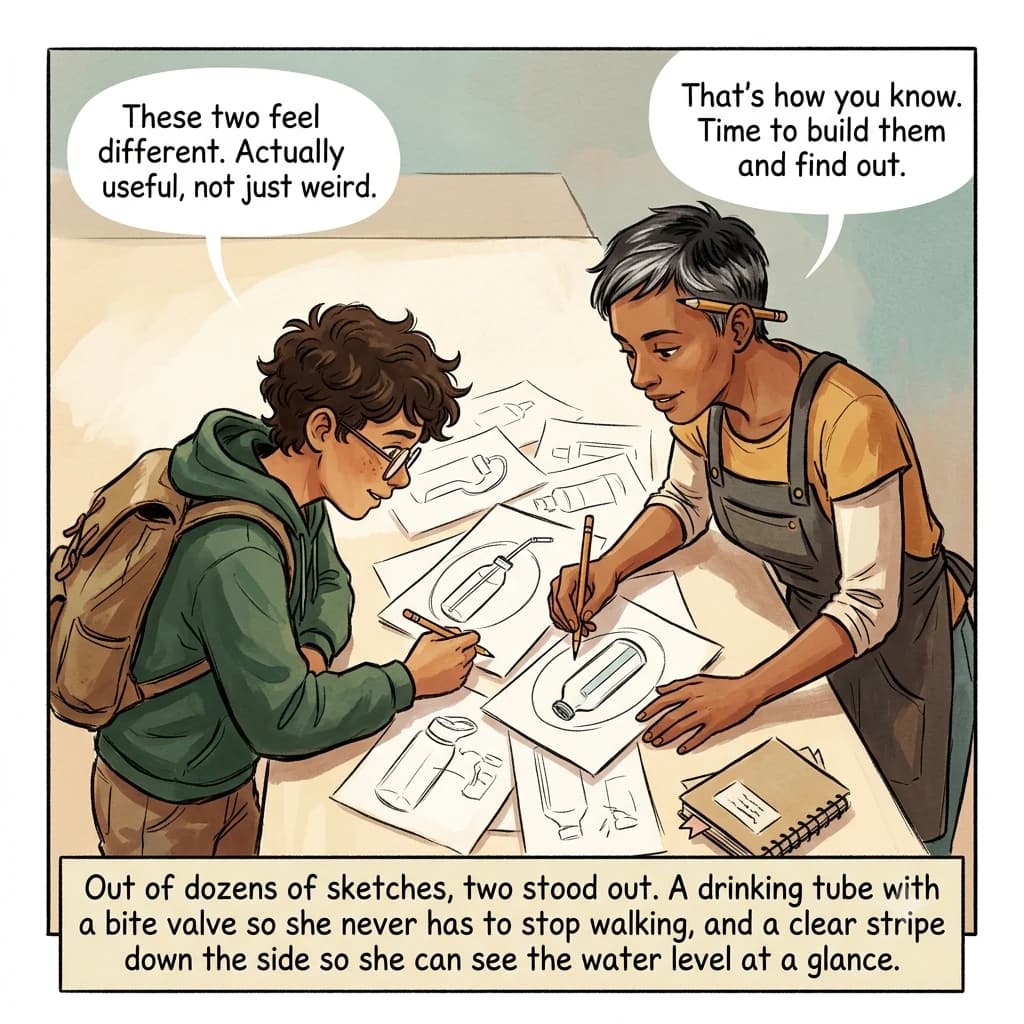
Rio and Milo circle two standout sketches on a cluttered table: a bottle with a drinking tube and a bottle with a clear water-level stripe.
Out of dozens of sketches, two stood out. A drinking tube with a bite valve so she never has to stop walking, and a clear stripe down the side so she can see the water level at a glance.
Milo: These two feel different. Actually useful, not just weird.
Rio: That's how you know. Time to build them and find out.
Panel 8
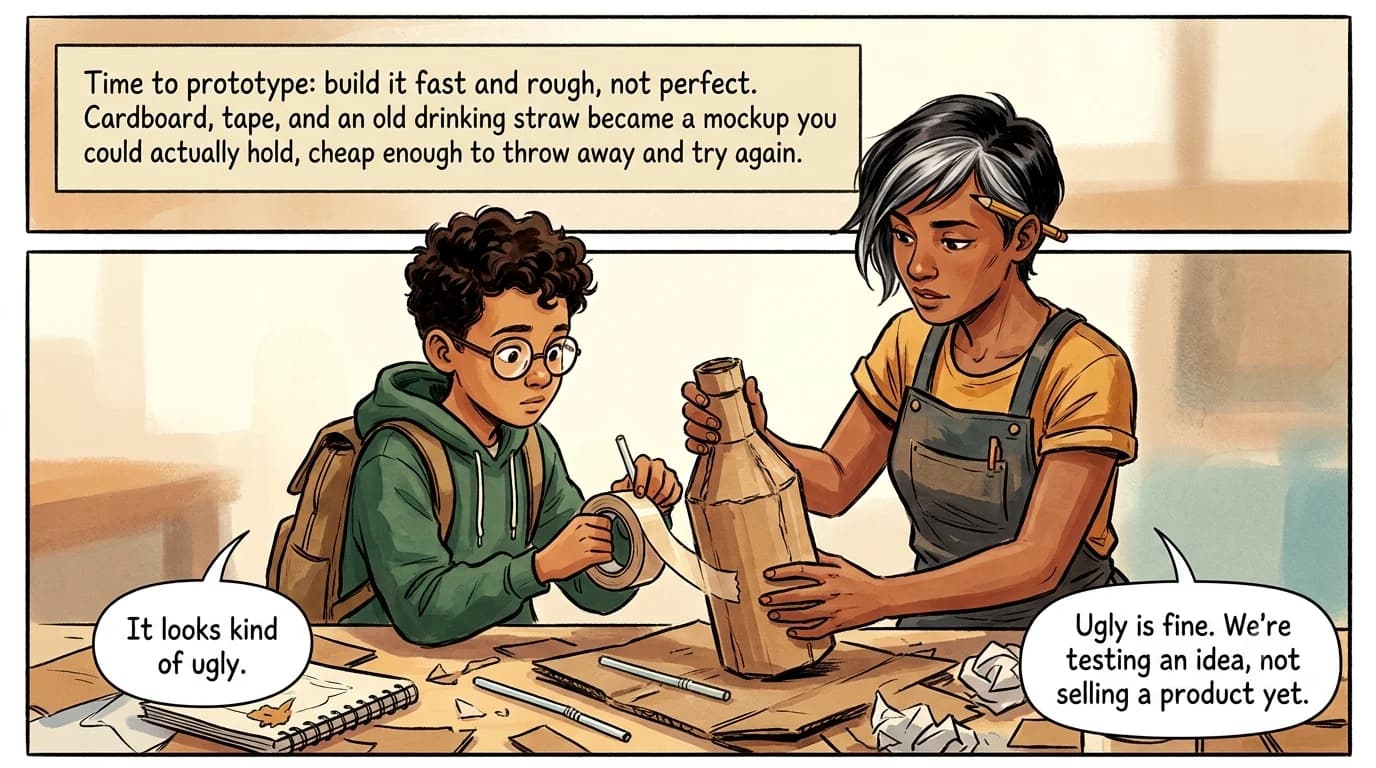
Rio and Milo tape together a rough cardboard prototype of a water bottle with a drinking straw poking out of the top.
Time to prototype: build it fast and rough, not perfect. Cardboard, tape, and an old drinking straw became a mockup you could actually hold, cheap enough to throw away and try again.
Milo: It looks kind of ugly.
Rio: Ugly is fine. We're testing an idea, not selling a product yet.
Panel 9
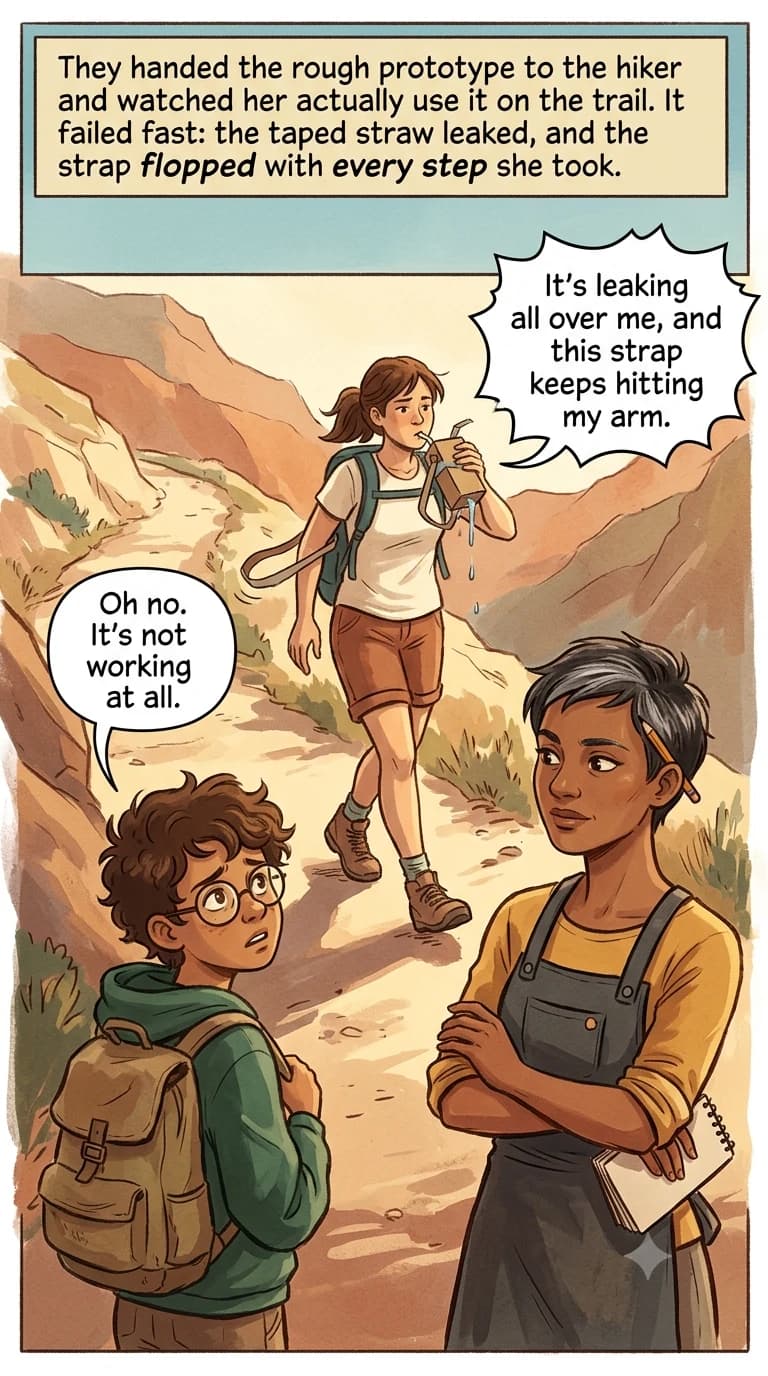
A hiker walks a sunny trail testing a rough cardboard prototype, water leaking from the taped straw, while Rio and Milo watch nearby.
They handed the rough prototype to the hiker and watched her actually use it on the trail. It failed fast: the taped straw leaked, and the strap flopped with every step she took.
Milo: Oh no. It's not working at all.
Hiker: It's leaking all over me, and this strap keeps hitting my arm.
Panel 10
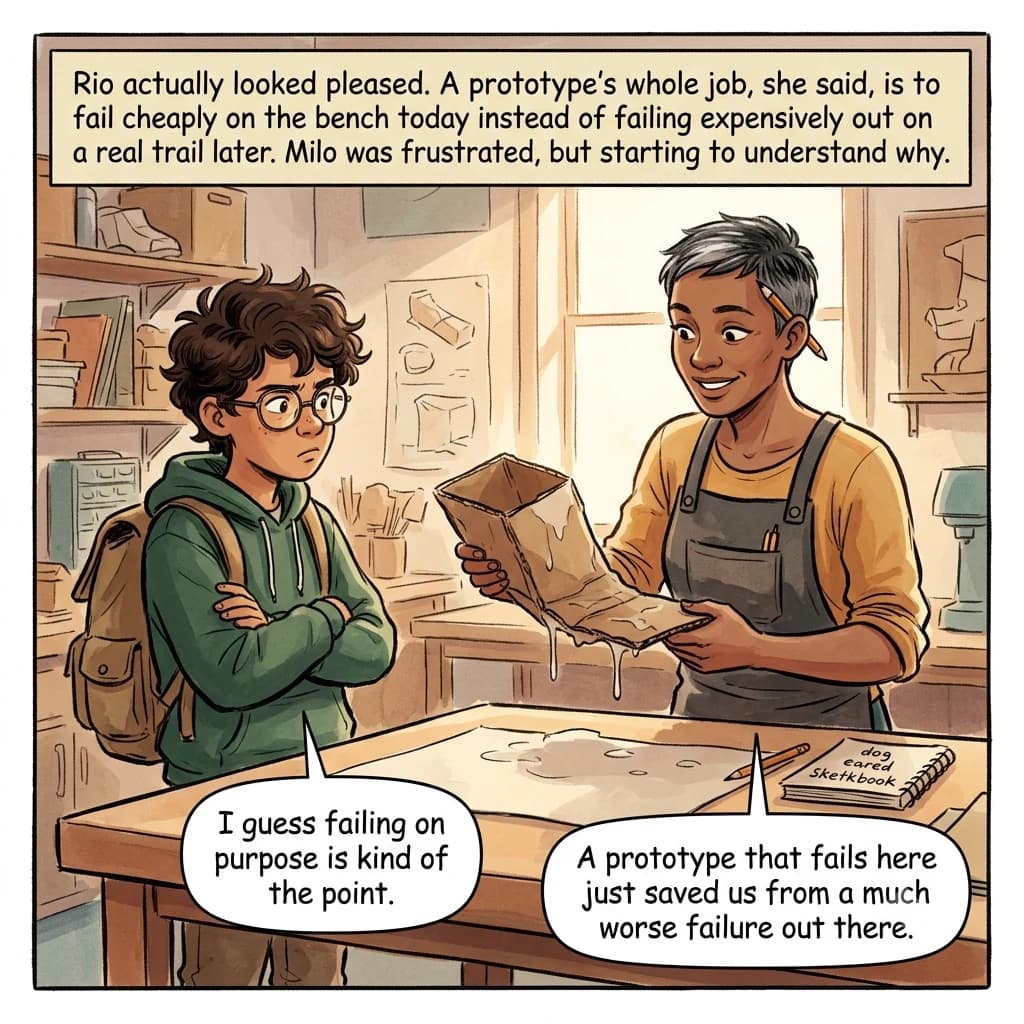
Rio holds up a soggy, failed cardboard prototype with a satisfied smile while Milo stands with arms crossed, frustrated but thinking.
Rio actually looked pleased. A prototype's whole job, she said, is to fail cheaply on the bench today instead of failing expensively out on a real trail later. Milo was frustrated, but starting to understand why.
Milo: I guess failing on purpose is kind of the point.
Rio: A prototype that fails here just saved us from a much worse failure out there.
Panel 11
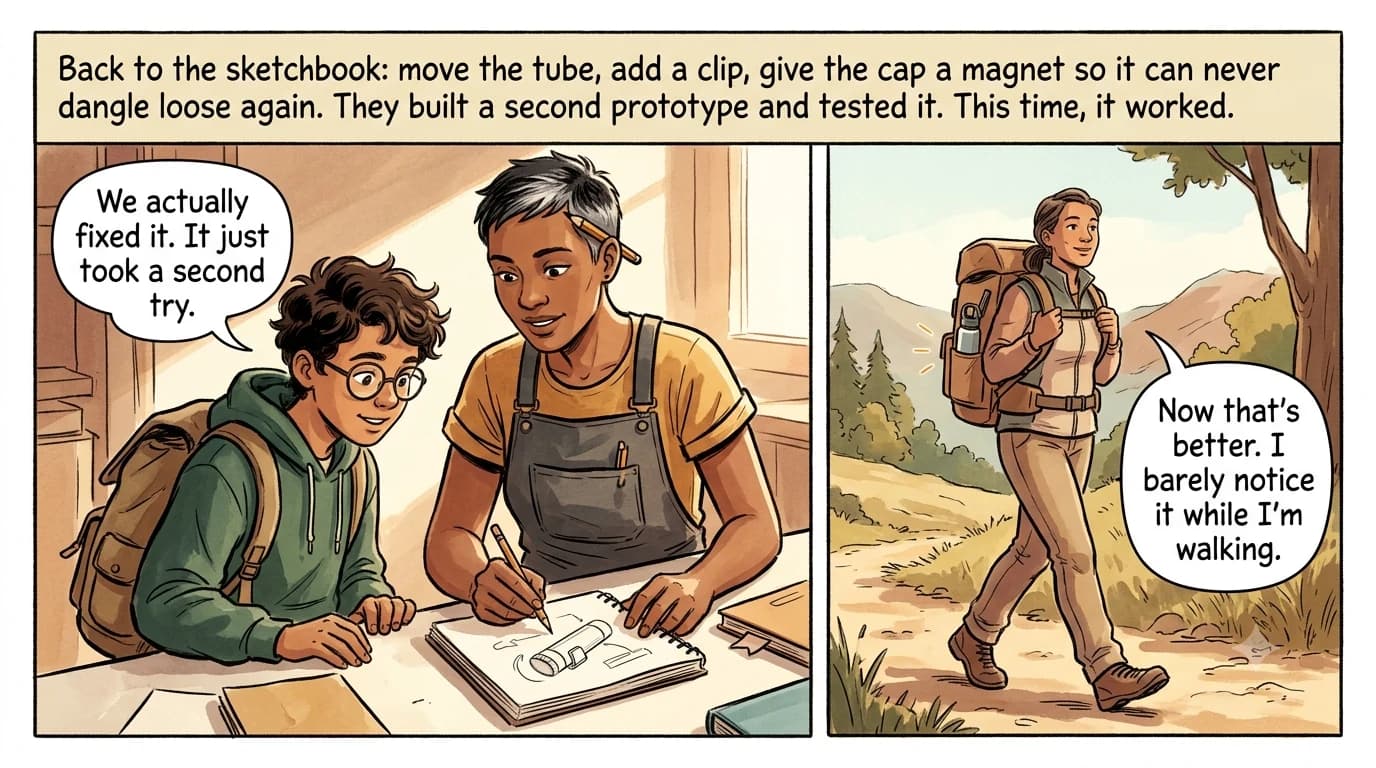
A hiker walks comfortably using an improved cardboard prototype with a magnetic cap, while Rio and Milo look on from the workbench.
Back to the sketchbook: move the tube, add a clip, give the cap a magnet so it can never dangle loose again. They built a second prototype and tested it. This time, it worked.
Milo: We actually fixed it. It just took a second try.
Hiker: Now that's better. I barely notice it while I'm walking.
Panel 12
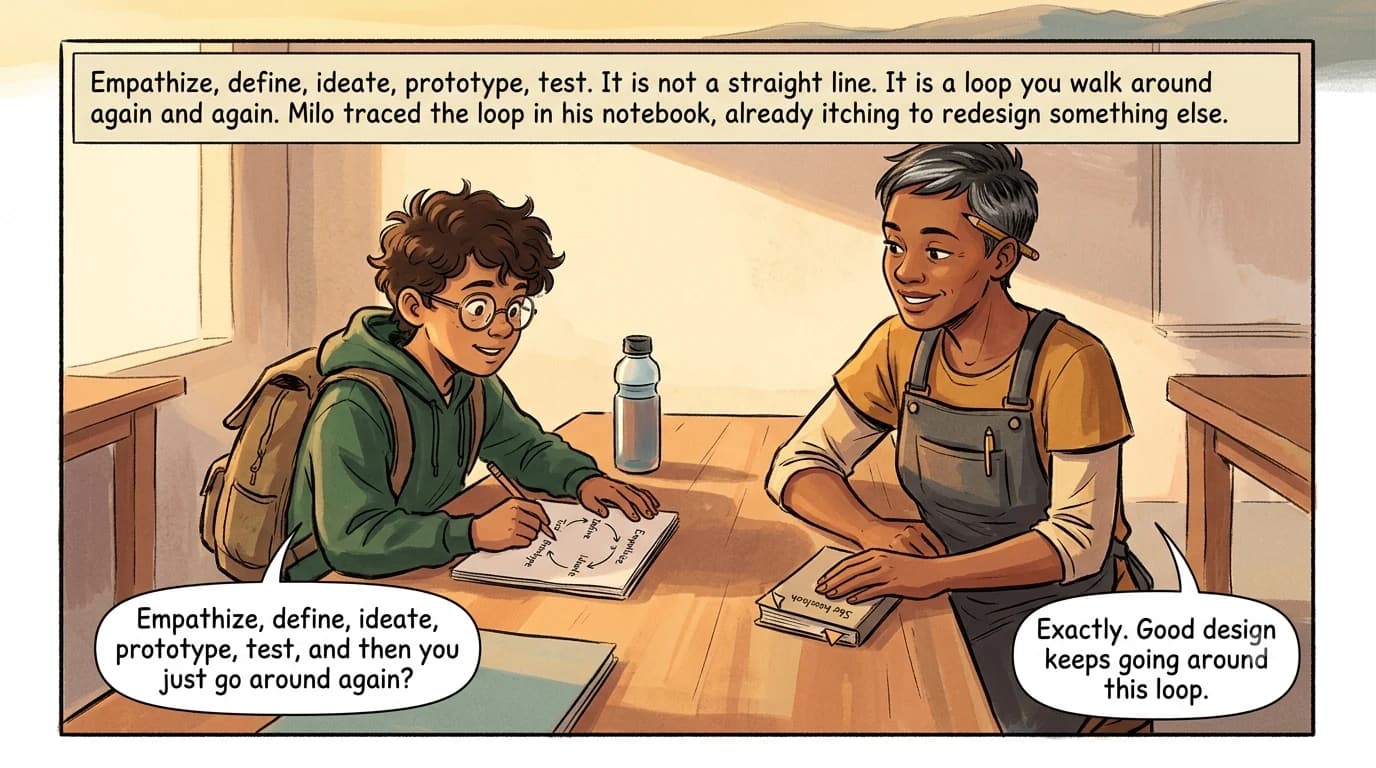
Rio and Milo sit together at golden hour with the finished water bottle between them, Milo drawing a five-step loop in his notebook.
Empathize, define, ideate, prototype, test. It is not a straight line. It is a loop you walk around again and again. Milo traced the loop in his notebook, already itching to redesign something else.
Milo: Empathize, define, ideate, prototype, test, and then you just go around again?
Rio: Exactly. Good design keeps going around this loop.