Made by Design · Chapter 4: Good Design, Bad Design
Cover
Made by Design · Chapter 4
Good Design, Bad Design
Doors that lie, handles that guide, and the design behind everyday things
A door tricks Milo into shoving instead of pulling, and Rio has a name for that: bad design. Together they explore affordances, ergonomics, honest design, and why Dieter Rams believed less is more.
12 panels · ~6 min read
Panel 1
Panel 2
Panel 3
Panel 4
Panel 5
Panel 6
Panel 7
Panel 8
Panel 9
Panel 10
Panel 11
Panel 12
Read chapter text: Good Design, Bad Design
A door tricks Milo into shoving instead of pulling, and Rio has a name for that: bad design. Together they explore affordances, ergonomics, honest design, and why Dieter Rams believed less is more.
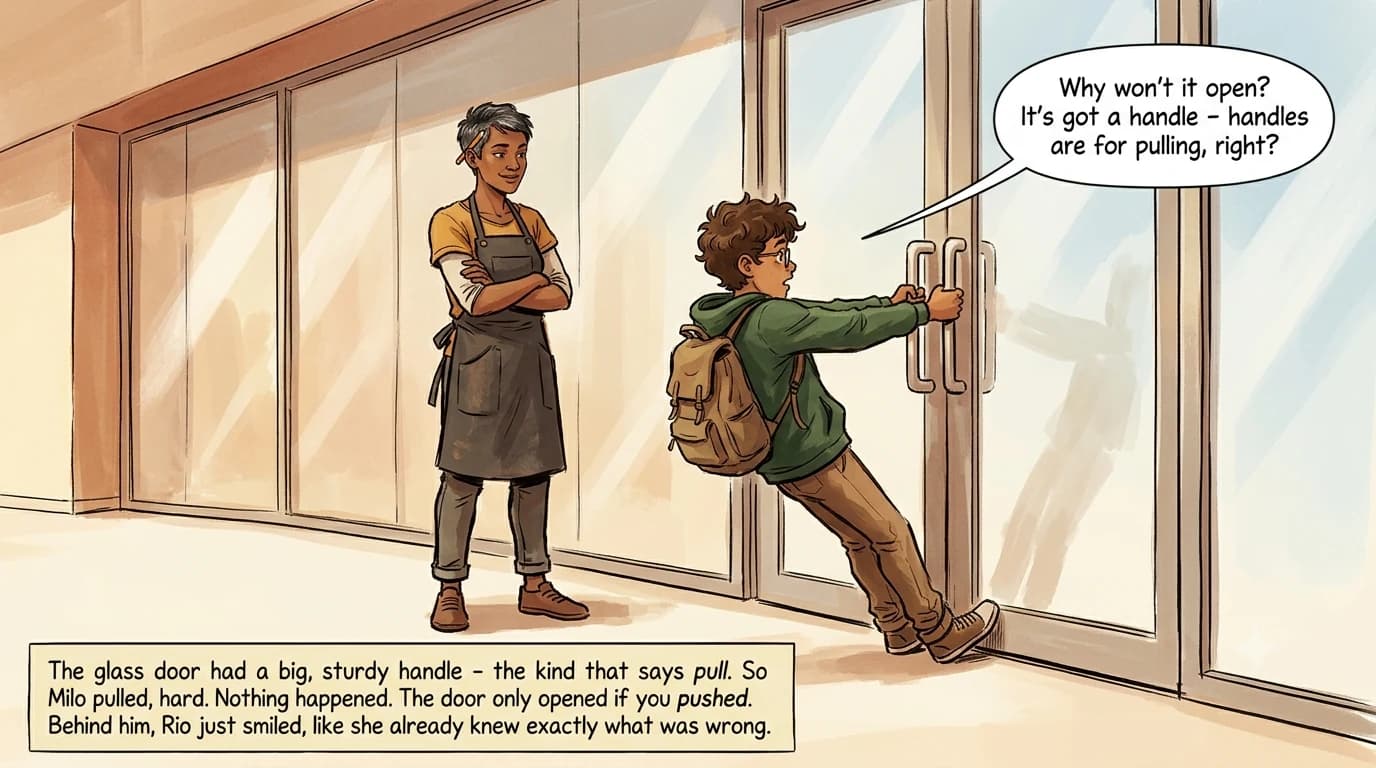
Panel 1
A boy leans away from a glass door, hauling on its large pull handle with all his weight, while a designer watches with a knowing smile.
The glass door had a big, sturdy handle - the kind that says pull. So Milo pulled, hard. Nothing happened. The door only opened if you pushed. Behind him, Rio just smiled, like she already knew exactly what was wrong.
Milo: Why won't it open? It's got a handle - handles are for pulling, right?
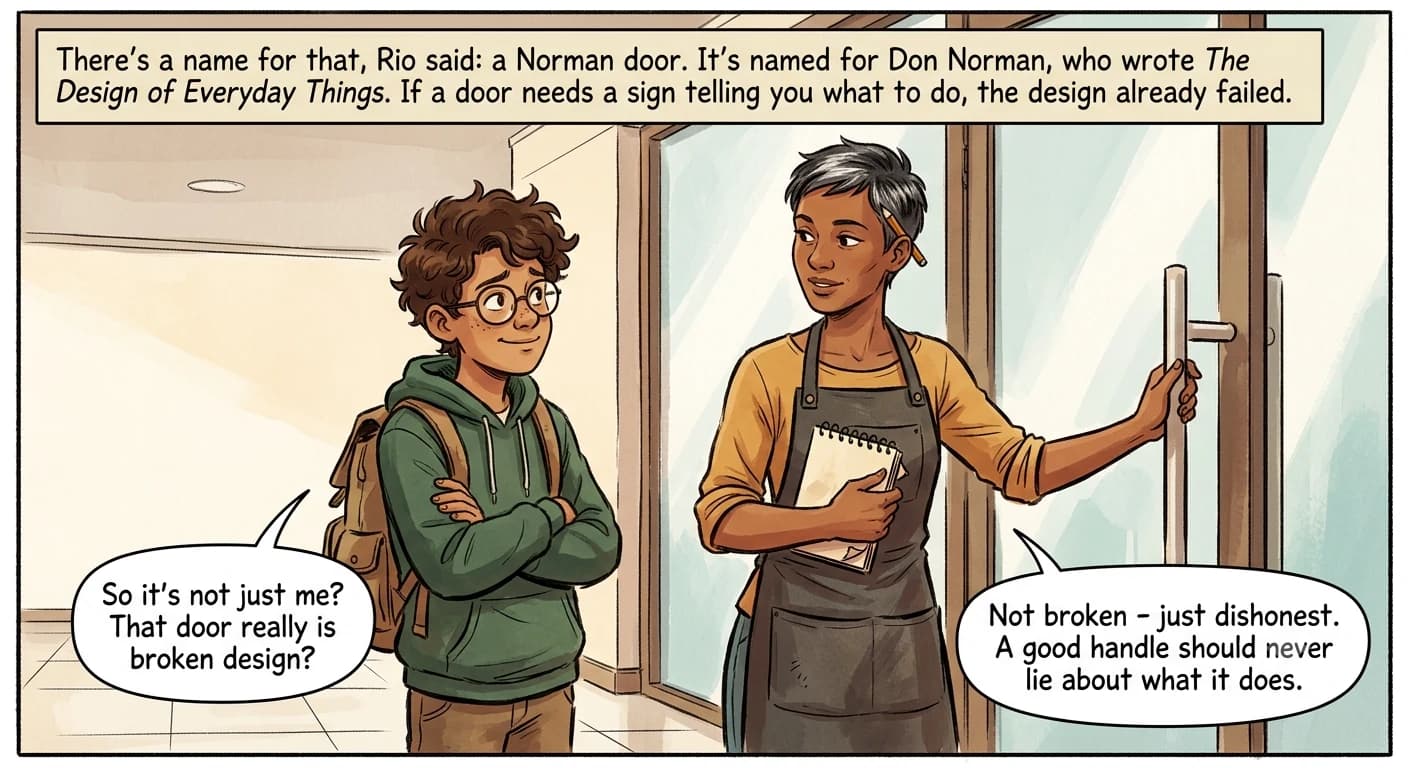
Panel 2
A designer taps a door handle while explaining to a curious boy why the door tricked him, both standing near a propped-open glass office door.
There's a name for that, Rio said: a Norman door. It's named for Don Norman, who wrote The Design of Everyday Things. If a door needs a sign telling you what to do, the design already failed.
Milo: So it's not just me? That door really is broken design?
Rio: Not broken - just dishonest. A good handle should never lie about what it does.
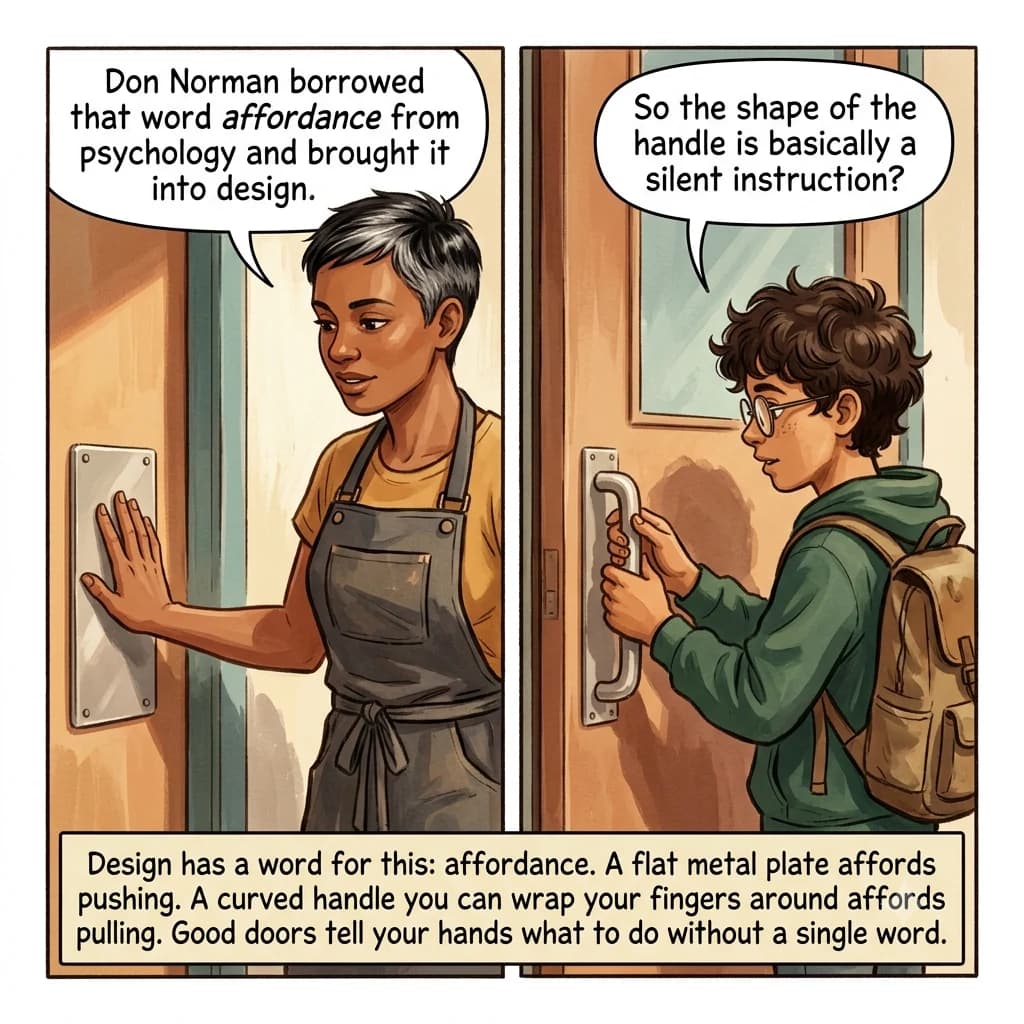
Panel 3
A designer's hand rests on a flat push plate beside a boy gripping a curved pull handle, comparing two kinds of door hardware.
Design has a word for this: affordance. A flat metal plate affords pushing. A curved handle you can wrap your fingers around affords pulling. Good doors tell your hands what to do without a single word.
Rio: Don Norman borrowed that word affordance from psychology and brought it into design.
Milo: So the shape of the handle is basically a silent instruction?
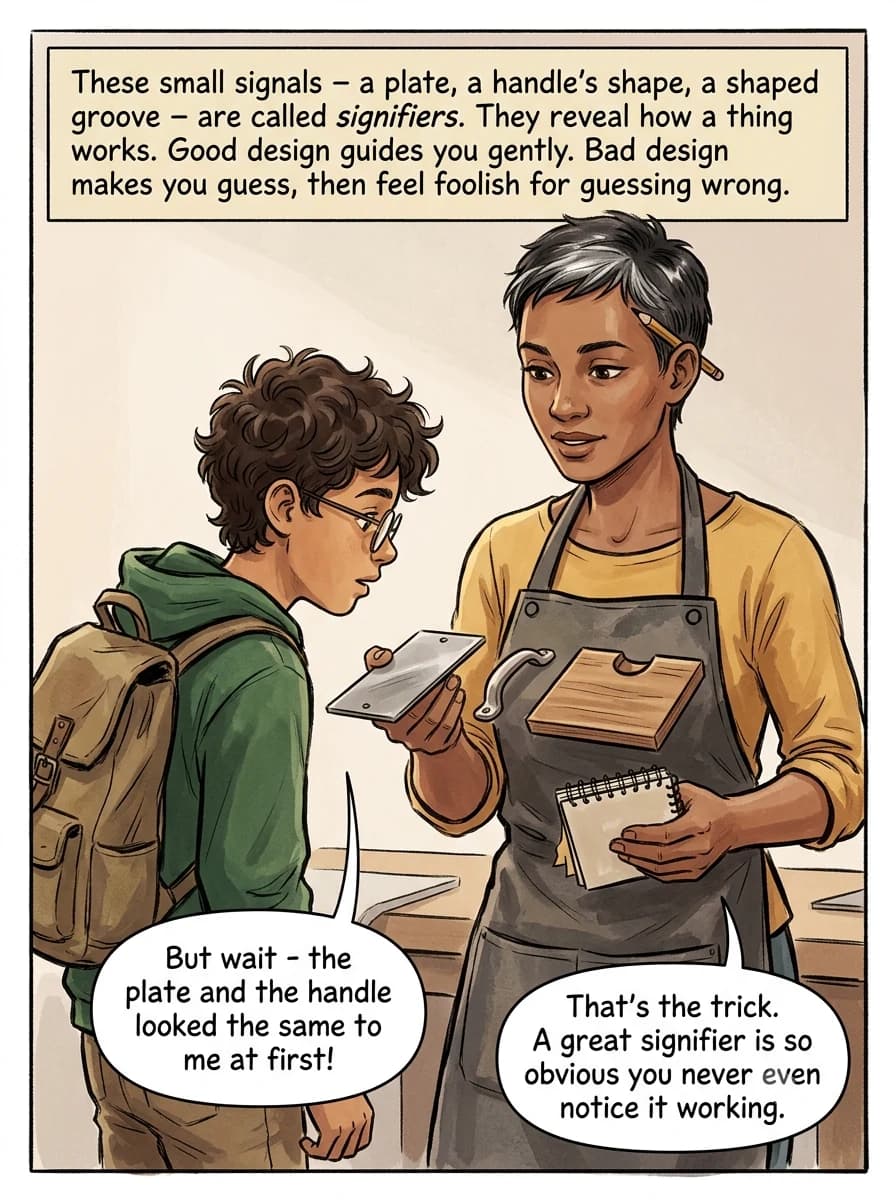
Panel 4
A designer holds up small hardware samples, a flat plate, a curved handle, and a grooved drawer front, while a boy leans in to examine them.
These small signals - a plate, a handle's shape, a shaped groove - are called signifiers. They reveal how a thing works. Good design guides you gently. Bad design makes you guess, then feel foolish for guessing wrong.
Milo: But wait - the plate and the handle looked the same to me at first!
Rio: That's the trick. A great signifier is so obvious you never even notice it working.
Panel 5
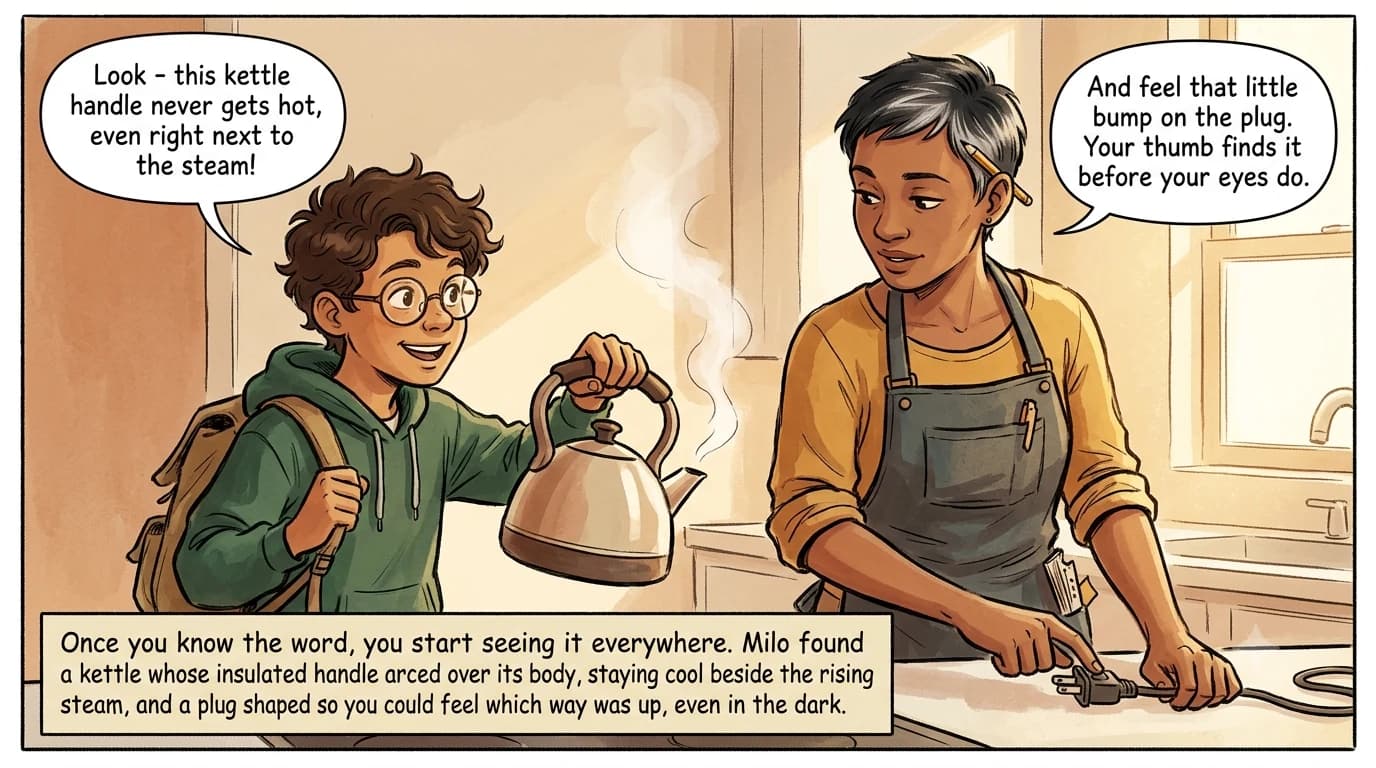
A boy happily lifts a kettle by a cool insulated handle arcing over its body, steam rising from the spout beside it, while a designer points out a raised bump on a nearby electrical plug.
Once you know the word, you start seeing it everywhere. Milo found a kettle whose insulated handle arced over its body, staying cool beside the rising steam, and a plug shaped so you could feel which way was up, even in the dark.
Milo: Look - this kettle handle never gets hot, even right next to the steam!
Rio: And feel that little bump on the plug. Your thumb finds it before your eyes do.
Panel 6
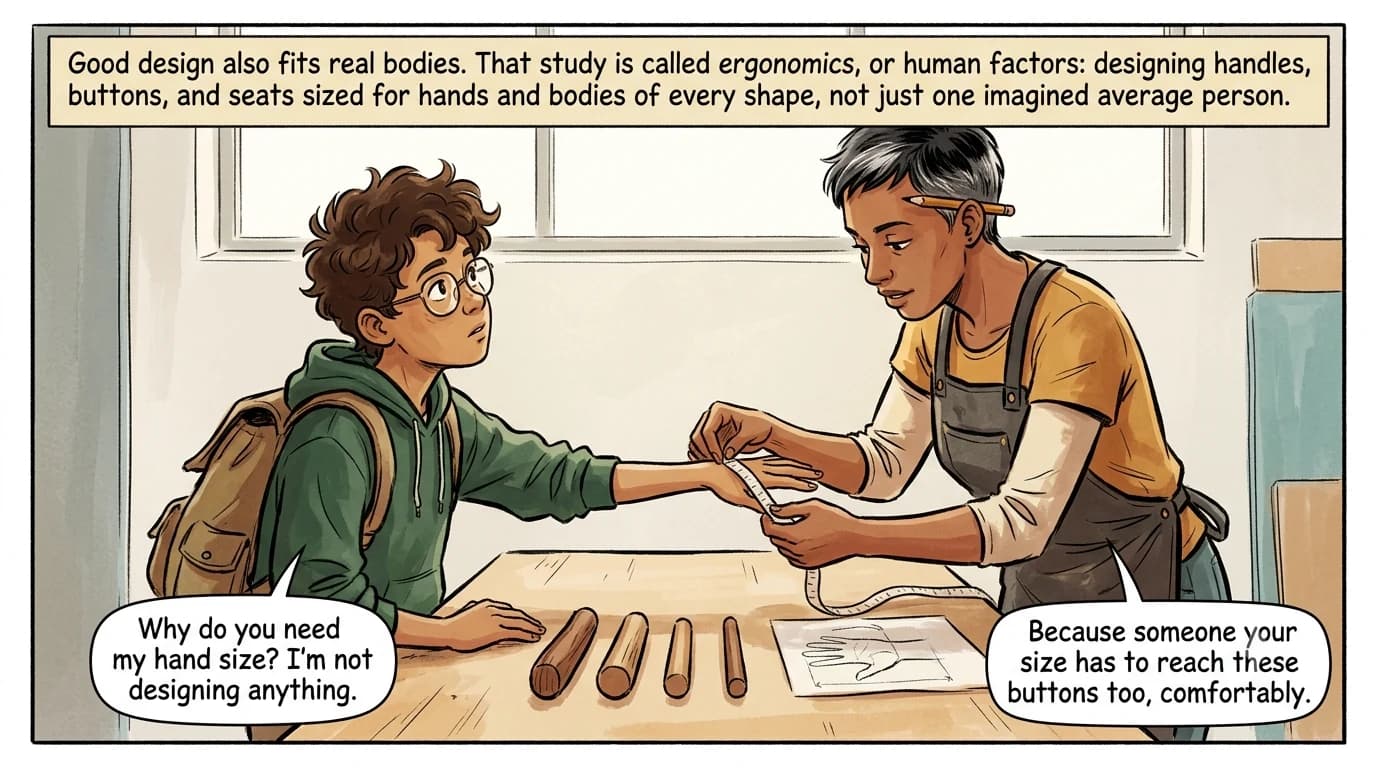
A designer measures a boy's outstretched hand with a soft tape in a bright studio, wooden handle mockups of different sizes laid out on the table.
Good design also fits real bodies. That study is called ergonomics, or human factors: designing handles, buttons, and seats sized for hands and bodies of every shape, not just one imagined average person.
Milo: Why do you need my hand size? I'm not designing anything.
Rio: Because someone your size has to reach these buttons too, comfortably.
Panel 7
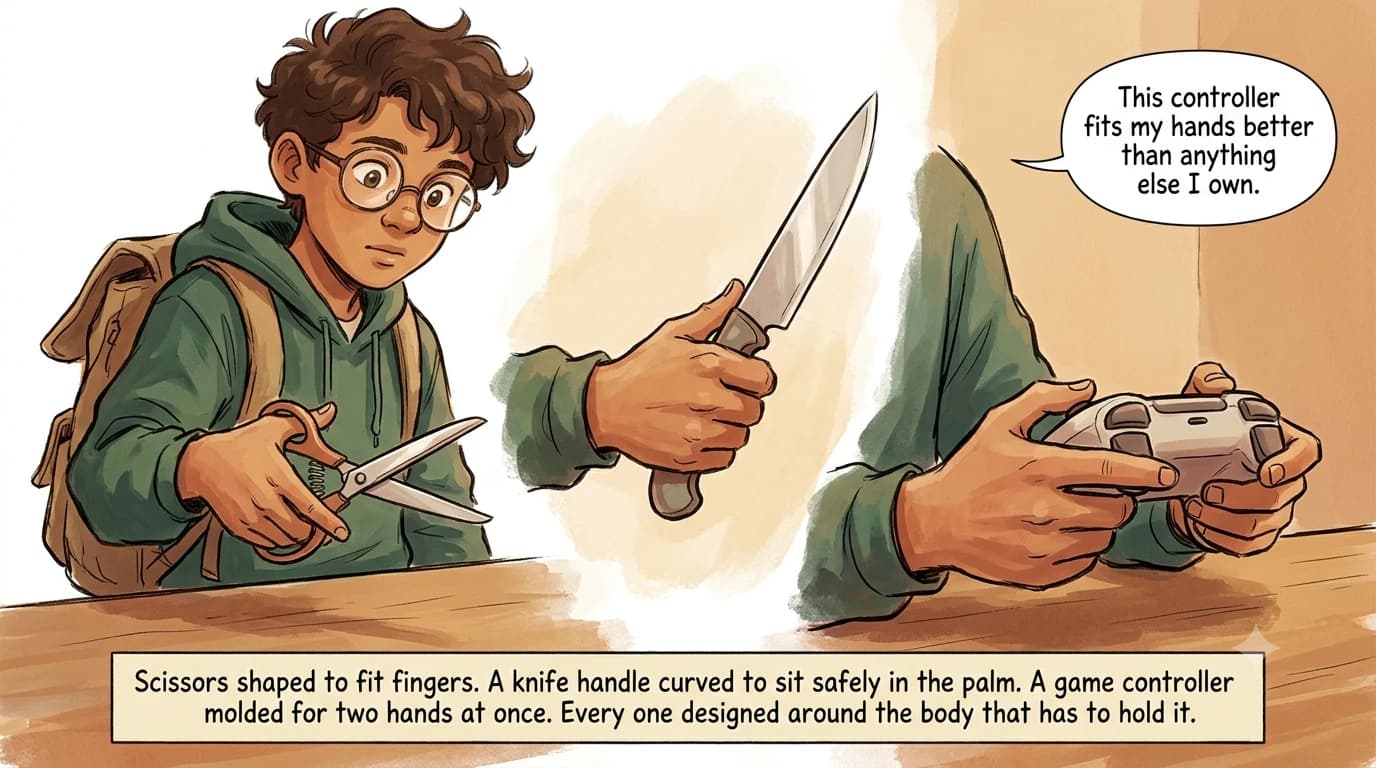
A boy's hands try a pair of ergonomic scissors, a curved-handled knife, and a two-handed game controller in a warm, sequential montage.
Scissors shaped to fit fingers. A knife handle curved to sit safely in the palm. A game controller molded for two hands at once. Every one designed around the body that has to hold it.
Milo: This controller fits my hands better than anything else I own.
Panel 8
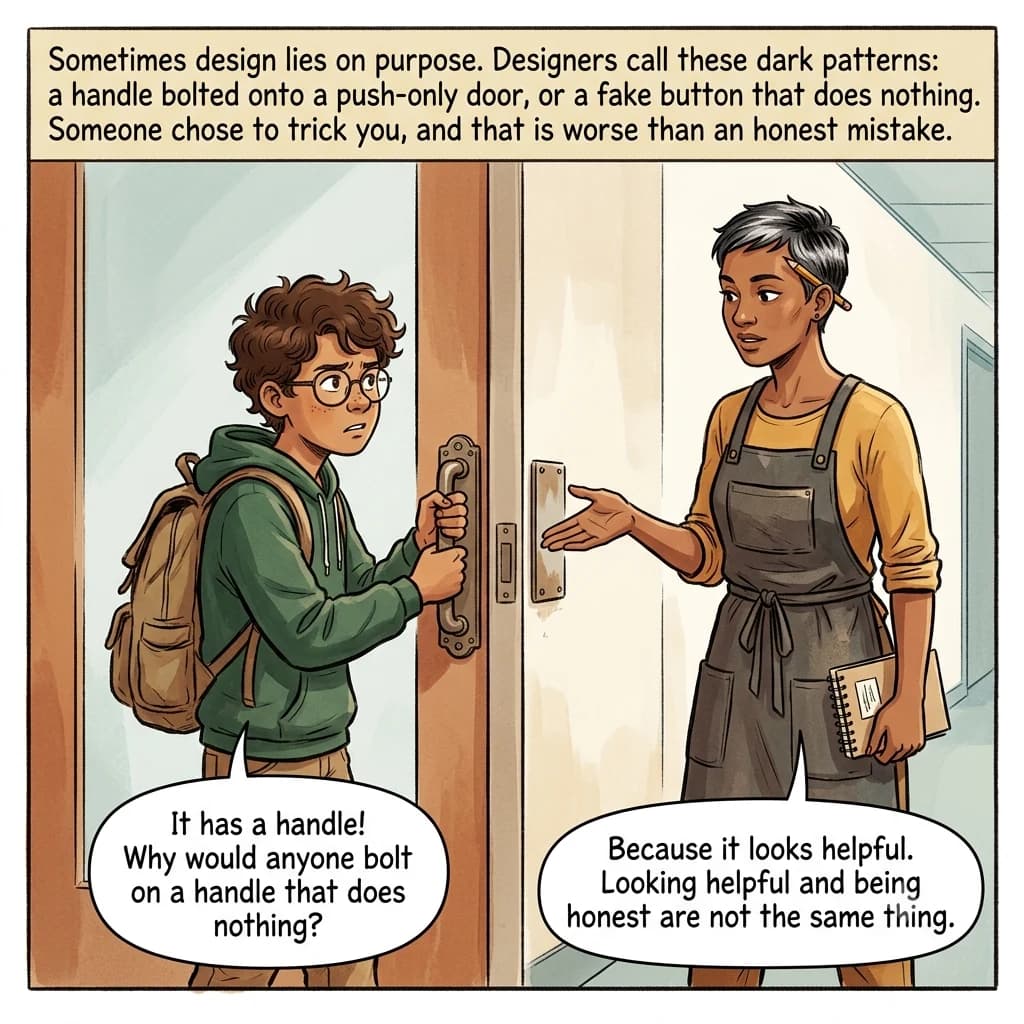
A designer gestures at a small push plate at hand height on the opening edge of a push-only door while a boy tugs in confused frustration on the decorative handle bolted to it.
Sometimes design lies on purpose. Designers call these dark patterns: a handle bolted onto a push-only door, or a fake button that does nothing. Someone chose to trick you, and that is worse than an honest mistake.
Milo: It has a handle! Why would anyone bolt on a handle that does nothing?
Rio: Because it looks helpful. Looking helpful and being honest are not the same thing.
Panel 9
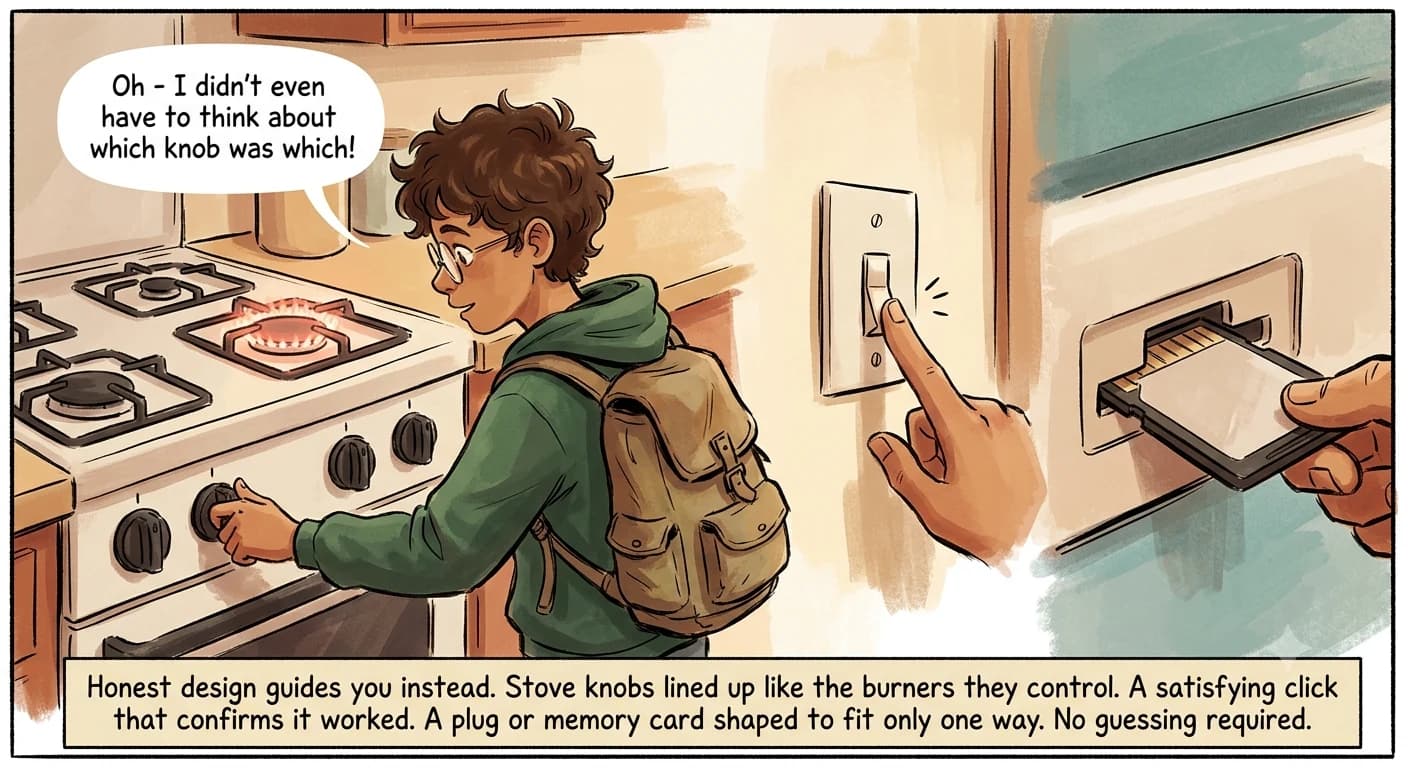
A boy turns one of four stove knobs laid out to match the four burners above them, clicks a light switch, and slides a memory card into a slot that fits only one way.
Honest design guides you instead. Stove knobs lined up like the burners they control. A satisfying click that confirms it worked. A plug or memory card shaped to fit only one way. No guessing required.
Milo: Oh - I didn't even have to think about which knob was which!
Panel 10
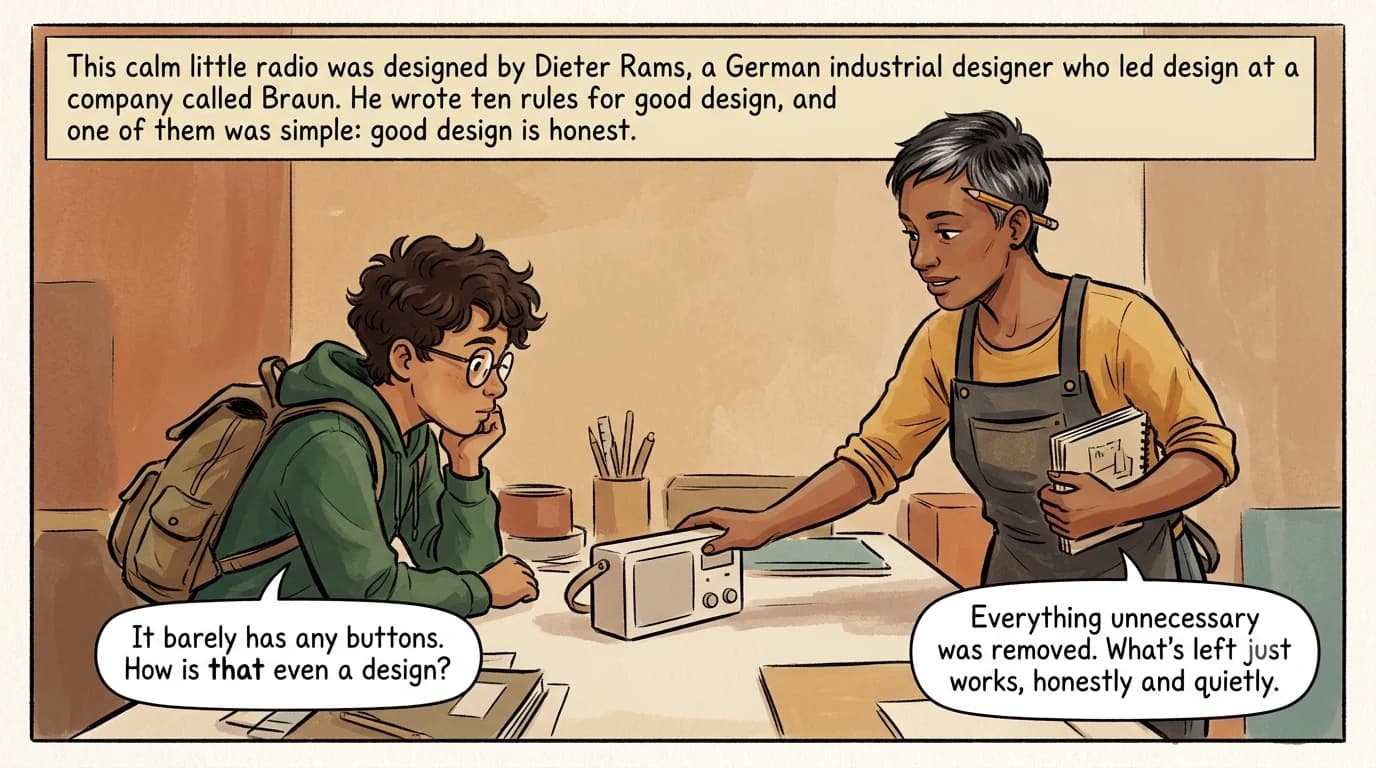
A designer places a plain, minimal boxy radio on a table while a boy leans in, studying how few controls it has.
This calm little radio was designed by Dieter Rams, a German industrial designer who led design at a company called Braun. He wrote ten rules for good design, and one of them was simple: good design is honest.
Milo: It barely has any buttons. How is that even a design?
Rio: Everything unnecessary was removed. What's left just works, honestly and quietly.
Panel 11
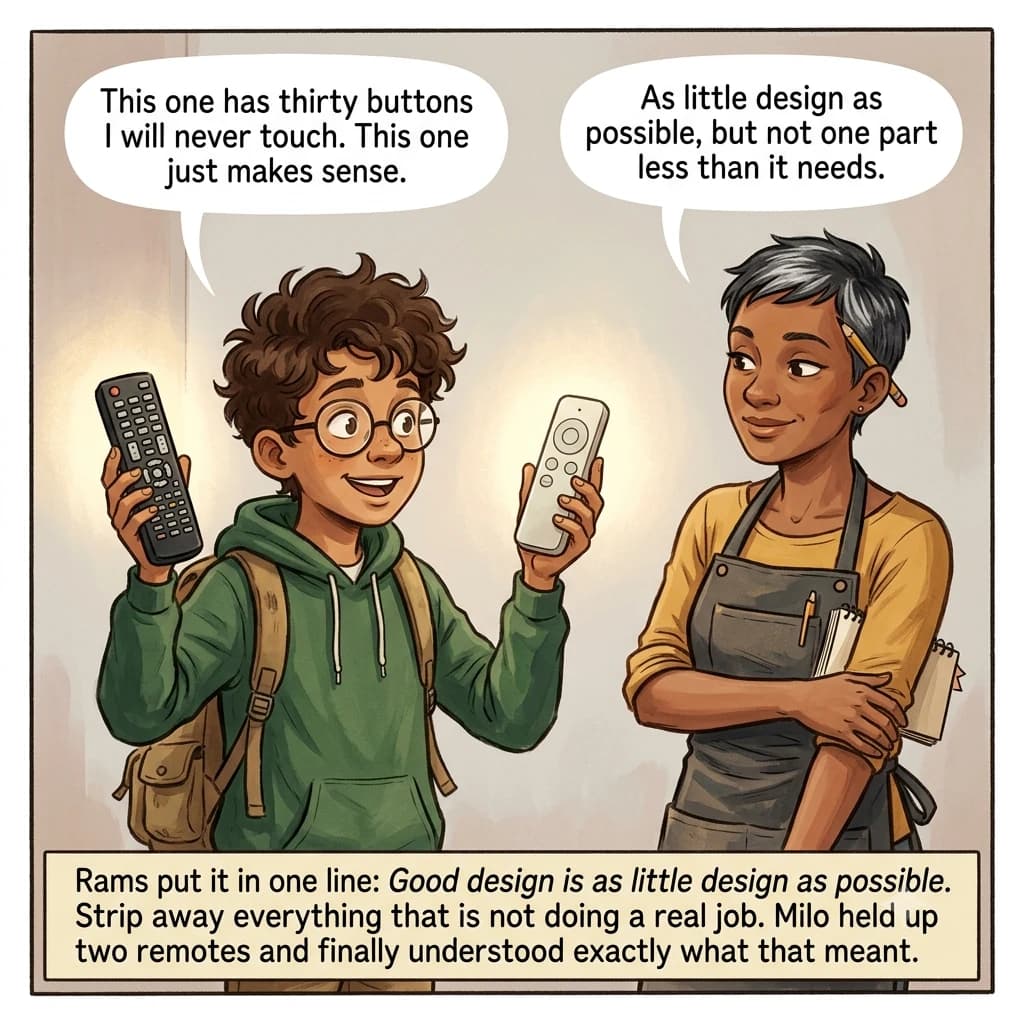
A boy holds a cluttered remote control crowded with buttons in one hand and a clean, simple remote in the other, comparing them.
Rams put it in one line: Good design is as little design as possible. Strip away everything that is not doing a real job. Milo held up two remotes and finally understood exactly what that meant.
Milo: This one has thirty buttons I will never touch. This one just makes sense.
Rio: As little design as possible, but not one part less than it needs.
Panel 12
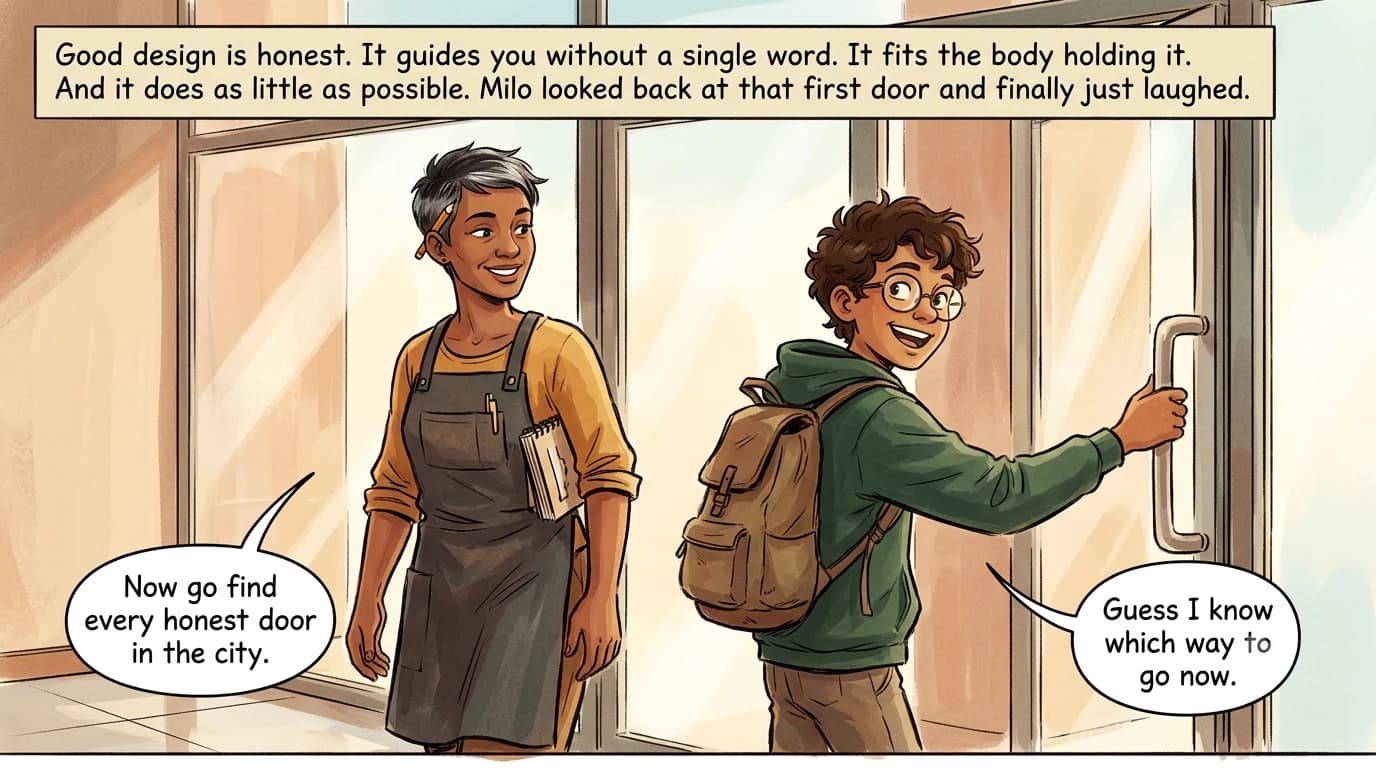
A boy laughs while easily pulling open the same glass door from earlier, glancing back at a smiling designer beside him.
Good design is honest. It guides you without a single word. It fits the body holding it. And it does as little as possible. Milo looked back at that first door and finally just laughed.
Milo: Guess I know which way to go now.
Rio: Now go find every honest door in the city.