How Not to Be Fooled · Chapter 1: The Map Is Not the Place
Cover
How Not to Be Fooled · Chapter 1
The Map Is Not the Place
Models are allowed to lie a little — the honest ones tell you how
A cartoon park map, a classroom globe, and a GPS arrow that points into the ducks. Jules learns the first rule of not being fooled: a model is a tool, not the world.
12 panels · ~6 min read
Panel 1
Panel 2
Panel 3
Panel 4
Panel 5
Panel 6
Panel 7
Panel 8
Panel 9
Panel 10
Panel 11
Panel 12
Read chapter text: The Map Is Not the Place
A cartoon park map, a classroom globe, and a GPS arrow that points into the ducks. Jules learns the first rule of not being fooled: a model is a tool, not the world.
Panel 1
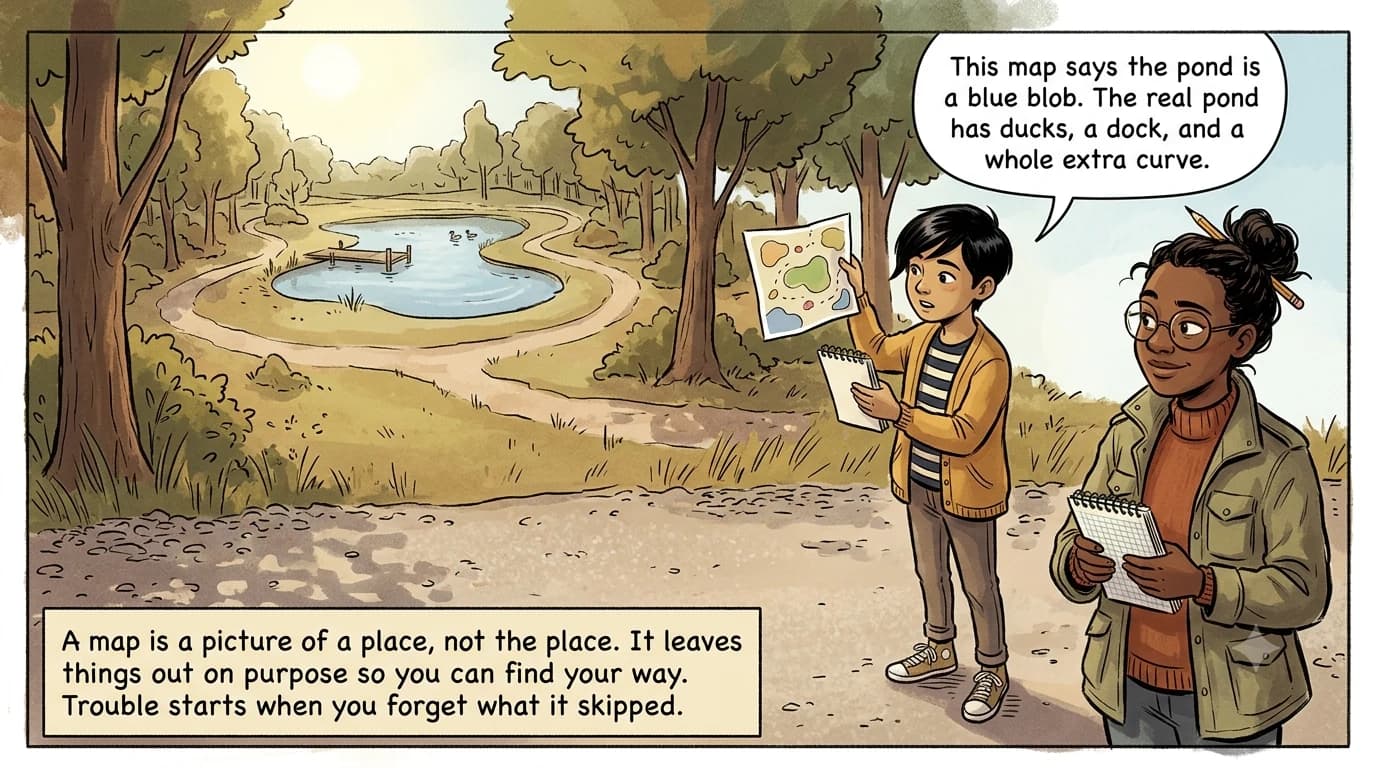
A kid at a park gate compares a simplified paper map with the real winding paths and pond ahead, while a researcher looks on.
A map is a picture of a place, not the place. It leaves things out on purpose so you can find your way. Trouble starts when you forget what it skipped.
Jules: This map says the pond is a blue blob. The real pond has ducks, a dock, and a whole extra curve.
Panel 2
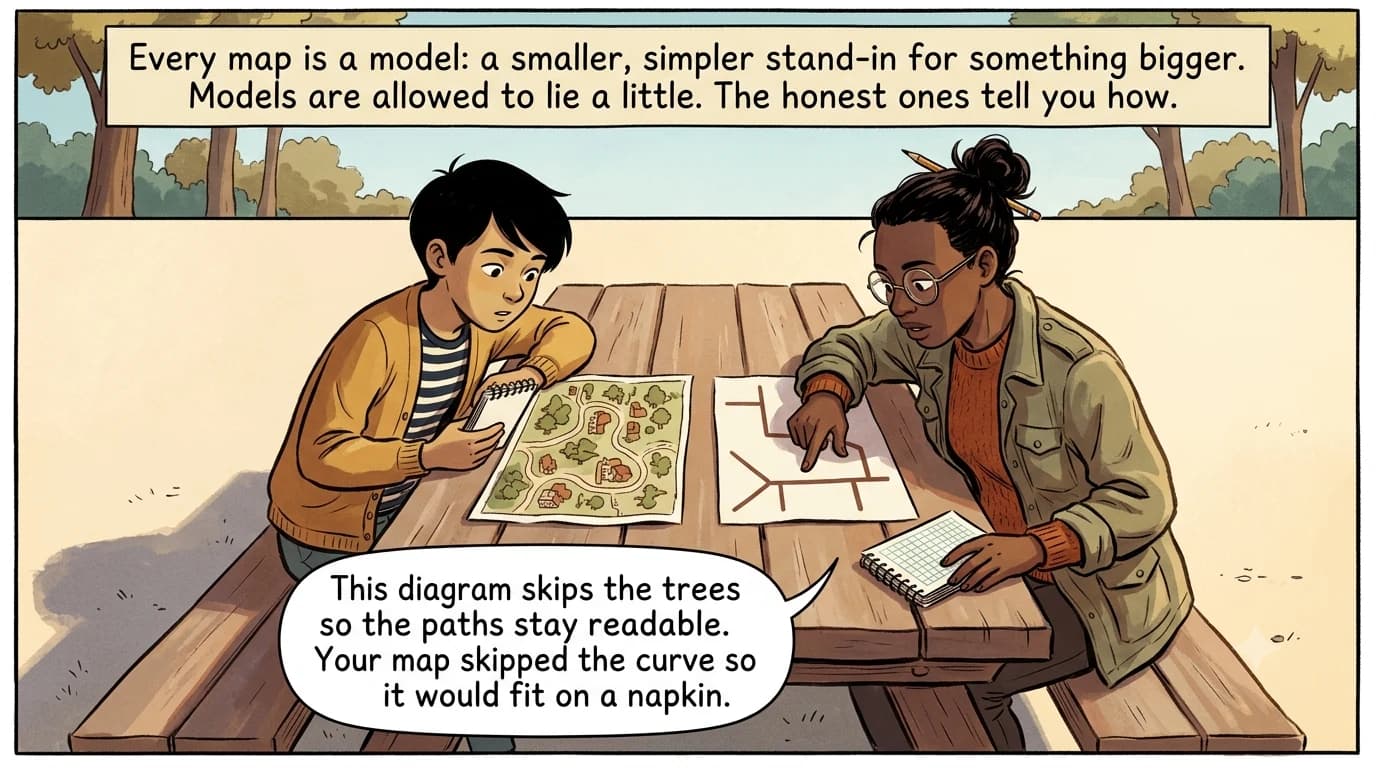
A researcher holds a spare diagram of park paths beside a kid's cartoon map, comparing what each drawing left out.
Every map is a model: a smaller, simpler stand-in for something bigger. Models are allowed to lie a little. The honest ones tell you how.
Nia: This diagram skips the trees so the paths stay readable. Your map skipped the curve so it would fit on a napkin.
Panel 3
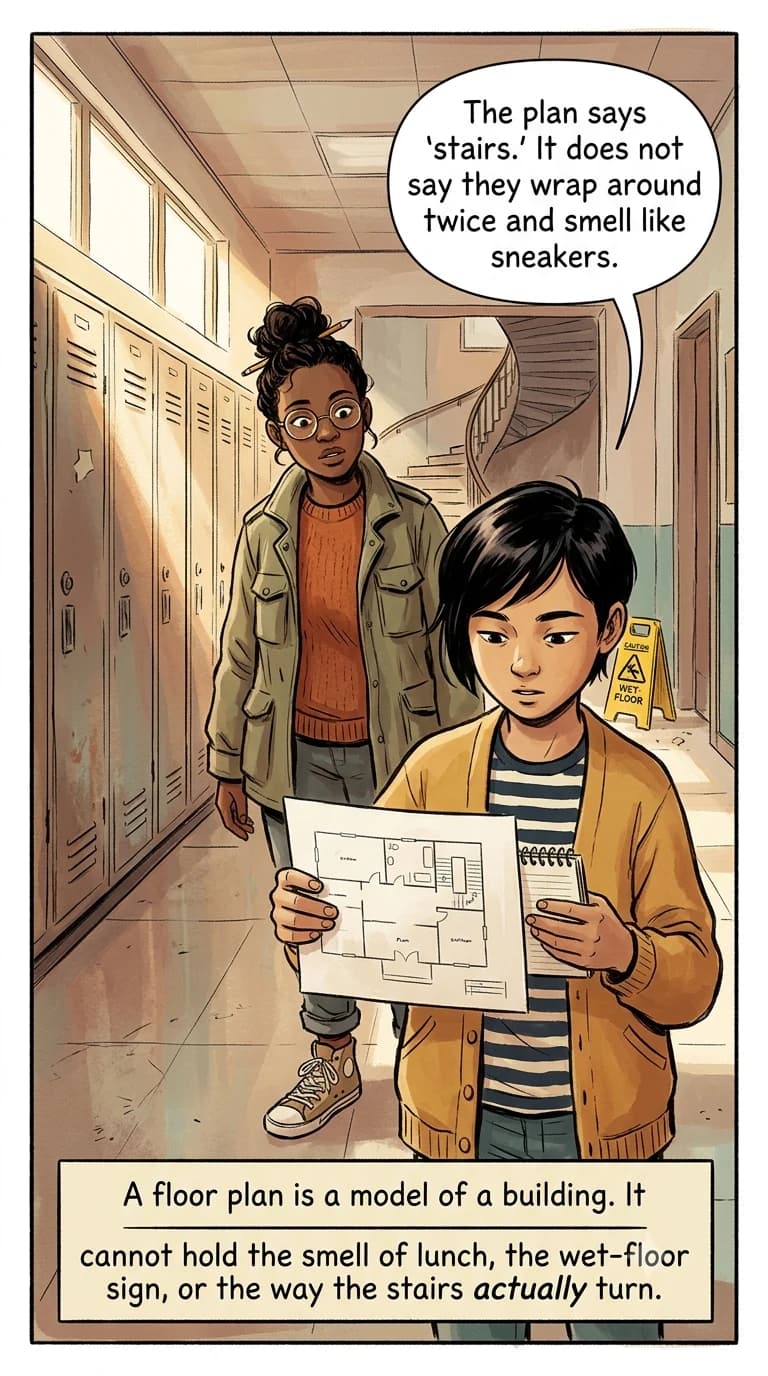
A kid holds a simple school floor plan in a hallway that is messier and more three-dimensional than the drawing.
A floor plan is a model of a building. It cannot hold the smell of lunch, the wet-floor sign, or the way the stairs actually turn.
Jules: The plan says 'stairs.' It does not say they wrap around twice and smell like sneakers.
Panel 4
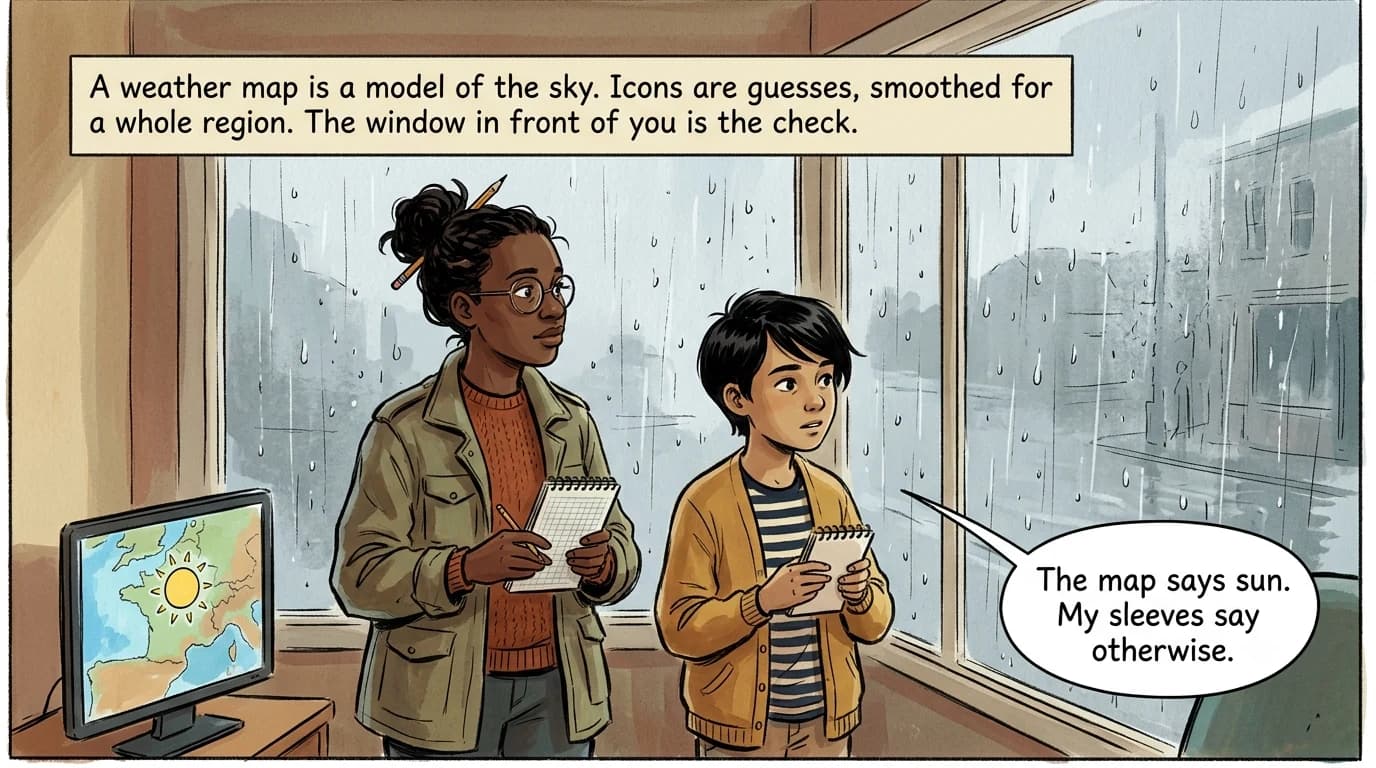
A colorful weather map on a screen shows a sun icon while rain streaks the window in front of a kid and a researcher.
A weather map is a model of the sky. Icons are guesses, smoothed for a whole region. The window in front of you is the check.
Jules: The map says sun. My sleeves say otherwise.
Panel 5
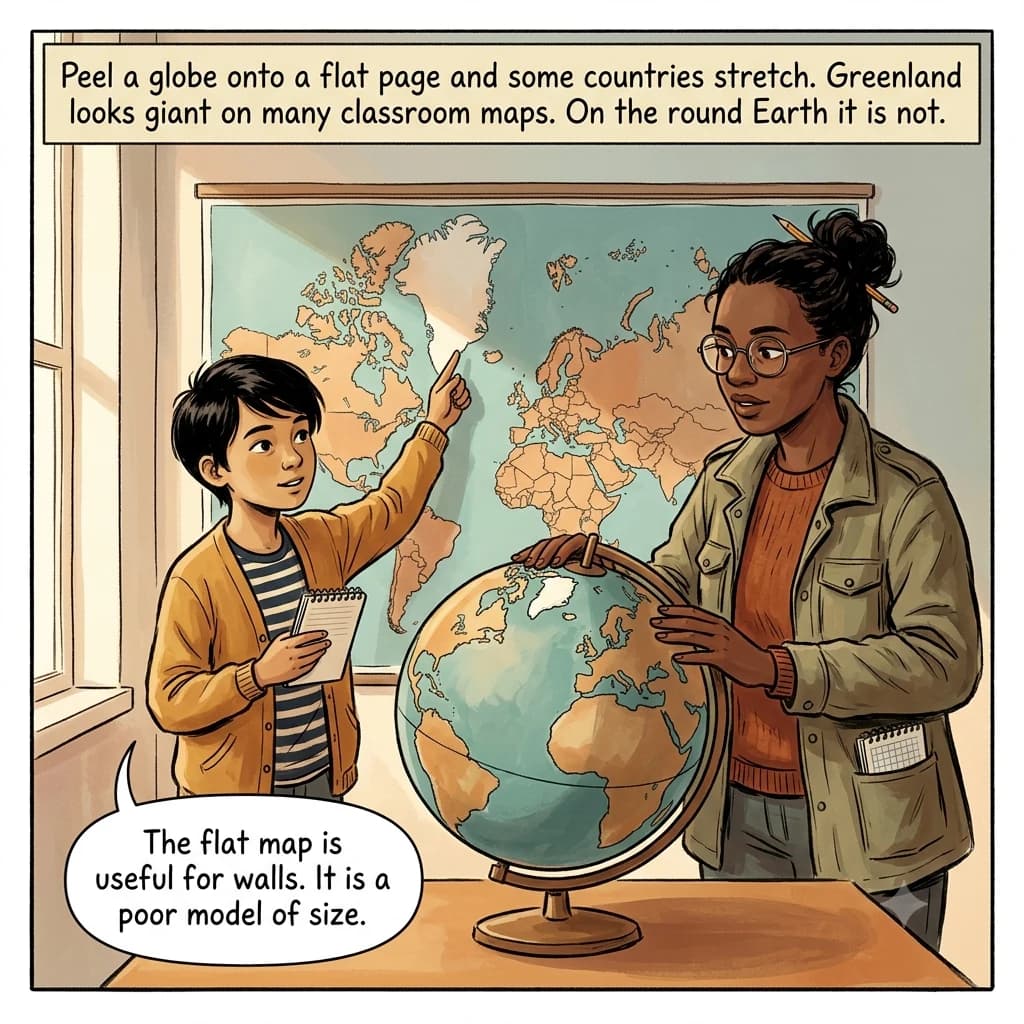
A globe and a flat classroom world map sit side by side so Greenland looks huge on the map and modest on the globe.
Peel a globe onto a flat page and some countries stretch. Greenland looks giant on many classroom maps. On the round Earth it is not.
Nia: The flat map is useful for walls. It is a poor model of size.
Panel 6
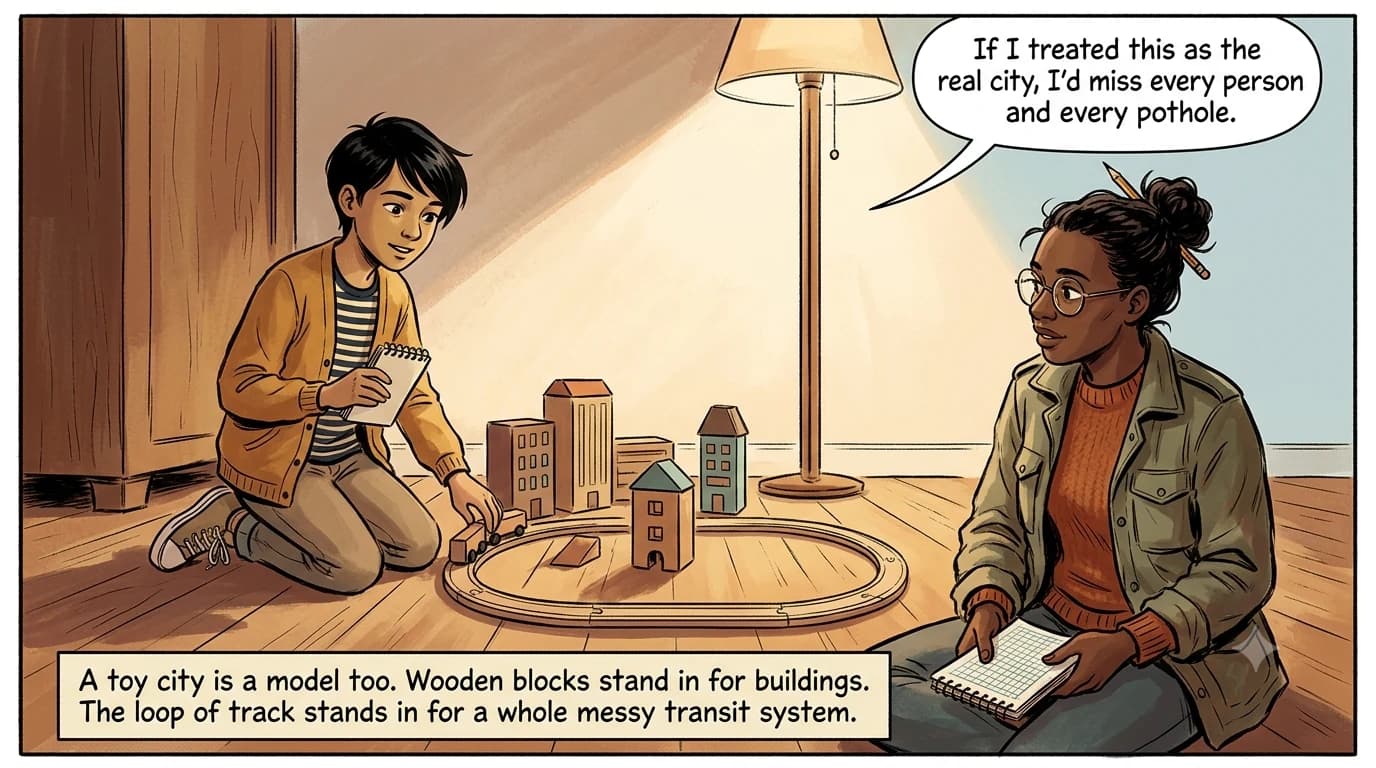
A kid kneels beside a wooden toy train city of blocks and a simple loop of track, treating it as a stand-in for a real city.
A toy city is a model too. Wooden blocks stand in for buildings. The loop of track stands in for a whole messy transit system.
Jules: If I treated this as the real city, I'd miss every person and every pothole.
Panel 7
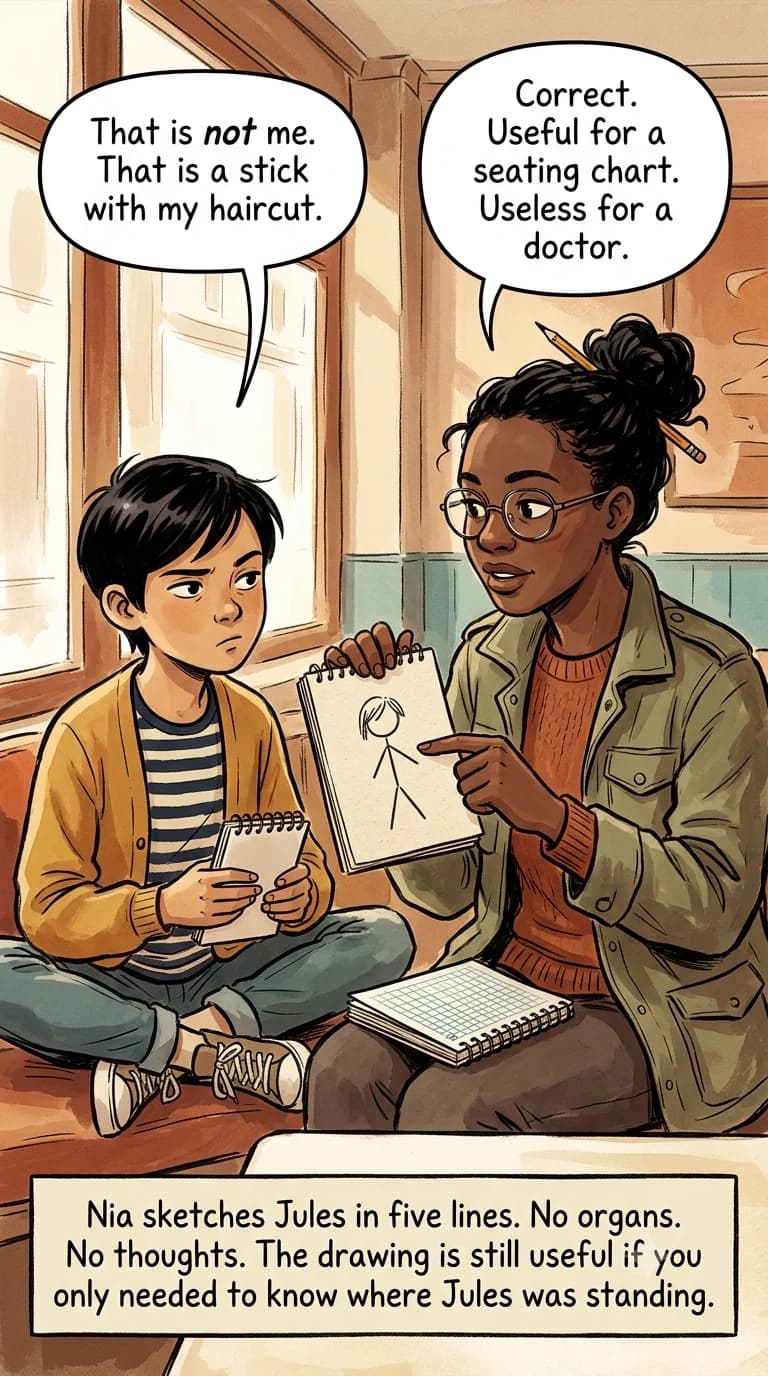
A researcher holds a stick-figure sketch of a kid while the real kid looks at it skeptically.
Nia sketches Jules in five lines. No organs. No thoughts. The drawing is still useful if you only needed to know where Jules was standing.
Jules: That is not me. That is a stick with my haircut.
Nia: Correct. Useful for a seating chart. Useless for a doctor.
Panel 8
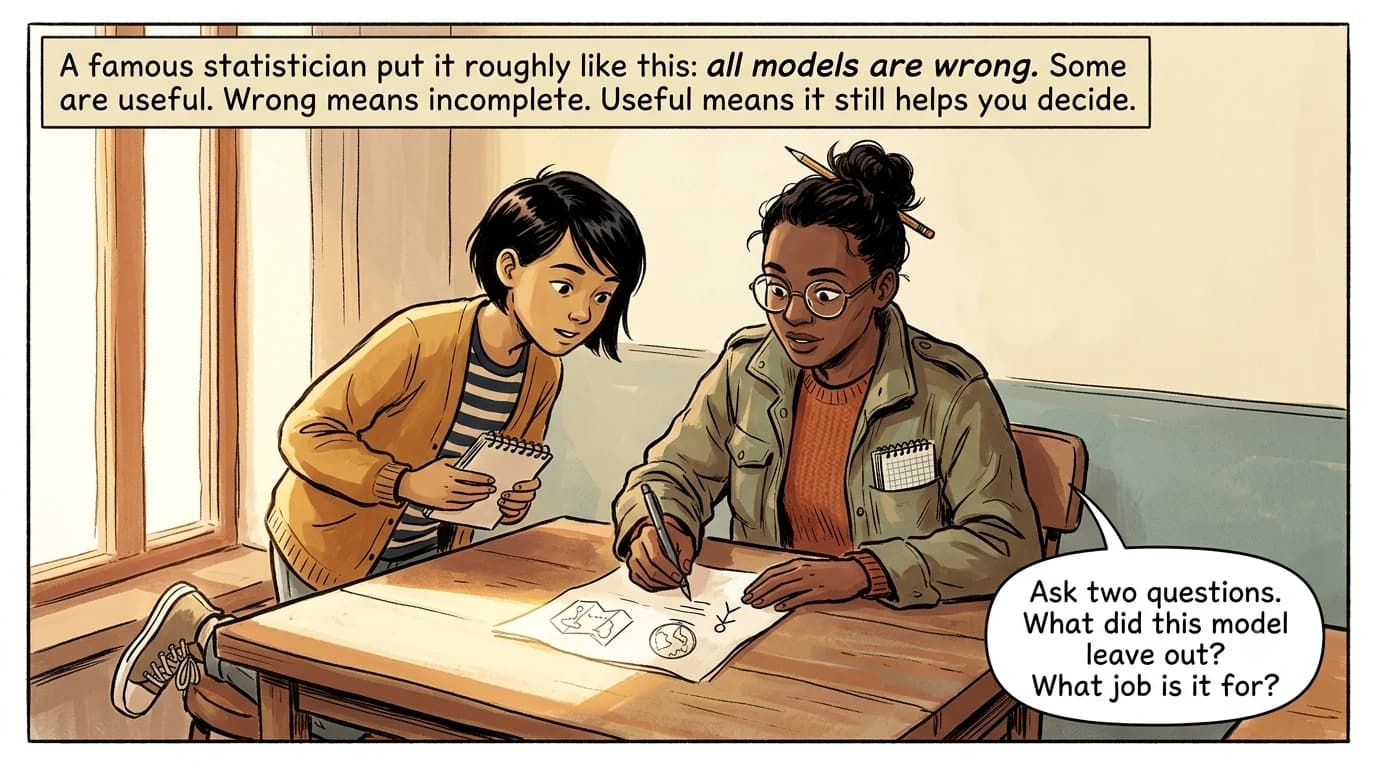
A researcher writes a short idea on a napkin while a kid reads it: models miss things, but some still help you decide.
A famous statistician put it roughly like this: all models are wrong. Some are useful. Wrong means incomplete. Useful means it still helps you decide.
Nia: Ask two questions. What did this model leave out? What job is it for?
Panel 9
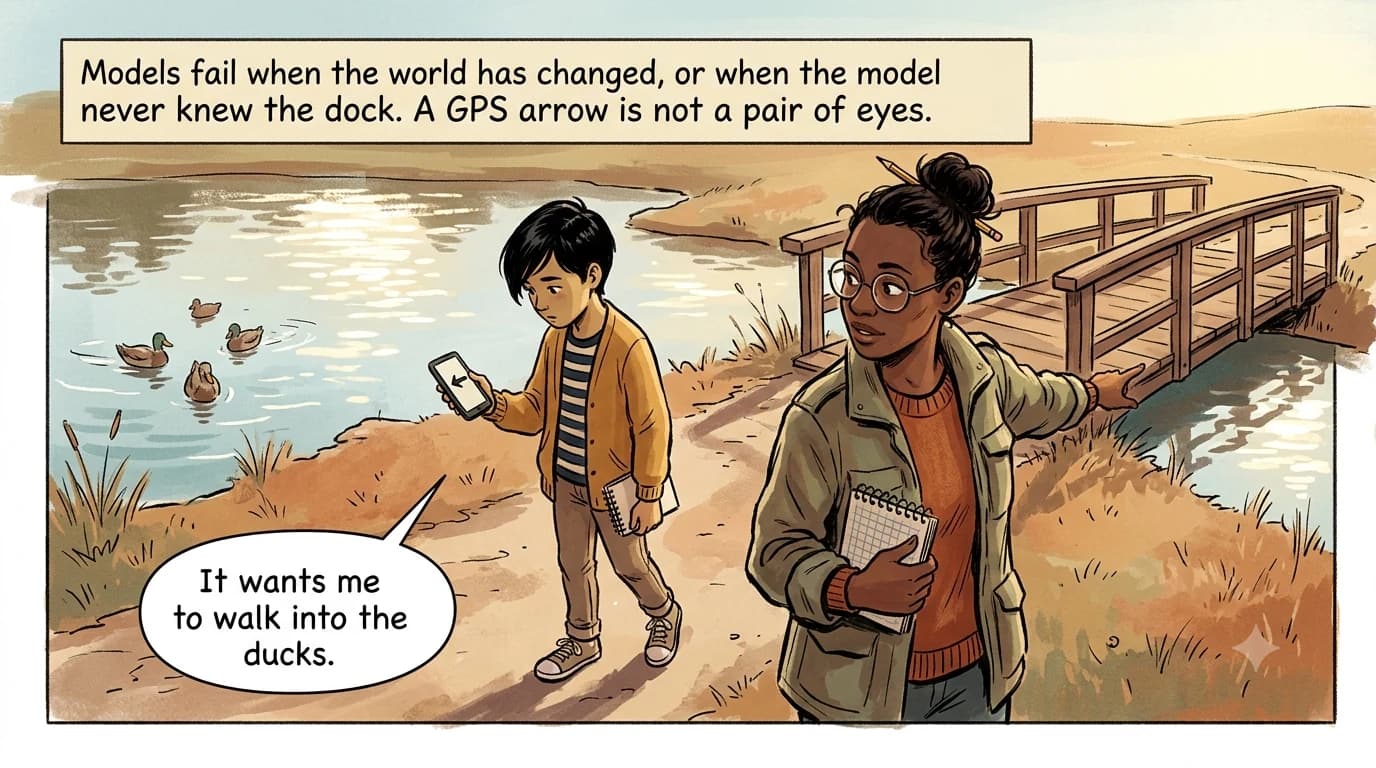
A phone GPS arrow points into a pond while a real wooden footbridge is clearly visible to the other side.
Models fail when the world has changed, or when the model never knew the dock. A GPS arrow is not a pair of eyes.
Jules: It wants me to walk into the ducks.
Panel 10
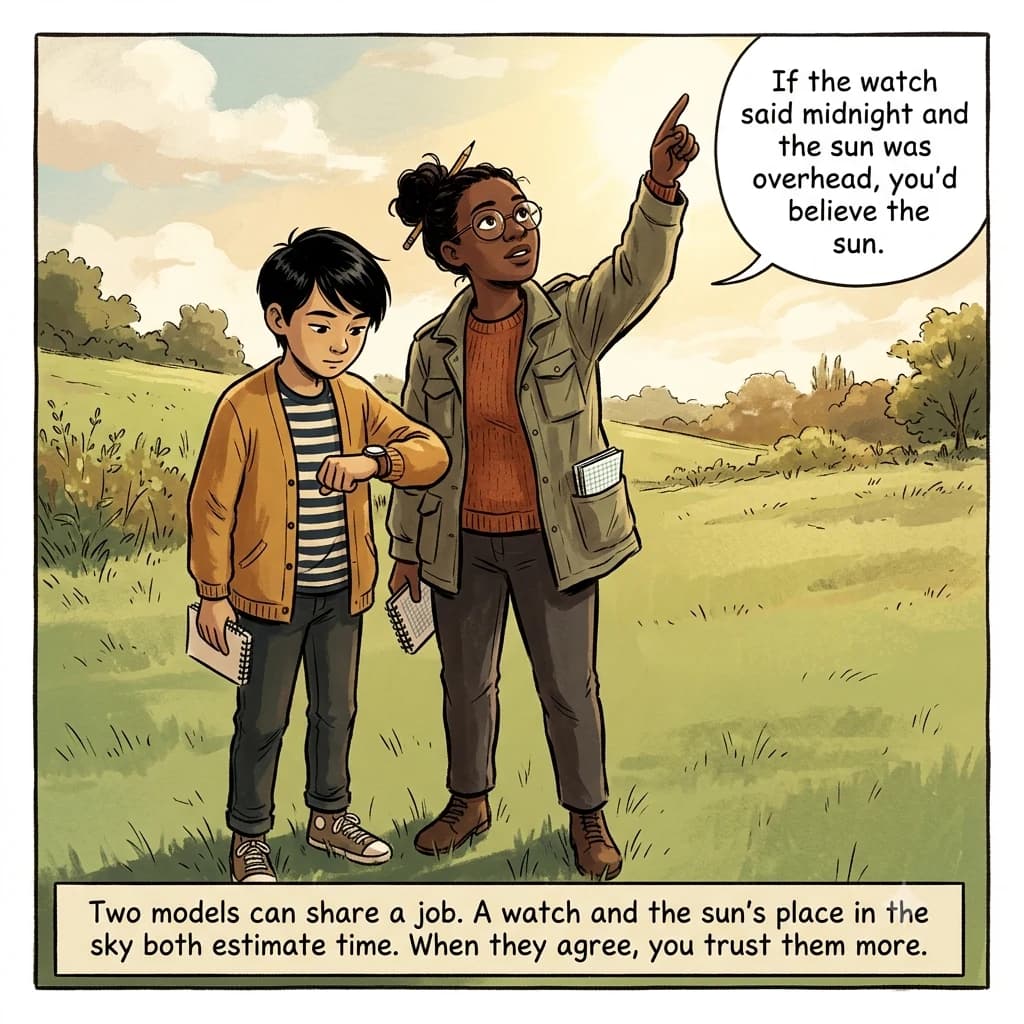
A kid checks a wristwatch while a researcher points at the sun, comparing two ways of estimating the time.
Two models can share a job. A watch and the sun's place in the sky both estimate time. When they agree, you trust them more.
Nia: If the watch said midnight and the sun was overhead, you'd believe the sun.
Panel 11
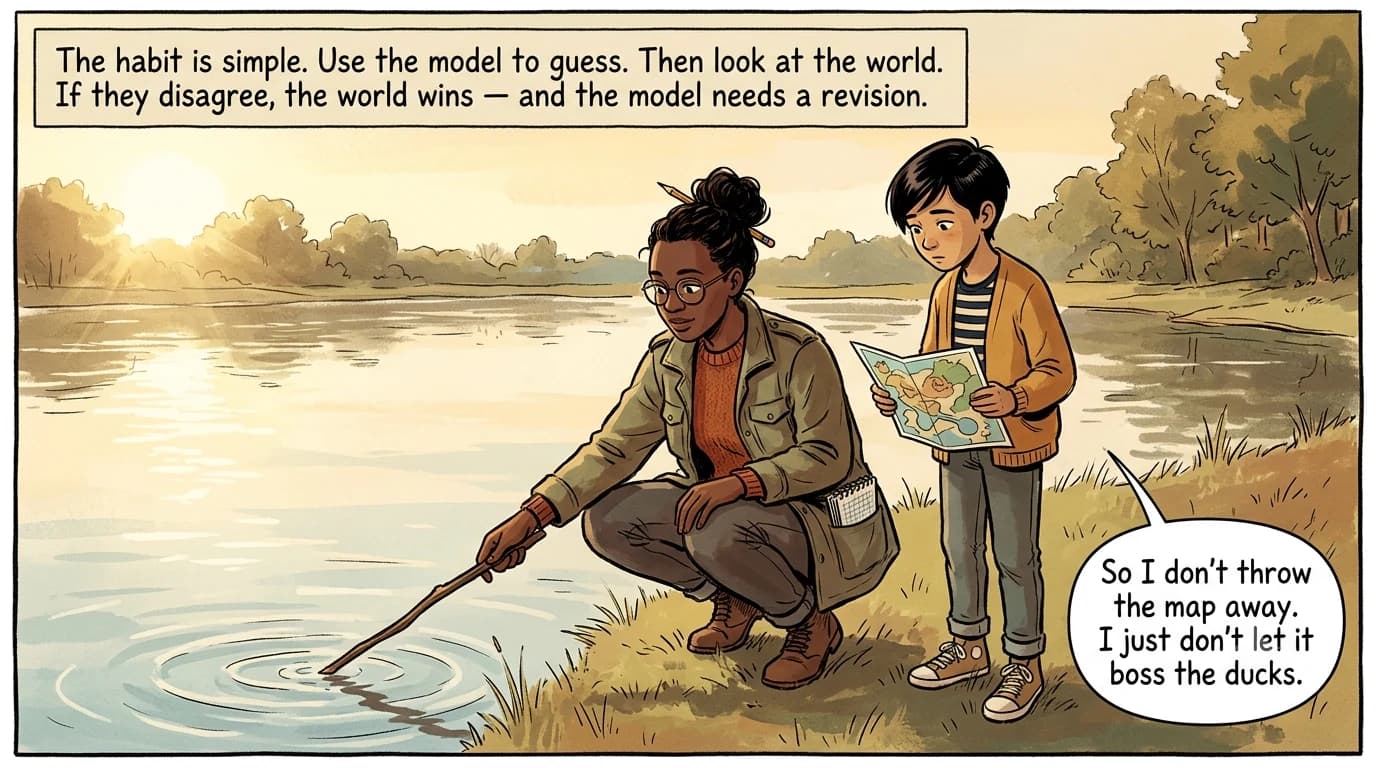
A researcher taps the real pond with a stick while a kid still holds the cartoon map, checking the drawing against the water.
The habit is simple. Use the model to guess. Then look at the world. If they disagree, the world wins — and the model needs a revision.
Jules: So I don't throw the map away. I just don't let it boss the ducks.
Panel 12
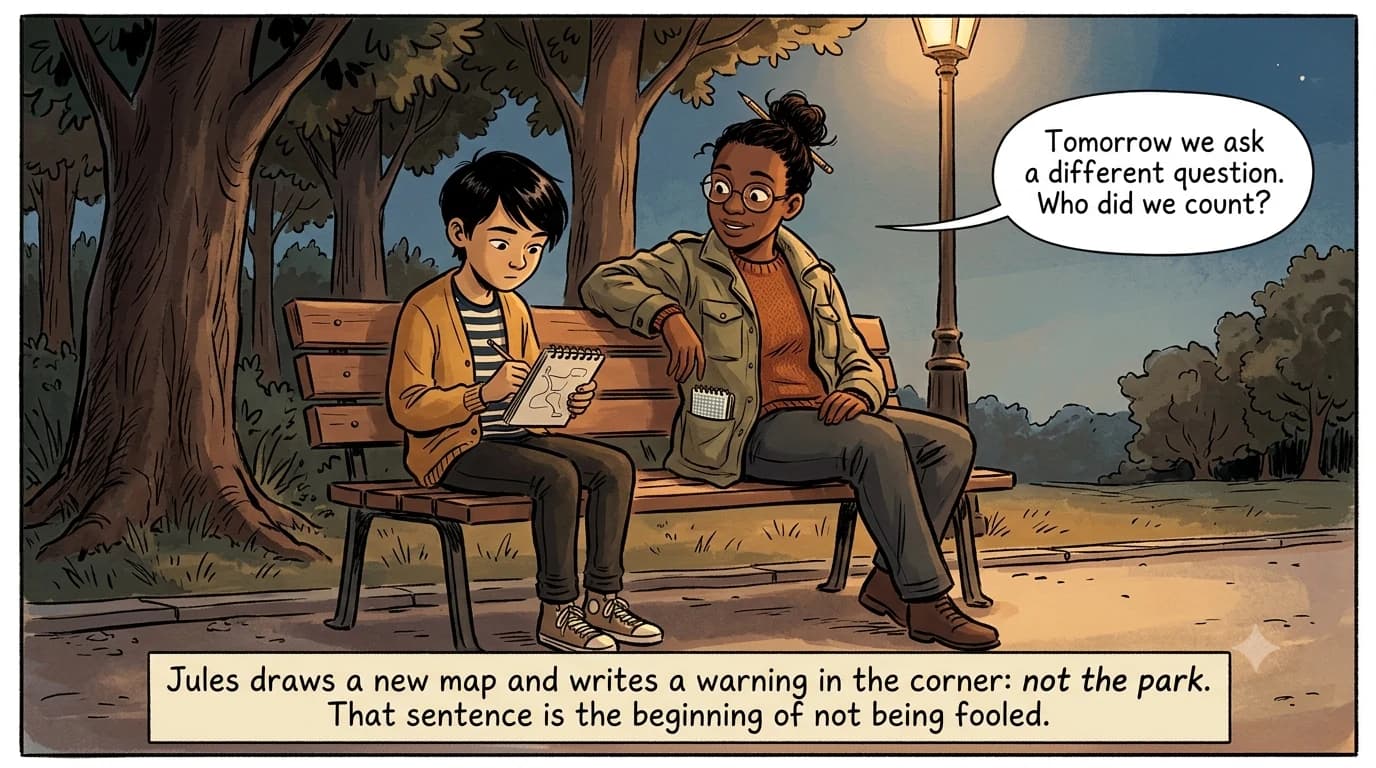
At dusk a kid sketches a new park map with a warning that it is not the park, while a researcher looks on proudly.
Jules draws a new map and writes a warning in the corner: not the park. That sentence is the beginning of not being fooled.
Nia: Tomorrow we ask a different question. Who did we count?