The Examined Life · Chapter 1: The Cave
Cover
The Examined Life · Chapter 1
The Cave
Plato's ancient allegory of shadows, sunlight, and the cost of truth
Prisoners have watched shadows on a wall their whole lives and call it the world. When one of them is dragged into the light, he learns what's real — and has to decide whether to go back and tell the others.
12 panels · ~6 min read
Panel 1
Panel 2
Panel 3
Panel 4
Panel 5
Panel 6
Panel 7
Panel 8
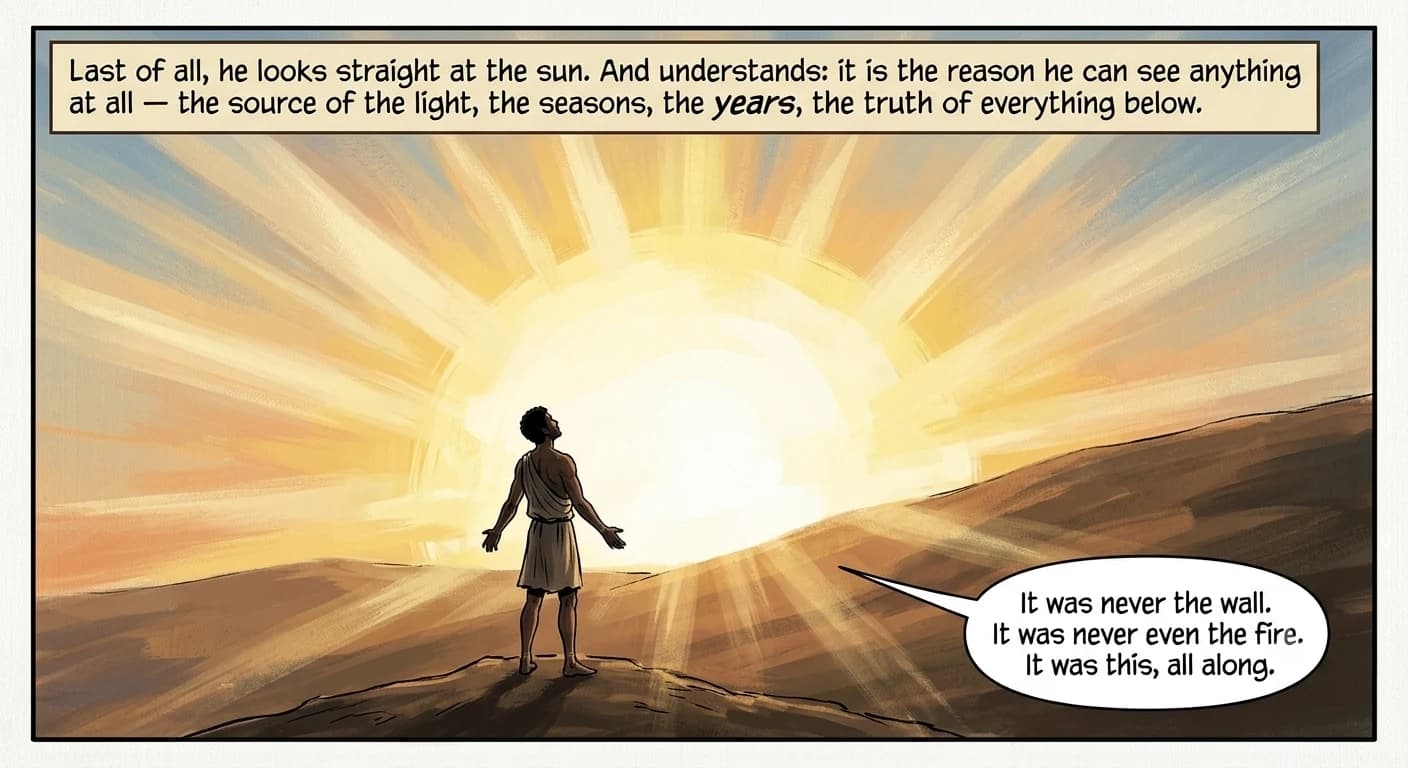
Panel 9
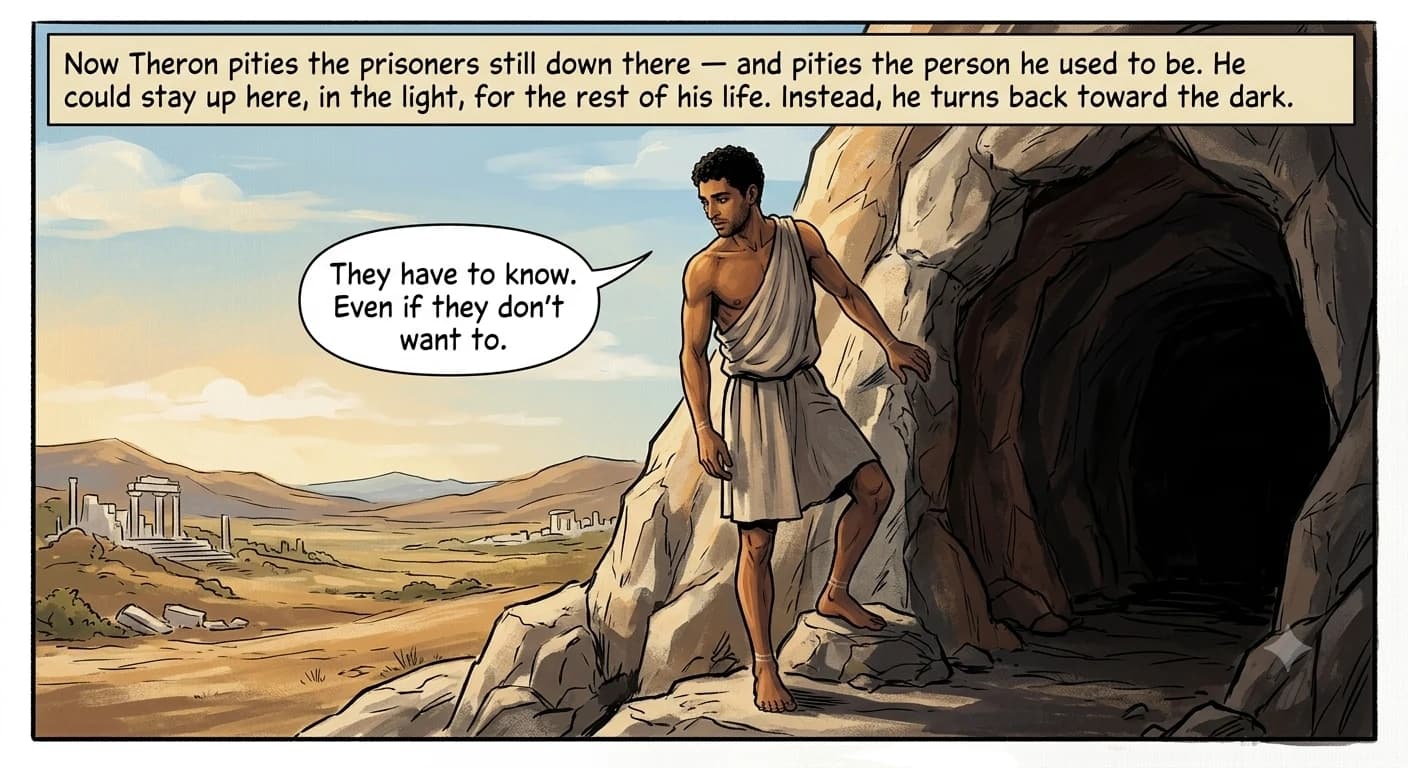
Panel 10
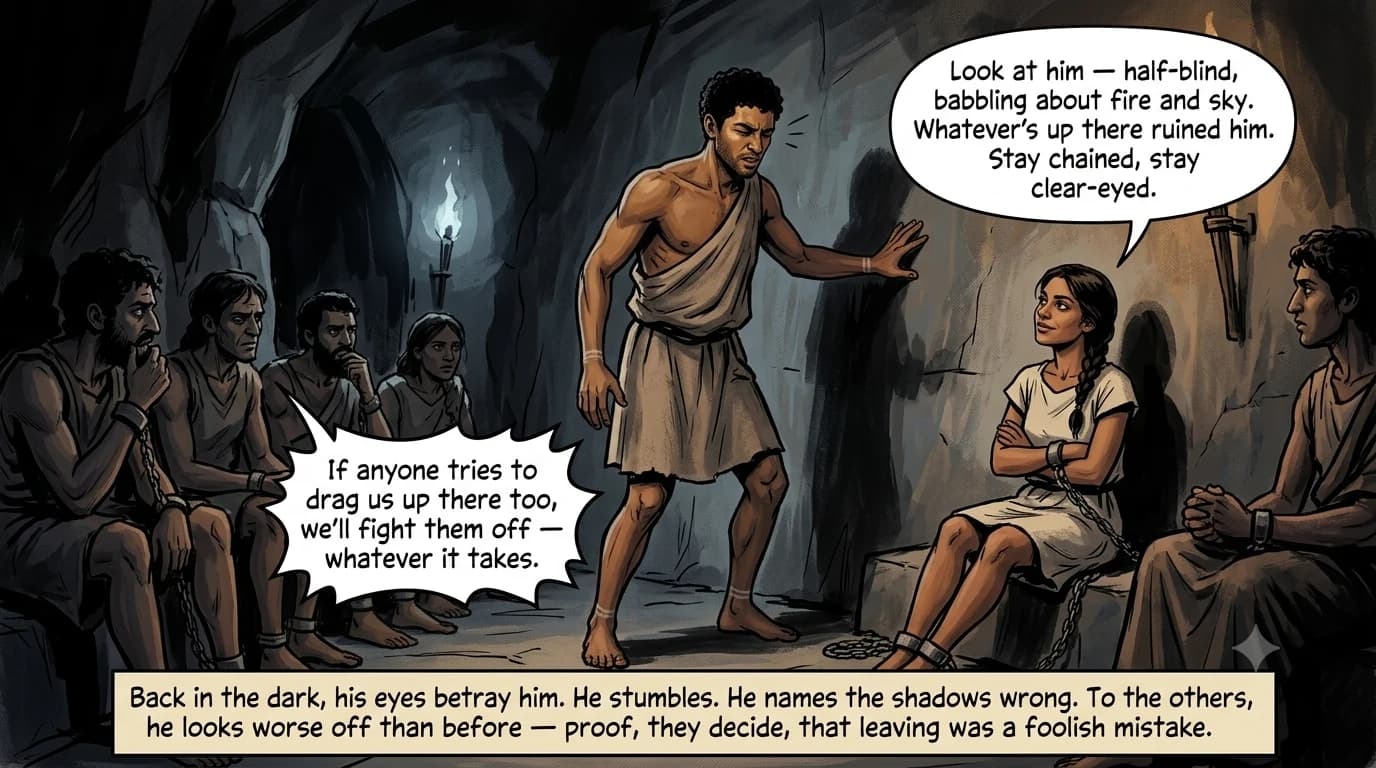
Panel 11
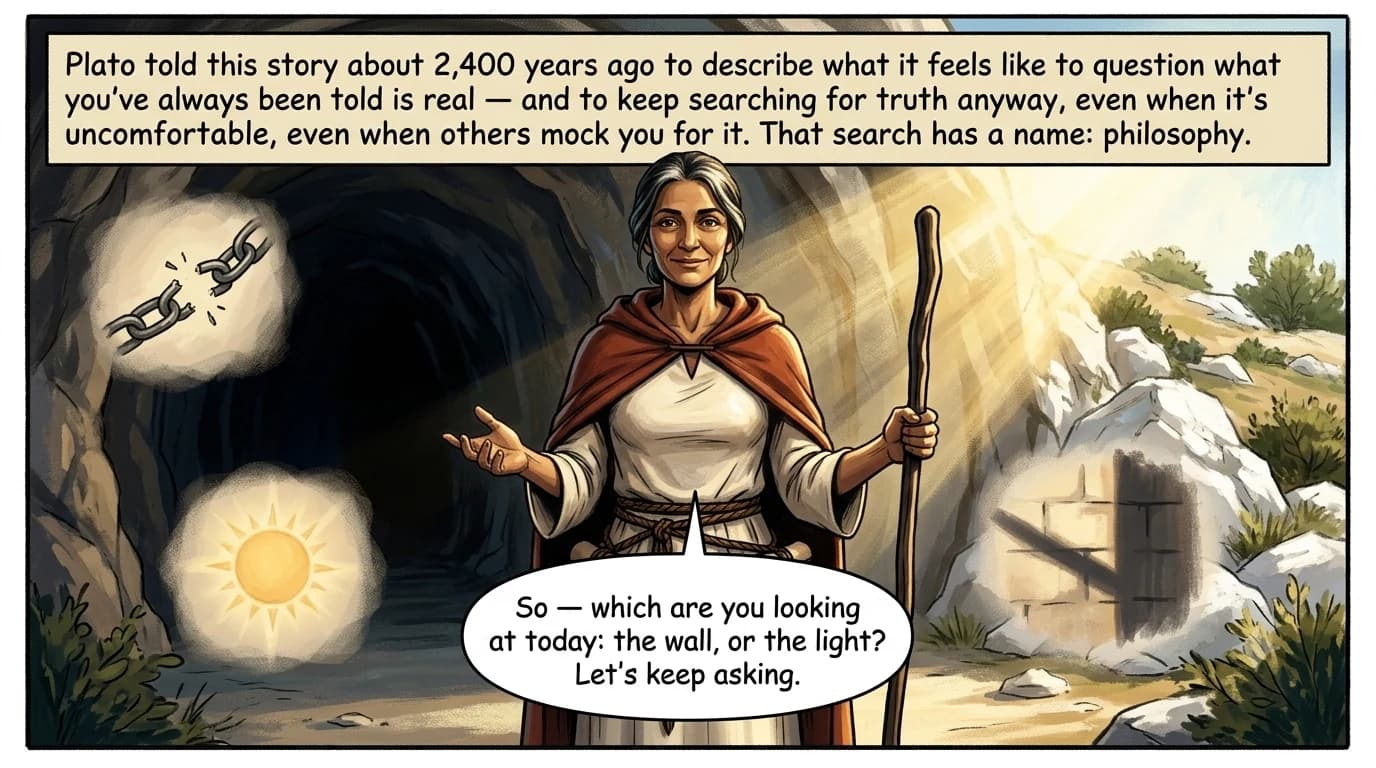
Panel 12
Read chapter text: The Cave
Prisoners have watched shadows on a wall their whole lives and call it the world. When one of them is dragged into the light, he learns what's real — and has to decide whether to go back and tell the others.
Panel 1
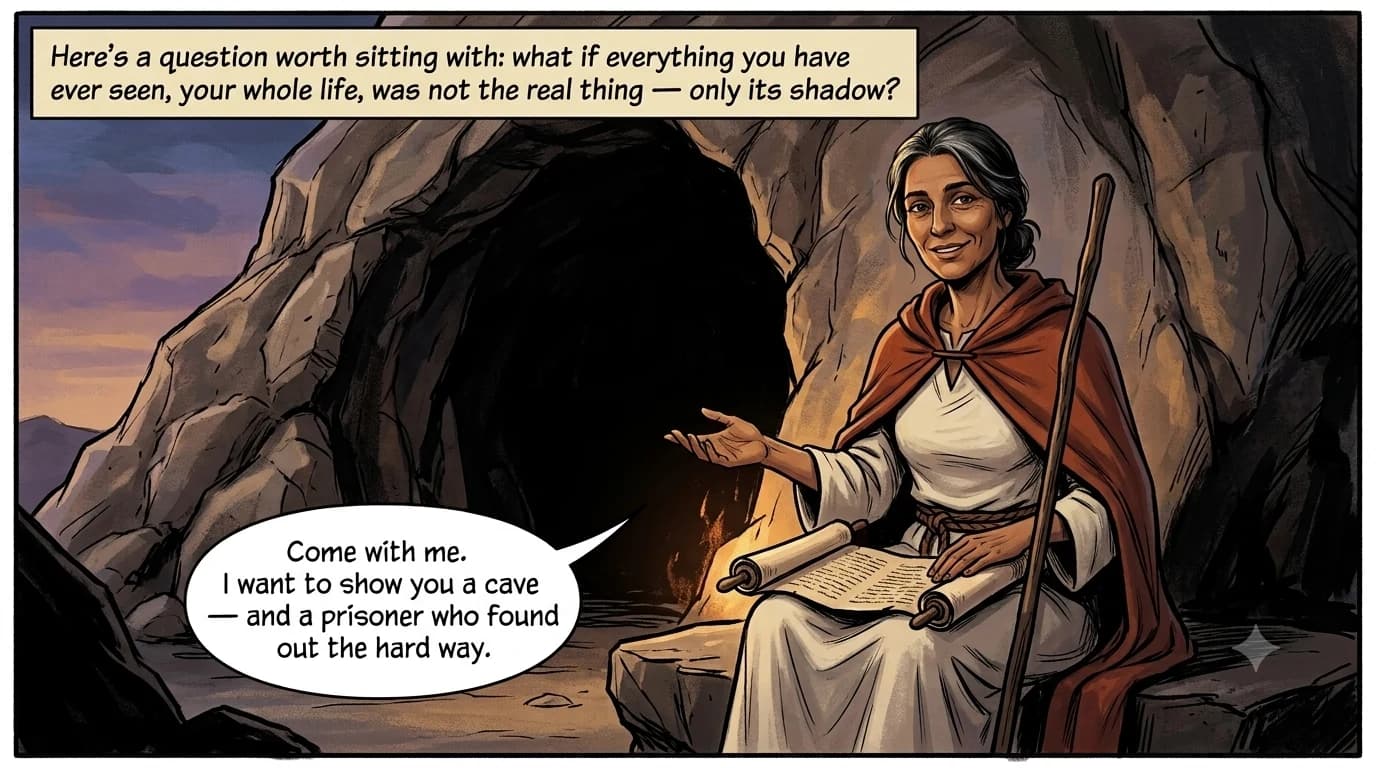
A philosophy guide sits at the mouth of a dim cave at dusk with an old scroll on her knee, looking out at the reader and inviting them in.
Here's a question worth sitting with: what if everything you have ever seen, your whole life, was not the real thing — only its shadow?
Mira: Come with me. I want to show you a cave — and a prisoner who found out the hard way.
Panel 2
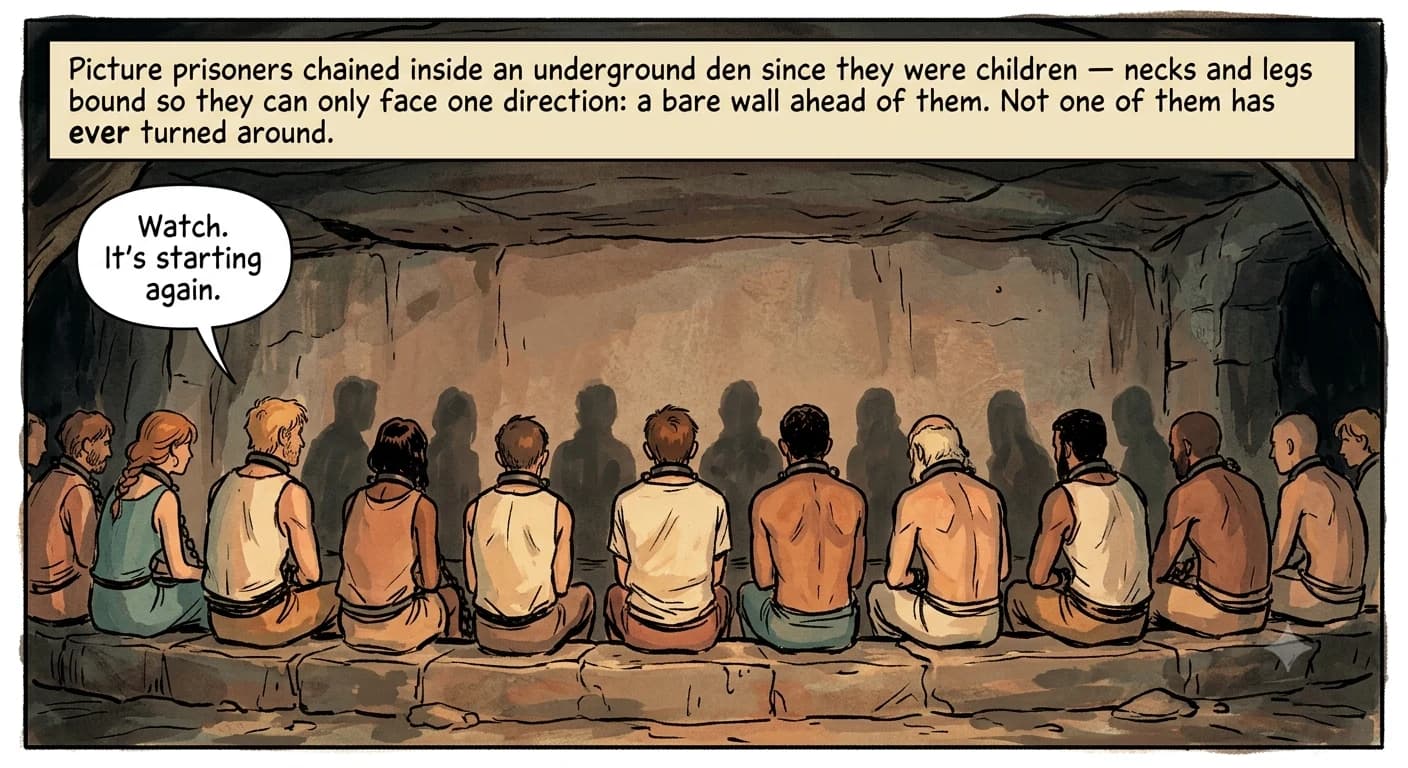
A row of prisoners, chained by the neck and legs since childhood, sit facing a bare stone wall deep underground, lit only by the glow of an unseen fire burning behind them.
Picture prisoners chained inside an underground den since they were children — necks and legs bound so they can only face one direction: a bare wall ahead of them. Not one of them has ever turned around.
Doxa: Watch. It's starting again.
Panel 3
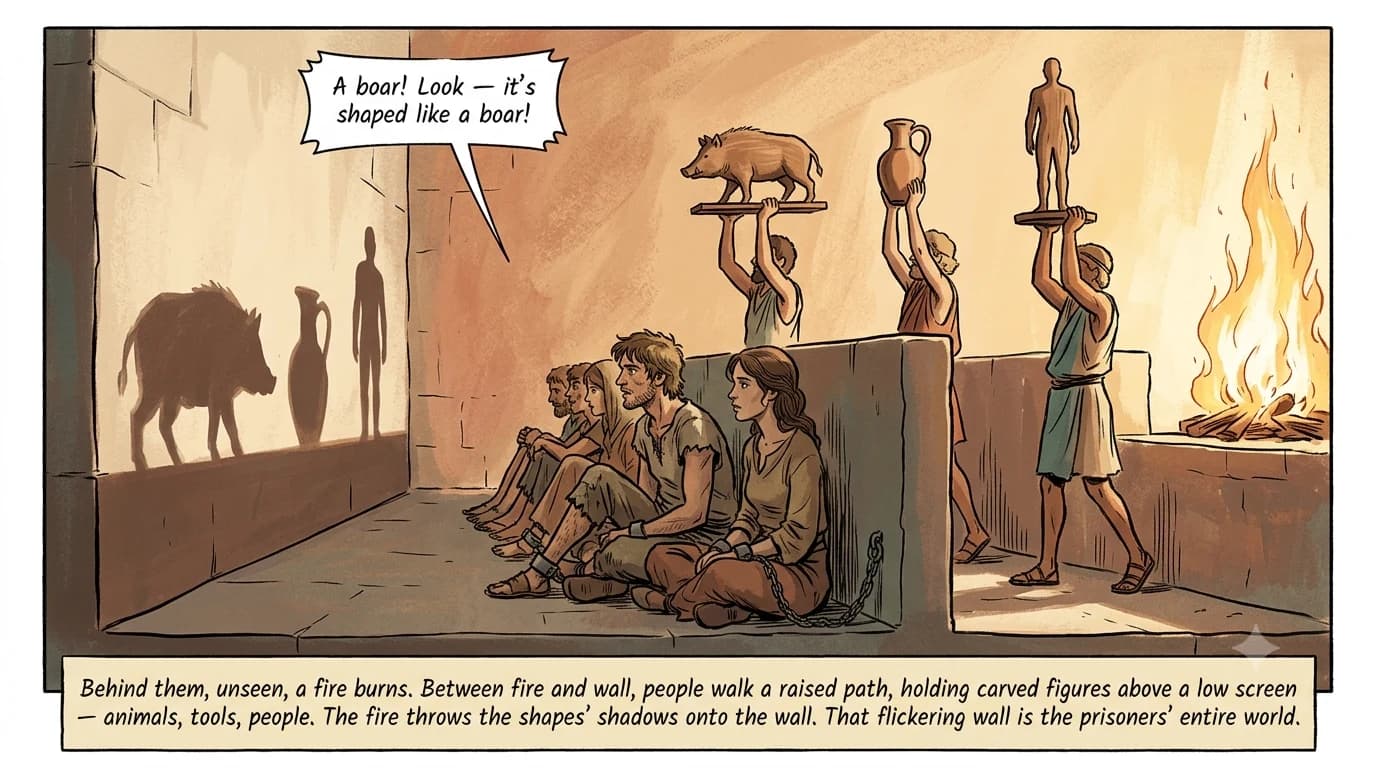
A cutaway view revealing a fire and a raised walkway behind the chained prisoners, where unseen figures carry carved shapes above a low wall, casting shadows onto the wall the prisoners face.
Behind them, unseen, a fire burns. Between fire and wall, people walk a raised path, holding carved figures above a low screen — animals, tools, people. The fire throws the shapes' shadows onto the wall. That flickering wall is the prisoners' entire world.
A Prisoner: A boar! Look — it's shaped like a boar!
Panel 4
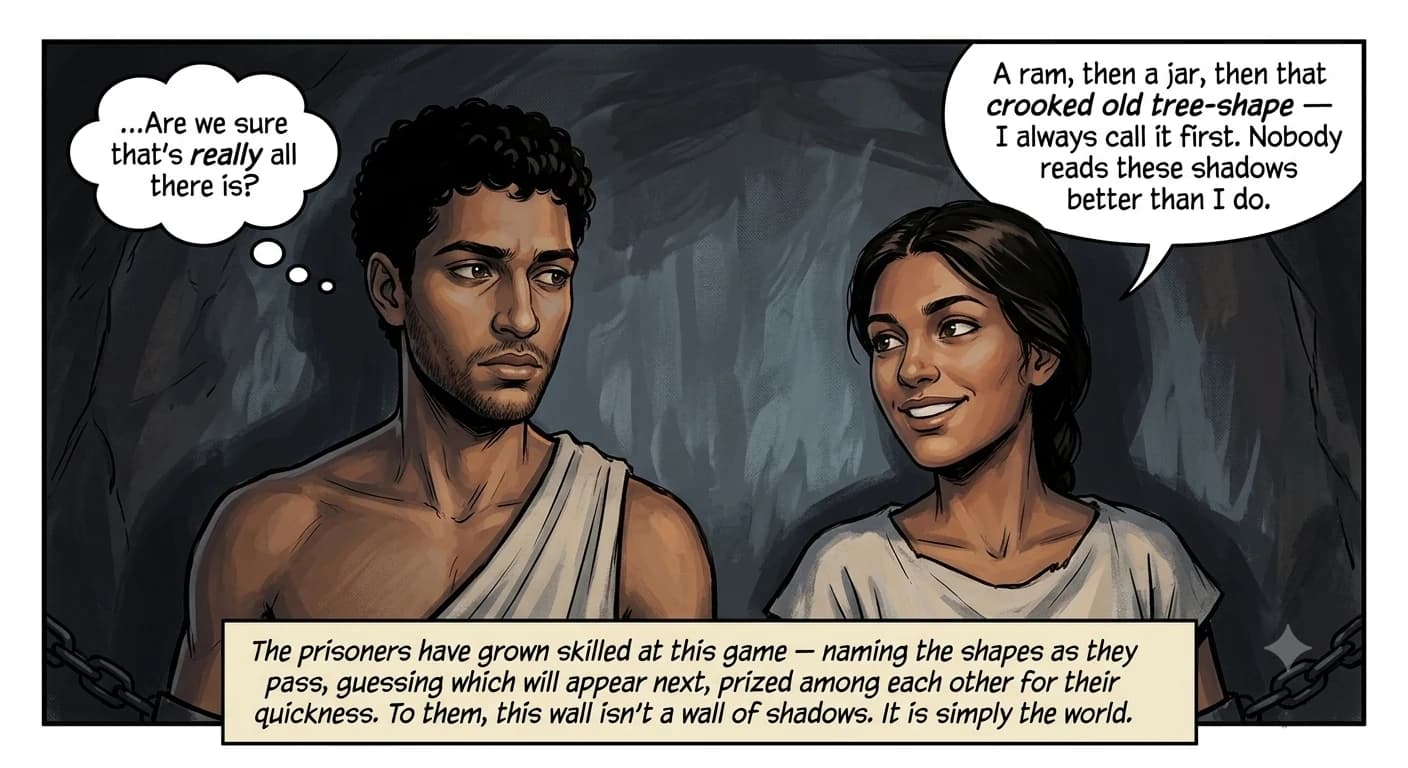
A close two-shot of two chained prisoners lit by shadow-flicker; one grins with confidence at correctly naming the shapes, while the other watches with a flicker of doubt.
The prisoners have grown skilled at this game — naming the shapes as they pass, guessing which will appear next, prized among each other for their quickness. To them, this wall isn't a wall of shadows. It is simply the world.
Doxa: A ram, then a jar, then that crooked old tree-shape — I always call it first. Nobody reads these shadows better than I do.
Theron: …Are we sure that's really all there is?
Panel 5
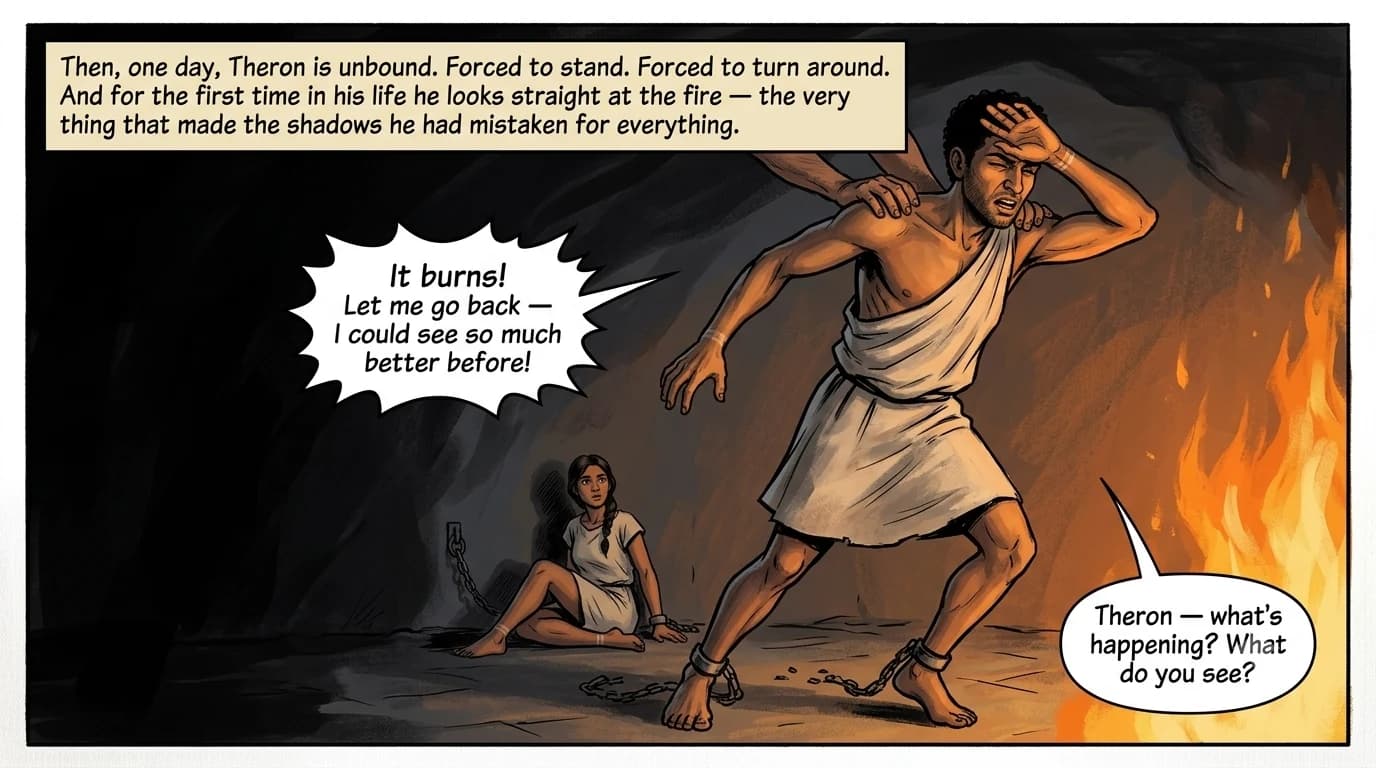
A prisoner is wrenched to his feet and forced to face a blazing fire for the first time, recoiling and shielding his eyes, while a chained companion calls out to him unseen.
Then, one day, Theron is unbound. Forced to stand. Forced to turn around. And for the first time in his life he looks straight at the fire — the very thing that made the shadows he had mistaken for everything.
Theron: It burns! Let me go back — I could see so much better before!
Doxa: Theron — what's happening? What do you see?
Panel 6
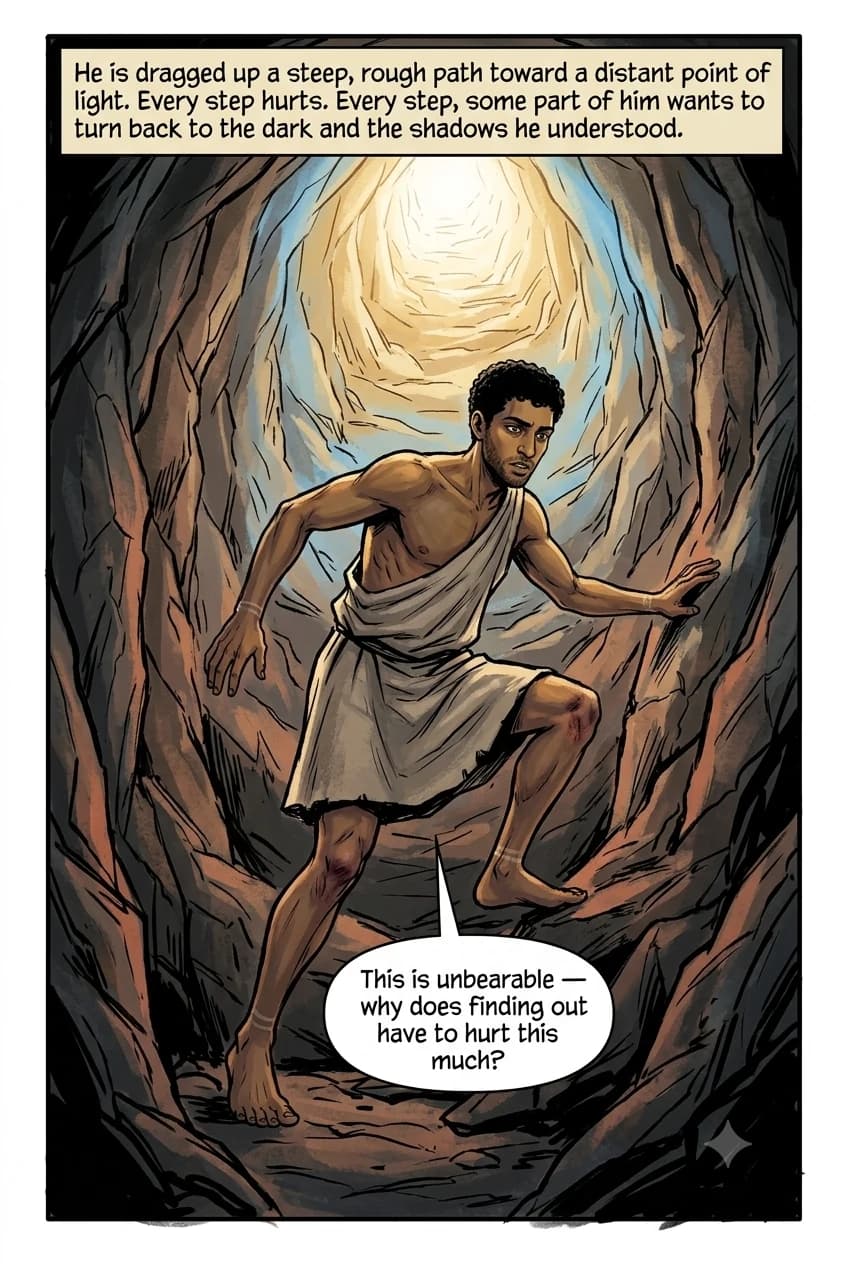
A prisoner is dragged up a steep, narrow rock tunnel toward a small distant point of light far above, struggling and scraping against the stone the whole way.
He is dragged up a steep, rough path toward a distant point of light. Every step hurts. Every step, some part of him wants to turn back to the dark and the shadows he understood.
Theron: This is unbearable — why does finding out have to hurt this much?
Panel 7
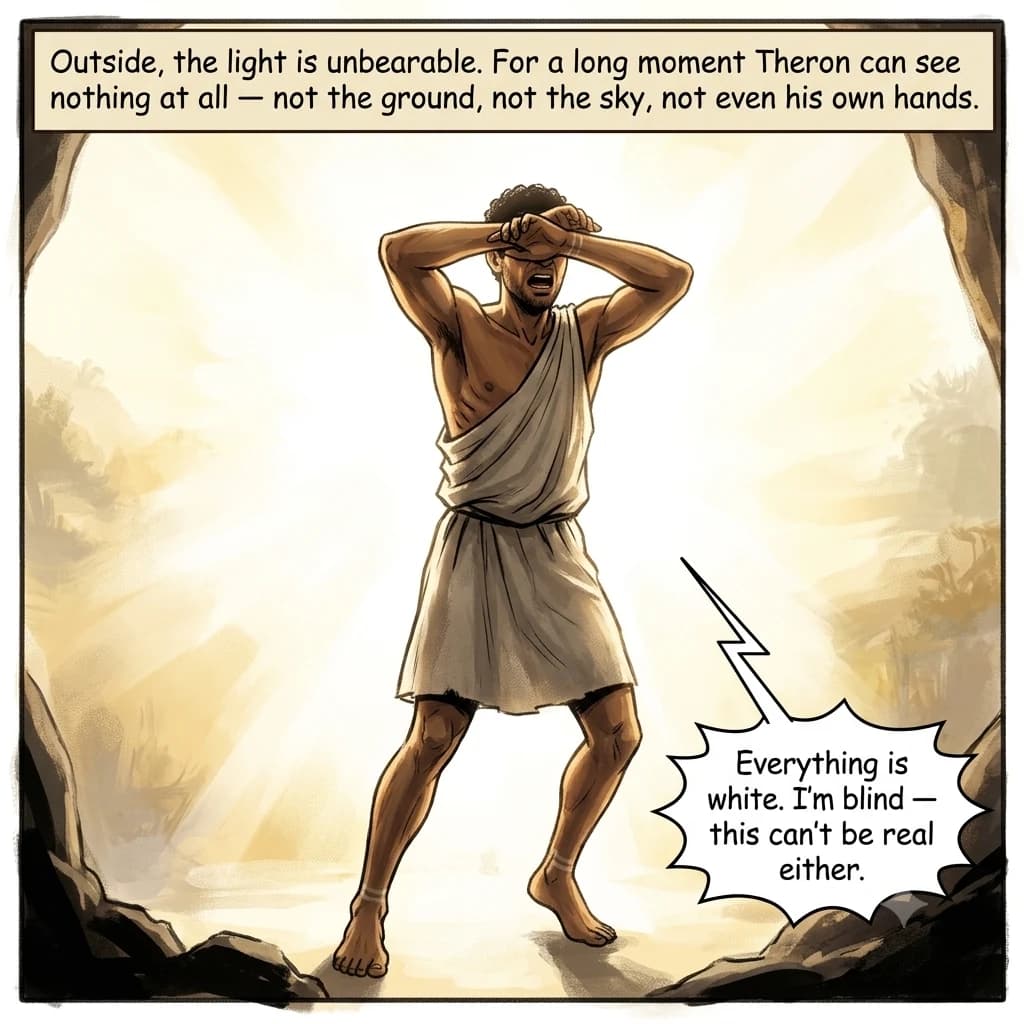
A man stumbles out of a cave mouth into blinding full daylight, both hands thrown over his eyes, unable to see anything at all.
Outside, the light is unbearable. For a long moment Theron can see nothing at all — not the ground, not the sky, not even his own hands.
Theron: Everything is white. I'm blind — this can't be real either.
Panel 8
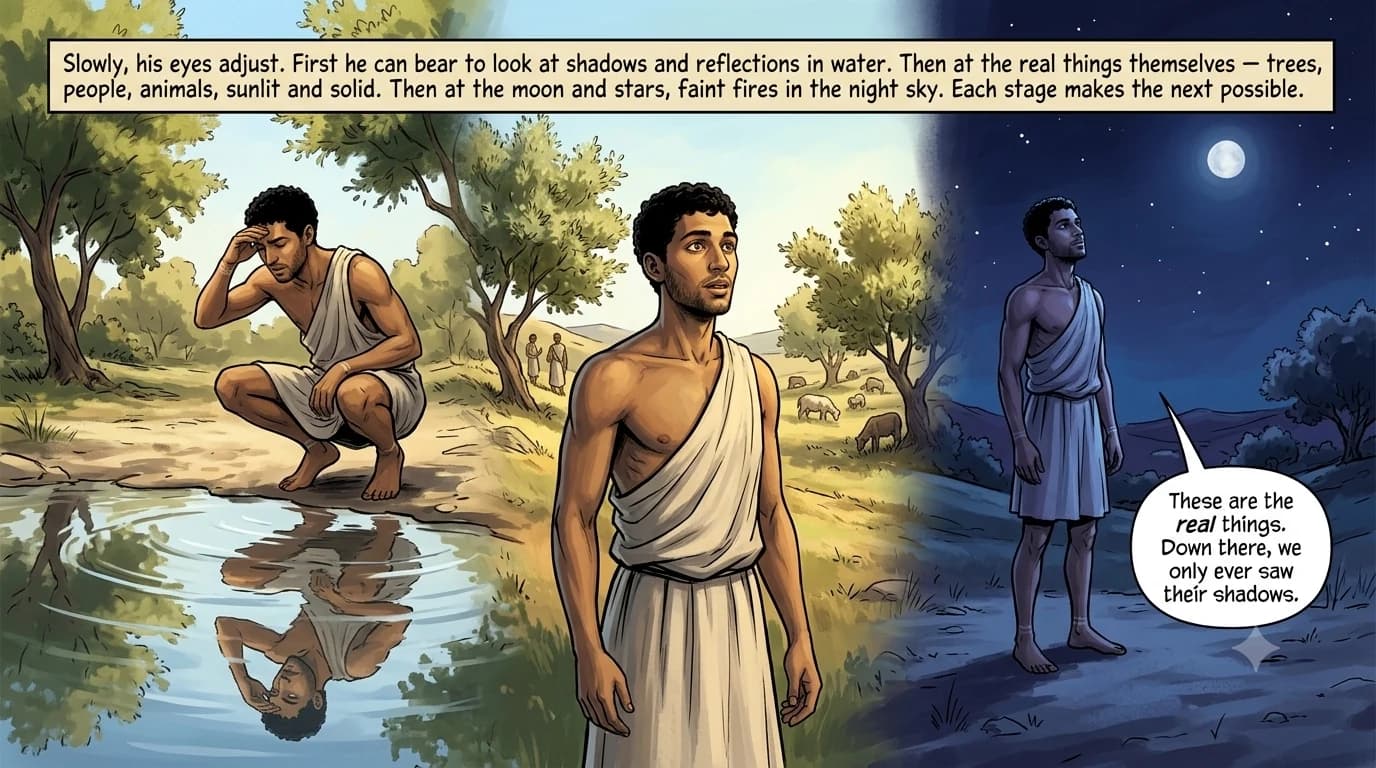
A three-stage wide sequence of a man slowly regaining his sight: first looking at reflections in still water, then at real sunlit trees and people, then at the moon and stars at night.
Slowly, his eyes adjust. First he can bear to look at shadows and reflections in water. Then at the real things themselves — trees, people, animals, sunlit and solid. Then at the moon and stars, faint fires in the night sky. Each stage makes the next possible.
Theron: These are the real things. Down there, we only ever saw their shadows.
Panel 9
A man stands on a hilltop at sunrise, staggered and awestruck as he looks directly at the sun for the first time, arms slightly spread.
Last of all, he looks straight at the sun. And understands: it is the reason he can see anything at all — the source of the light, the seasons, the years, the truth of everything below.
Theron: It was never the wall. It was never even the fire. It was this, all along.
Panel 10
A man sits at a bright cave mouth looking back down into the darkness below with an expression of sorrow and resolve, choosing to return.
Now Theron pities the prisoners still down there — and pities the person he used to be. He could stay up here, in the light, for the rest of his life. Instead, he turns back toward the dark.
Theron: They have to know. Even if they don't want to.
Panel 11
A man stumbles back into the dim cave, squinting and disoriented, fumbling to name the shadows correctly while his chained companions mock him.
Back in the dark, his eyes betray him. He stumbles. He names the shadows wrong. To the others, he looks worse off than before — proof, they decide, that leaving was a foolish mistake.
Doxa: Look at him — half-blind, babbling about fire and sky. Whatever's up there ruined him. Stay chained, stay clear-eyed.
A Prisoner: If anyone tries to drag us up there too, we'll fight them off — whatever it takes.
Panel 12
The philosophy guide stands at a sunlit cave mouth looking warmly out at the reader, surrounded by faint painted motifs of a broken chain, a small sun, and a shadow-streaked wall.
Plato told this story about 2,400 years ago to describe what it feels like to question what you've always been told is real — and to keep searching for truth anyway, even when it's uncomfortable, even when others mock you for it. That search has a name: philosophy.
Mira: So — which are you looking at today: the wall, or the light? Let's keep asking.