The Examined Life · Chapter 4: The Doubter
Cover
The Examined Life · Chapter 4
The Doubter
René Descartes, radical doubt, and the one thought that survives it
In a snowbound Dutch room, René Descartes decides to doubt everything he possibly can — his senses, his memories, even whether he is awake — to see if anything at all can survive. One surprising thing does: the doubting itself.
12 panels · ~6 min read
Panel 1
Panel 2
Panel 3
Panel 4
Panel 5
Panel 6
Panel 7
Panel 8
Panel 9
Panel 10
Panel 11
Panel 12
Read chapter text: The Doubter
In a snowbound Dutch room, René Descartes decides to doubt everything he possibly can — his senses, his memories, even whether he is awake — to see if anything at all can survive. One surprising thing does: the doubting itself.
Panel 1
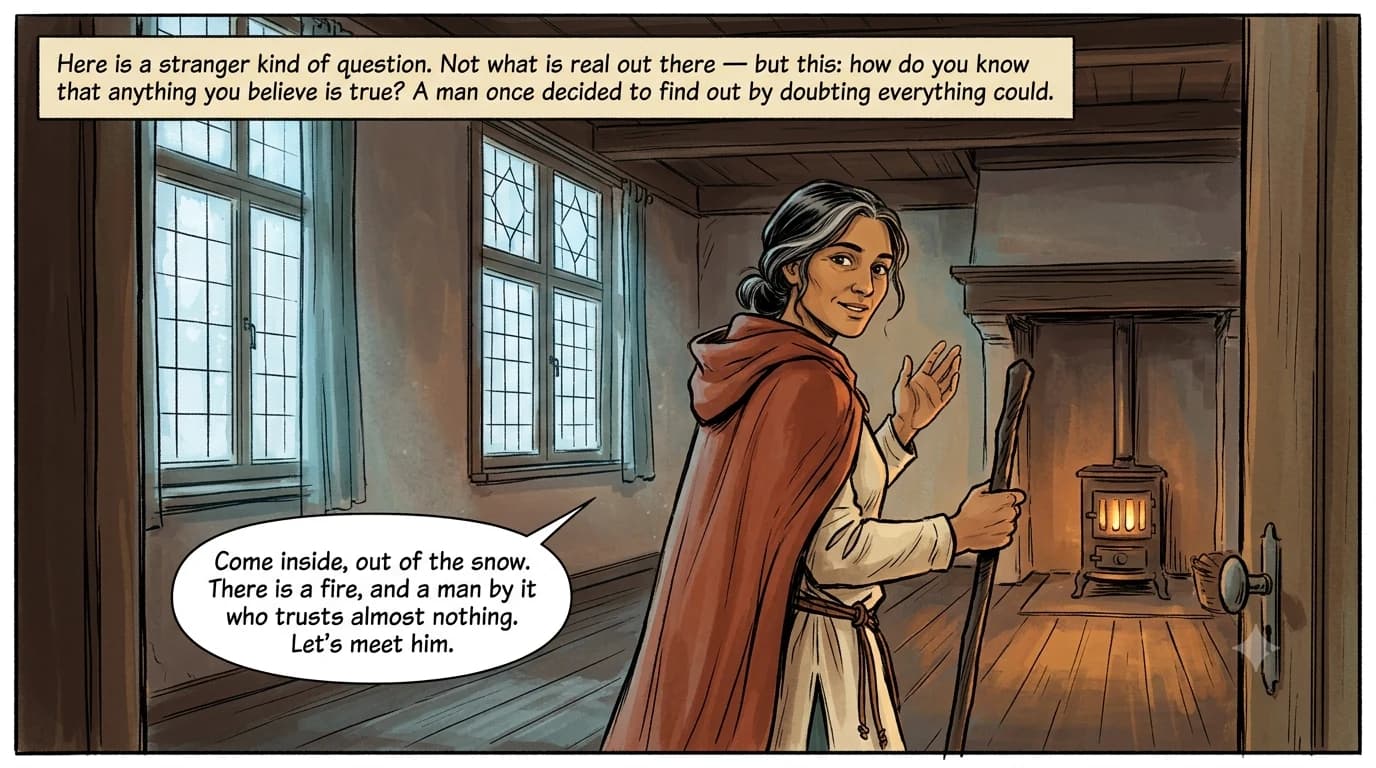
A philosophy guide stands just inside the doorway of a warm old Dutch room, snow-blue light at the leaded windows and a glowing stove within, turning to welcome the reader.
Here is a stranger kind of question. Not what is real out there — but this: how do you know that anything you believe is true? A man once decided to find out by doubting everything he could.
Mira: Come inside, out of the snow. There is a fire, and a man by it who trusts almost nothing. Let's meet him.
Panel 2
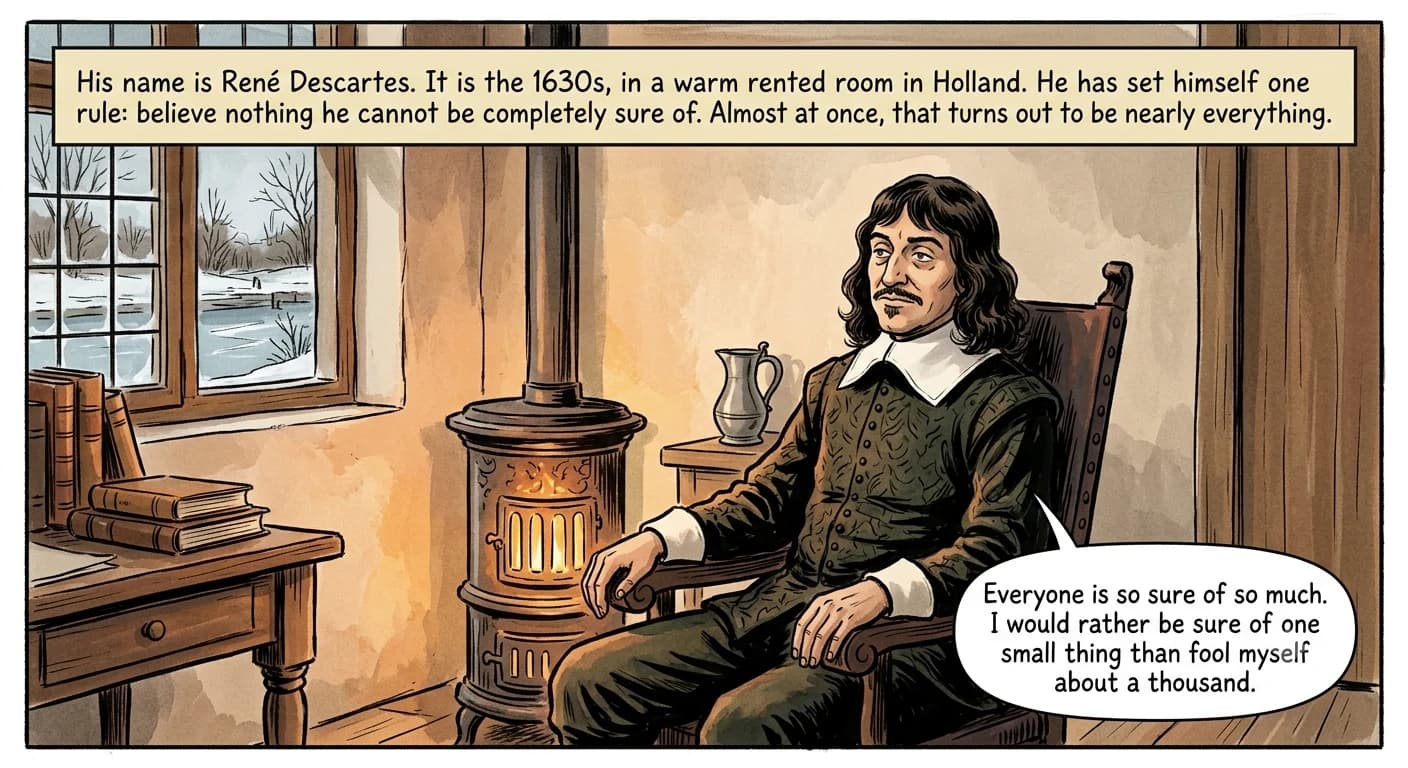
A thoughtful 17th-century man sits in a high-backed chair beside a glowing stove in a modest study, a frozen canal visible through the window behind him.
His name is René Descartes. It is the 1630s, in a warm rented room in Holland. He has set himself one rule: believe nothing he cannot be completely sure of. Almost at once, that turns out to be nearly everything.
René Descartes: Everyone is so sure of so much. I would rather be sure of one small thing than fool myself about a thousand.
Panel 3
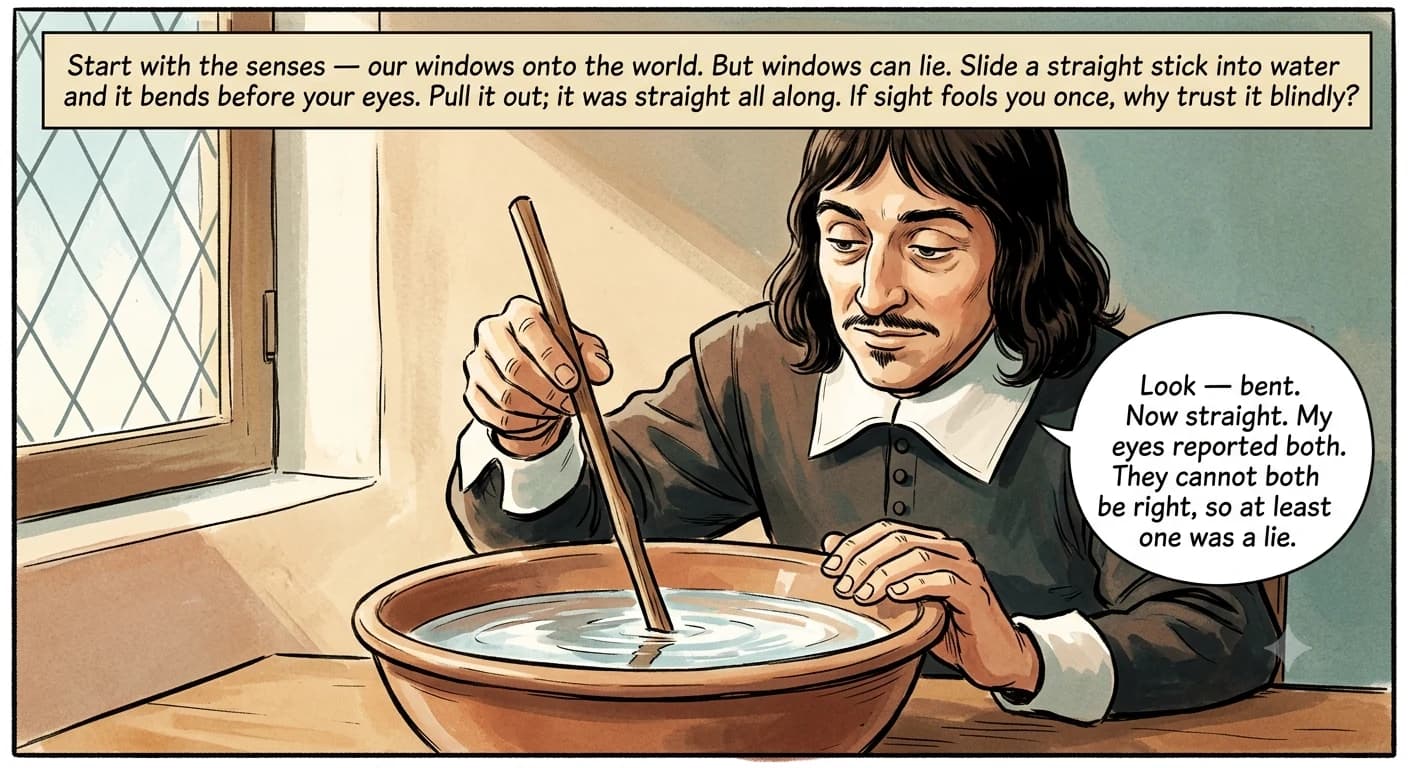
A man lowers a straight stick into a wide bowl of clear water on a table; at the water's surface the stick appears sharply bent although it is whole.
Start with the senses — our windows onto the world. But windows can lie. Slide a straight stick into water and it bends before your eyes. Pull it out; it was straight all along. If sight fools you once, why trust it blindly?
René Descartes: Look — bent. Now straight. My eyes reported both. They cannot both be right, so at least one was a lie.
Panel 4
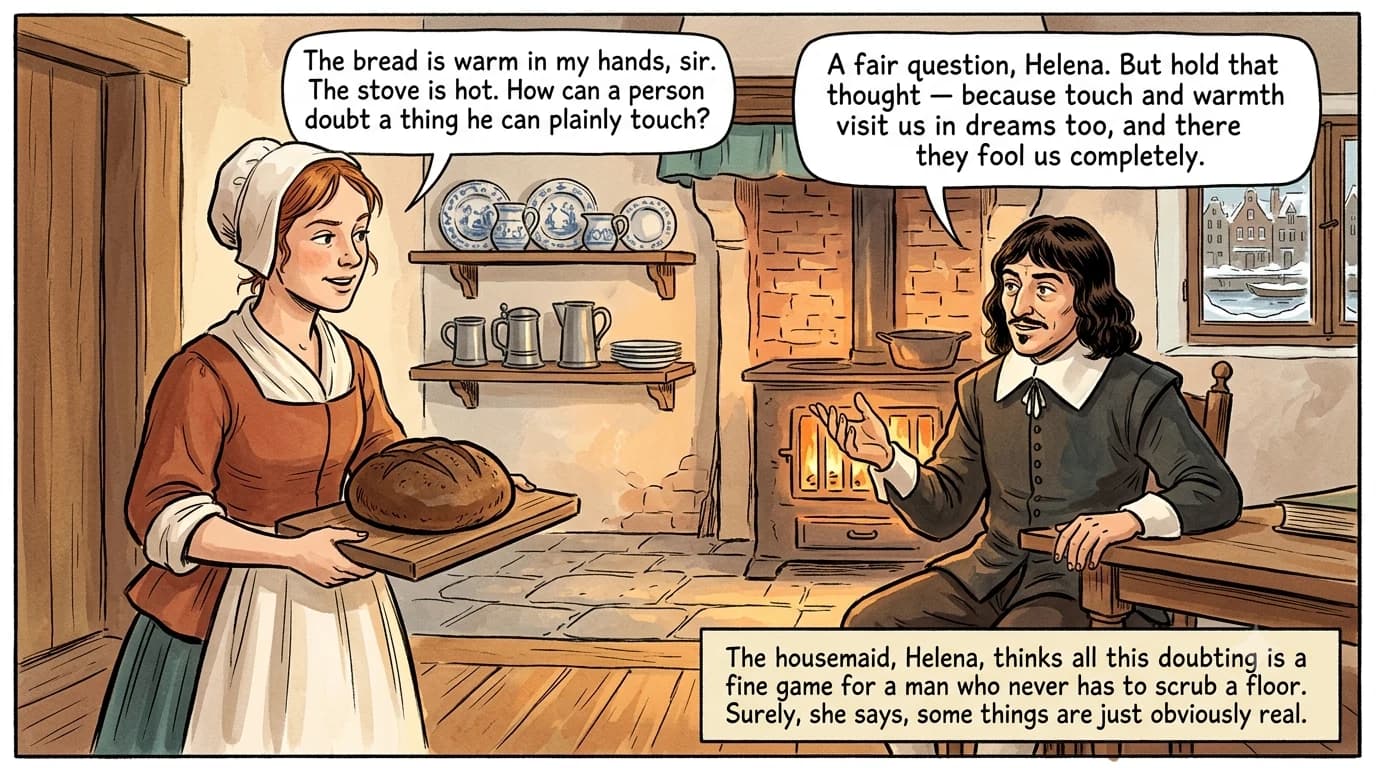
A young housemaid holds a loaf of bread on a board and questions a seated 17th-century scholar across a warm kitchen-study, who half-turns to answer her.
The housemaid, Helena, thinks all this doubting is a fine game for a man who never has to scrub a floor. Surely, she says, some things are just obviously real.
Helena: The bread is warm in my hands, sir. The stove is hot. How can a person doubt a thing he can plainly touch?
René Descartes: A fair question, Helena. But hold that thought — because touch and warmth visit us in dreams too, and there they fool us completely.
Panel 5
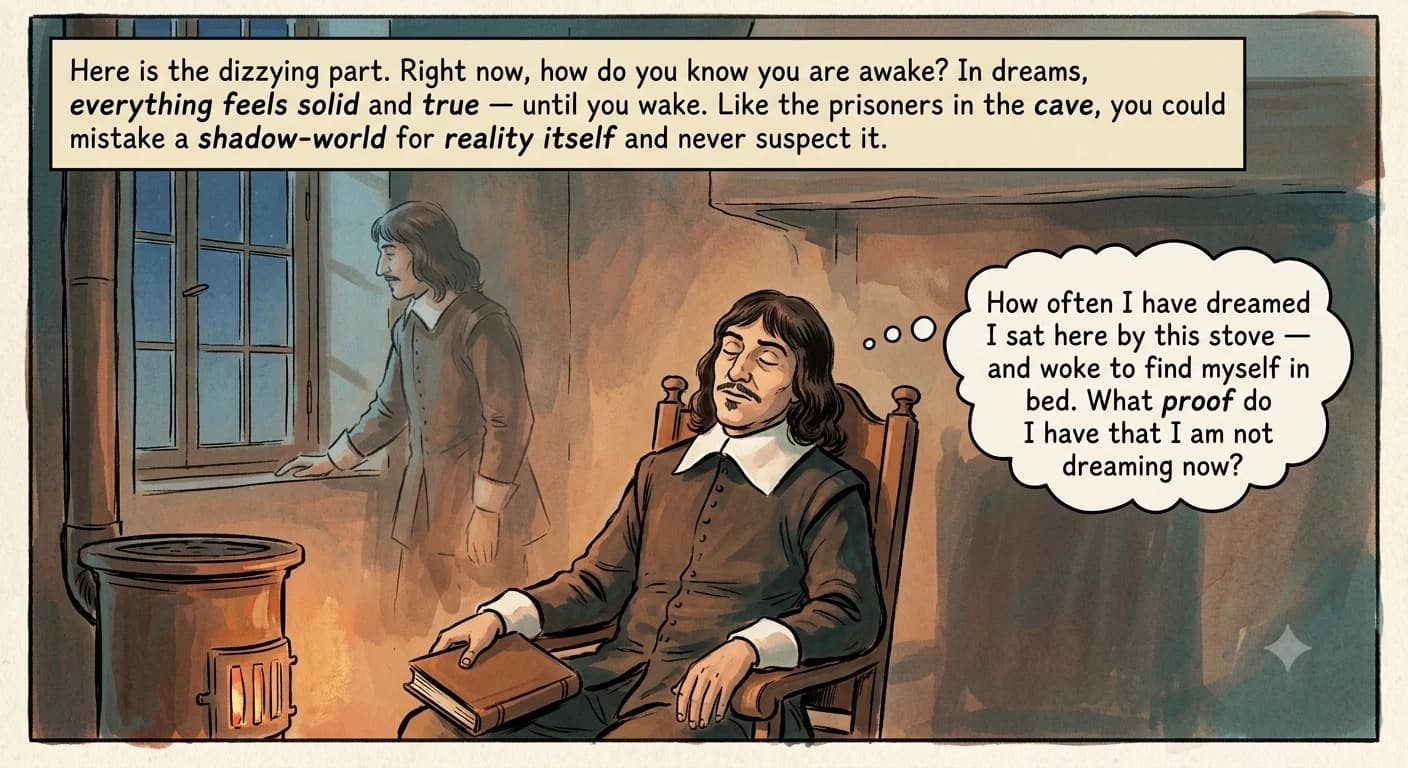
A man dozes in a chair by a dying stove as the room around him blurs into a dreamlike double image, its walls softening toward a dim, shadow-streaked surface like a cave wall.
Here is the dizzying part. Right now, how do you know you are awake? In dreams, everything feels solid and true — until you wake. Like the prisoners in the cave, you could mistake a shadow-world for reality itself and never suspect it.
René Descartes: How often I have dreamed I sat here by this stove — and woke to find myself in bed. What proof do I have that I am not dreaming now?
Panel 6
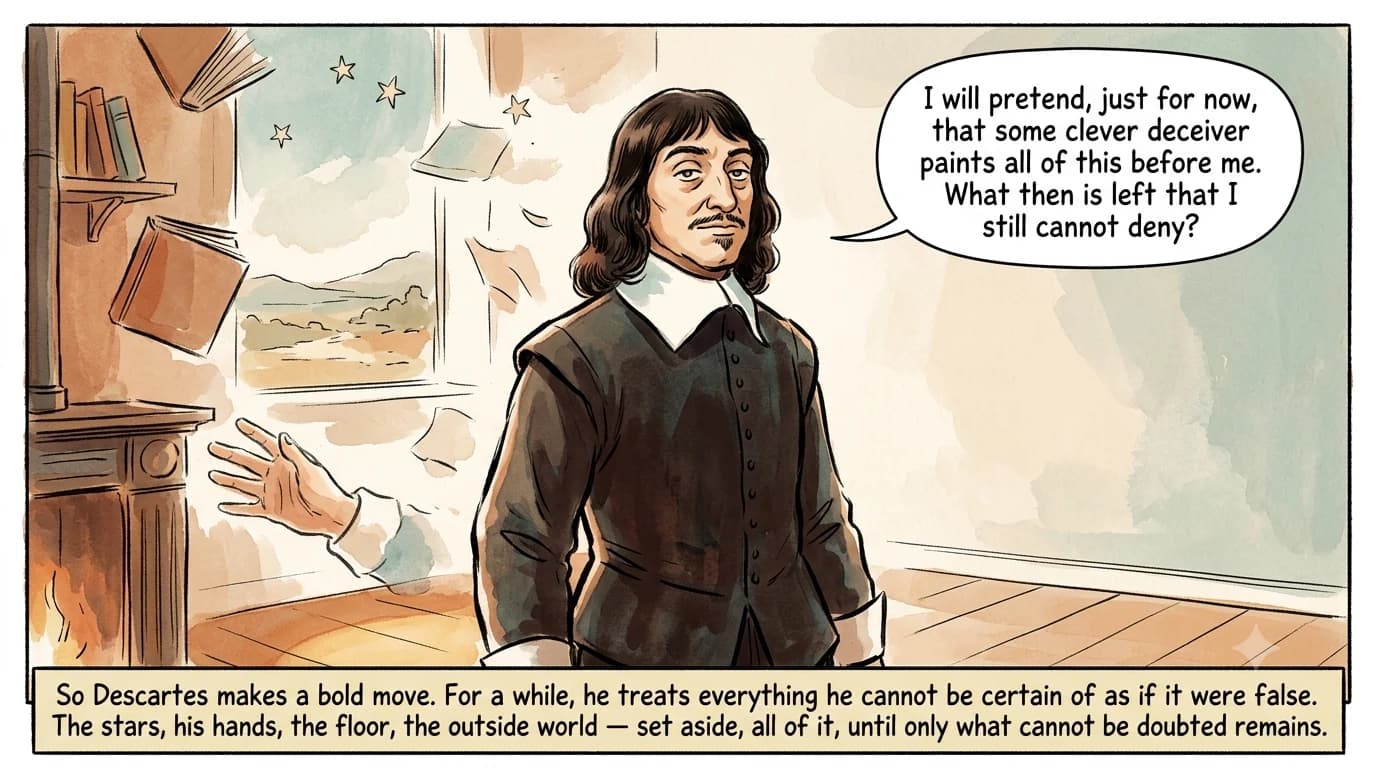
A man stands upright and resolute in his study while the room and the world beyond dissolve into pale fading fragments, only the small patch of floor beneath his feet staying solid.
So Descartes makes a bold move. For a while, he treats everything he cannot be certain of as if it were false. The stars, his hands, the floor, the outside world — set aside, all of it, until only what cannot be doubted remains.
René Descartes: I will pretend, just for now, that some clever deceiver paints all of this before me. What then is left that I still cannot deny?
Panel 7
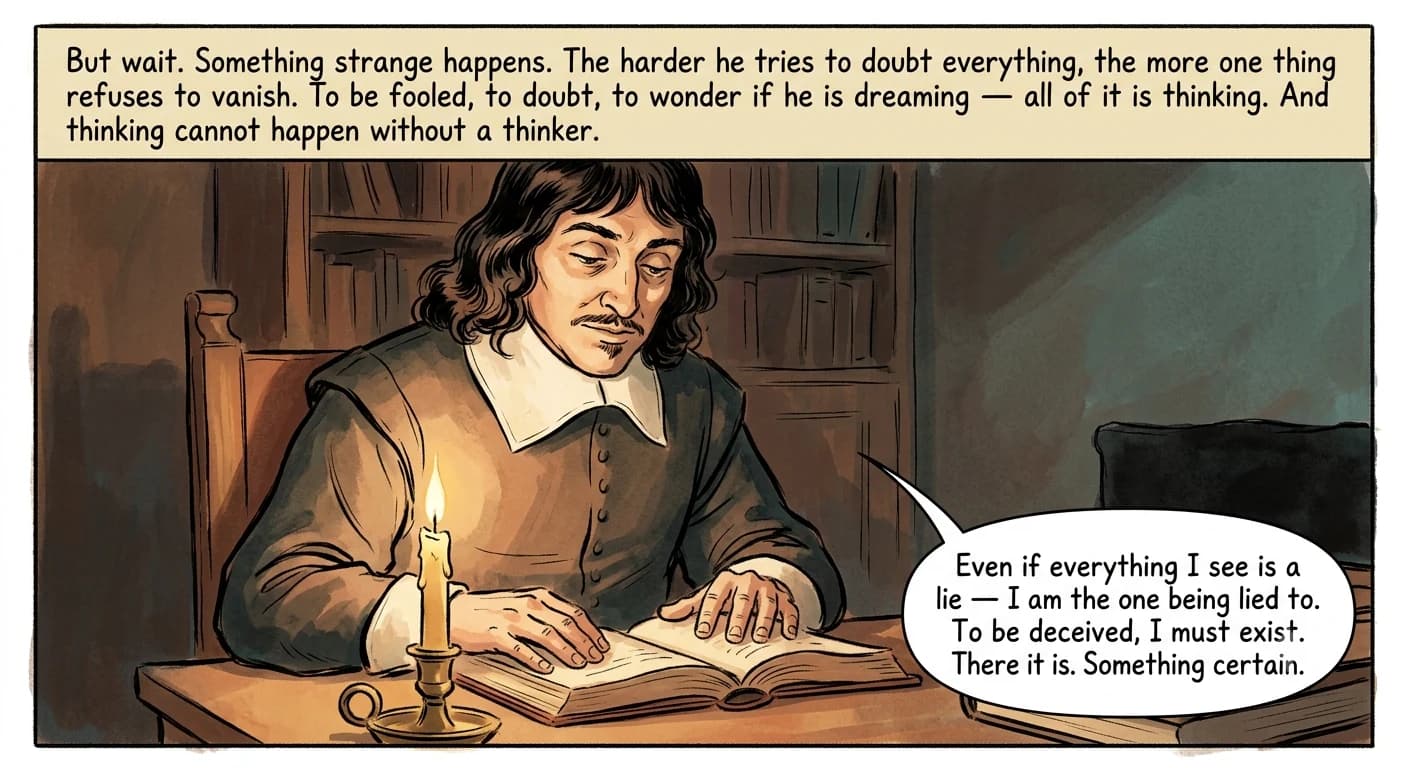
A man's face is lit from below by a single candle flame, sudden clarity dawning in his eyes, while the study around him falls away into deep shadow.
But wait. Something strange happens. The harder he tries to doubt everything, the more one thing refuses to vanish. To be fooled, to doubt, to wonder if he is dreaming — all of it is thinking. And thinking cannot happen without a thinker.
René Descartes: Even if everything I see is a lie — I am the one being lied to. To be deceived, I must exist. There it is. Something certain.
Panel 8
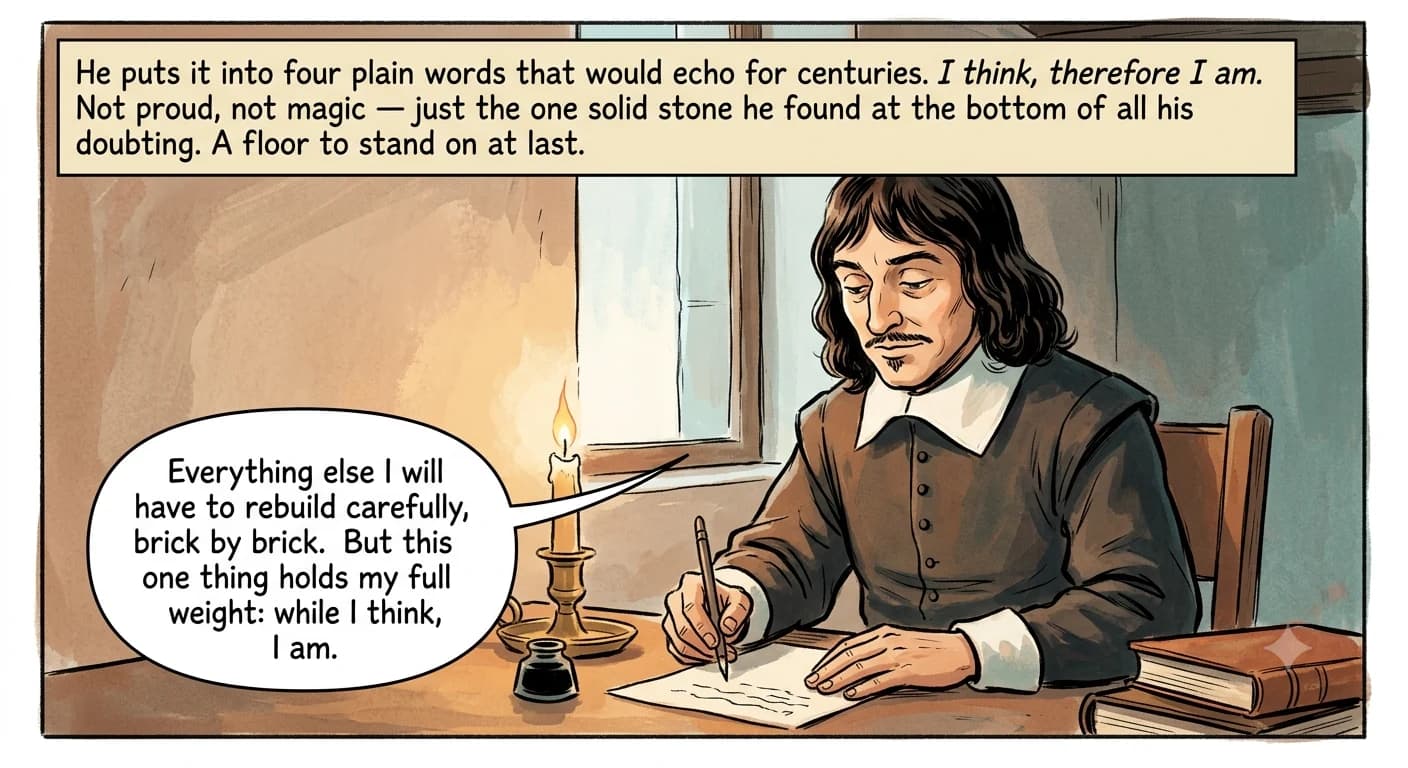
A man bends over a sheet of paper at his writing desk by a window, pen in hand, candlelight and cool daylight mingling across the desk as he writes.
He puts it into four plain words that would echo for centuries. I think, therefore I am. Not proud, not magic — just the one solid stone he found at the bottom of all his doubting. A floor to stand on at last.
René Descartes: Everything else I will have to rebuild carefully, brick by brick. But this one thing holds my full weight: while I think, I am.
Panel 9
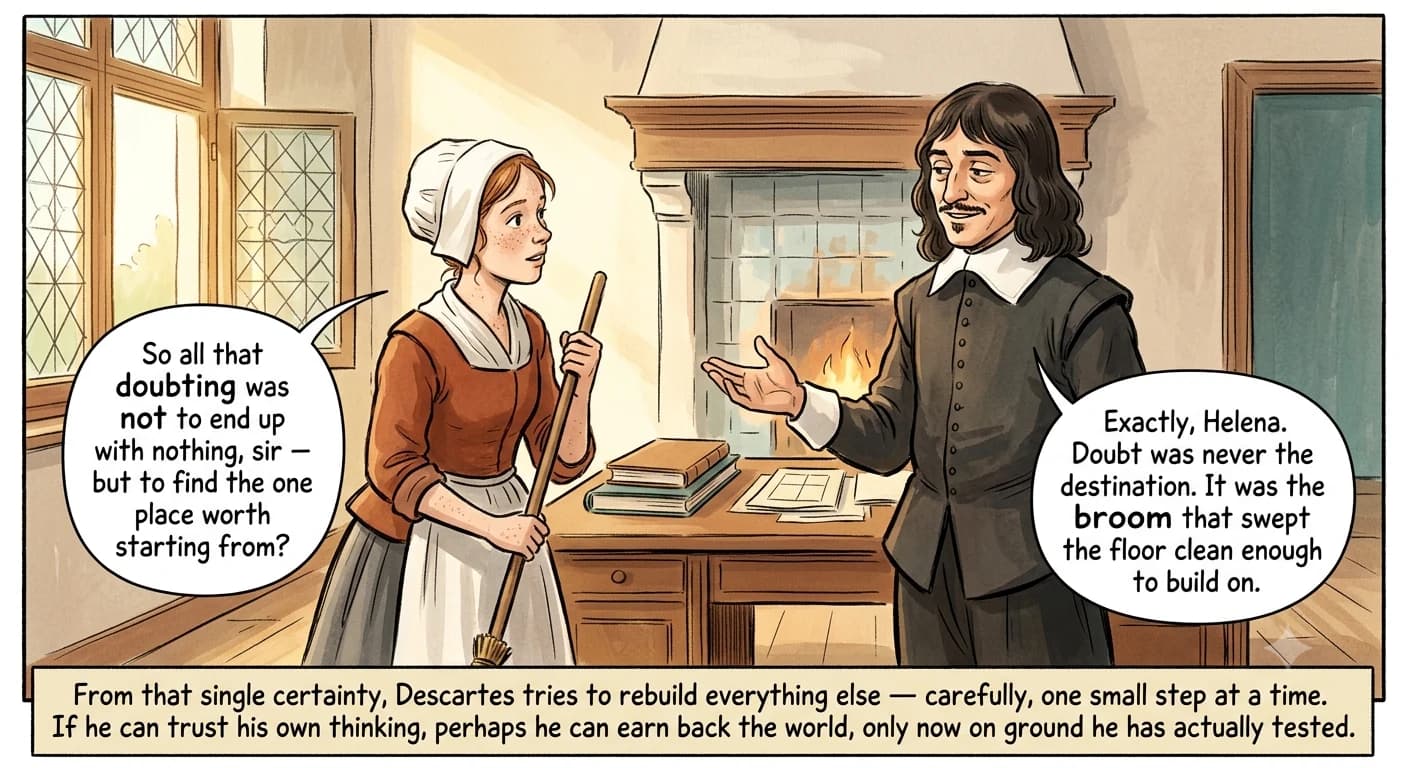
In a bright, tidy study a young housemaid pauses mid-sweep with a broom, listening, while a more relaxed 17th-century scholar gestures warmly as he explains.
From that single certainty, Descartes tries to rebuild everything else — carefully, one small step at a time. If he can trust his own thinking, perhaps he can earn back the world, only now on ground he has actually tested.
Helena: So all that doubting was not to end up with nothing, sir — but to find the one place worth starting from?
René Descartes: Exactly, Helena. Doubt was never the destination. It was the broom that swept the floor clean enough to build on.
Panel 10
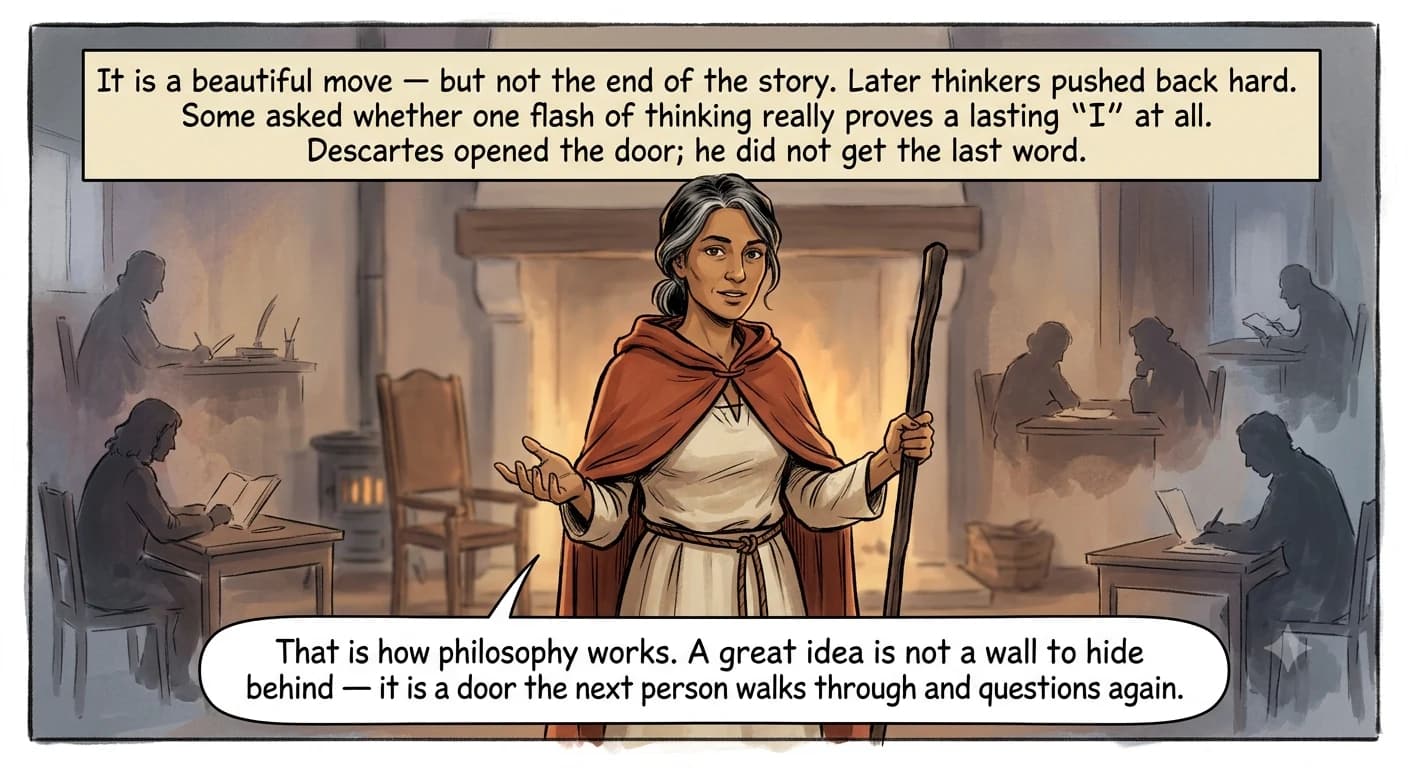
A philosophy guide stands in a warm study addressing the reader while faint painted silhouettes of later scholars at their desks drift in the dim background behind her.
It is a beautiful move — but not the end of the story. Later thinkers pushed back hard. Some asked whether one flash of thinking really proves a lasting 'I' at all. Descartes opened the door; he did not get the last word.
Mira: That is how philosophy works. A great idea is not a wall to hide behind — it is a door the next person walks through and questions again.
Panel 11
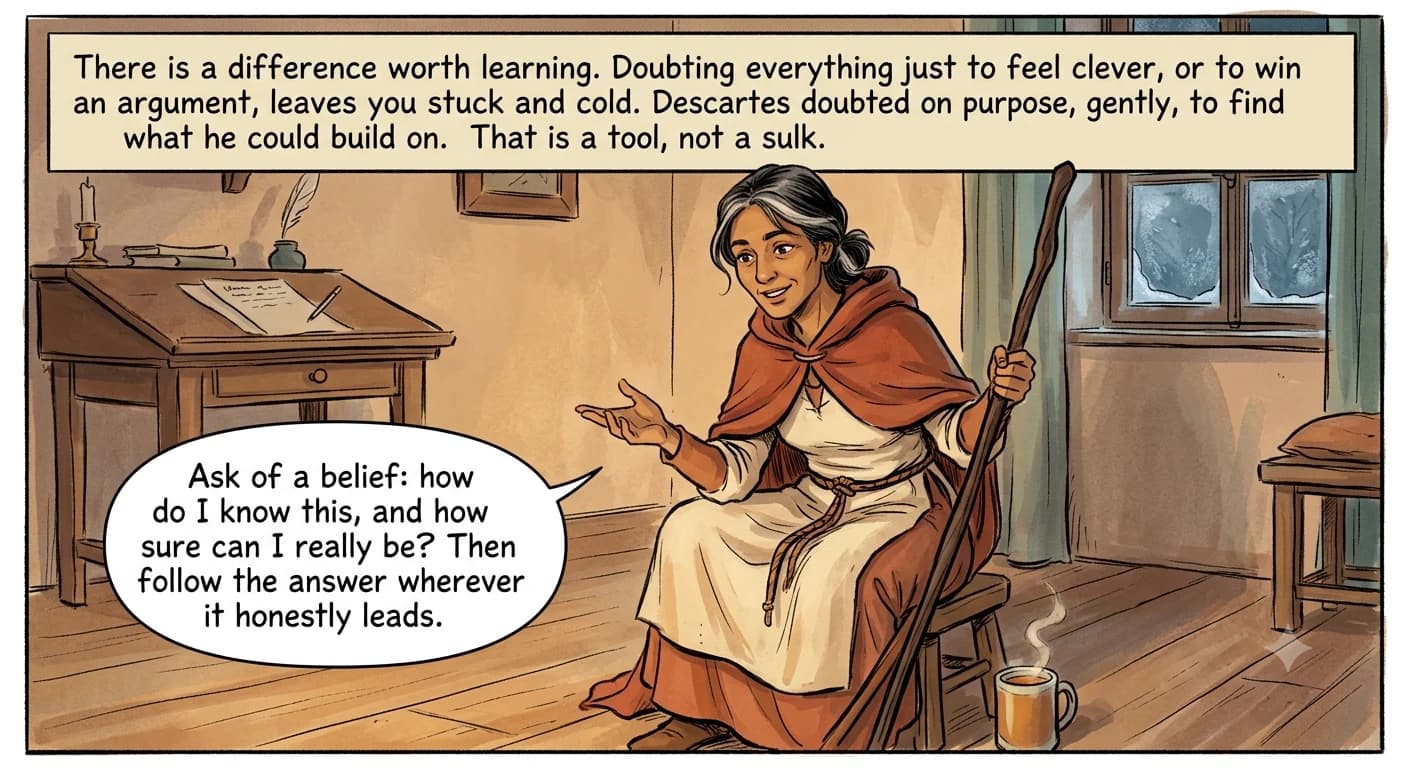
A philosophy guide sits on a low stool beside a glowing stove, leaning warmly toward the reader as she gestures, the cozy old Dutch room settling quietly around her.
There is a difference worth learning. Doubting everything just to feel clever, or to win an argument, leaves you stuck and cold. Descartes doubted on purpose, gently, to find what he could build on. That is a tool, not a sulk.
Mira: Ask of a belief: how do I know this, and how sure can I really be? Then follow the answer wherever it honestly leads.
Panel 12
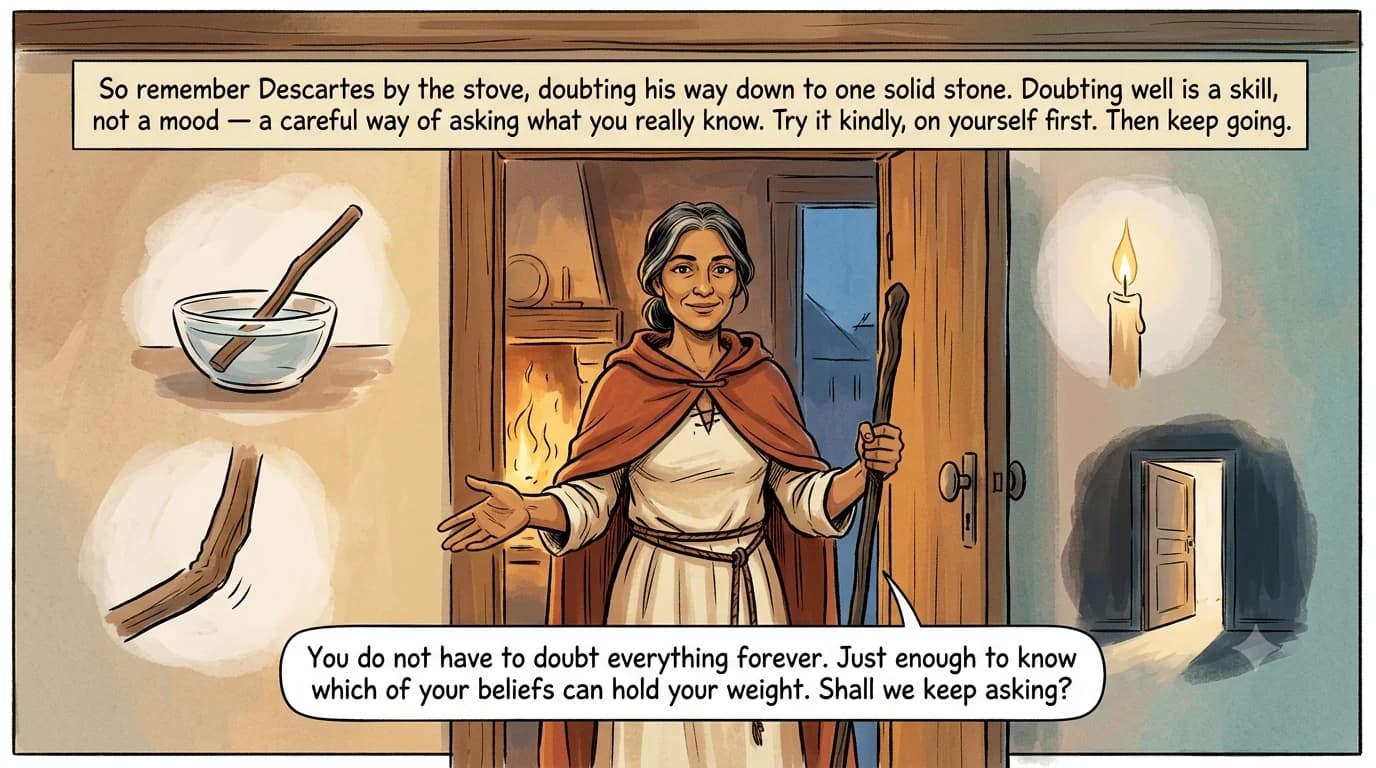
A philosophy guide stands in the warm doorway of an old Dutch study addressing the reader, faint painted motifs of a bent stick in water, a candle flame, and an open door of light floating around her.
So remember Descartes by the stove, doubting his way down to one solid stone. Doubting well is a skill, not a mood — a careful way of asking what you really know. Try it kindly, on yourself first. Then keep going.
Mira: You do not have to doubt everything forever. Just enough to know which of your beliefs can hold your weight. Shall we keep asking?