The Examined Life · Chapter 3: The Good Life
Cover
The Examined Life · Chapter 3
The Good Life
Aristotle's Lyceum, and why a happy life is something you practice
Mira visits Aristotle's Lyceum, the school that taught while walking. There she learns that happiness is not a feeling to chase but a way of living you build by habit, one small daily choice at a time.
12 panels · ~6 min read
Panel 1
Panel 2
Panel 3
Panel 4
Panel 5
Panel 6
Panel 7
Panel 8
Panel 9
Panel 10
Panel 11
Panel 12
Read chapter text: The Good Life
Mira visits Aristotle's Lyceum, the school that taught while walking. There she learns that happiness is not a feeling to chase but a way of living you build by habit, one small daily choice at a time.
Panel 1
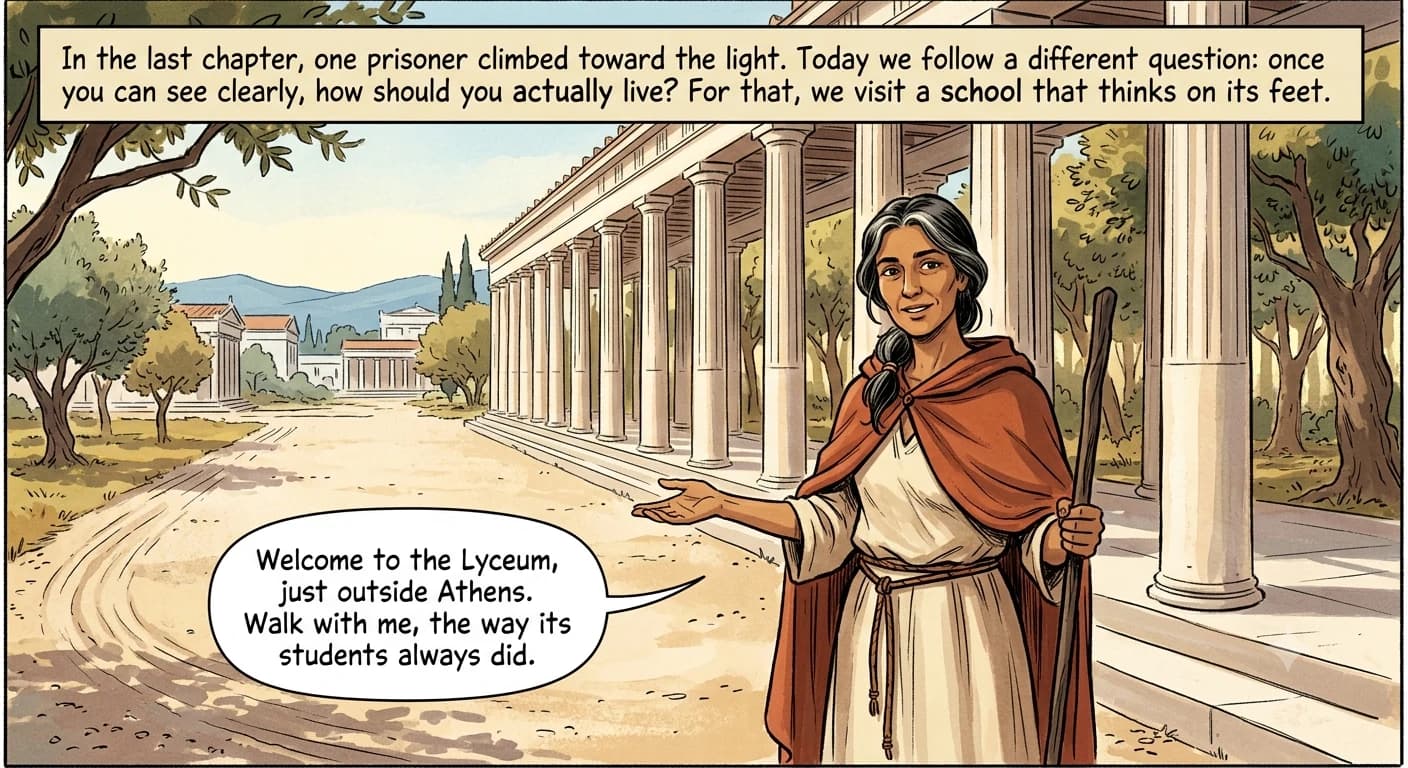
A warm philosophy guide stands beside a columned walkway that runs into an olive grove at golden morning, one hand on her staff, welcoming the viewer onto the path.
In the last chapter, one prisoner climbed toward the light. Today we follow a different question: once you can see clearly, how should you actually live? For that, we visit a school that thinks on its feet.
Mira: Welcome to the Lyceum, just outside Athens. Walk with me, the way its students always did.
Panel 2
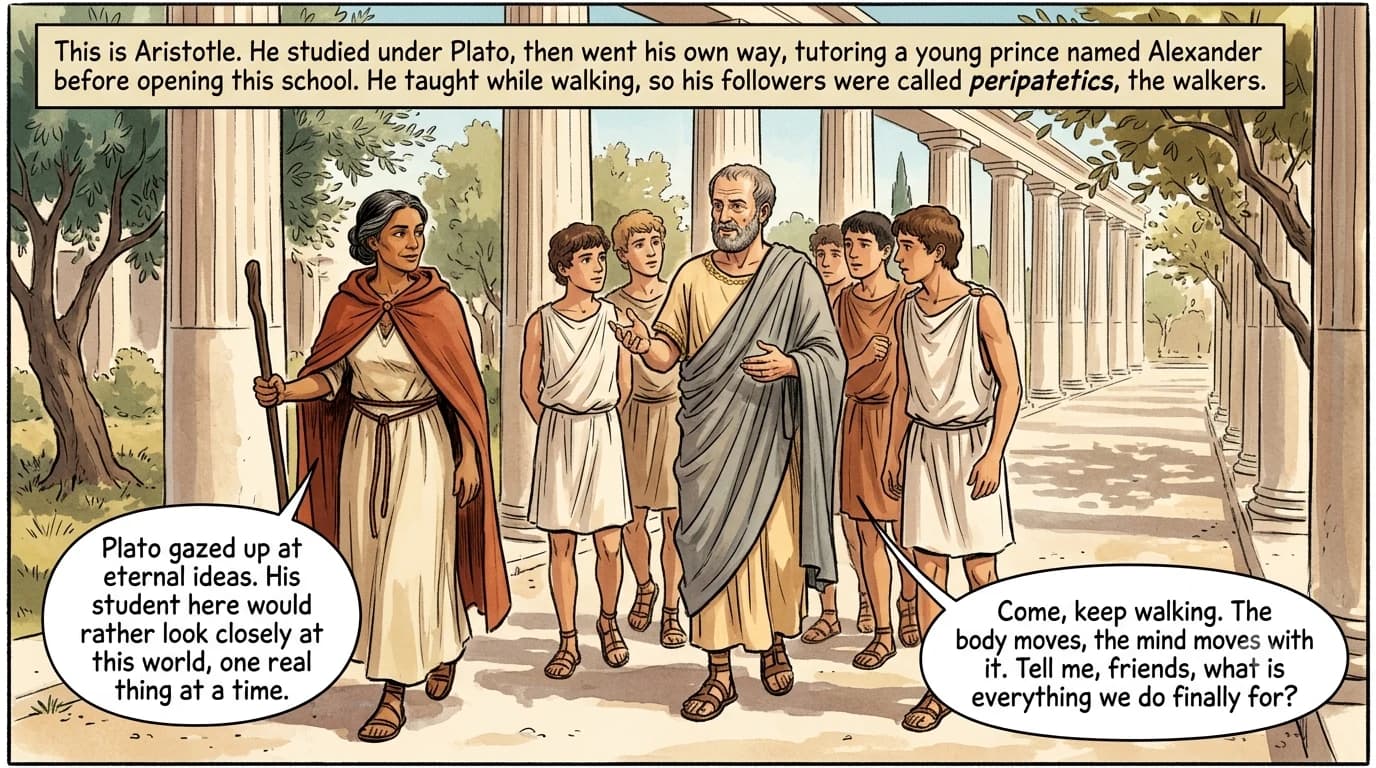
A well-dressed older philosopher walks mid-stride along a sunlit colonnade, gesturing as he speaks to a cluster of young students, while a guide walks a half-step apart introducing him.
This is Aristotle. He studied under Plato, then went his own way, tutoring a young prince named Alexander before opening this school. He taught while walking, so his followers were called peripatetics, the walkers.
Mira: Plato gazed up at eternal ideas. His student here would rather look closely at this world, one real thing at a time.
Aristotle: Come, keep walking. The body moves, the mind moves with it. Tell me, friends, what is everything we do finally for?
Panel 3
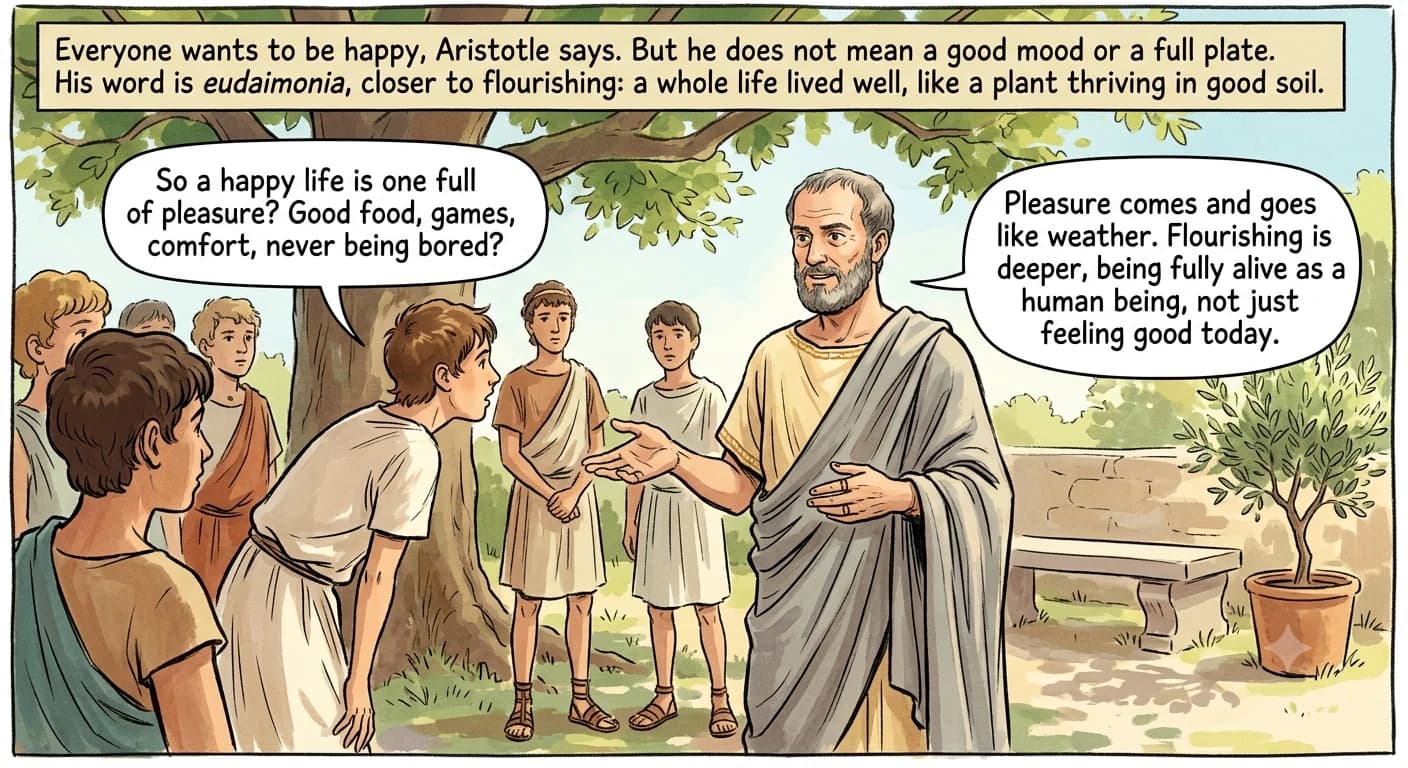
Under a broad tree, an older philosopher explains patiently to a cluster of students, one of whom leans in with a question, a thriving potted olive sapling glowing in the sunlit garden behind them.
Everyone wants to be happy, Aristotle says. But he does not mean a good mood or a full plate. His word is eudaimonia, closer to flourishing: a whole life lived well, like a plant thriving in good soil.
A student: So a happy life is one full of pleasure? Good food, games, comfort, never being bored?
Aristotle: Pleasure comes and goes like weather. Flourishing is deeper, being fully alive as a human being, not just feeling good today.
Panel 4
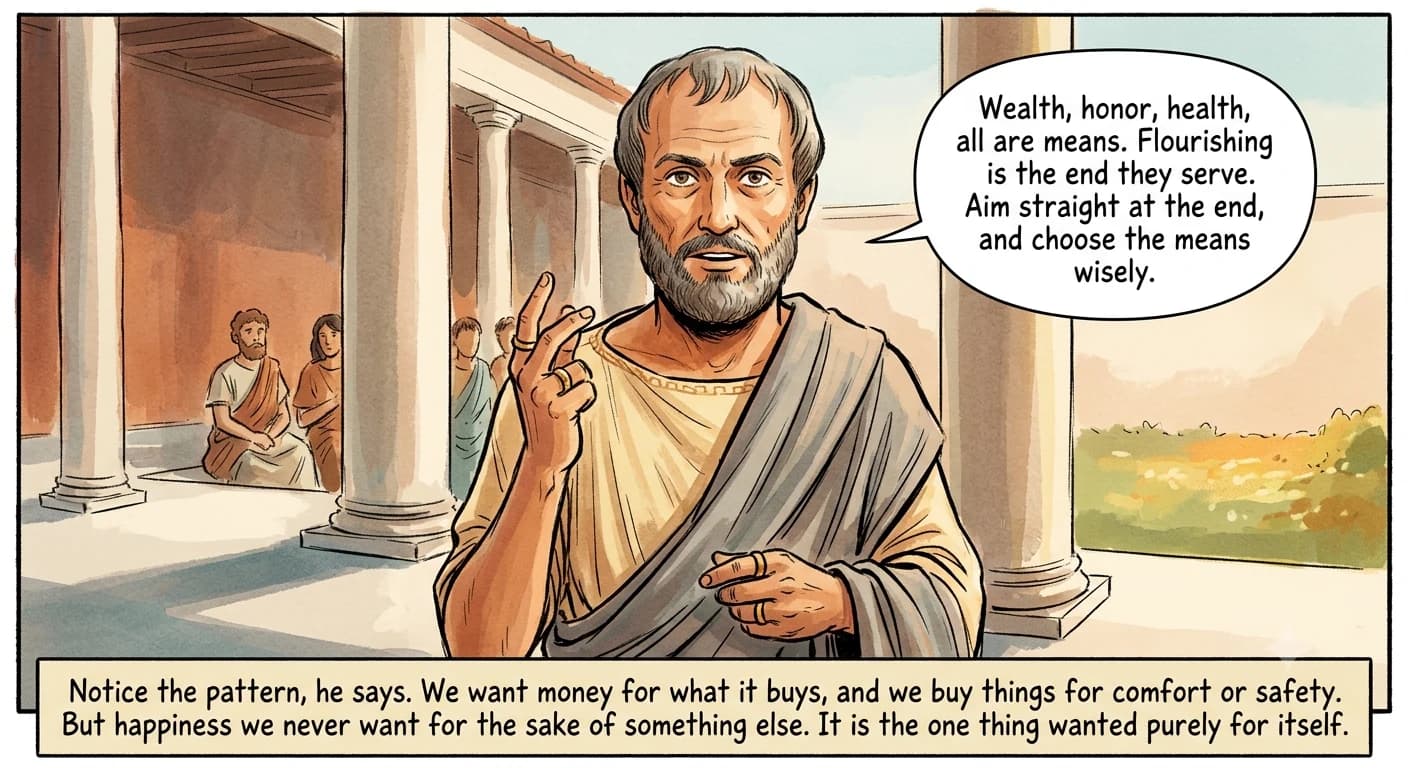
A medium close portrait of a well-dressed older philosopher framed between two pale stone columns, lifting a ringed hand in a counting gesture as students listen in the softly blurred background.
Notice the pattern, he says. We want money for what it buys, and we buy things for comfort or safety. But happiness we never want for the sake of something else. It is the one thing wanted purely for itself.
Aristotle: Wealth, honor, health, all are means. Flourishing is the end they serve. Aim straight at the end, and choose the means wisely.
Panel 5
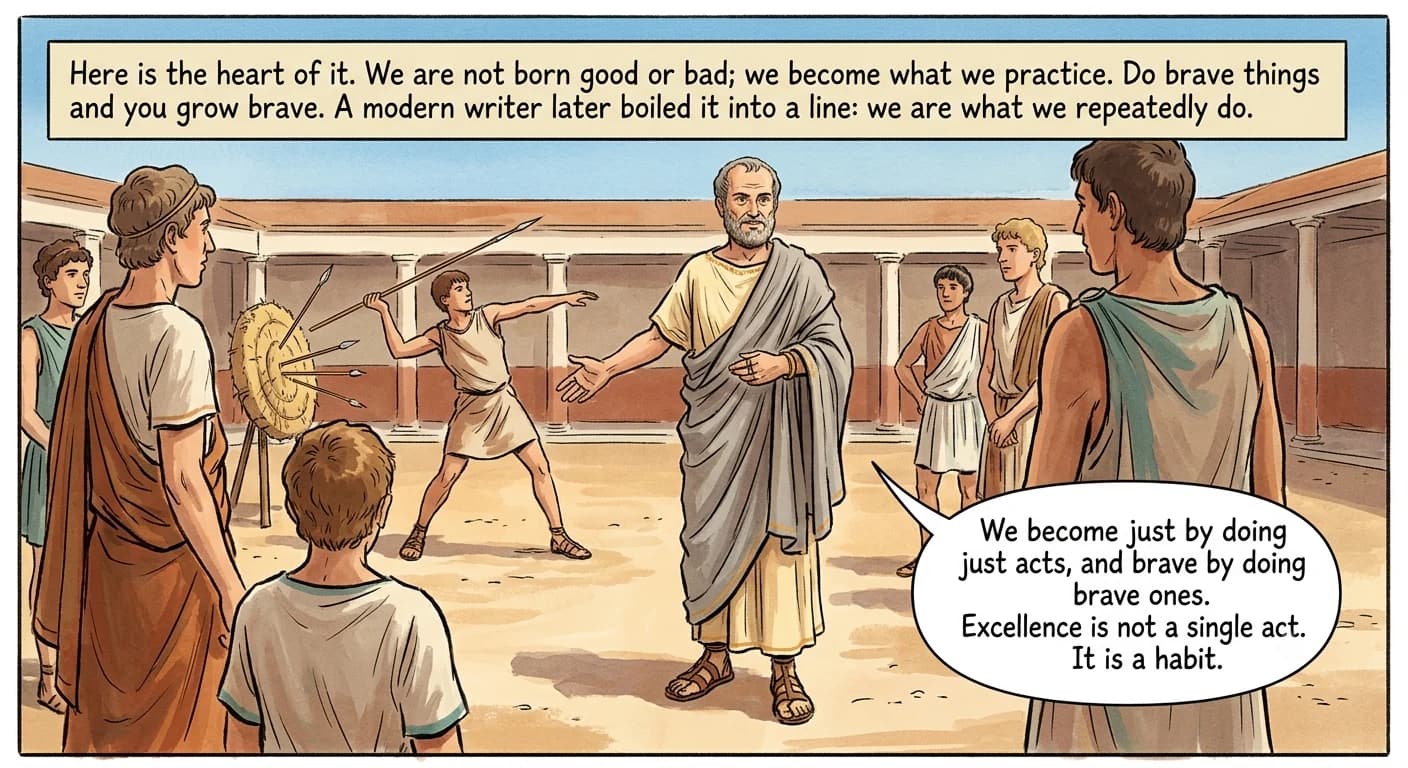
A young student practices javelin throws at a straw target, earlier javelins already clustered near the mark, while an older philosopher turns to the other students and gestures toward him as an example.
Here is the heart of it. We are not born good or bad; we become what we practice. Do brave things and you grow brave. A modern writer later boiled it into a line: we are what we repeatedly do.
Aristotle: We become just by doing just acts, and brave by doing brave ones. Excellence is not a single act. It is a habit.
Panel 6
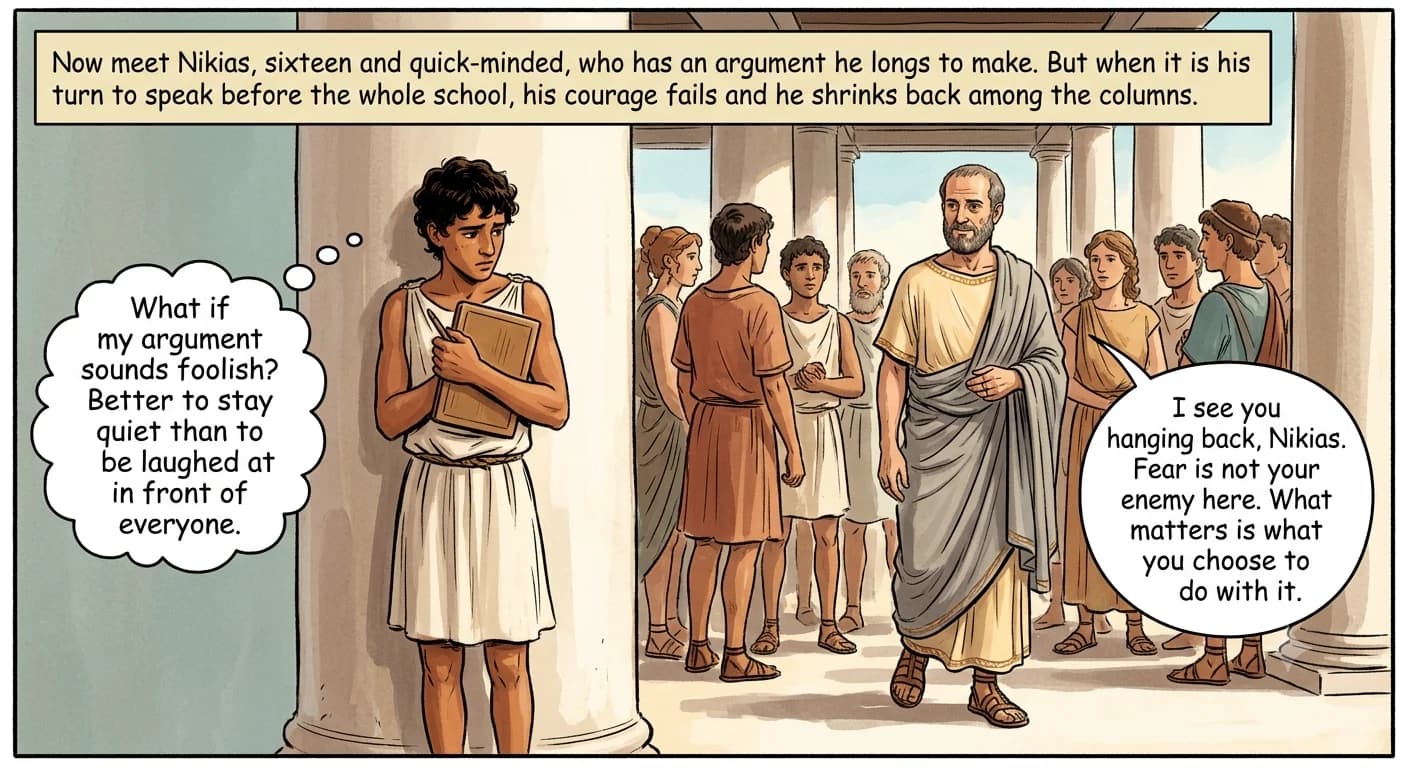
A lean teenage student presses himself against a stone column, shoulders drawn in and clutching a wax tablet in fear, while an older philosopher turns from the crowd to notice him with an encouraging look.
Now meet Nikias, sixteen and quick-minded, who has an argument he longs to make. But when it is his turn to speak before the whole school, his courage fails and he shrinks back among the columns.
Nikias: What if my argument sounds foolish? Better to stay quiet than to be laughed at in front of everyone.
Aristotle: I see you hanging back, Nikias. Fear is not your enemy here. What matters is what you choose to do with it.
Panel 7
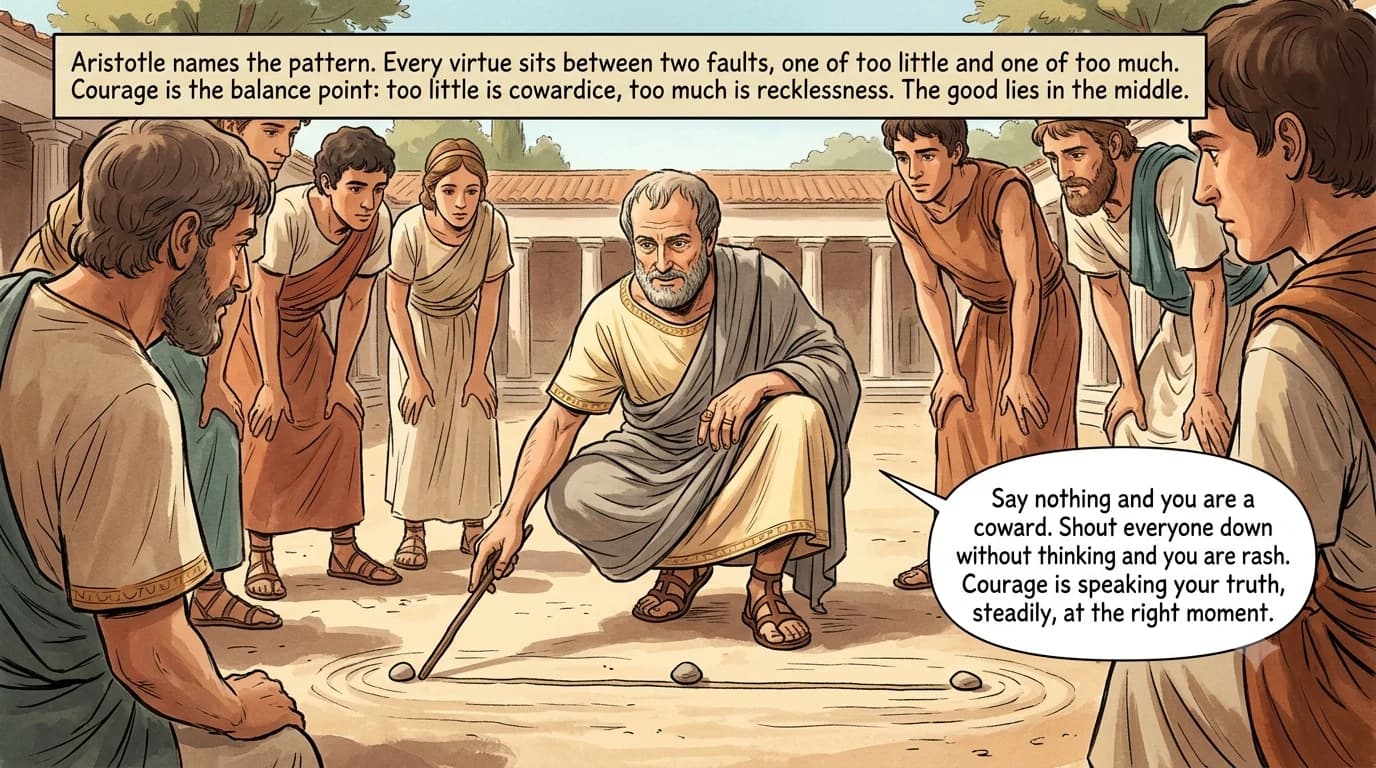
An older philosopher crouches in a sunlit courtyard drawing a long line in the dust with a stick, three small pebbles set along it at the ends and middle, as students lean in around him in a loose ring.
Aristotle names the pattern. Every virtue sits between two faults, one of too little and one of too much. Courage is the balance point: too little is cowardice, too much is recklessness. The good lies in the middle.
Aristotle: Say nothing and you are a coward. Shout everyone down without thinking and you are rash. Courage is speaking your truth, steadily, at the right moment.
Panel 8
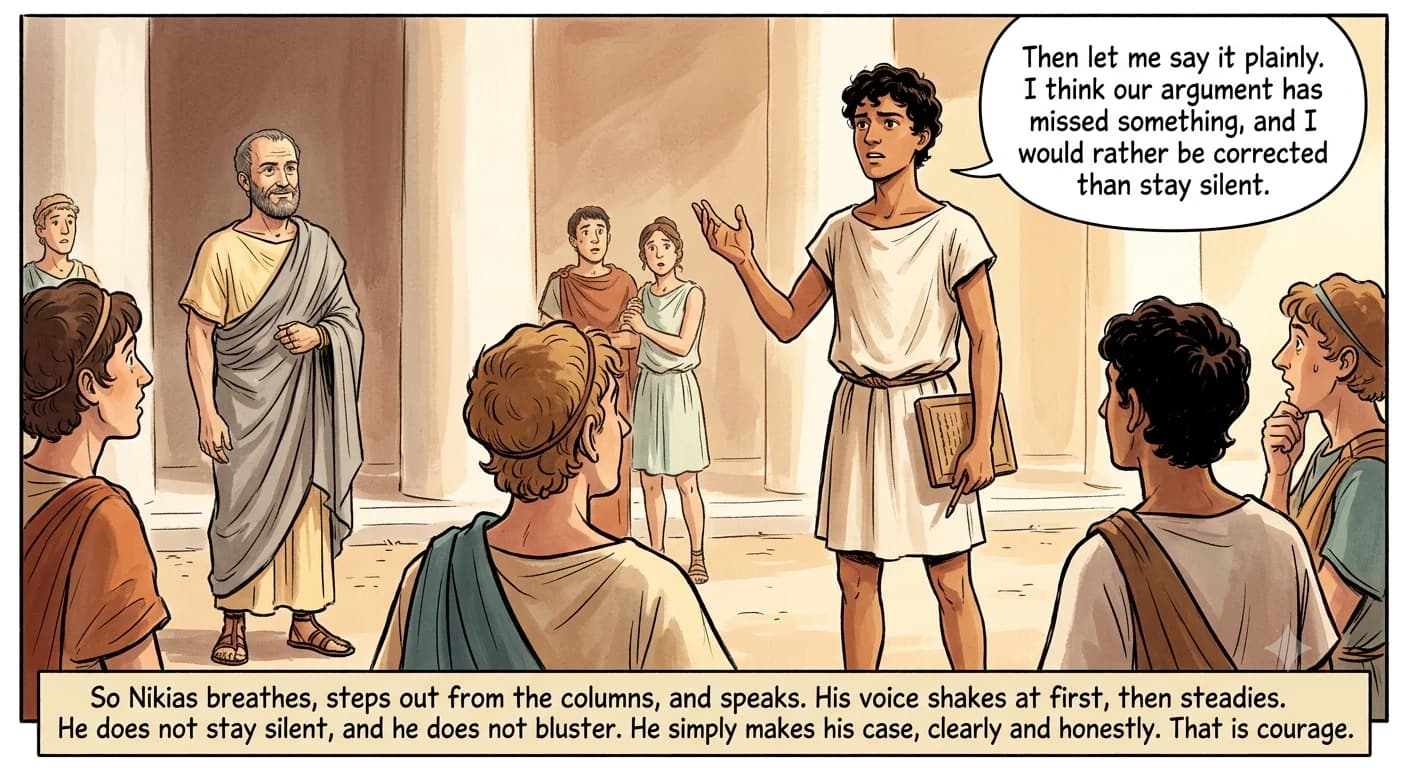
A lean teenage student stands tall in the open courtyard, tablet lowered, one hand lifted in a measured gesture as he makes his argument, while the students listen and an older philosopher watches with a quiet approving smile.
So Nikias breathes, steps out from the columns, and speaks. His voice shakes at first, then steadies. He does not stay silent, and he does not bluster. He simply makes his case, clearly and honestly. That is courage.
Nikias: Then let me say it plainly. I think our argument has missed something, and I would rather be corrected than stay silent.
Panel 9
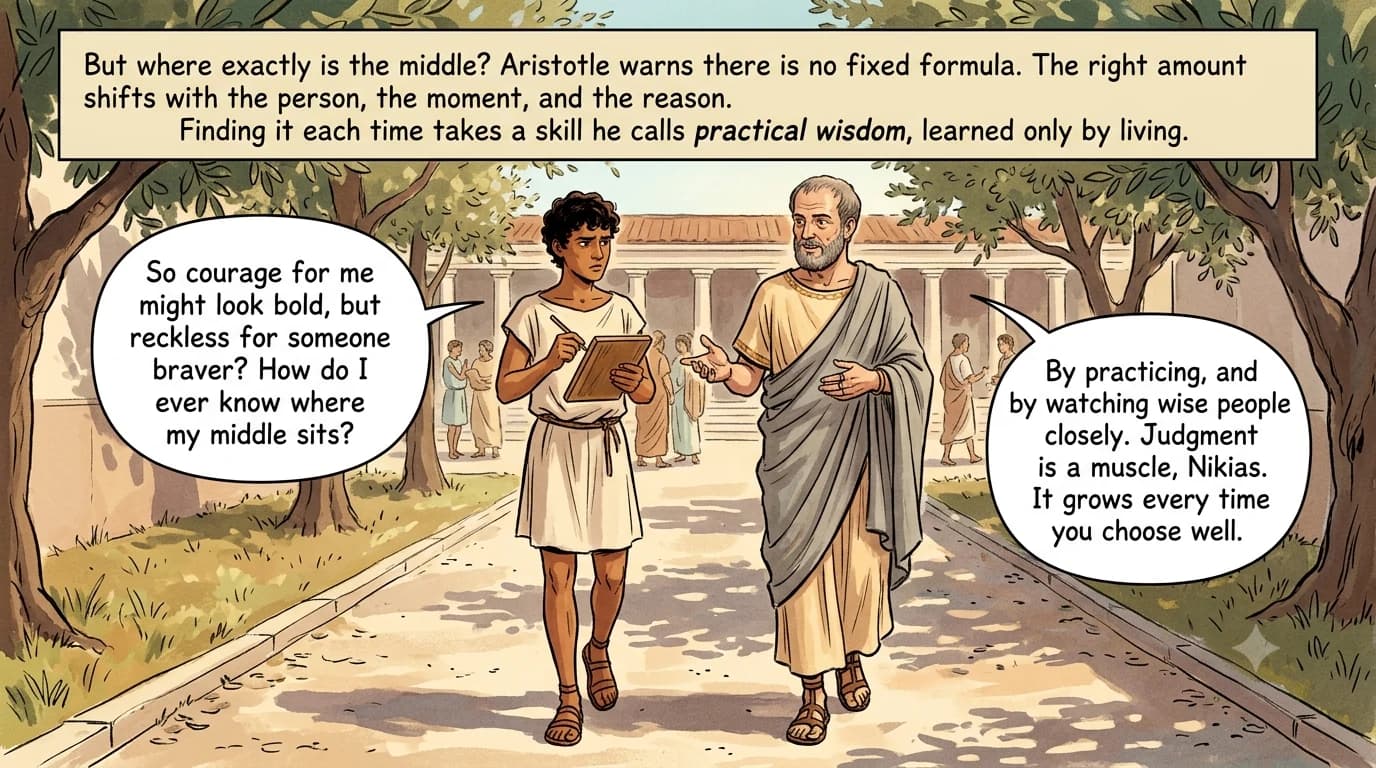
An older philosopher and a lean teenage student walk slowly together along a tree-lined path in soft late-afternoon light, the student turning a stylus in thought as the teacher speaks with an open gesture.
But where exactly is the middle? Aristotle warns there is no fixed formula. The right amount shifts with the person, the moment, and the reason. Finding it each time takes a skill he calls practical wisdom, learned only by living.
Nikias: So courage for me might look bold, but reckless for someone braver? How do I ever know where my middle sits?
Aristotle: By practicing, and by watching wise people closely. Judgment is a muscle, Nikias. It grows every time you choose well.
Panel 10
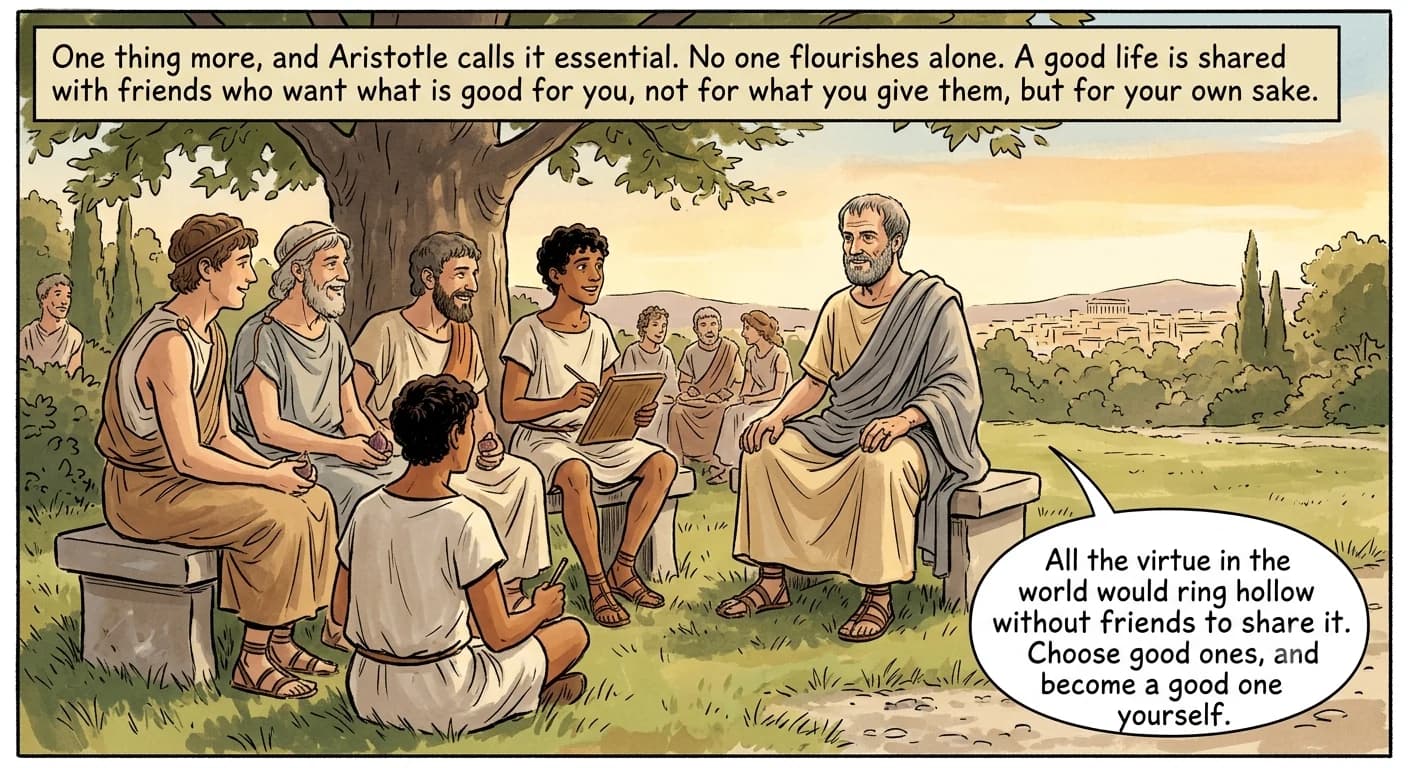
A warm evening gathering under a spreading tree, an older philosopher seated among a relaxed half-circle of students sharing figs and wine, one young student laughing easily with a friend beside him, Athens glowing beyond the trees.
One thing more, and Aristotle calls it essential. No one flourishes alone. A good life is shared with friends who want what is good for you, not for what you give them, but for your own sake.
Aristotle: All the virtue in the world would ring hollow without friends to share it. Choose good ones, and become a good one yourself.
Panel 11
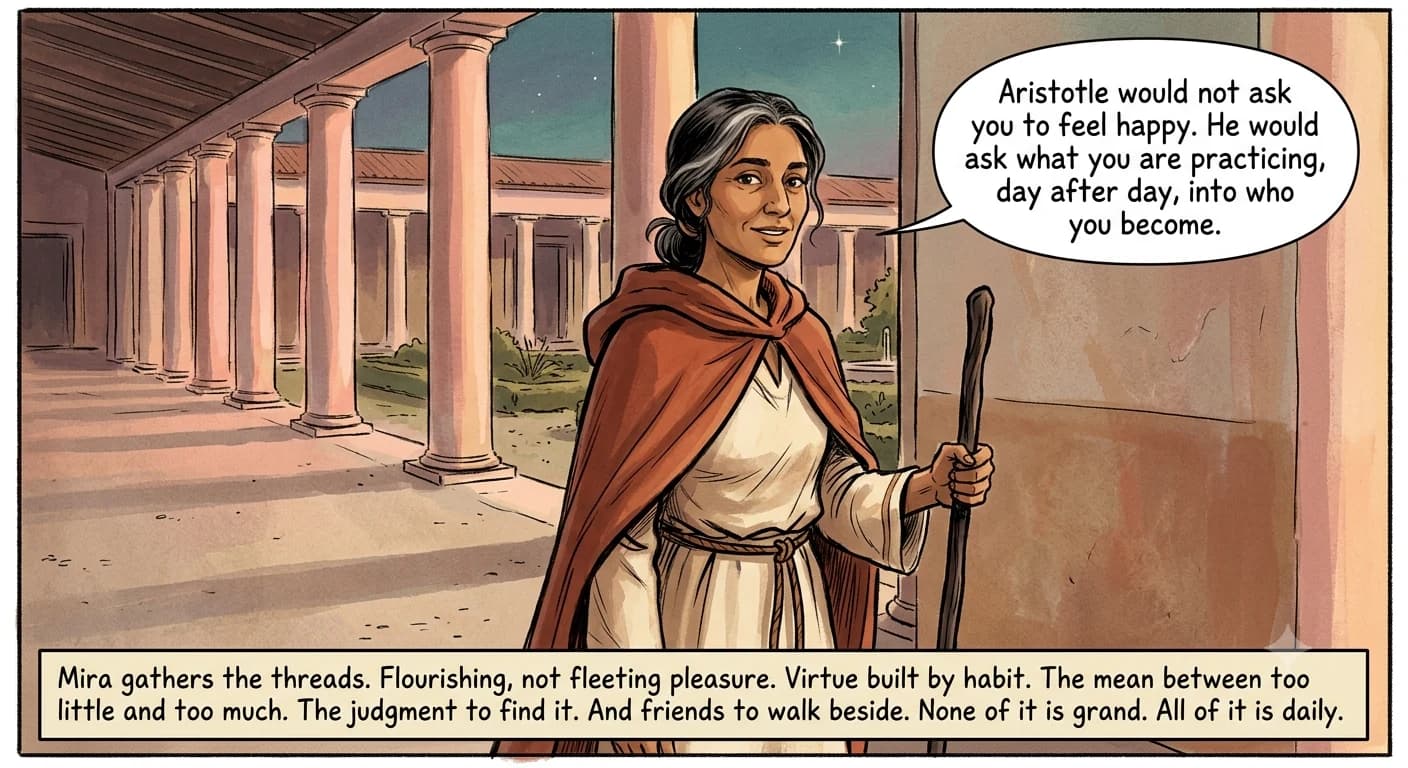
A warm philosophy guide stands alone on an emptying columned walkway at dusk, staff in hand, half-turned toward the viewer with a gathering expression as a first star appears in the deepening sky.
Mira gathers the threads. Flourishing, not fleeting pleasure. Virtue built by habit. The mean between too little and too much. The judgment to find it. And friends to walk beside. None of it is grand. All of it is daily.
Mira: Aristotle would not ask you to feel happy. He would ask what you are practicing, day after day, into who you become.
Panel 12
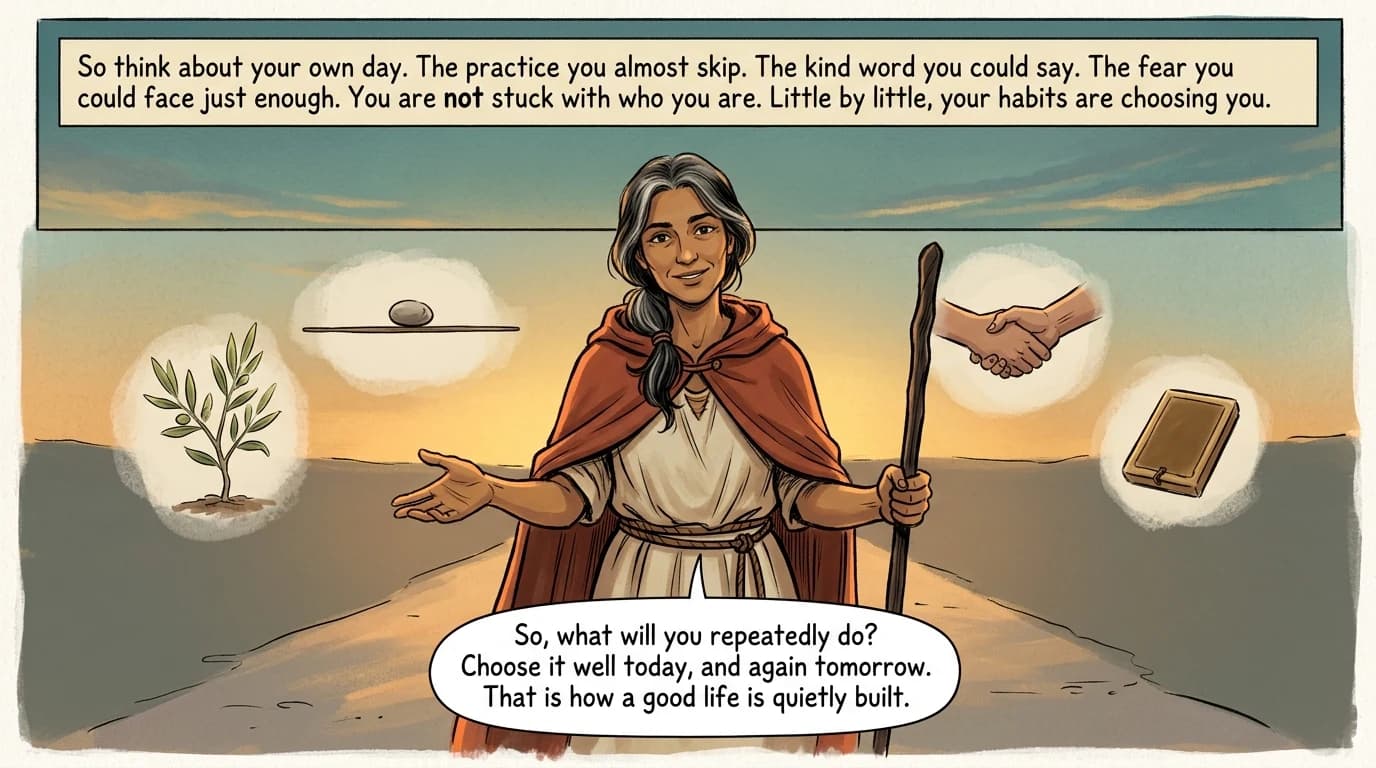
A warm philosophy guide stands centered on a dusk-lit path addressing the viewer with an open hand, surrounded by faint painted motifs of a young olive shoot, a line with a centered pebble, two clasped hands, and a wax tablet.
So think about your own day. The practice you almost skip. The kind word you could say. The fear you could face just enough. You are not stuck with who you are. Little by little, your habits are choosing you.
Mira: So, what will you repeatedly do? Choose it well today, and again tomorrow. That is how a good life is quietly built.