The Examined Life · Chapter 5: The Trolley
Cover
The Examined Life · Chapter 5
The Trolley
A runaway tram, a lever, and the two great answers to what is right
A tram is loose, and five lives stand against one. Mira and two friends use a famous thought experiment to meet the two great answers to a single question: how do we decide what is right?
12 panels · ~6 min read
Panel 1
Panel 2
Panel 3
Panel 4
Panel 5
Panel 6
Panel 7
Panel 8
Panel 9
Panel 10
Panel 11
Panel 12
Read chapter text: The Trolley
A tram is loose, and five lives stand against one. Mira and two friends use a famous thought experiment to meet the two great answers to a single question: how do we decide what is right?
Panel 1
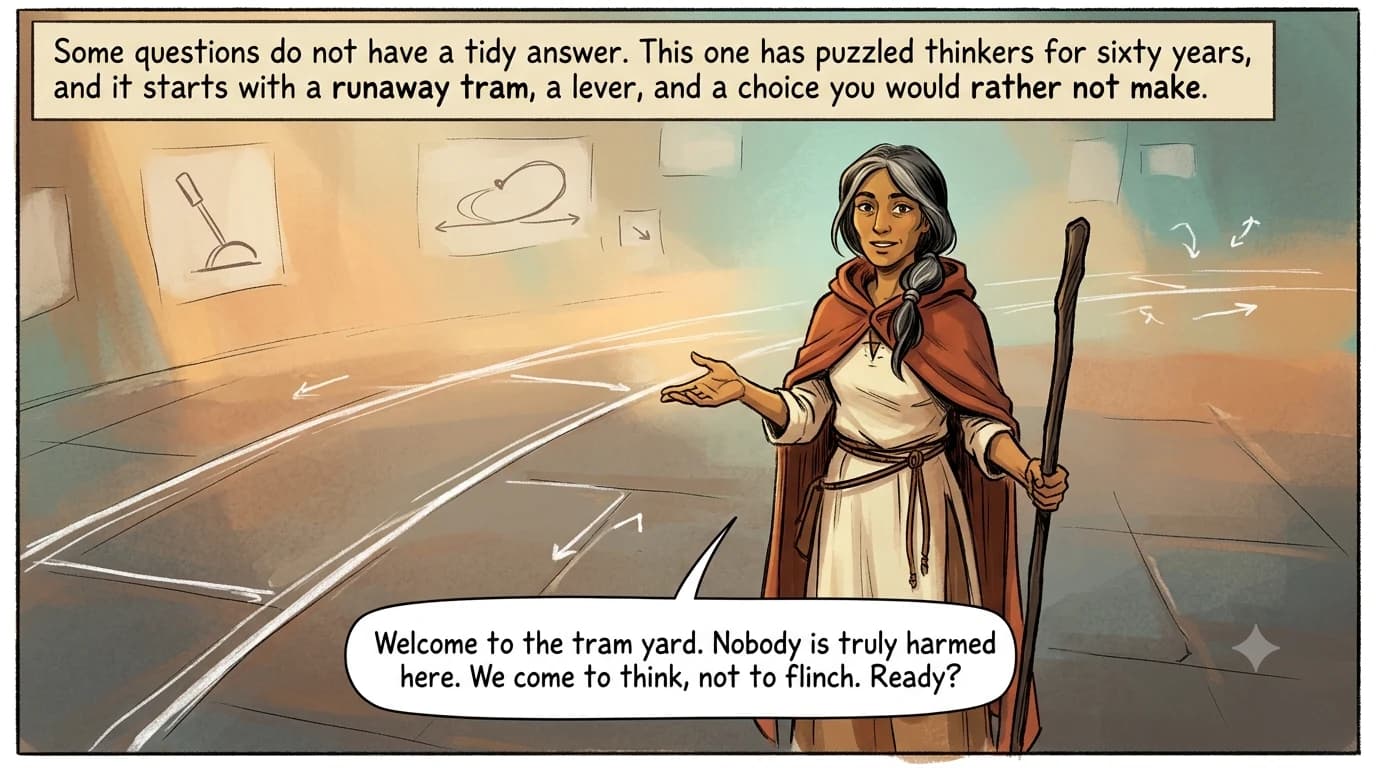
A warm philosophy guide stands in a stylized chalk-drawn tram yard, one hand open in welcome, inviting the reader into an imaginary thought experiment.
Some questions do not have a tidy answer. This one has puzzled thinkers for sixty years, and it starts with a runaway tram, a lever, and a choice you would rather not make.
Mira: Welcome to the tram yard. Nobody is truly harmed here. We come to think, not to flinch. Ready?
Panel 2
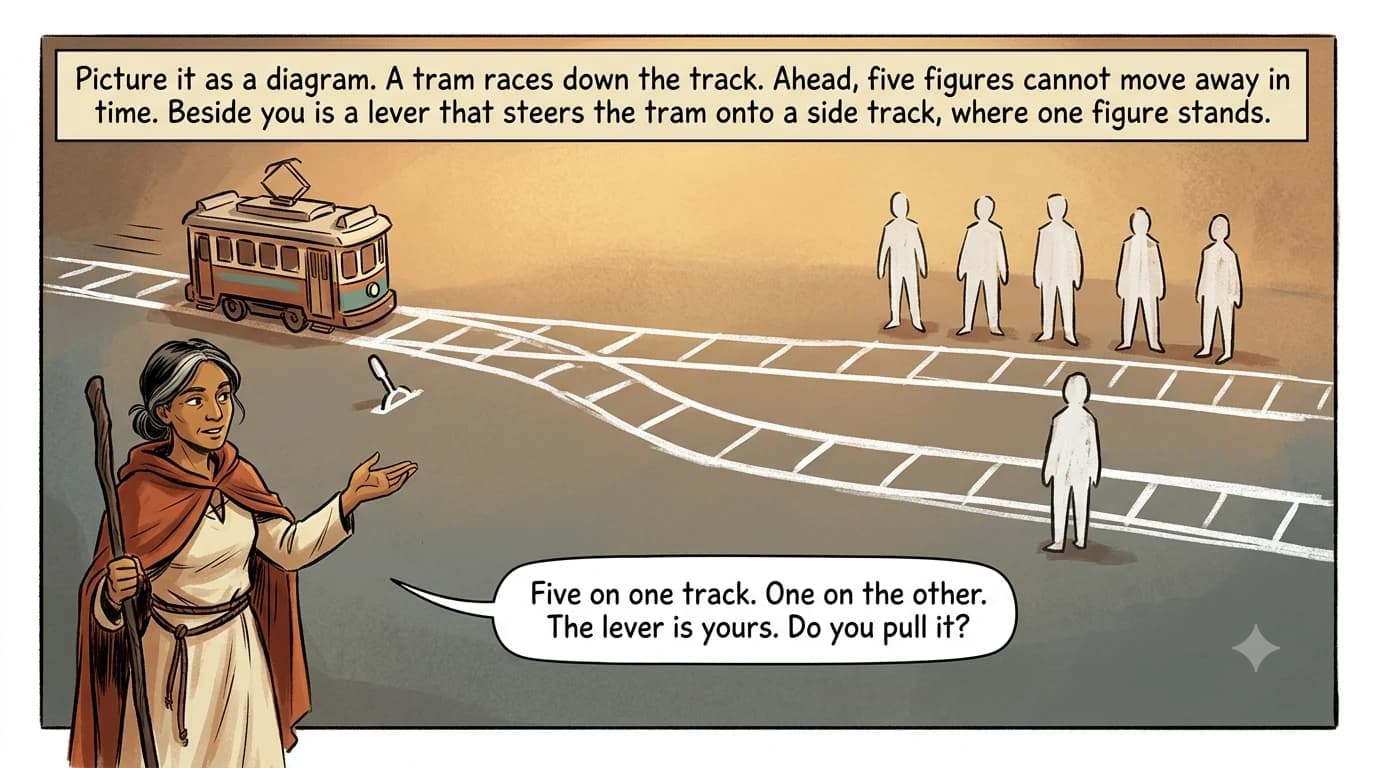
A chalk schematic on a grey floor shows a toy tram on a track that splits at a lever, with five flat silhouette figures on one line and a single silhouette on the other.
Picture it as a diagram. A tram races down the track. Ahead, five figures cannot move away in time. Beside you is a lever that steers the tram onto a side track, where one figure stands.
Mira: Five on one track. One on the other. The lever is yours. Do you pull it?
Panel 3
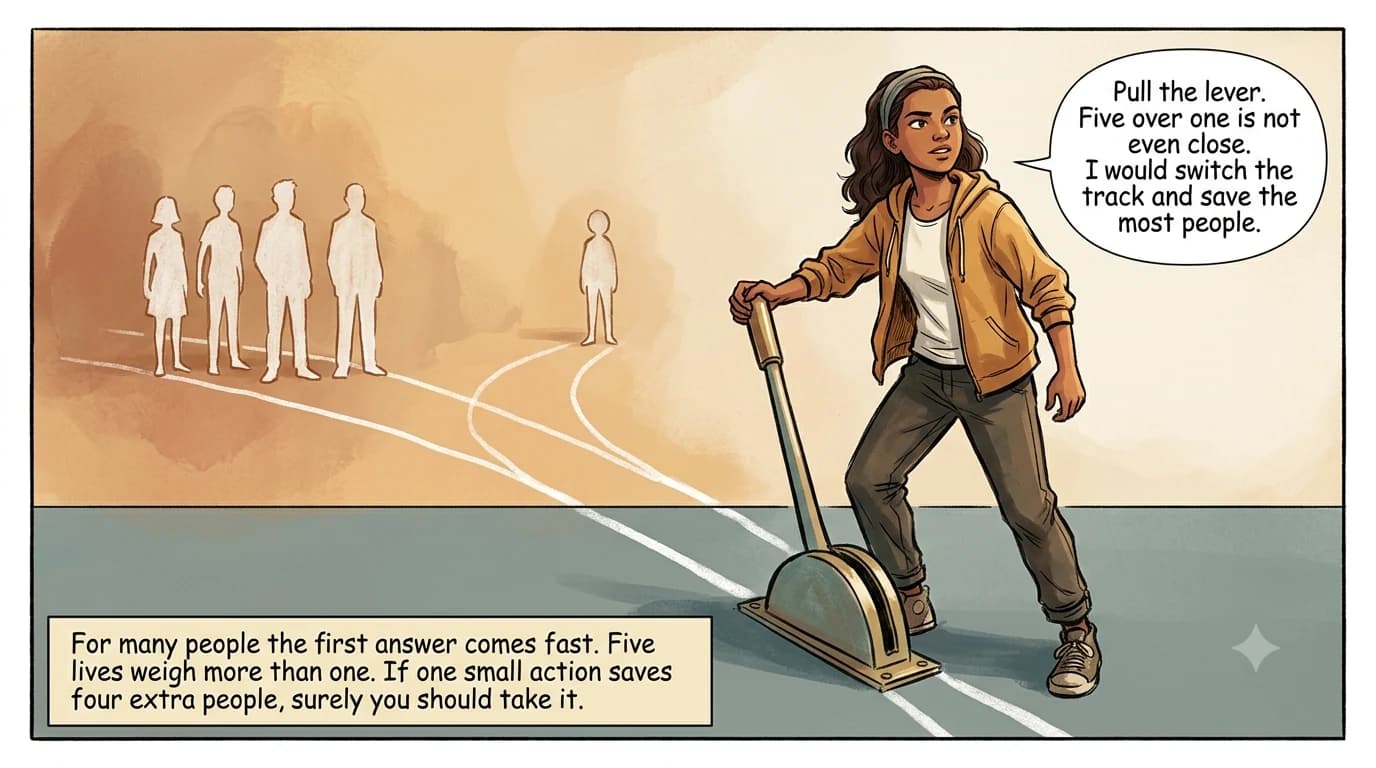
A confident teen grips a large chalk-and-brass lever, leaning to throw it, with chalk rails sweeping toward distant silhouette figures.
For many people the first answer comes fast. Five lives weigh more than one. If one small action saves four extra people, surely you should take it.
Priya: Pull the lever. Five over one is not even close. I would switch the track and save the most people.
Panel 4
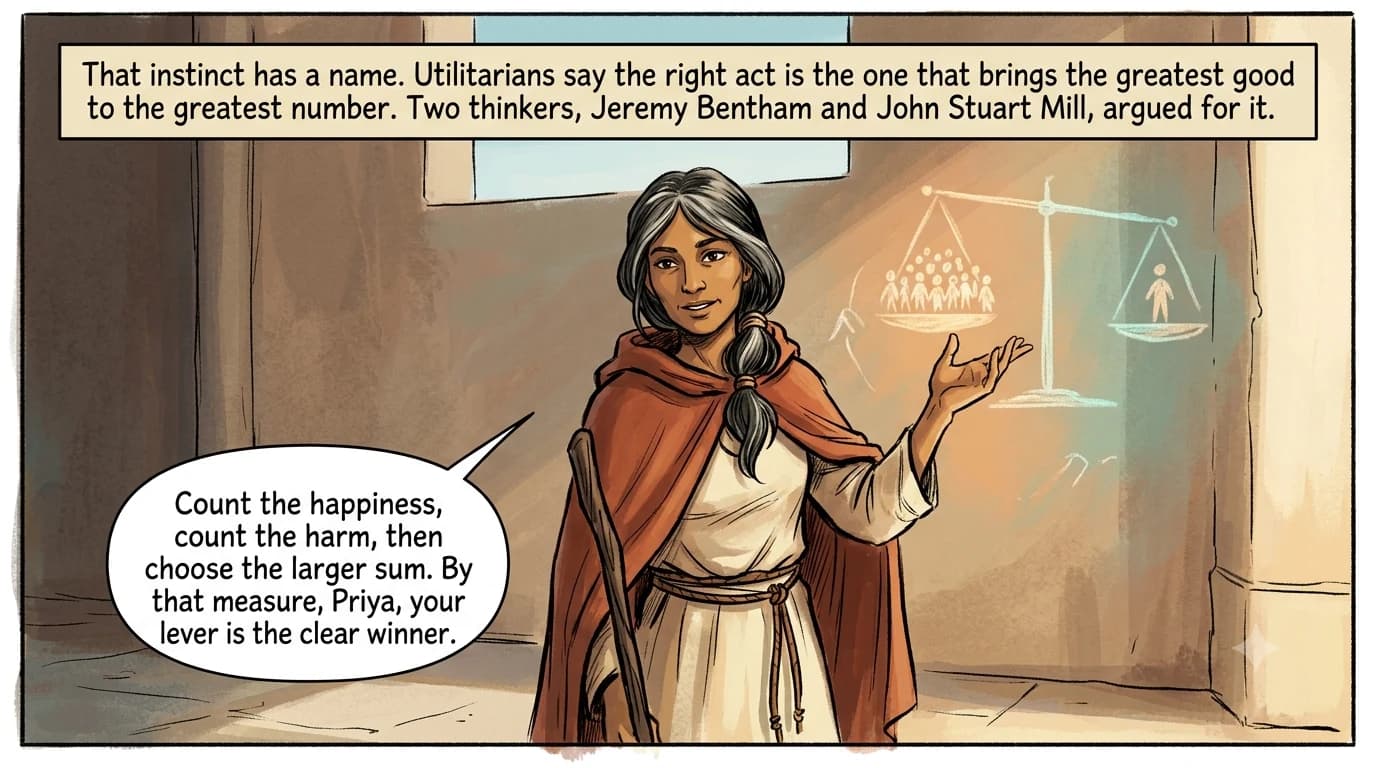
A philosophy guide raises one hand as if weighing an invisible balance, with faint chalk motifs of a scale and a crowd beside a single figure floating behind her.
That instinct has a name. Utilitarians say the right act is the one that brings the greatest good to the greatest number. Two thinkers, Jeremy Bentham and John Stuart Mill, argued for it.
Mira: Count the happiness, count the harm, then choose the larger sum. By that measure, Priya, your lever is the clear winner.
Panel 5
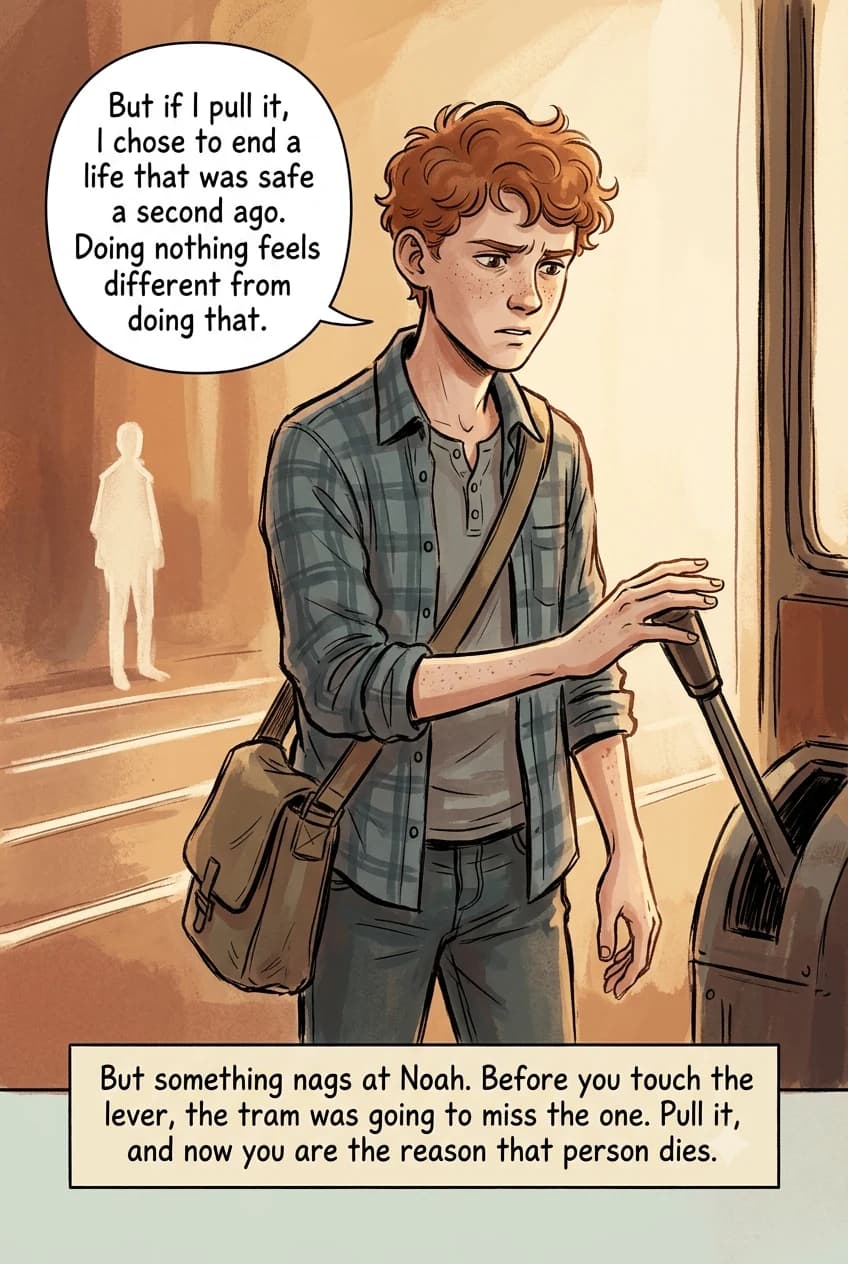
A troubled teen stands close to the frame, hand hovering near a chalk lever without touching it, brow drawn, a single silhouette glowing softly behind him.
But something nags at Noah. Before you touch the lever, the tram was going to miss the one. Pull it, and now you are the reason that person dies.
Noah: But if I pull it, I chose to end a life that was safe a second ago. Doing nothing feels different from doing that.
Panel 6
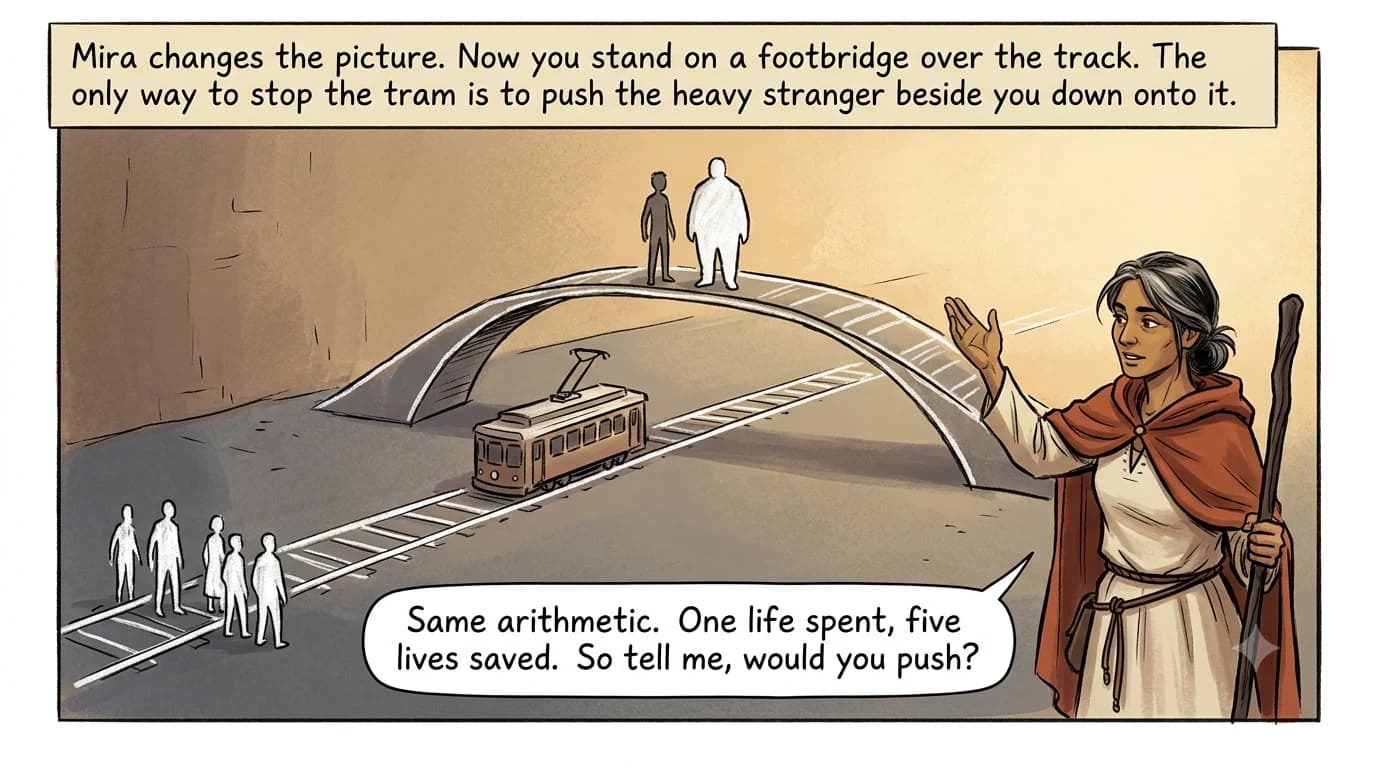
A chalk footbridge arcs over rail lines; two small figures stand on it while a toy tram rolls toward five distant silhouettes, and the guide gestures up at the bridge.
Mira changes the picture. Now you stand on a footbridge over the track. The only way to stop the tram is to push the heavy stranger beside you down onto it.
Mira: Same arithmetic. One life spent, five lives saved. So tell me, would you push?
Panel 7
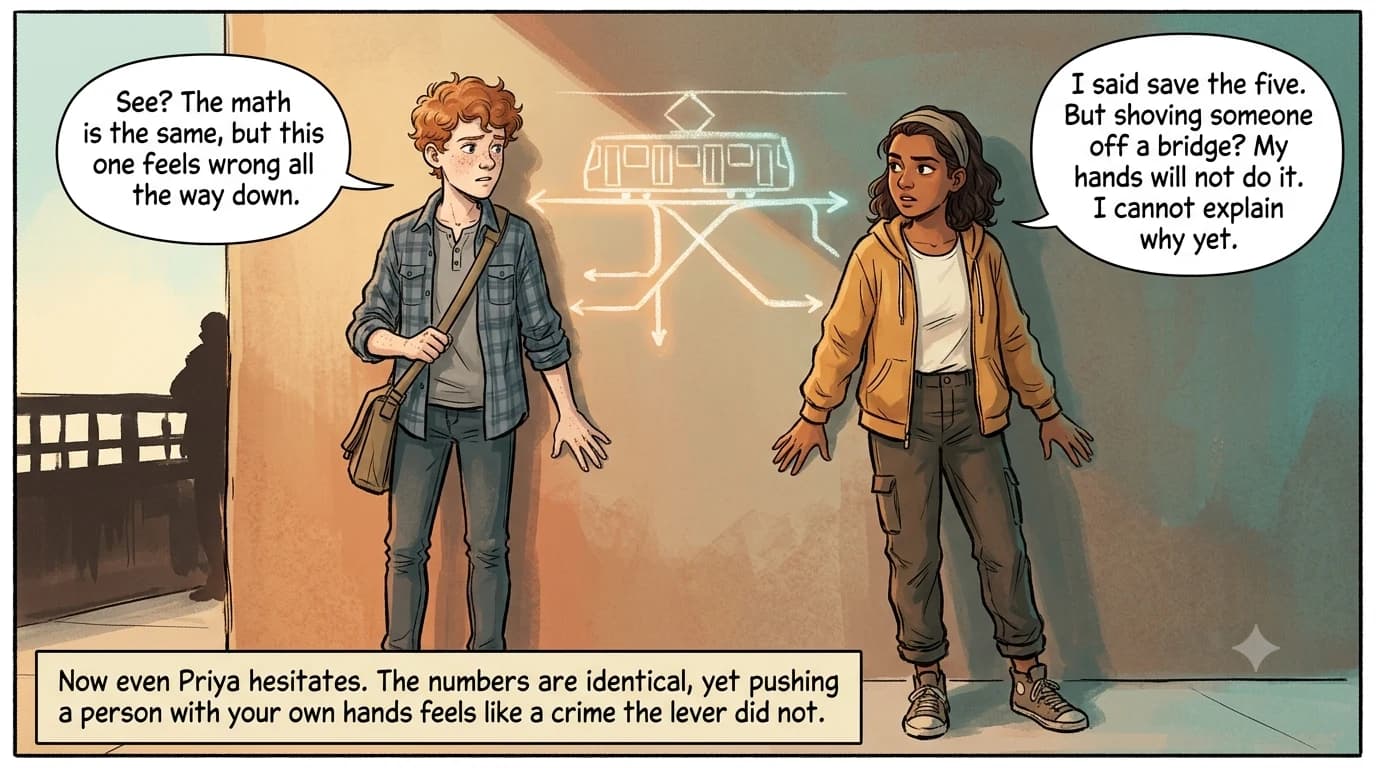
Two teens stand near a chalk footbridge, leaning back and raising their hands in instinctive refusal, a heavy silhouette still on the bridge behind them.
Now even Priya hesitates. The numbers are identical, yet pushing a person with your own hands feels like a crime the lever did not.
Noah: See? The math is the same, but this one feels wrong all the way down.
Priya: I said save the five. But shoving someone off a bridge? My hands will not do it. I cannot explain why yet.
Panel 8
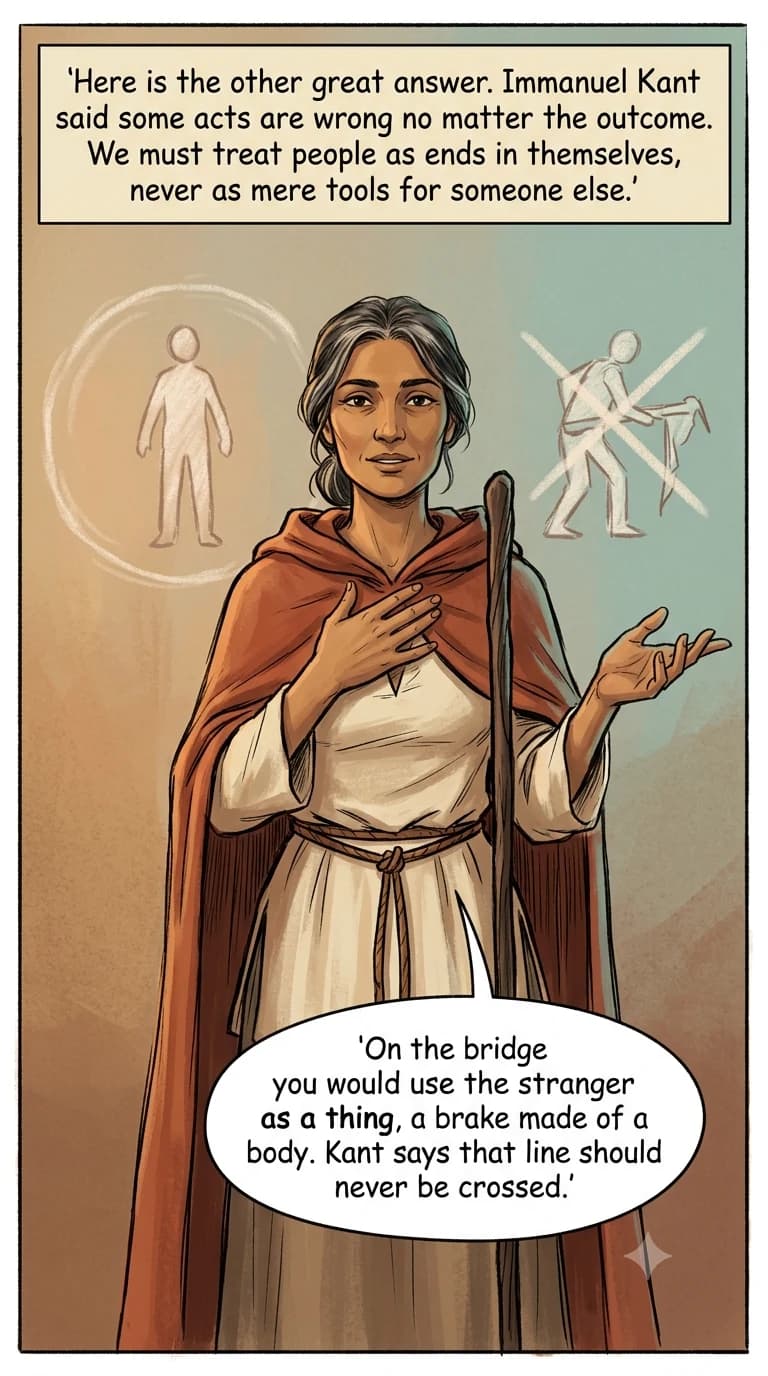
A philosophy guide stands calm and centered, one hand at her chest, with faint chalk motifs of a single figure ringed by a protective circle floating behind her.
Here is the other great answer. Immanuel Kant said some acts are wrong no matter the outcome. We must treat people as ends in themselves, never as mere tools for someone else.
Mira: On the bridge you would use the stranger as a thing, a brake made of a body. Kant says that line should never be crossed.
Panel 9
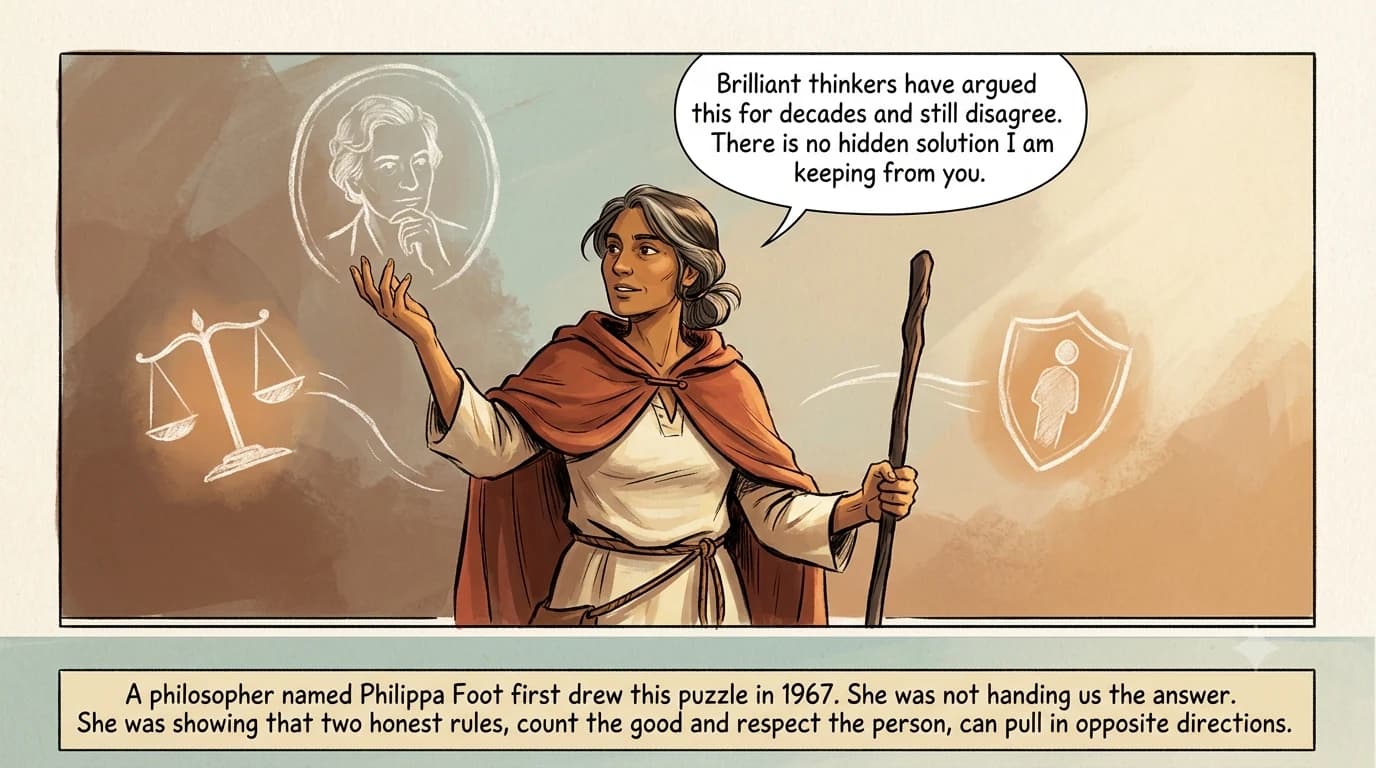
A philosophy guide lifts a hand toward a faint chalk portrait medallion of a thoughtful philosopher, with a set of scales and a shielded figure drifting apart nearby.
A philosopher named Philippa Foot first drew this puzzle in 1967. She was not handing us the answer. She was showing that two honest rules, count the good and respect the person, can pull in opposite directions.
Mira: Brilliant thinkers have argued this for decades and still disagree. There is no hidden solution I am keeping from you.
Panel 10
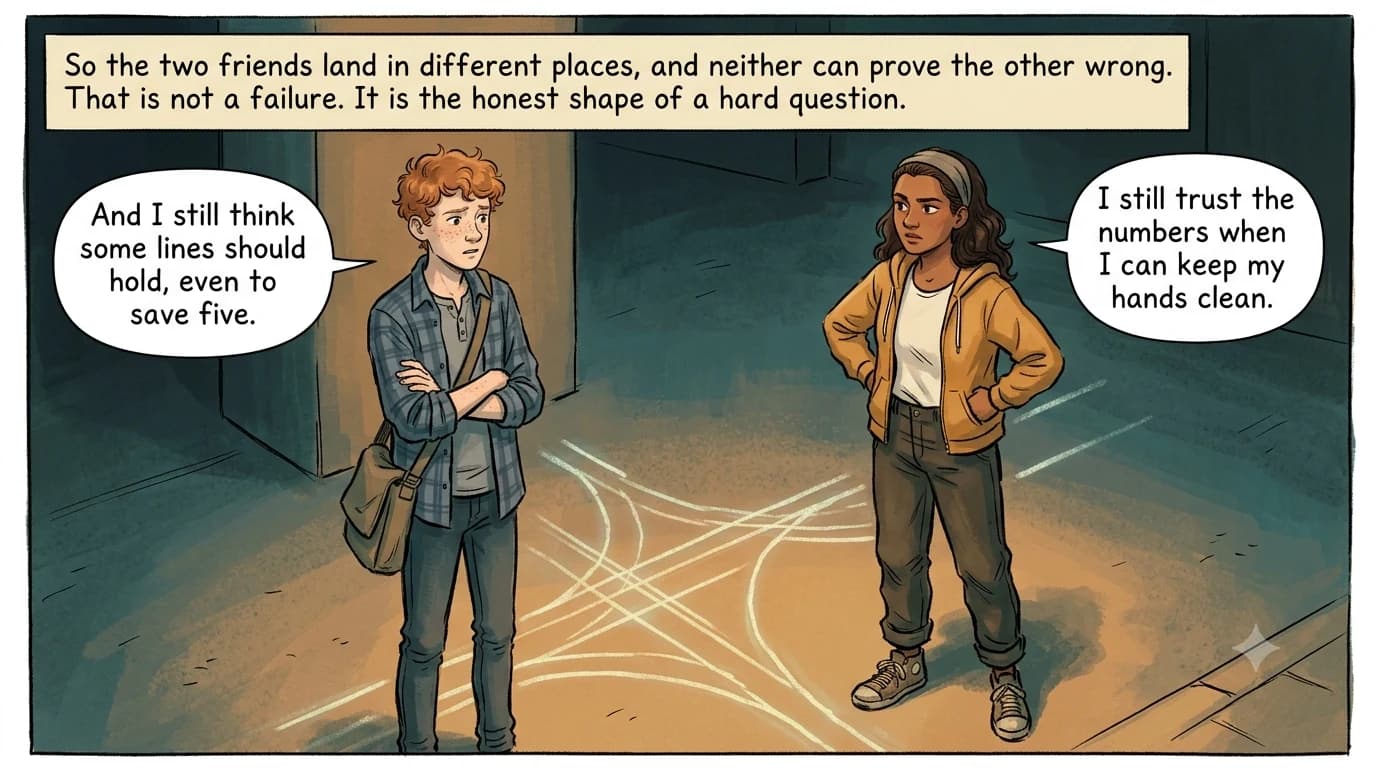
Two teens stand slightly apart on either side of a soft line of light on the floor, calm and thoughtful, having reached different conclusions.
So the two friends land in different places, and neither can prove the other wrong. That is not a failure. It is the honest shape of a hard question.
Noah: And I still think some lines should hold, even to save five.
Priya: I still trust the numbers when I can keep my hands clean.
Panel 11
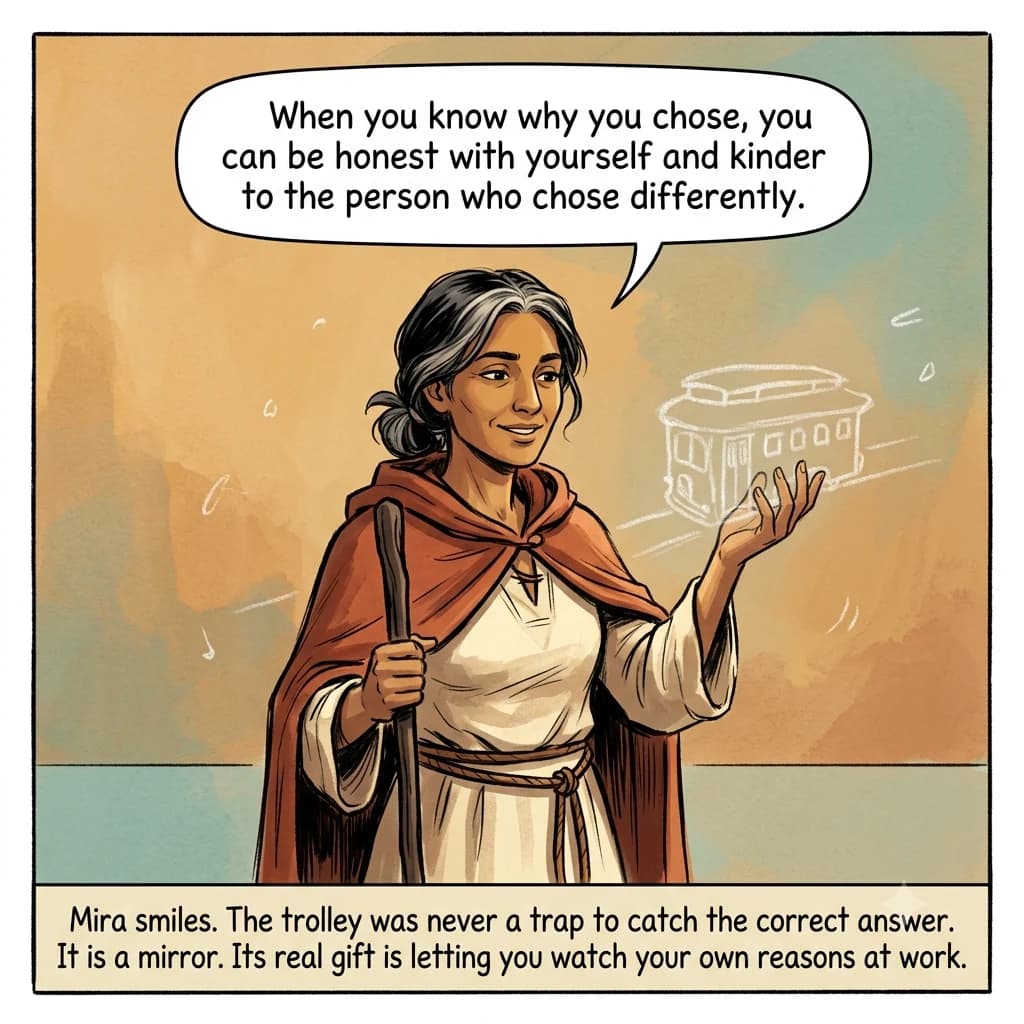
A philosophy guide smiles gently and holds up one hand where a faint chalk outline of the whole trolley diagram softly reflects, like a mirror turned on the viewer.
Mira smiles. The trolley was never a trap to catch the correct answer. It is a mirror. Its real gift is letting you watch your own reasons at work.
Mira: When you know why you chose, you can be honest with yourself and kinder to the person who chose differently.
Panel 12
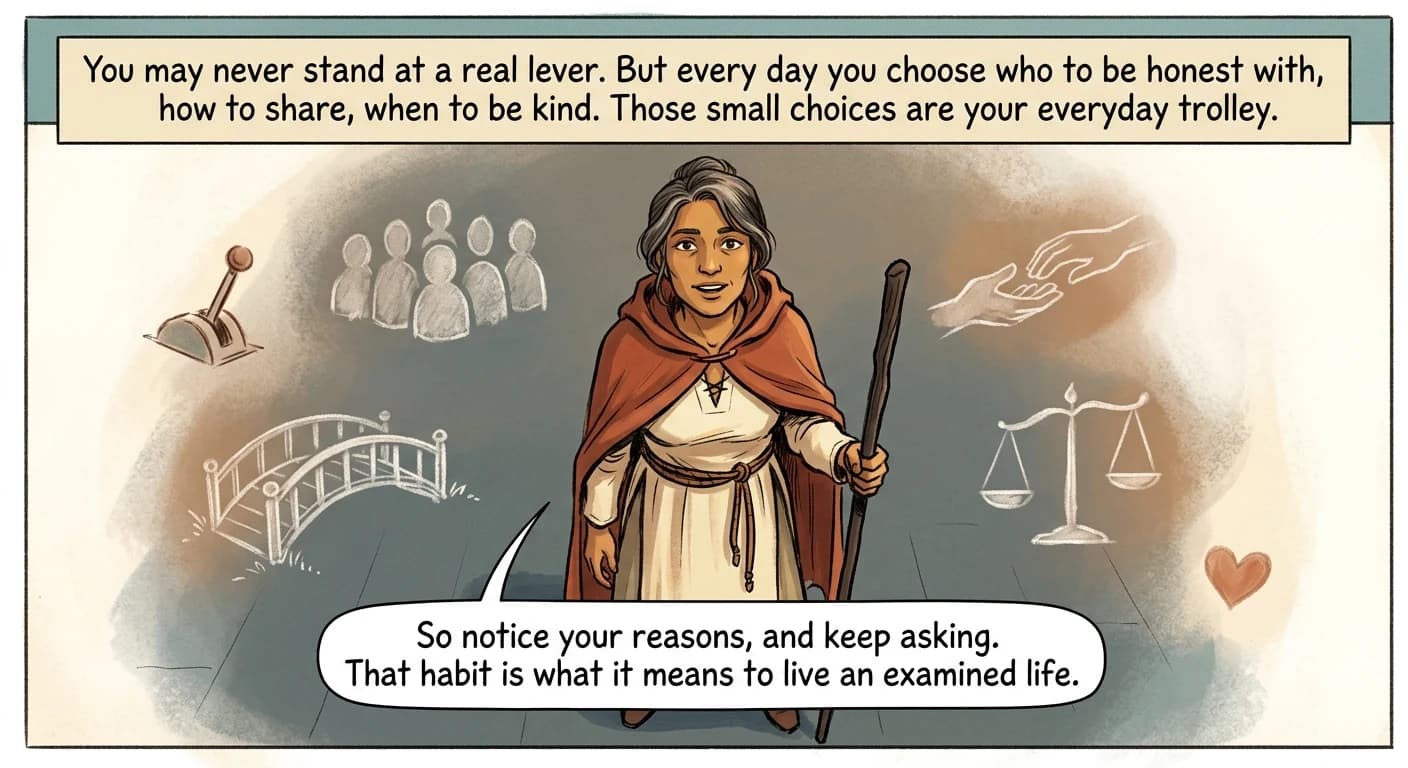
A philosophy guide addresses the reader warmly as faint chalk motifs of a lever, silhouettes, and a footbridge soften into everyday emblems of sharing, fairness, and kindness.
You may never stand at a real lever. But every day you choose who to be honest with, how to share, when to be kind. Those small choices are your everyday trolley.
Mira: So notice your reasons, and keep asking. That habit is what it means to live an examined life.