The Examined Life · Chapter 6: The Inner Citadel
Cover
The Examined Life · Chapter 6
The Inner Citadel
The Stoics, and the freedom of knowing what is yours to control
The Stoics faced storms, slavery, and empire — and found freedom in one hard question: what is actually up to me? Meet Epictetus and Marcus Aurelius, then gather the whole examined life into a single way of walking.
12 panels · ~6 min read
Panel 1
Panel 2
Panel 3
Panel 4
Panel 5
Panel 6
Panel 7
Panel 8
Panel 9
Panel 10
Panel 11
Panel 12
Read chapter text: The Inner Citadel
The Stoics faced storms, slavery, and empire — and found freedom in one hard question: what is actually up to me? Meet Epictetus and Marcus Aurelius, then gather the whole examined life into a single way of walking.
Panel 1
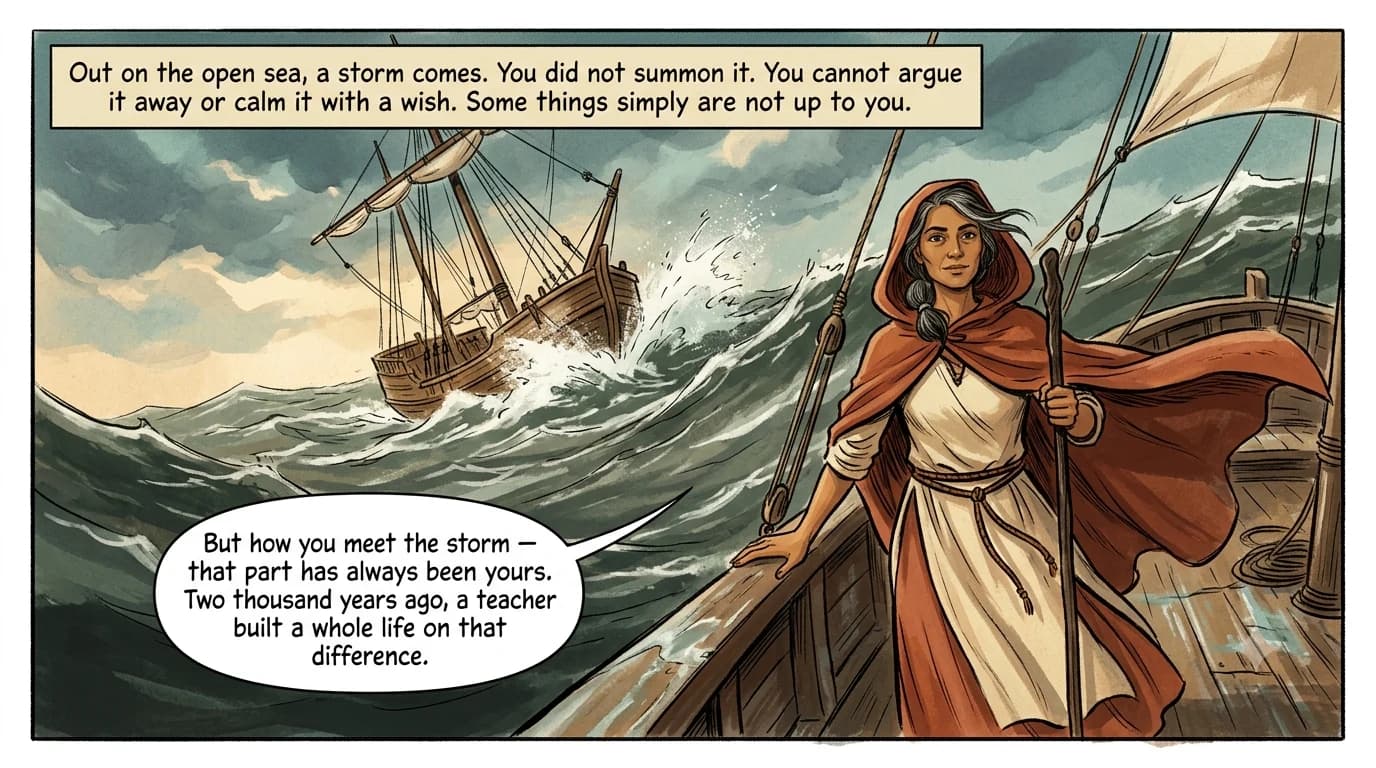
A small ship pitches on huge storm waves while a calm philosophy guide stands braced on the tilting deck, her cloak whipping in the wind, looking out at the reader.
Out on the open sea, a storm comes. You did not summon it. You cannot argue it away or calm it with a wish. Some things simply are not up to you.
Mira: But how you meet the storm — that part has always been yours. Two thousand years ago, a teacher built a whole life on that difference.
Panel 2
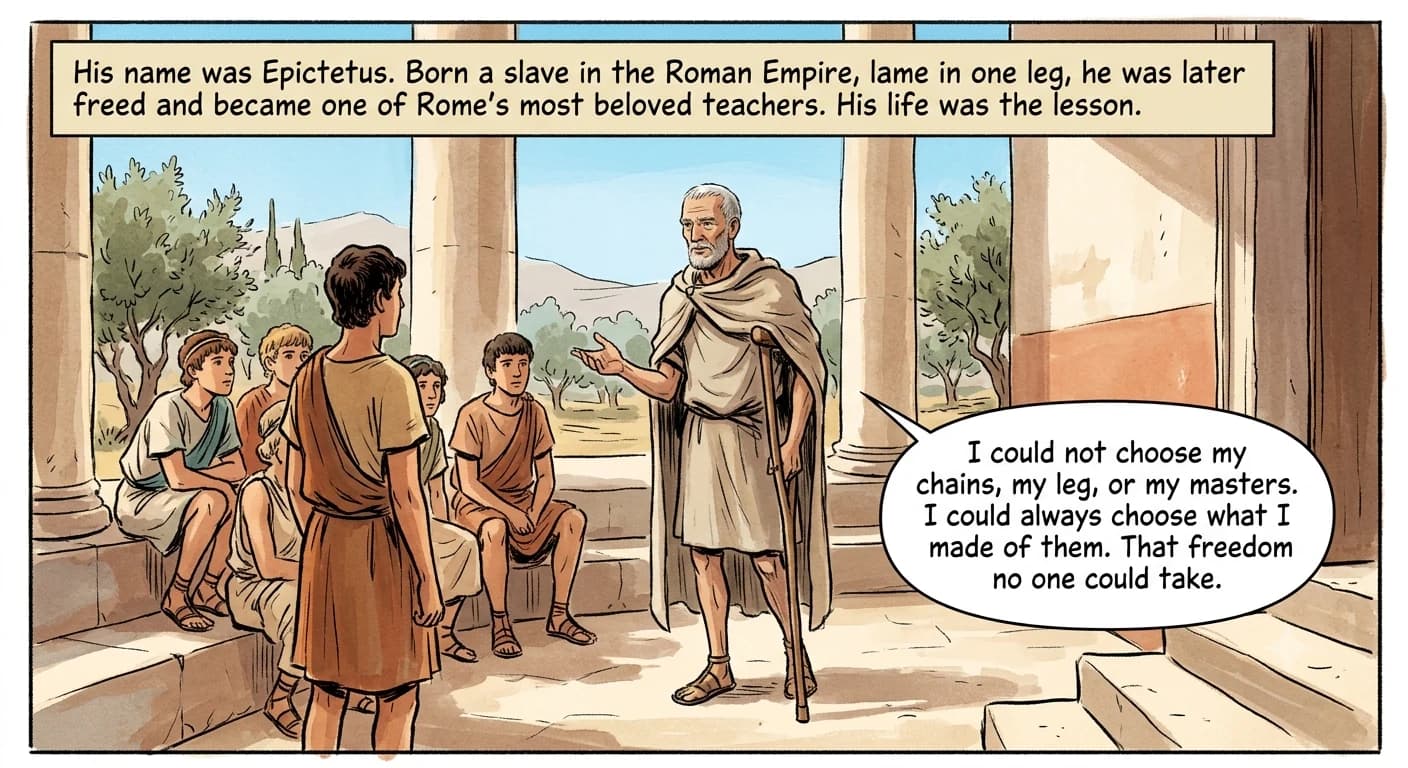
An elderly lame teacher leaning on a wooden crutch teaches a small group of young students seated on the stone steps of a sunlit colonnaded portico.
His name was Epictetus. Born a slave in the Roman Empire, lame in one leg, he was later freed and became one of Rome's most beloved teachers. His life was the lesson.
Epictetus: I could not choose my chains, my leg, or my masters. I could always choose what I made of them. That freedom no one could take.
Panel 3
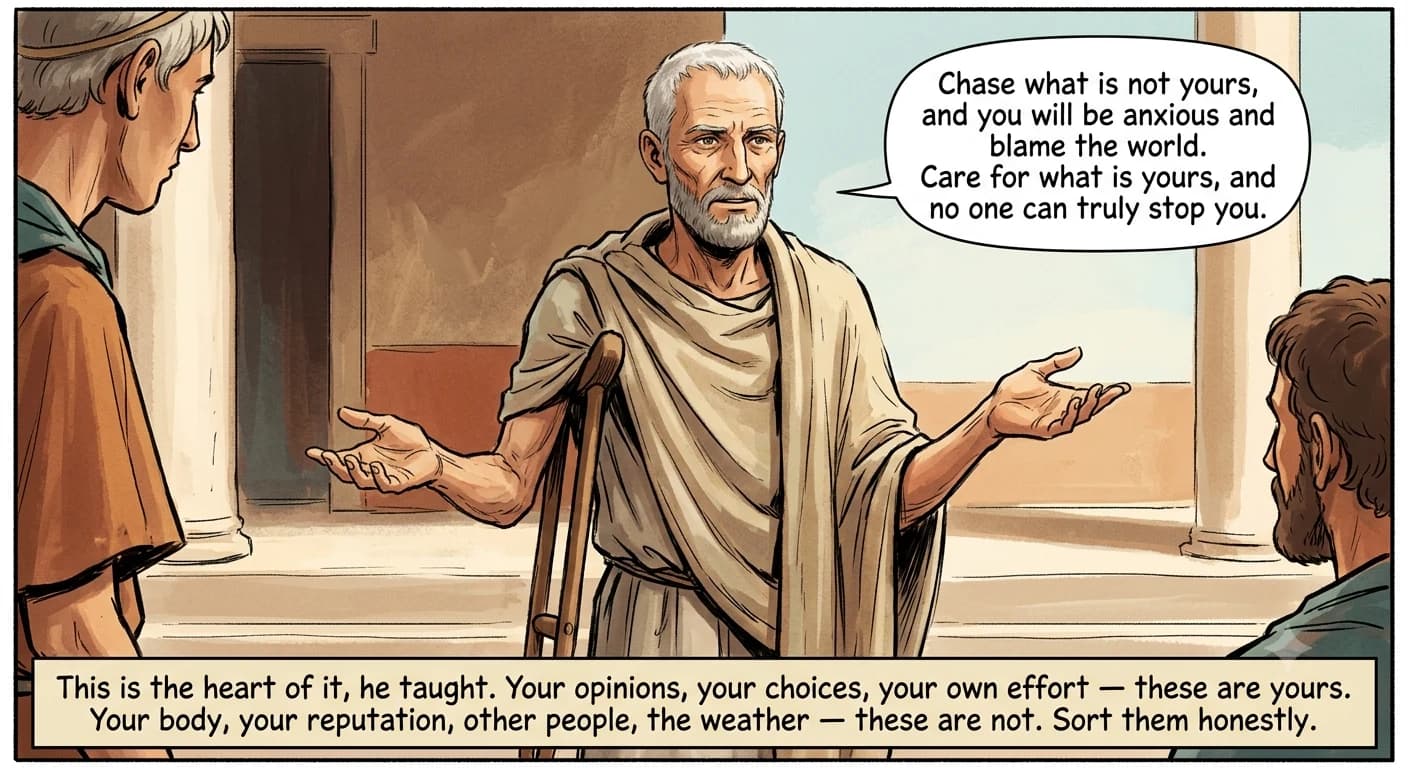
An elderly teacher stands holding both hands apart as if weighing two unseen things, one palm turned up and one turned down, while a few students lean in at the edges.
This is the heart of it, he taught. Your opinions, your choices, your own effort — these are yours. Your body, your reputation, other people, the weather — these are not. Sort them honestly.
Epictetus: Chase what is not yours, and you will be anxious and blame the world. Care for what is yours, and no one can truly stop you.
Panel 4
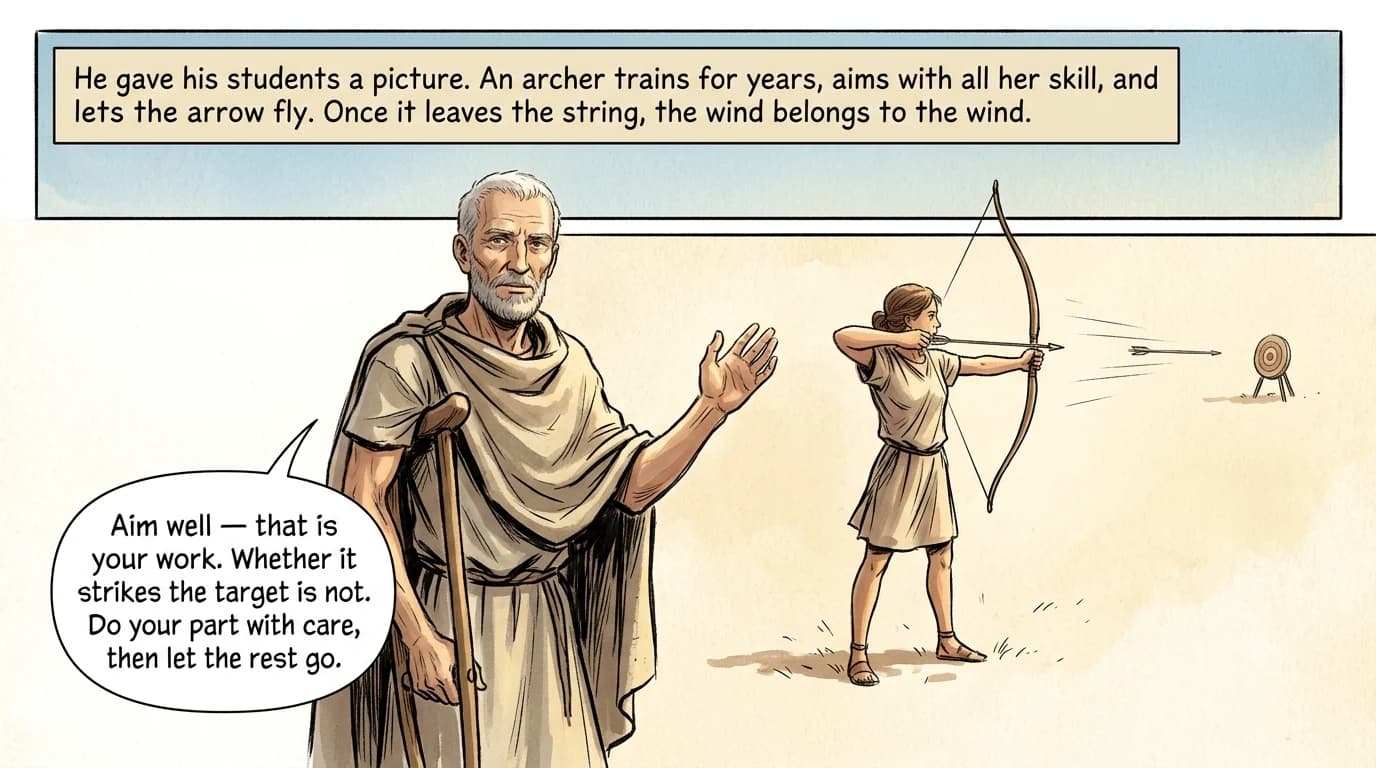
On the left a teacher gestures toward an illustrated scene on the right, where a young archer in profile looses an arrow from a fully drawn bow toward a distant target.
He gave his students a picture. An archer trains for years, aims with all her skill, and lets the arrow fly. Once it leaves the string, the wind belongs to the wind.
Epictetus: Aim well — that is your work. Whether it strikes the target is not. Do your part with care, then let the rest go.
Panel 5
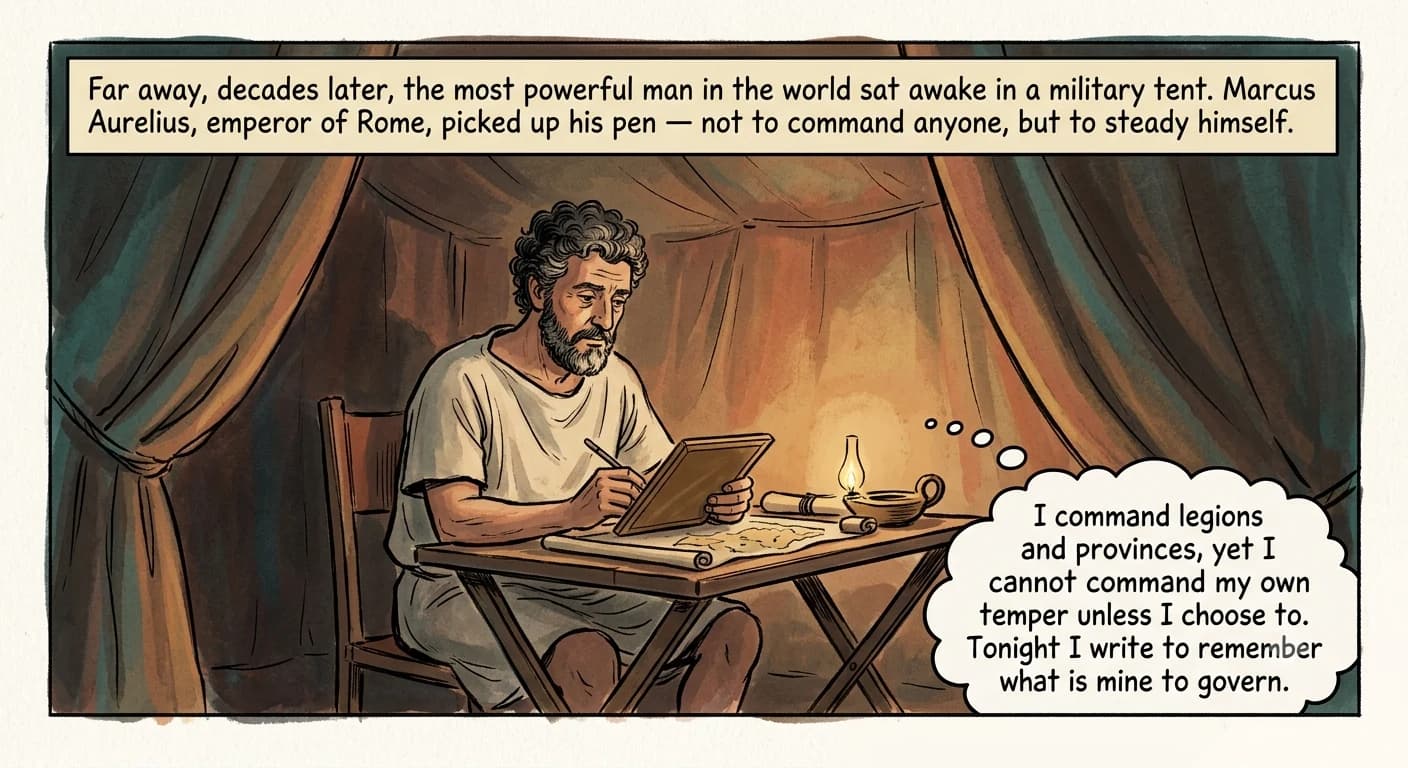
A bearded man in a plain tunic sits alone at a folding camp desk inside a dim military tent at night, a single oil lamp lighting a wax tablet as he pauses in thought.
Far away, decades later, the most powerful man in the world sat awake in a military tent. Marcus Aurelius, emperor of Rome, picked up his pen — not to command anyone, but to steady himself.
Marcus Aurelius: I command legions and provinces, yet I cannot command my own temper unless I choose to. Tonight I write to remember what is mine to govern.
Panel 6
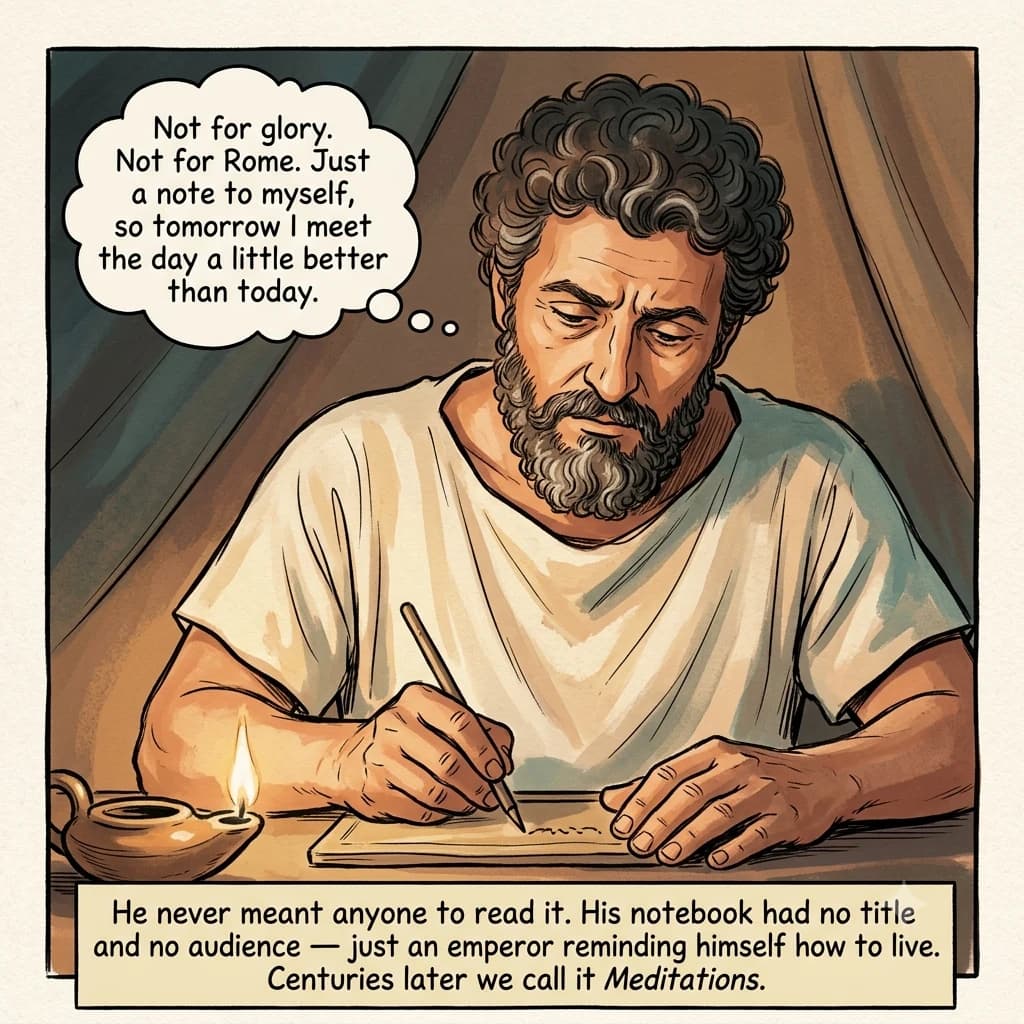
A close view of a bearded man bent over a plain personal wax tablet by lamplight, stylus mid-word, his brow furrowed in honest private reflection.
He never meant anyone to read it. His notebook had no title and no audience — just an emperor reminding himself how to live. Centuries later we call it Meditations.
Marcus Aurelius: Not for glory. Not for Rome. Just a note to myself, so tomorrow I meet the day a little better than today.
Panel 7
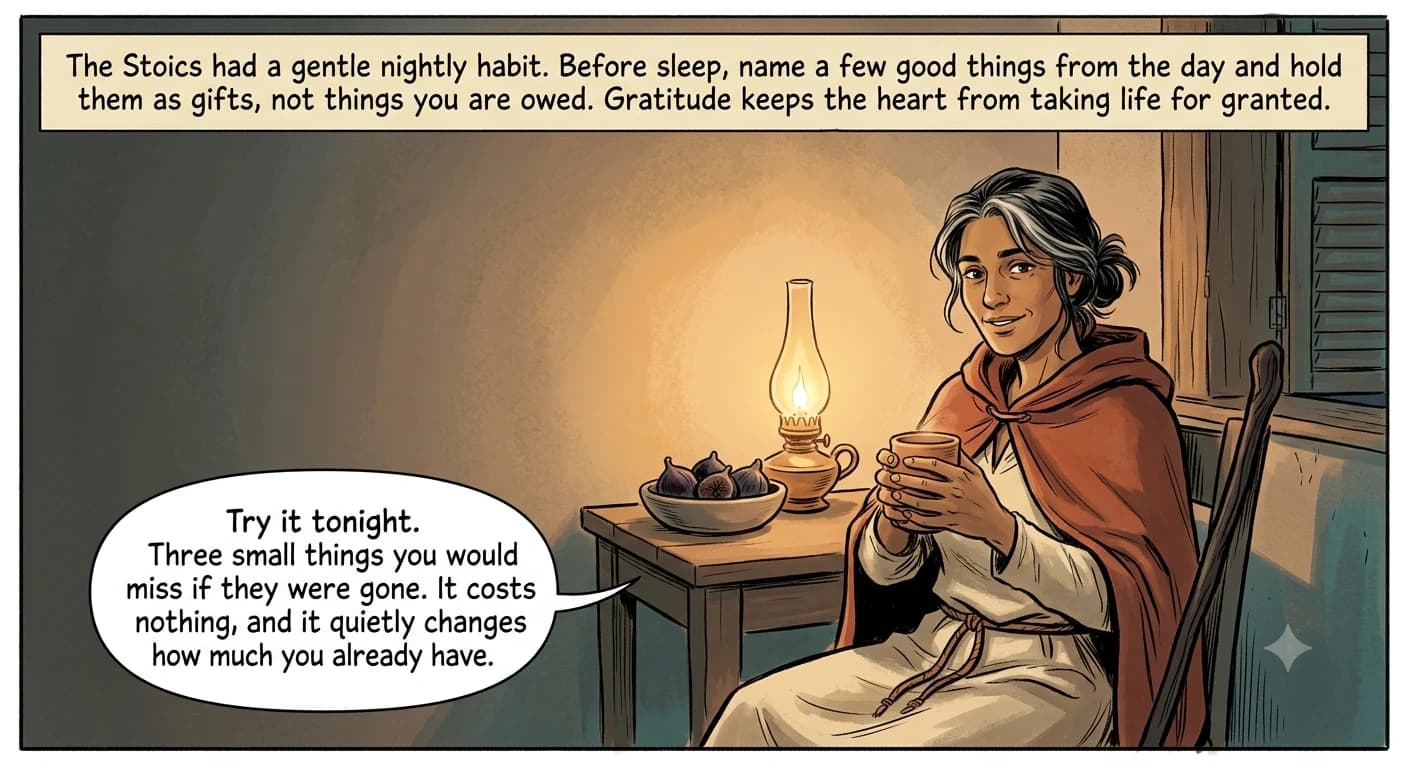
A warm evening interior where the philosophy guide sits at a small lamplit table by a shuttered window, hands around a cup, a calm grateful half-smile as she looks toward the reader.
The Stoics had a gentle nightly habit. Before sleep, name a few good things from the day and hold them as gifts, not things you are owed. Gratitude keeps the heart from taking life for granted.
Mira: Try it tonight. Three small things you would miss if they were gone. It costs nothing, and it quietly changes how much you already have.
Panel 8
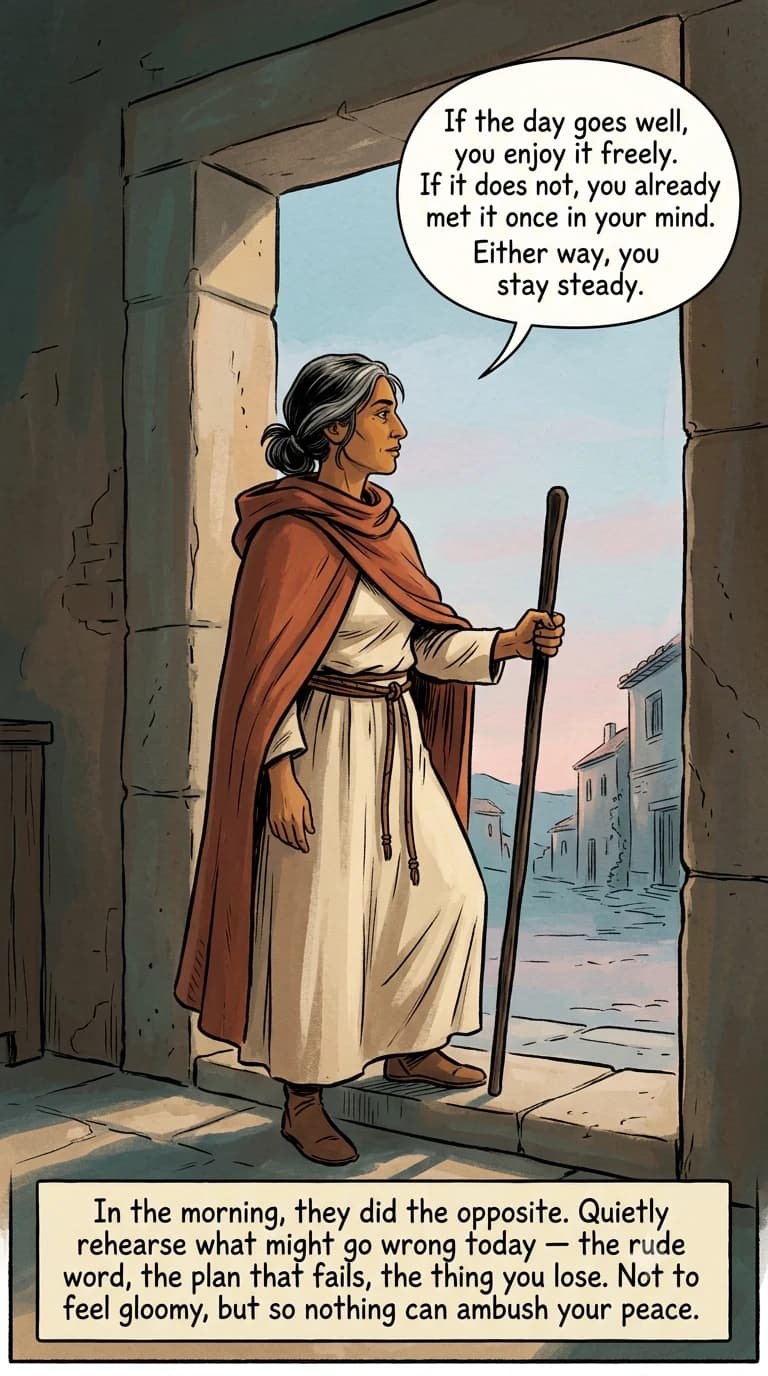
A tall view of the philosophy guide standing in a stone doorway at dawn, cloak wrapped against the chill and staff in hand, gazing out at a pale rose-and-blue morning sky.
In the morning, they did the opposite. Quietly rehearse what might go wrong today — the rude word, the plan that fails, the thing you lose. Not to feel gloomy, but so nothing can ambush your peace.
Mira: If the day goes well, you enjoy it freely. If it does not, you already met it once in your mind. Either way, you stay steady.
Panel 9
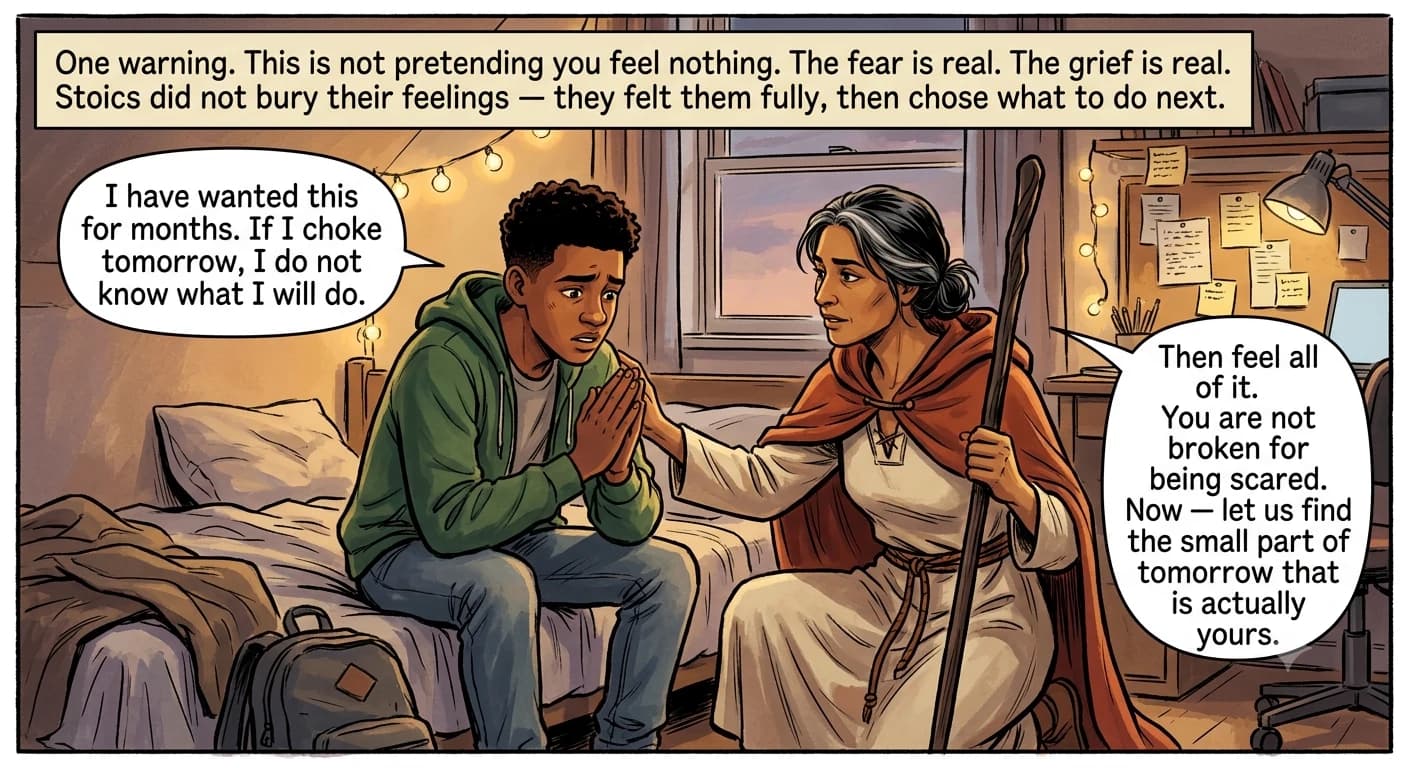
A modern bedroom at dusk where an anxious teenager sits hunched on the edge of the bed while the philosophy guide kneels beside him, one hand near his shoulder, listening calmly.
One warning. This is not pretending you feel nothing. The fear is real. The grief is real. Stoics did not bury their feelings — they felt them fully, then chose what to do next.
Sam: I have wanted this for months. If I choke tomorrow, I do not know what I will do.
Mira: Then feel all of it. You are not broken for being scared. Now — let us find the small part of tomorrow that is actually yours.
Panel 10
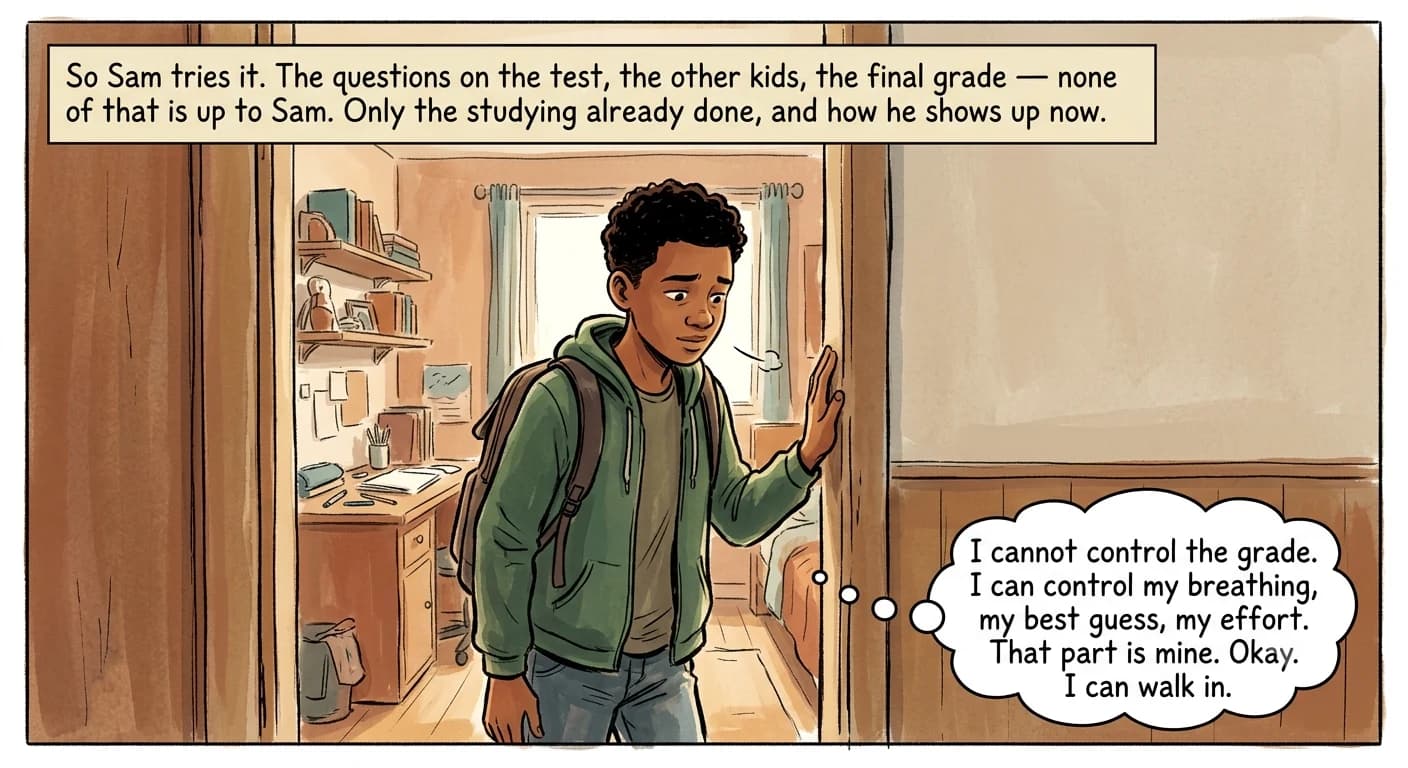
A teenager stands in a bedroom doorway with a backpack on one shoulder, one hand on the frame, taking a steadying breath, his expression shifting from nervous to quietly resolved.
So Sam tries it. The questions on the test, the other kids, the final grade — none of that is up to Sam. Only the studying already done, and how he shows up now.
Sam: I cannot control the grade. I can control my breathing, my best guess, my effort. That part is mine. Okay. I can walk in.
Panel 11
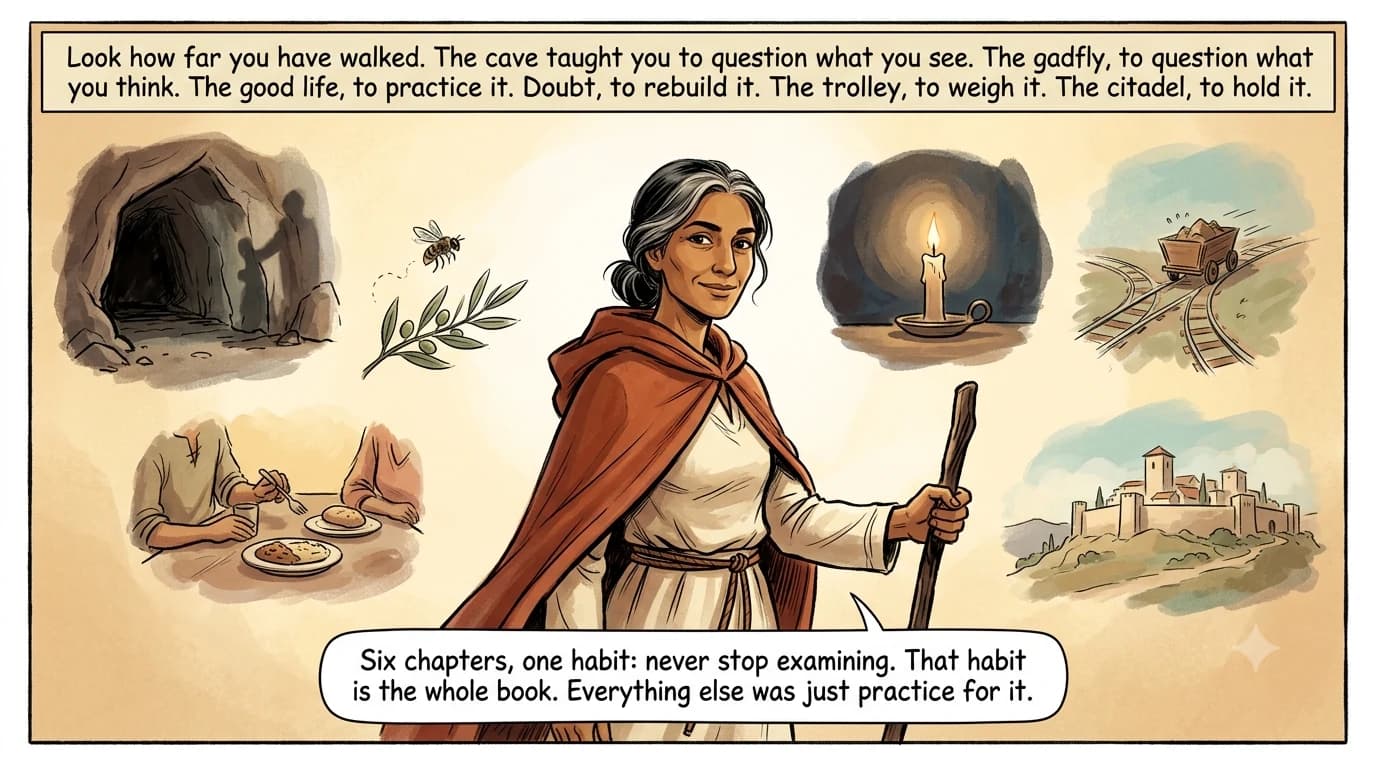
The philosophy guide stands in a soft golden space facing the reader, surrounded by six faint floating painted motifs recalling each chapter of the journey.
Look how far you have walked. The cave taught you to question what you see. The gadfly, to question what you think. The good life, to practice it. Doubt, to rebuild it. The trolley, to weigh it. The citadel, to hold it.
Mira: Six chapters, one habit: never stop examining. That habit is the whole book. Everything else was just practice for it.
Panel 12
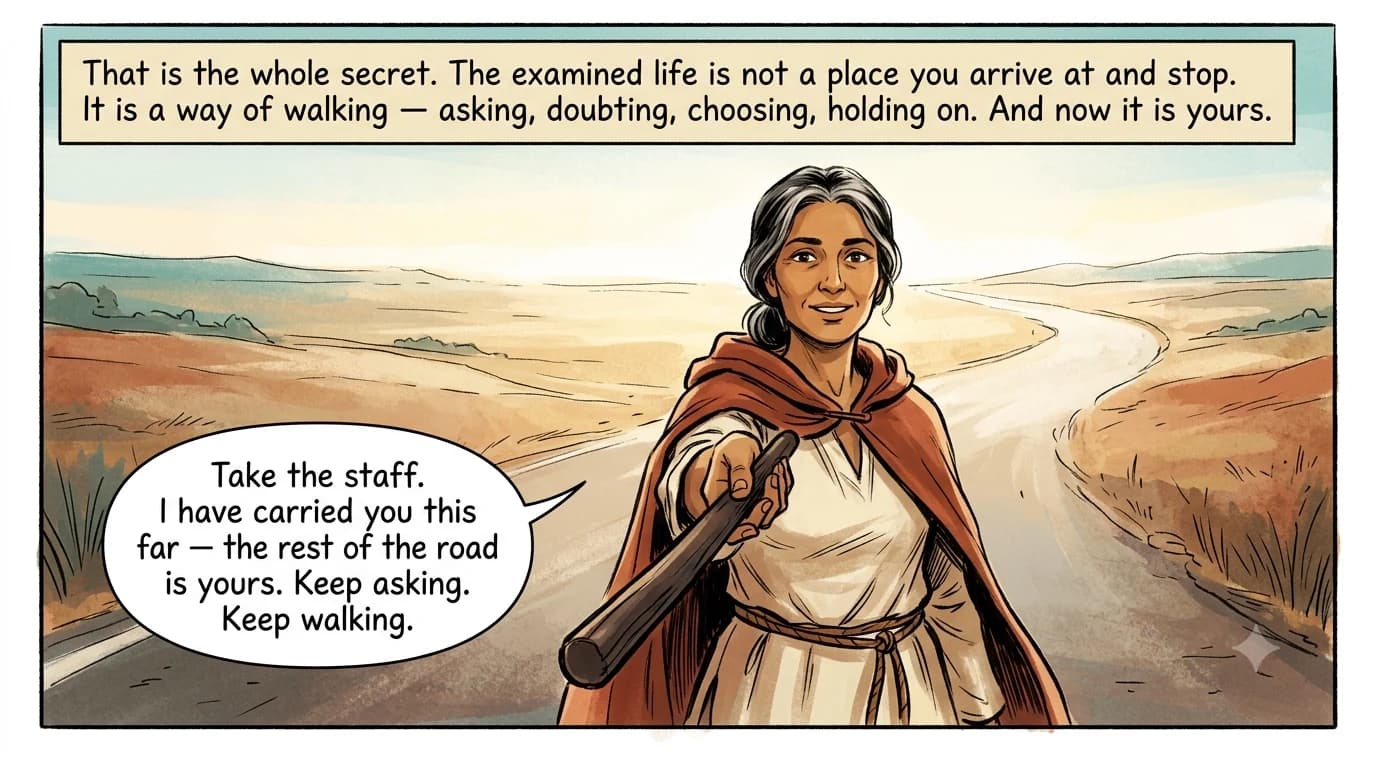
A final wide scene of the philosophy guide stepping toward the reader and holding out her wooden staff in offering, with a long open road winding away into a bright dawn behind her.
That is the whole secret. The examined life is not a place you arrive at and stop. It is a way of walking — asking, doubting, choosing, holding on. And now it is yours.
Mira: Take the staff. I have carried you this far — the rest of the road is yours. Keep asking. Keep walking.