The Examined Life · Chapter 2: The Gadfly
Cover
The Examined Life · Chapter 2
The Gadfly
How one barefoot old man in Athens turned questioning into a way of life — and died for it
In the noisy markets of ancient Athens, Socrates stopped confident people and asked what they really knew. He wrote nothing, annoyed the powerful, and faced a death sentence with astonishing calm — all to defend one idea: the unexamined life is not worth living.
12 panels · ~6 min read
Panel 1
Panel 2
Panel 3
Panel 4
Panel 5
Panel 6
Panel 7
Panel 8
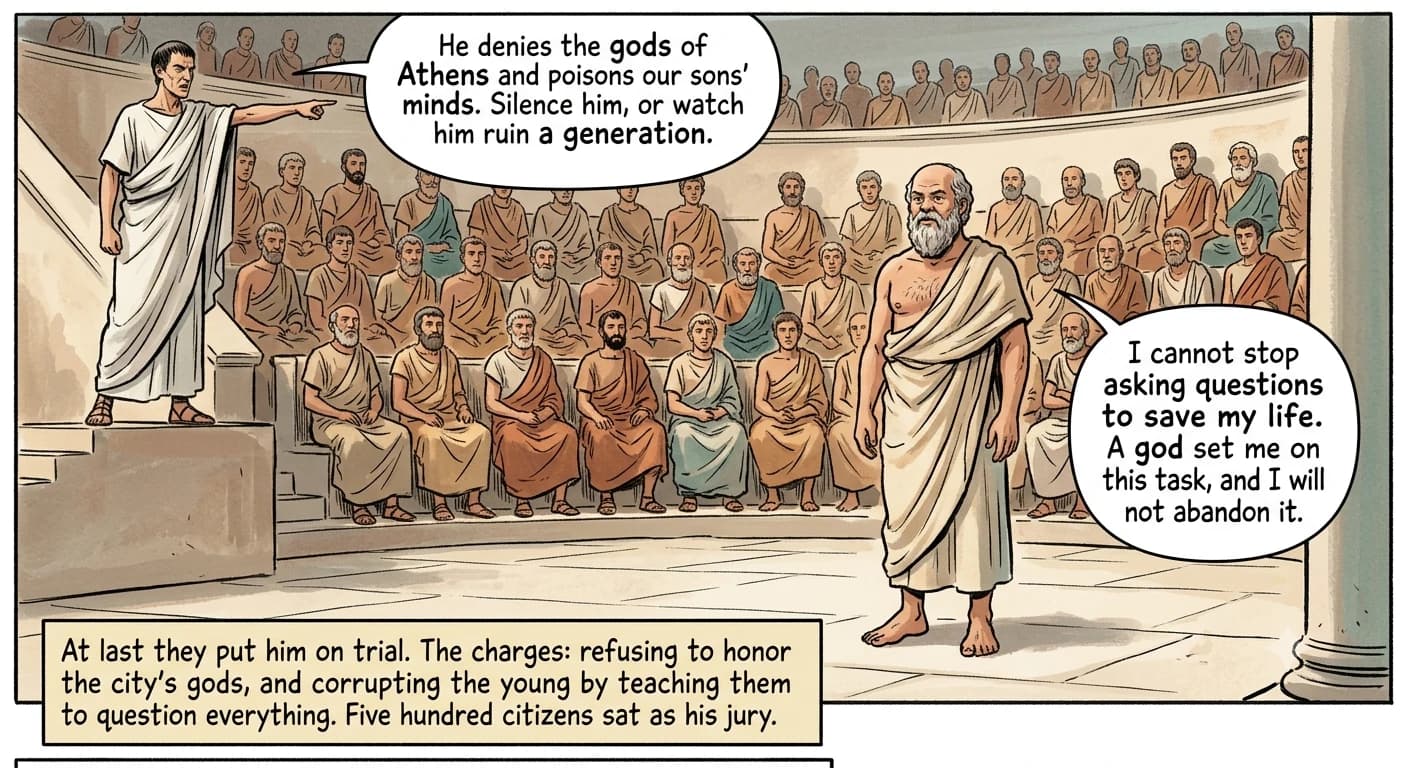
Panel 9
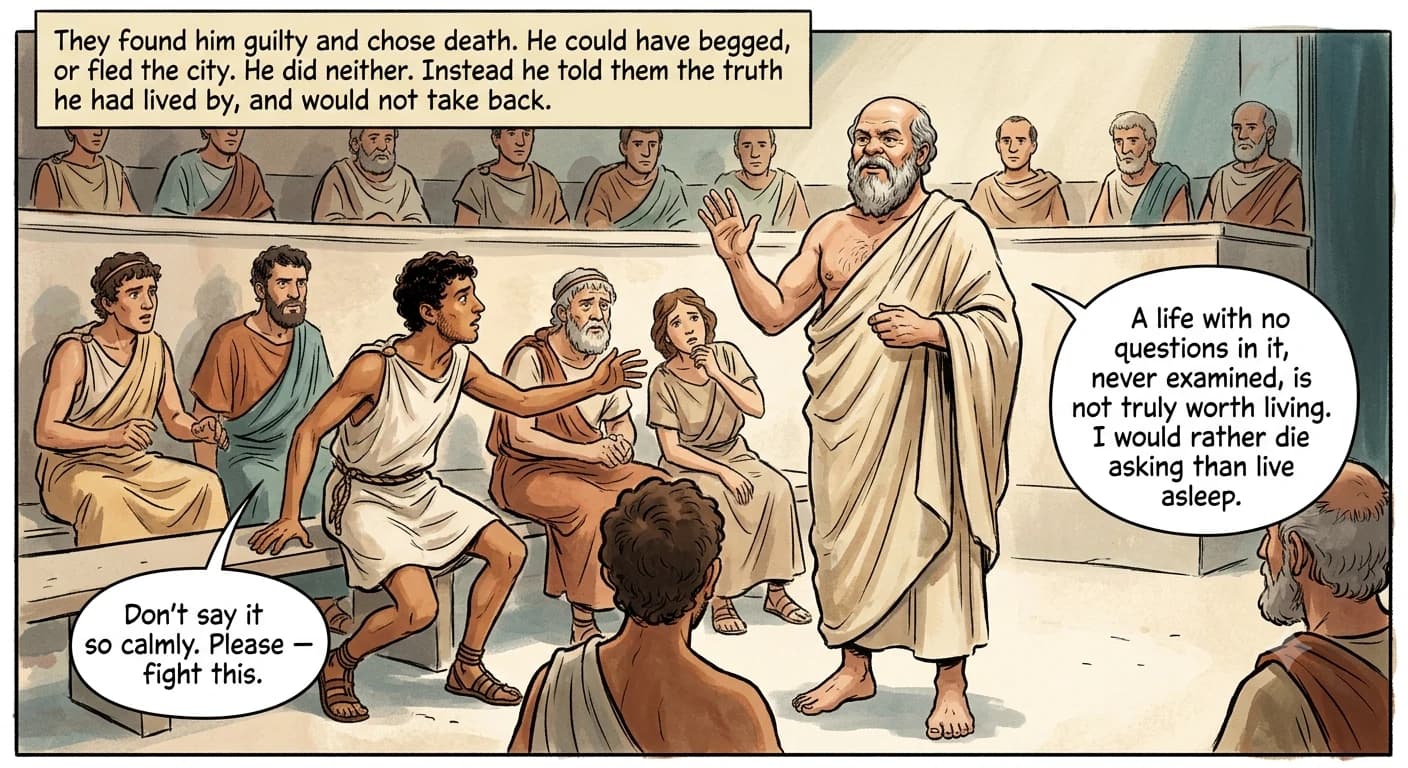
Panel 10
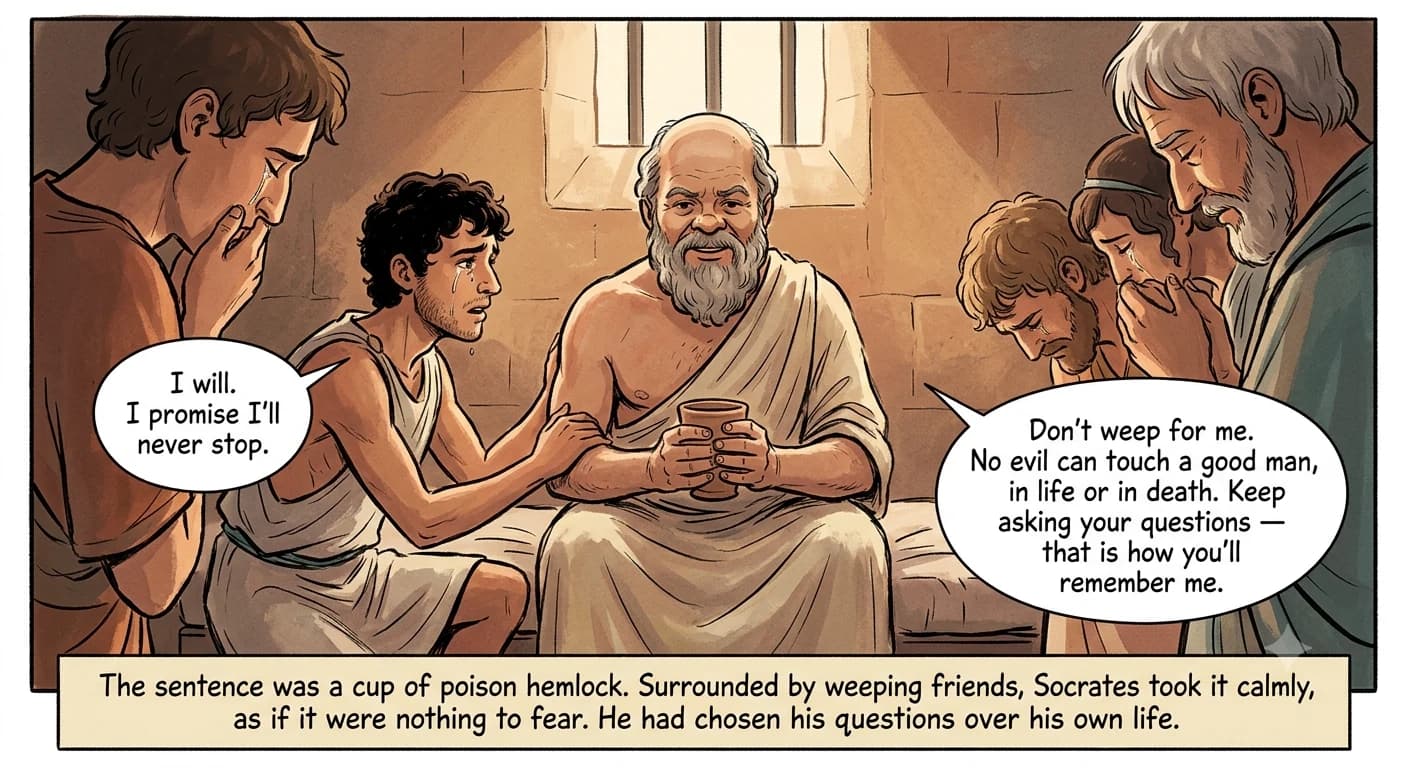
Panel 11
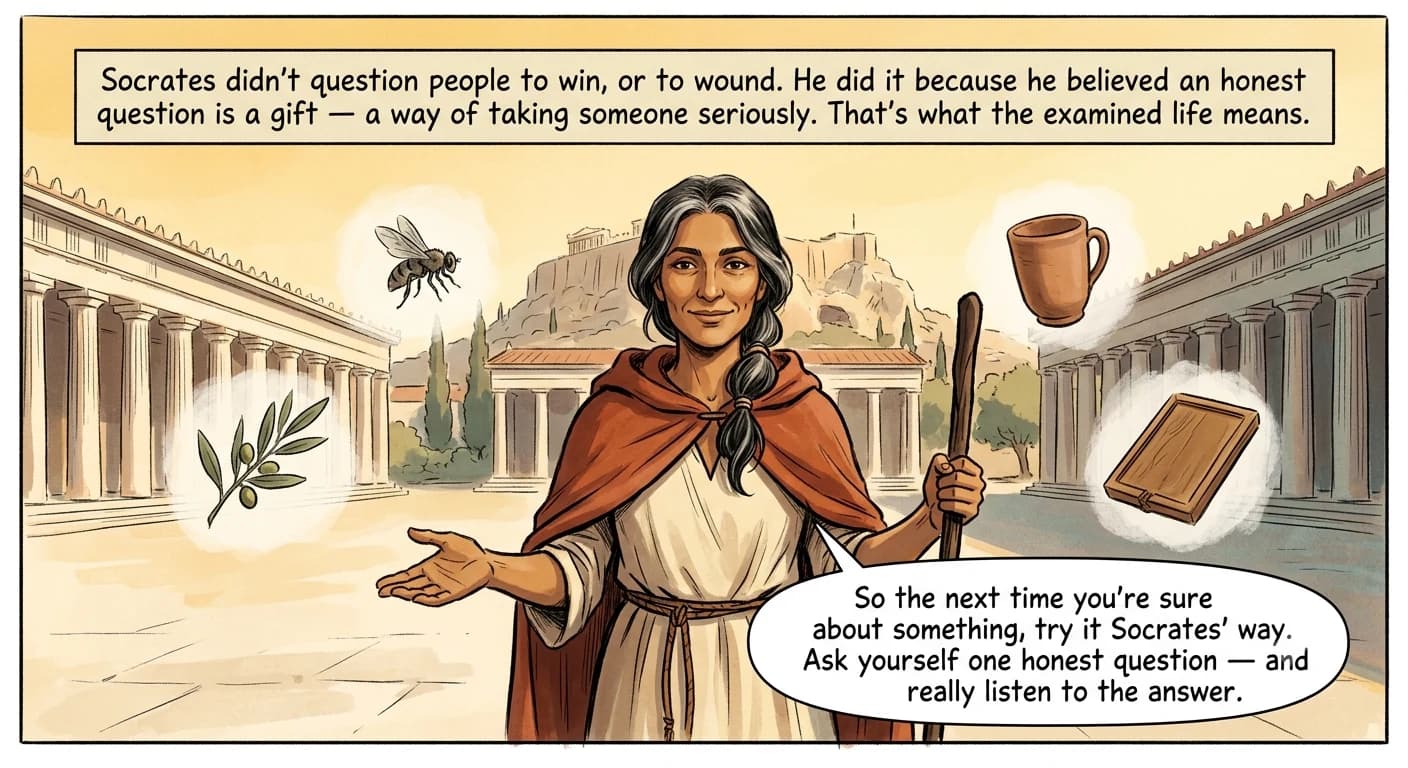
Panel 12
Read chapter text: The Gadfly
In the noisy markets of ancient Athens, Socrates stopped confident people and asked what they really knew. He wrote nothing, annoyed the powerful, and faced a death sentence with astonishing calm — all to defend one idea: the unexamined life is not worth living.
Panel 1
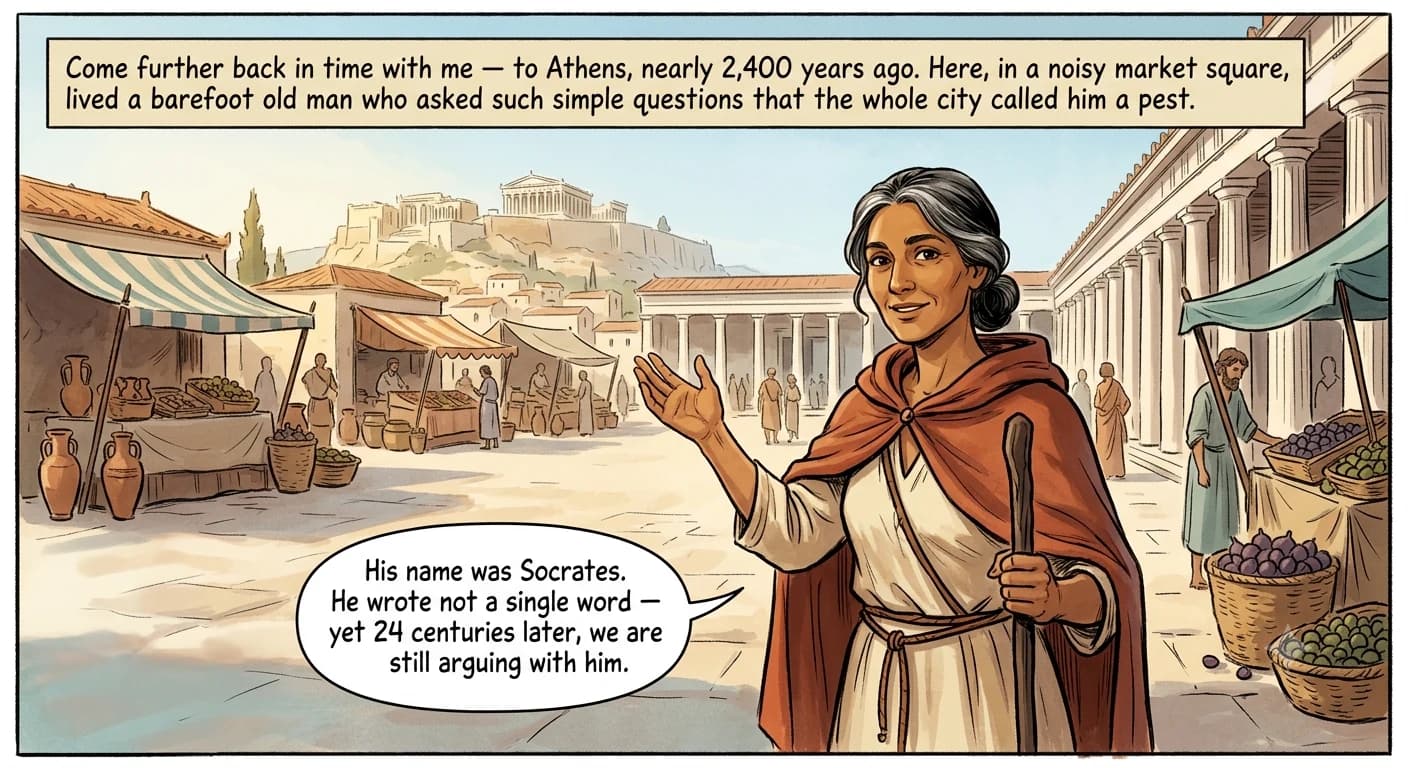
A warm philosophy guide stands in a sunlit ancient Athenian market square, turning to look out at the reader with an inviting gesture, the Acropolis hazy in the distance.
Come further back in time with me — to Athens, nearly 2,400 years ago. Here, in a noisy market square, lived a barefoot old man who asked such simple questions that the whole city called him a pest.
Mira: His name was Socrates. He wrote not a single word — yet 24 centuries later, we are still arguing with him.
Panel 2
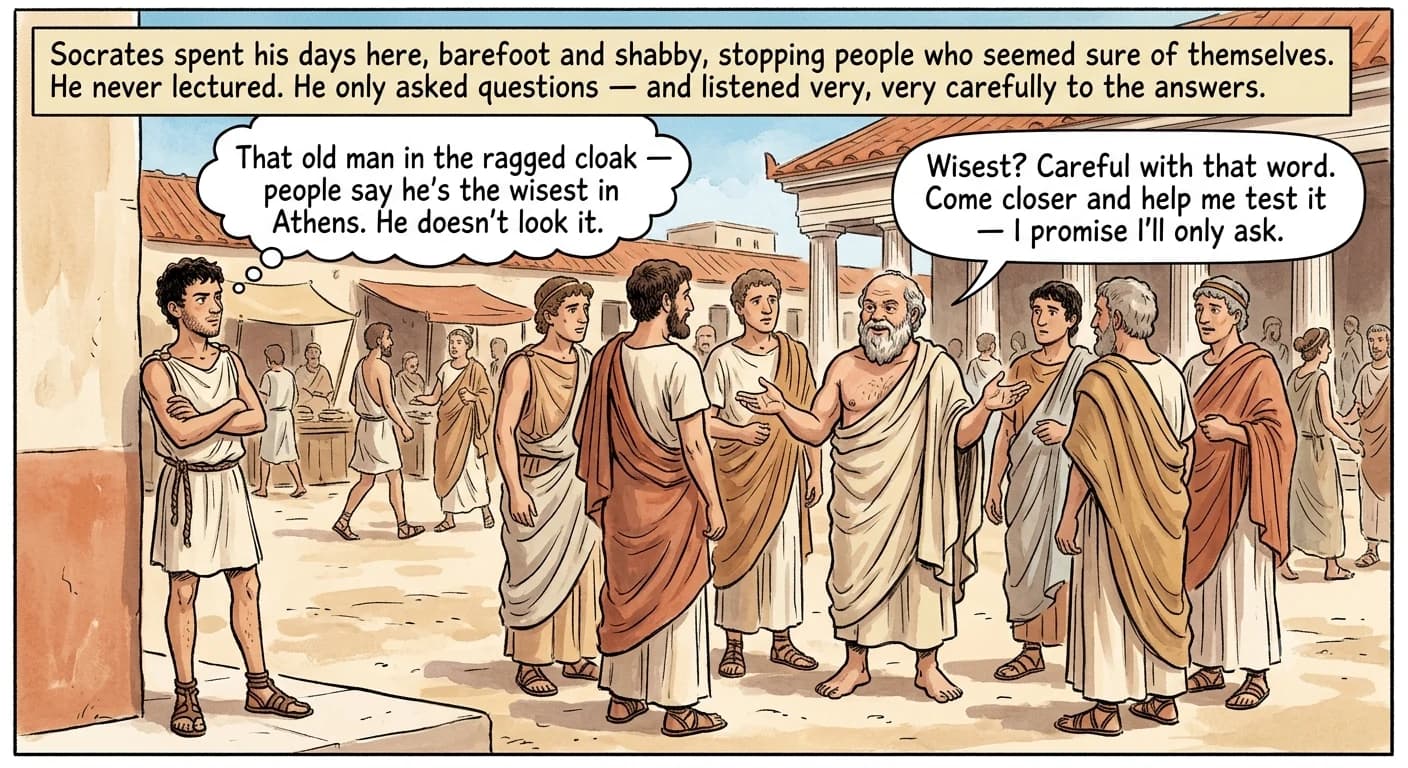
A stocky barefoot old man stands amused at the center of a loose ring of Athenian citizens in a sunlit market, while a skeptical teenage boy watches from the edge.
Socrates spent his days here, barefoot and shabby, stopping people who seemed sure of themselves. He never lectured. He only asked questions — and listened very, very carefully to the answers.
Deon: That old man in the ragged cloak — people say he's the wisest in Athens. He doesn't look it.
Socrates: Wisest? Careful with that word. Come closer and help me test it — I promise I'll only ask.
Panel 3
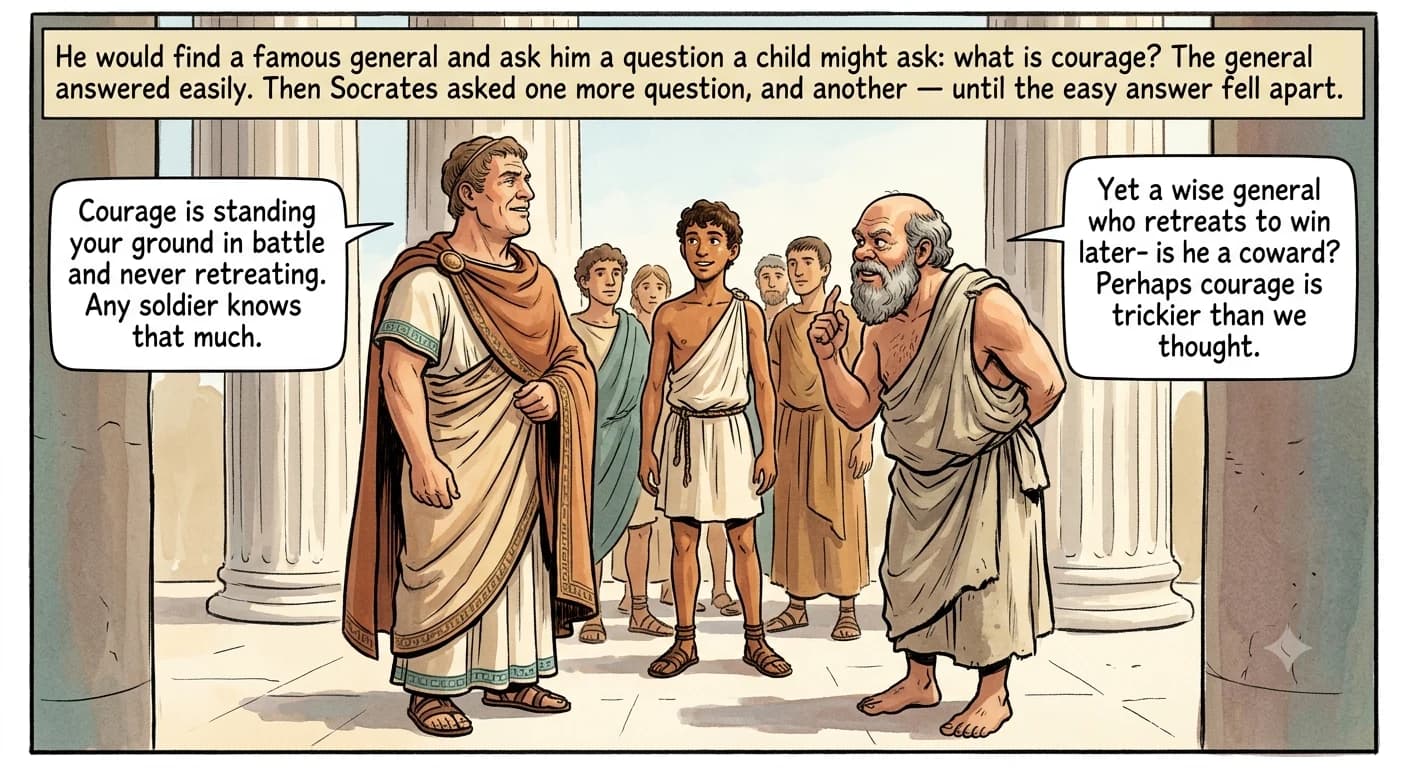
A proud Athenian general in a fine cloak faces a barefoot old man who leans in with a raised finger and a mischievous look, as onlookers watch in a sunlit colonnade.
He would find a famous general and ask him a question a child might ask: what is courage? The general answered easily. Then Socrates asked one more question, and another — until the easy answer fell apart.
The General: Courage is standing your ground in battle and never retreating. Any soldier knows that much.
Socrates: Yet a wise general who retreats to win later — is he a coward? Perhaps courage is trickier than we thought.
Panel 4
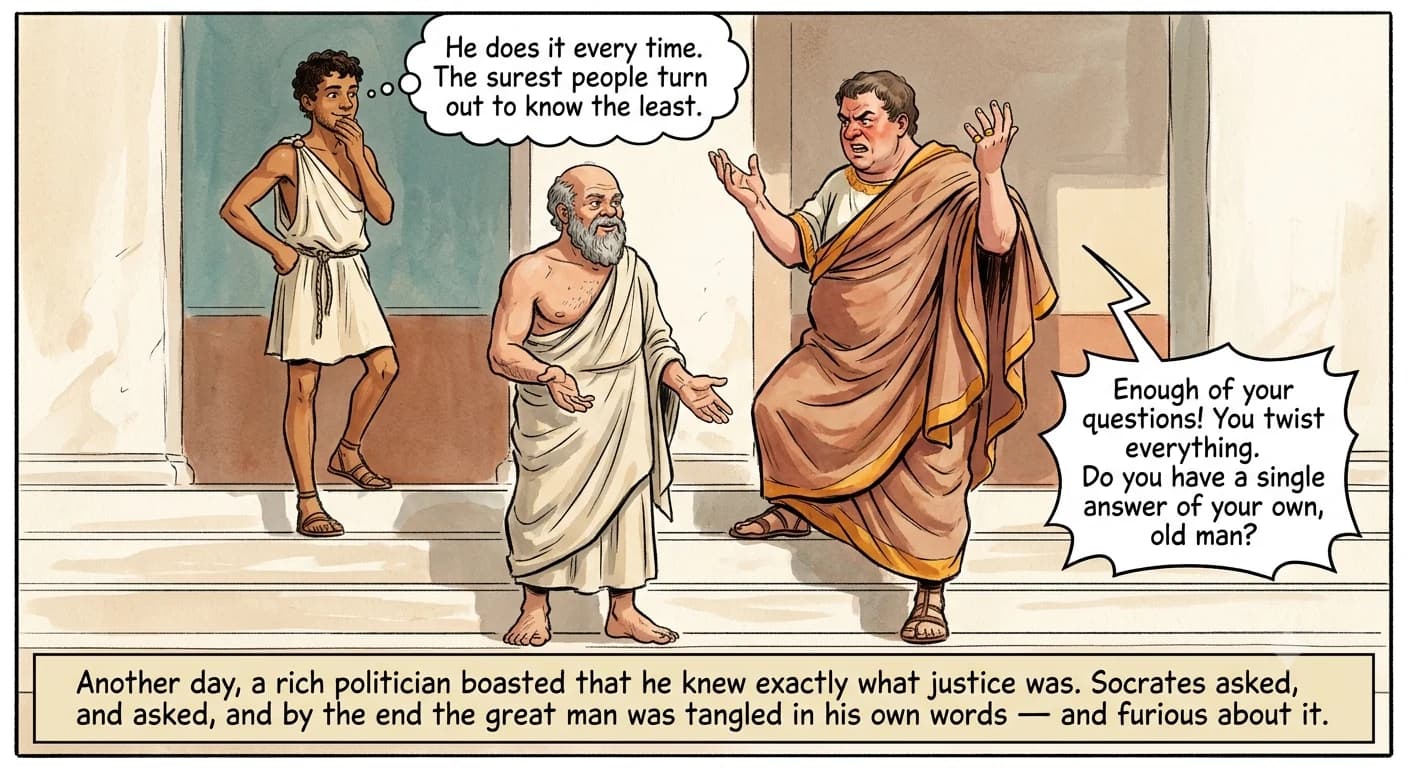
A plump, richly dressed politician throws up his hands in red-faced frustration on stone steps, while a calm barefoot old man smiles beside him and a boy hides a grin above them.
Another day, a rich politician boasted that he knew exactly what justice was. Socrates asked, and asked, and by the end the great man was tangled in his own words — and furious about it.
The Politician: Enough of your questions! You twist everything. Do you have a single answer of your own, old man?
Deon: He does it every time. The surest people turn out to know the least.
Panel 5
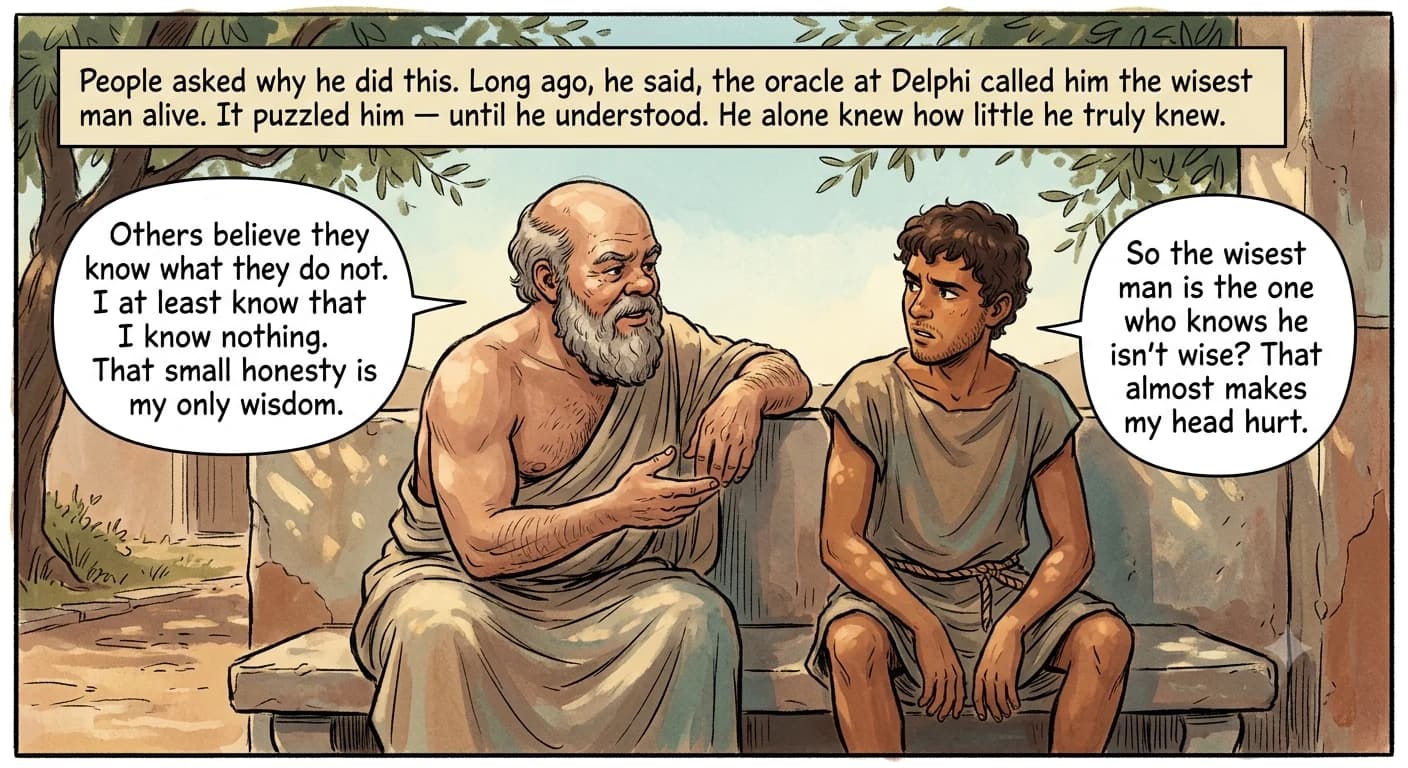
A barefoot old man and a teenage boy sit together on a worn stone bench in dappled olive-tree shade, deep in a quiet conversation at golden hour.
People asked why he did this. Long ago, he said, the oracle at Delphi called him the wisest man alive. It puzzled him — until he understood. He alone knew how little he truly knew.
Socrates: Others believe they know what they do not. I at least know that I know nothing. That small honesty is my only wisdom.
Deon: So the wisest man is the one who knows he isn't wise? That almost makes my head hurt.
Panel 6
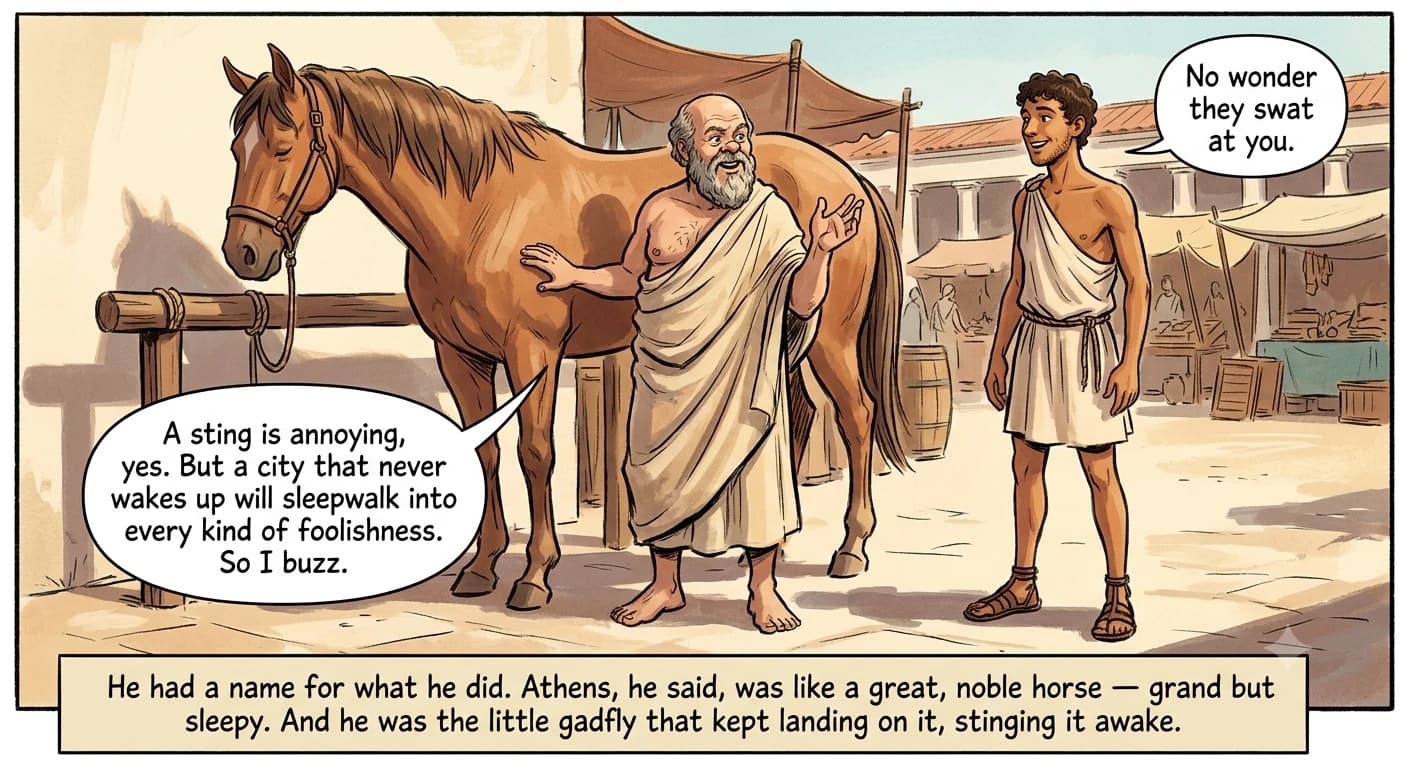
A barefoot old man stands beside a big, dozing, well-groomed horse at a market hitching rail, one hand near its flank and the other raised in a lively storyteller's gesture, a laughing youth nearby.
He had a name for what he did. Athens, he said, was like a great, noble horse — grand but sleepy. And he was the little gadfly that kept landing on it, stinging it awake.
Socrates: A sting is annoying, yes. But a city that never wakes up will sleepwalk into every kind of foolishness. So I buzz.
Deon: No wonder they swat at you.
Panel 7
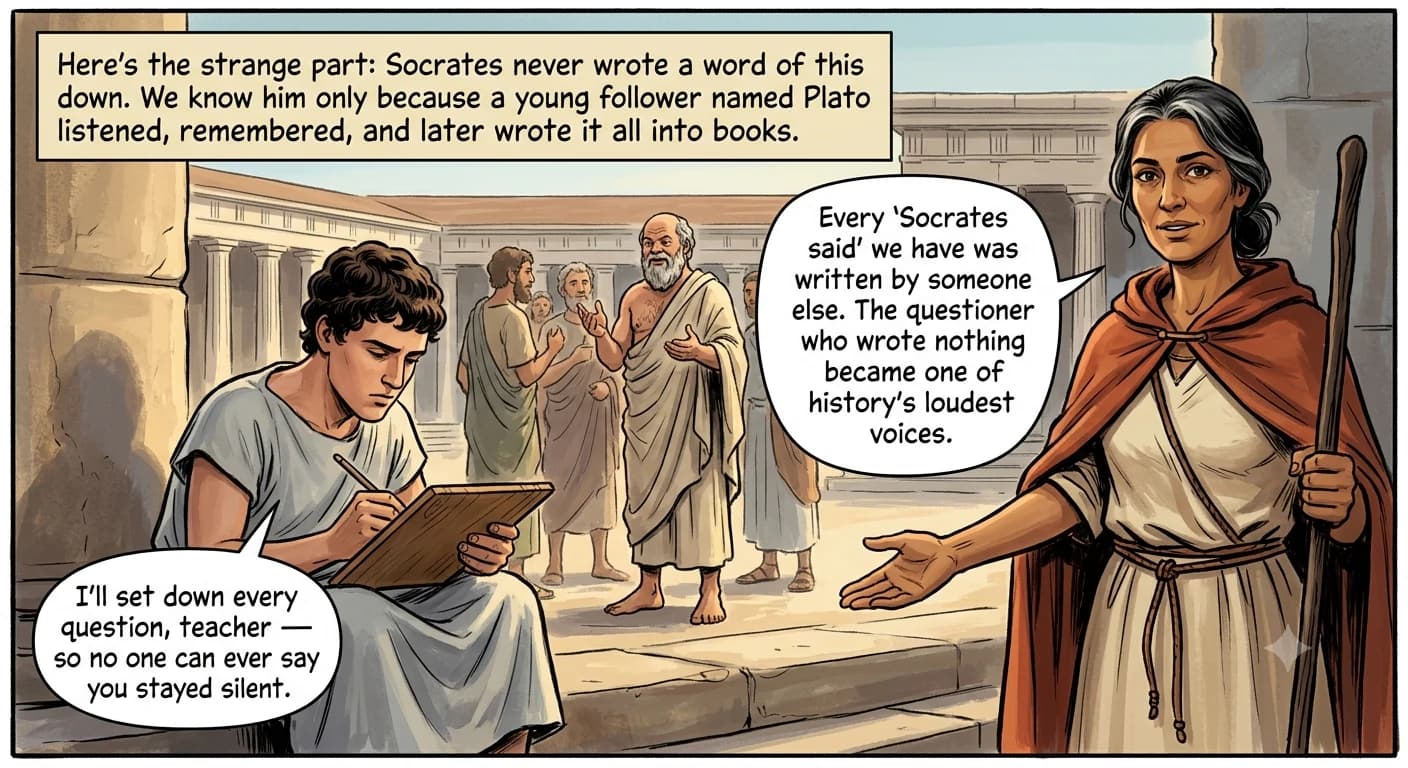
A serious teenage boy sits on a step writing on a wax tablet in the foreground, a barefoot old man talks with a group behind him, and a timeless cloaked guide steps in from the right to address the reader.
Here's the strange part: Socrates never wrote a word of this down. We know him only because a young follower named Plato listened, remembered, and later wrote it all into books.
Mira: Every 'Socrates said' we have was written by someone else. The questioner who wrote nothing became one of history's loudest voices.
Plato: I'll set down every question, teacher — so no one can ever say you stayed silent.
Panel 8
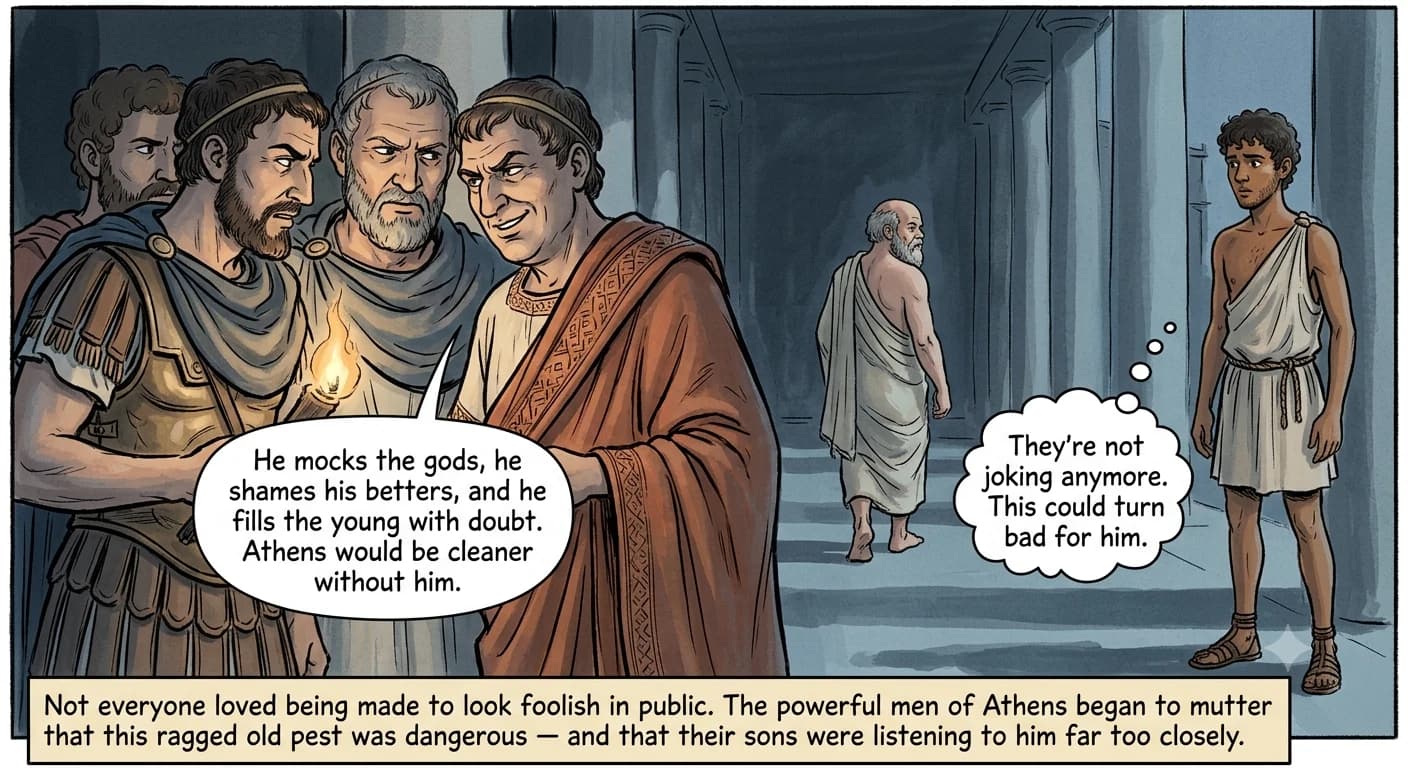
In a shadowed dusk colonnade, a tight huddle of richly dressed Athenian men lean together muttering with hard faces, while a small barefoot figure walks away in the distance and a worried youth looks on.
Not everyone loved being made to look foolish in public. The powerful men of Athens began to mutter that this ragged old pest was dangerous — and that their sons were listening to him far too closely.
The Politician: He mocks the gods, he shames his betters, and he fills the young with doubt. Athens would be cleaner without him.
Deon: They're not joking anymore. This could turn bad for him.
Panel 9
A small barefoot old man stands composed on the floor of a large open-air Athenian court, facing curved tiers of hundreds of seated jurors, as a severe accuser points at him from a speaker's step.
At last they put him on trial. The charges: refusing to honor the city's gods, and corrupting the young by teaching them to question everything. Five hundred citizens sat as his jury.
The Accuser: He denies the gods of Athens and poisons our sons' minds. Silence him, or watch him ruin a generation.
Socrates: I cannot stop asking questions to save my life. A god set me on this task, and I will not abandon it.
Panel 10
A calm barefoot old man stands with his chin lifted and one hand raised in an open gesture before a banked jury, a warm shaft of light on him, while a stricken youth half-rises reaching toward him.
They found him guilty and chose death. He could have begged, or fled the city. He did neither. Instead he told them the truth he had lived by, and would not take back.
Socrates: A life with no questions in it, never examined, is not truly worth living. I would rather die asking than live asleep.
Deon: Don't say it so calmly. Please — fight this.
Panel 11
A serene old man sits upright on a plain cot in a softly lit prison cell, both hands cupped calmly around a simple clay cup, while grieving friends bow their heads and a tearful youth grips his forearm.
The sentence was a cup of poison hemlock. Surrounded by weeping friends, Socrates took it calmly, as if it were nothing to fear. He had chosen his questions over his own life.
Socrates: Don't weep for me. No evil can touch a good man, in life or in death. Keep asking your questions — that is how you'll remember me.
Deon: I will. I promise I'll never stop.
Panel 12
A warm philosophy guide stands in a golden, nearly empty Athenian market square looking out at the reader, surrounded by faint painted motifs of a gadfly, an olive sprig, a clay cup, and a wax tablet.
Socrates didn't question people to win, or to wound. He did it because he believed an honest question is a gift — a way of taking someone seriously. That's what the examined life means.
Mira: So the next time you're sure about something, try it Socrates' way. Ask yourself one honest question — and really listen to the answer.