The Human Story · Chapter 2: The Agricultural Revolution
Cover
The Human Story · Chapter 2
The Agricultural Revolution
How wheat quietly rewrote the terms of being human
About 12,000 years ago, in the hill country of the Fertile Crescent, people began planting the wild grain they once only gathered. Follow one farmer's family through a season of harvest and hunger, surplus and toil, as a reliable crop reshapes their bodies, their village, and their freedom to ever walk away.
12 panels · ~6 min read
Panel 1
Panel 2
Panel 3
Panel 4
Panel 5
Panel 6
Panel 7
Panel 8
Panel 9
Panel 10
Panel 11
Panel 12
Read chapter text: The Agricultural Revolution
About 12,000 years ago, in the hill country of the Fertile Crescent, people began planting the wild grain they once only gathered. Follow one farmer's family through a season of harvest and hunger, surplus and toil, as a reliable crop reshapes their bodies, their village, and their freedom to ever walk away.
Panel 1
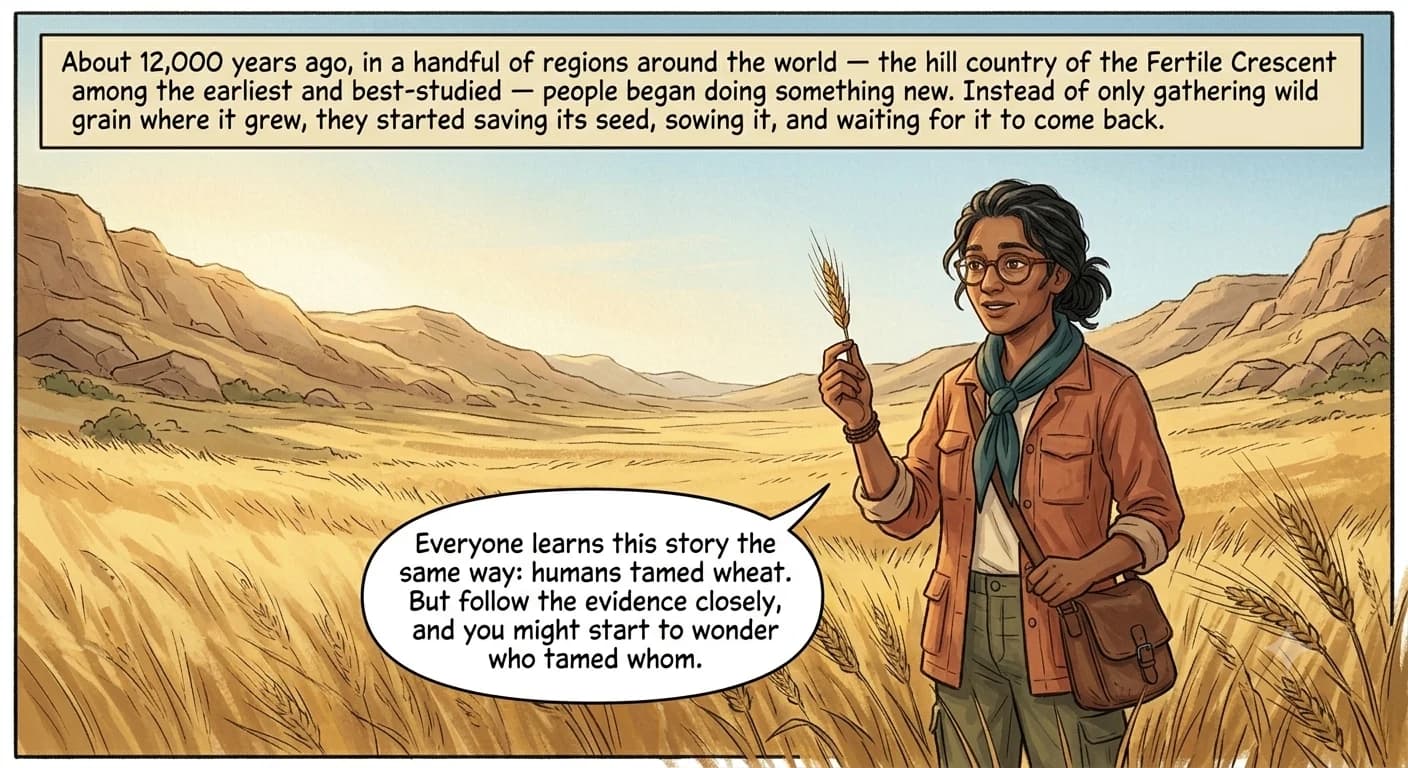
A field anthropologist stands at the edge of a wild wheat valley at dawn, holding up a single wheat spikelet toward the viewer, rocky foothills behind her.
About 12,000 years ago, in a handful of regions around the world — the hill country of the Fertile Crescent among the earliest and best-studied — people began doing something new. Instead of only gathering wild grain where it grew, they started saving its seed, sowing it, and waiting for it to come back.
Kessa: Everyone learns this story the same way: humans tamed wheat. But follow the evidence closely, and you might start to wonder who tamed whom.
Panel 2
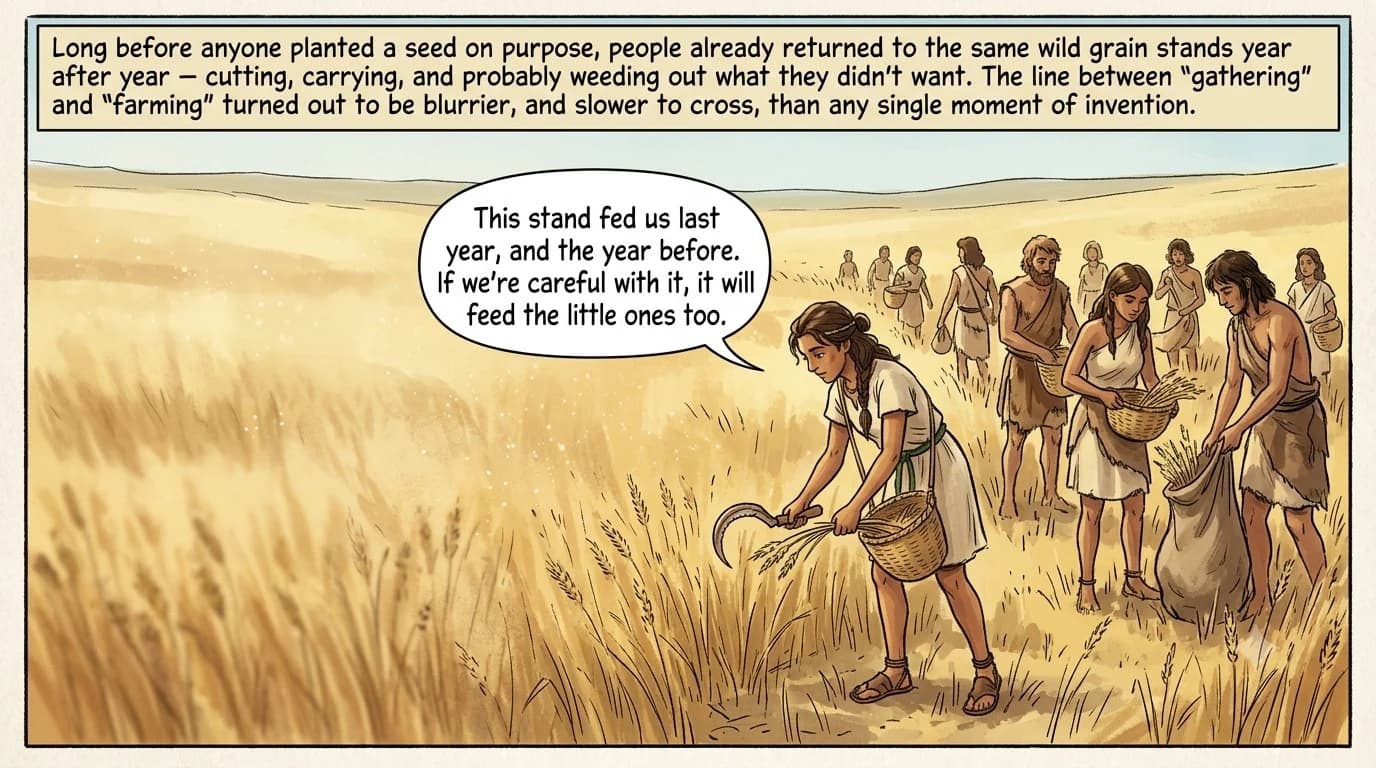
A young Neolithic woman harvests wild wheat by hand with a flint sickle alongside her foraging band in a sunlit valley, cutting grain heads into a basket at her hip.
Long before anyone planted a seed on purpose, people already returned to the same wild grain stands year after year — cutting, carrying, and probably weeding out what they didn't want. The line between "gathering" and "farming" turned out to be blurrier, and slower to cross, than any single moment of invention.
Nima: This stand fed us last year, and the year before. If we're careful with it, it will feed the little ones too.
Panel 3
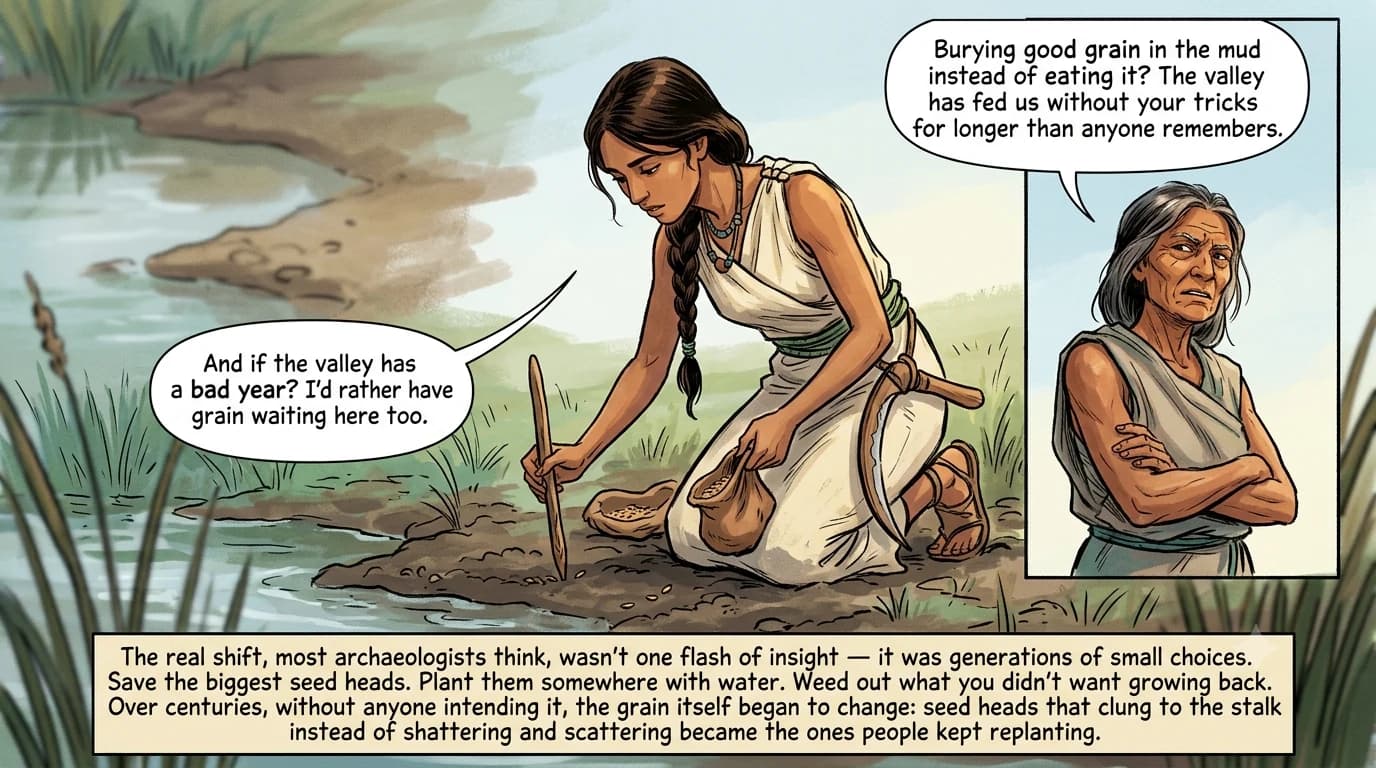
A young woman crouches by a stream pressing saved wheat seeds into softened soil with a digging stick, while an older skeptical woman looks on with arms crossed.
The real shift, most archaeologists think, wasn't one flash of insight — it was generations of small choices. Save the biggest seed heads. Plant them somewhere with water. Weed out what you didn't want growing back. Over centuries, without anyone intending it, the grain itself began to change: seed heads that clung to the stalk instead of shattering and scattering became the ones people kept replanting.
Nima's Mother: Burying good grain in the mud instead of eating it? The valley has fed us without your tricks for longer than anyone remembers.
Nima: And if the valley has a bad year? I'd rather have grain waiting here too.
Panel 4
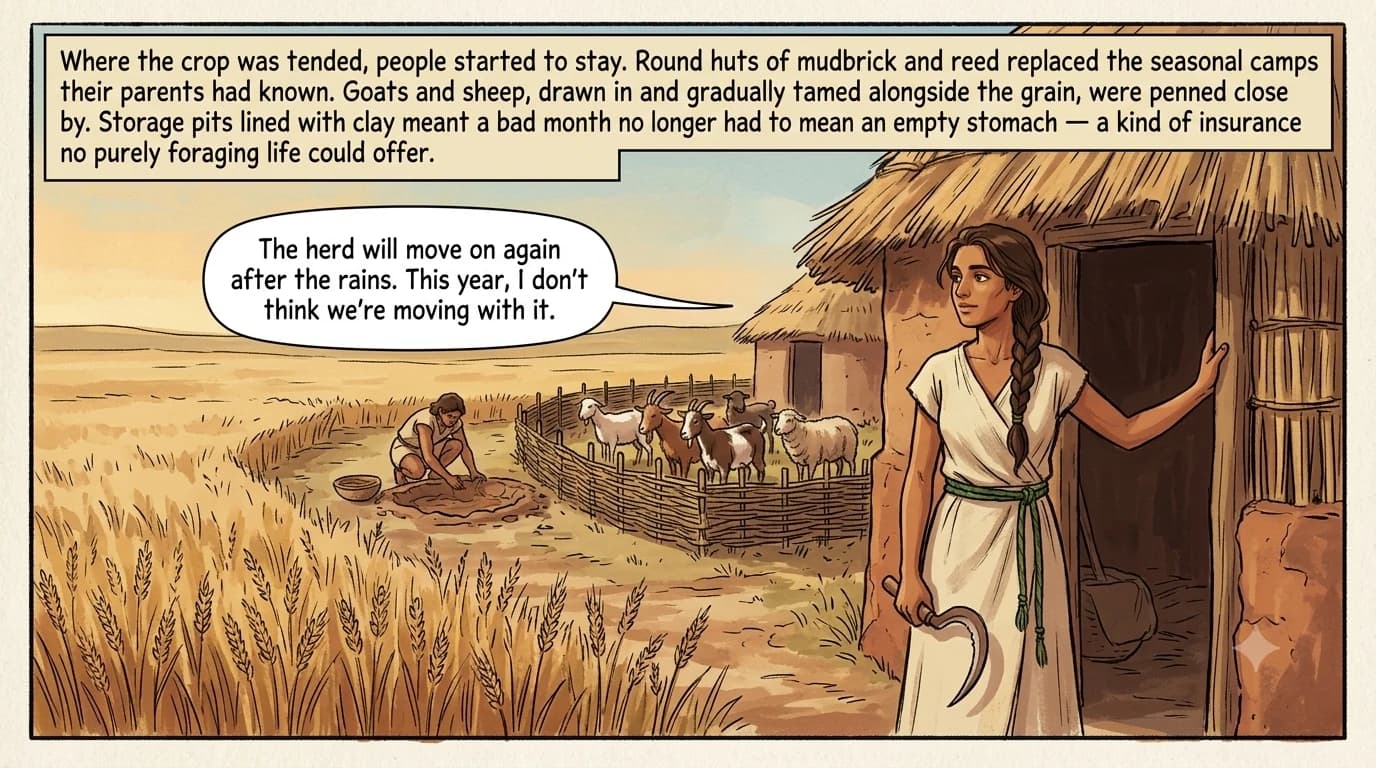
A small Neolithic village of round mudbrick and reed huts stands beside rows of cultivated wheat and barley, with penned goats and a woman digging a clay-lined storage pit.
Where the crop was tended, people started to stay. Round huts of mudbrick and reed replaced the seasonal camps their parents had known. Goats and sheep, drawn in and gradually tamed alongside the grain, were penned close by. Storage pits lined with clay meant a bad month no longer had to mean an empty stomach — a kind of insurance no purely foraging life could offer.
Nima: The herd will move on again after the rains. This year, I don't think we're moving with it.
Panel 5
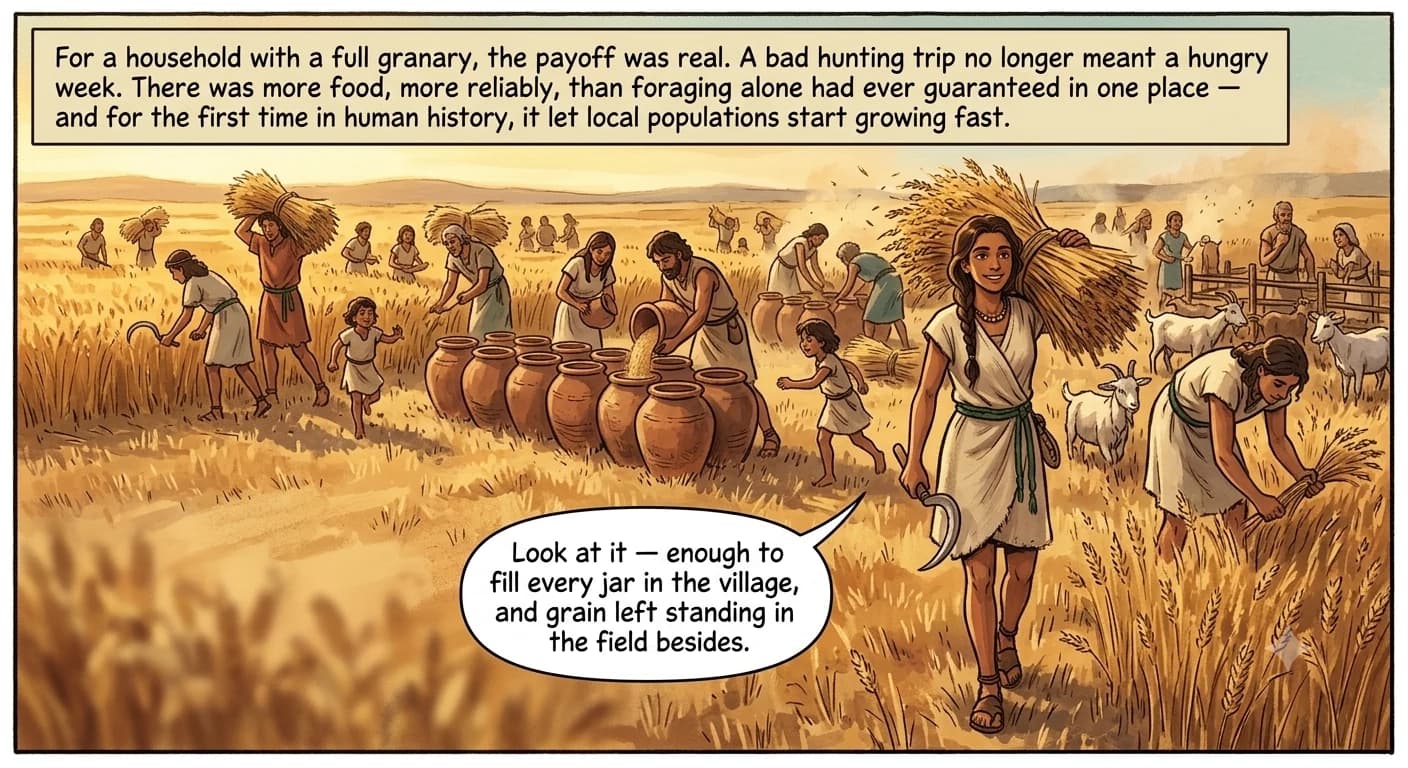
A whole Neolithic village harvests grain together at golden hour, carrying bundled sheaves and filling storage jars, children running between the workers and goats penned nearby.
For a household with a full granary, the payoff was real. A bad hunting trip no longer meant a hungry week. There was more food, more reliably, than foraging alone had ever guaranteed in one place — and for the first time in human history, it let local populations start growing fast.
Nima: Look at it — enough to fill every jar in the village, and grain left standing in the field besides.
Panel 6
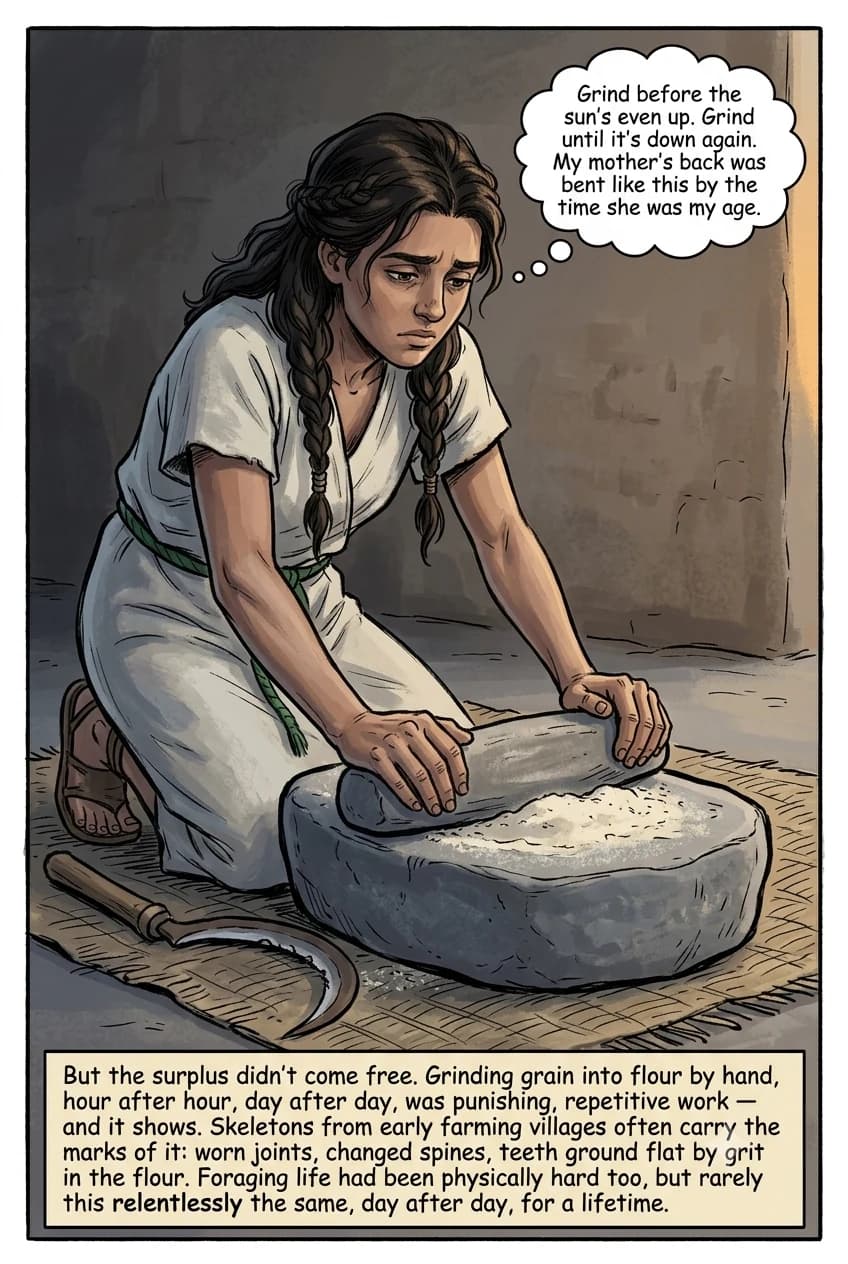
Close portrait of a young woman kneeling at dawn, back bent, calloused hands grinding grain into flour on a stone quern, her expression showing the dull ache of daily repetitive labor.
But the surplus didn't come free. Grinding grain into flour by hand, hour after hour, day after day, was punishing, repetitive work — and it shows. Skeletons from early farming villages often carry the marks of it: worn joints, changed spines, teeth ground flat by grit in the flour. Foraging life had been physically hard too, but rarely this relentlessly the same, day after day, for a lifetime.
Nima: Grind before the sun's even up. Grind until it's down again. My mother's back was bent like this by the time she was my age.
Panel 7
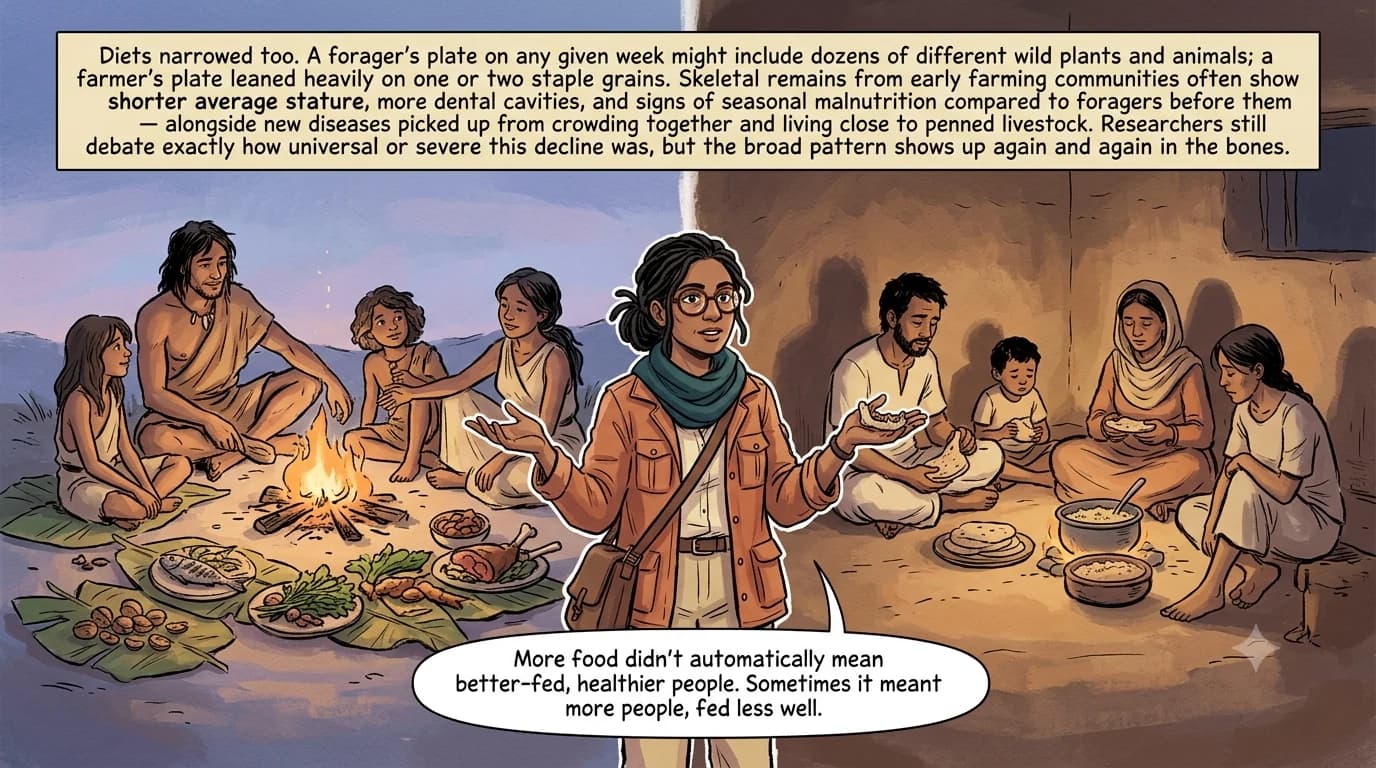
A split panel: on the left, a foraging family shares a varied meal of wild foods around a fire; on the right, a farming family shares a plainer meal of grain porridge and flatbread, with a guide figure standing at the dividing line holding an ancient jawbone.
Diets narrowed too. A forager's plate on any given week might include dozens of different wild plants and animals; a farmer's plate leaned heavily on one or two staple grains. Skeletal remains from early farming communities often show shorter average stature, more dental cavities, and signs of seasonal malnutrition compared to foragers before them — alongside new diseases picked up from crowding together and living close to penned livestock. Researchers still debate exactly how universal or severe this decline was, but the broad pattern shows up again and again in the bones.
Kessa: More food didn't automatically mean better-fed, healthier people. Sometimes it meant more people, fed less well.
Panel 8
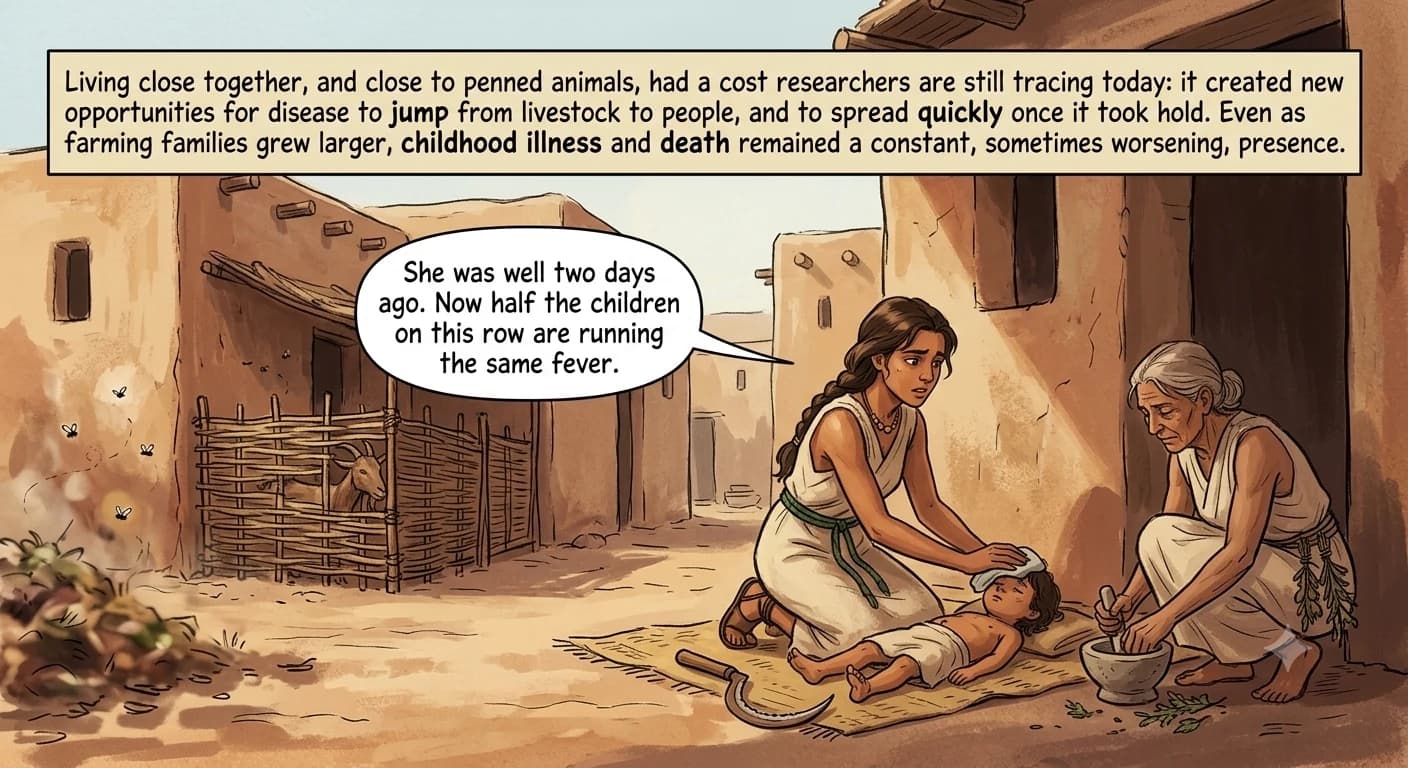
In a crowded, close-packed corner of a Neolithic village, a woman kneels beside a sick child on a mat while an unnamed healer grinds herbs nearby, a goat pen built against the house wall behind them.
Living close together, and close to penned animals, had a cost researchers are still tracing today: it created new opportunities for disease to jump from livestock to people, and to spread quickly once it took hold. Even as farming families grew larger, childhood illness and death remained a constant, sometimes worsening, presence.
Nima: She was well two days ago. Now half the children on this row are running the same fever.
Panel 9
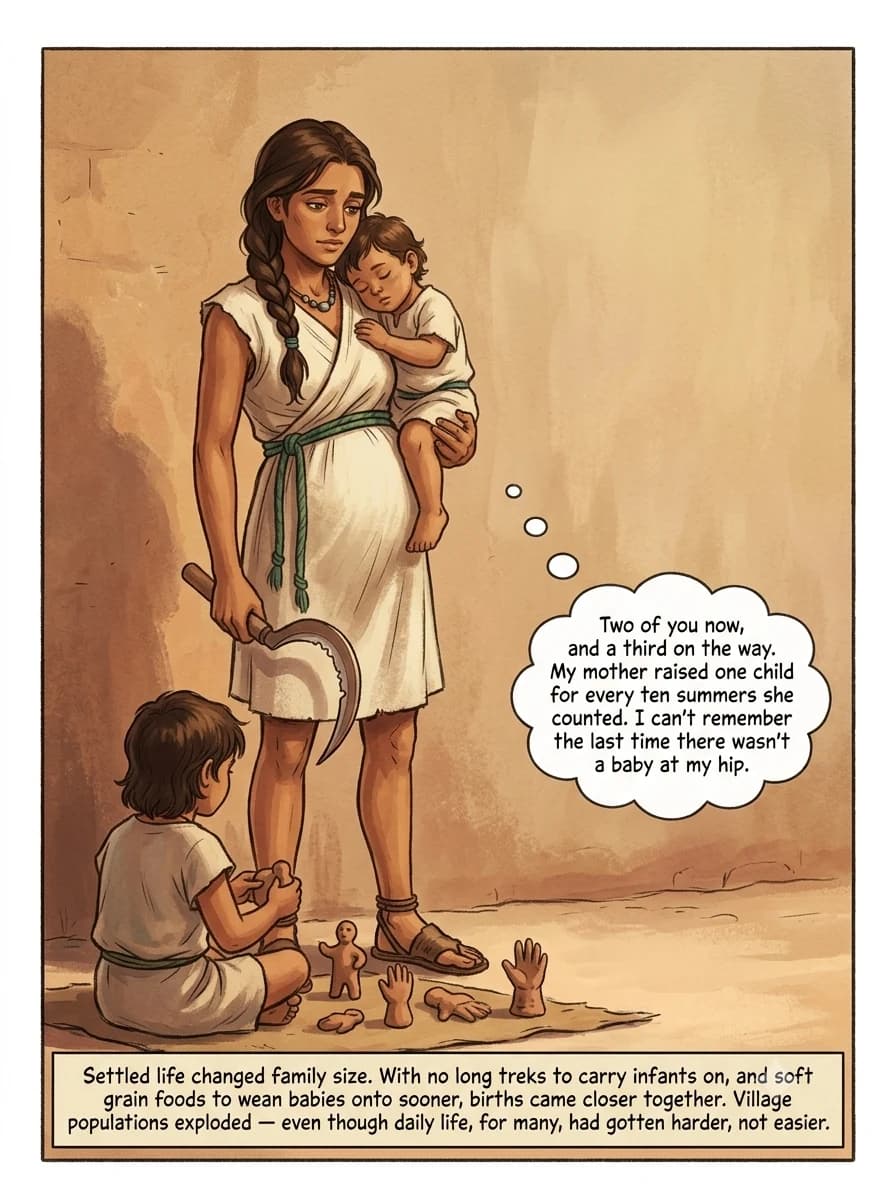
A visibly pregnant young woman stands in front of a mudbrick home holding a toddler on her hip while an older child plays with clay figurines at her feet.
Settled life changed family size. With no long treks to carry infants on, and soft grain foods to wean babies onto sooner, births came closer together. Village populations exploded — even though daily life, for many, had gotten harder, not easier.
Nima: Two of you now, and a third on the way. My mother raised one child for every ten summers she counted. I can't remember the last time there wasn't a baby at my hip.
Panel 10
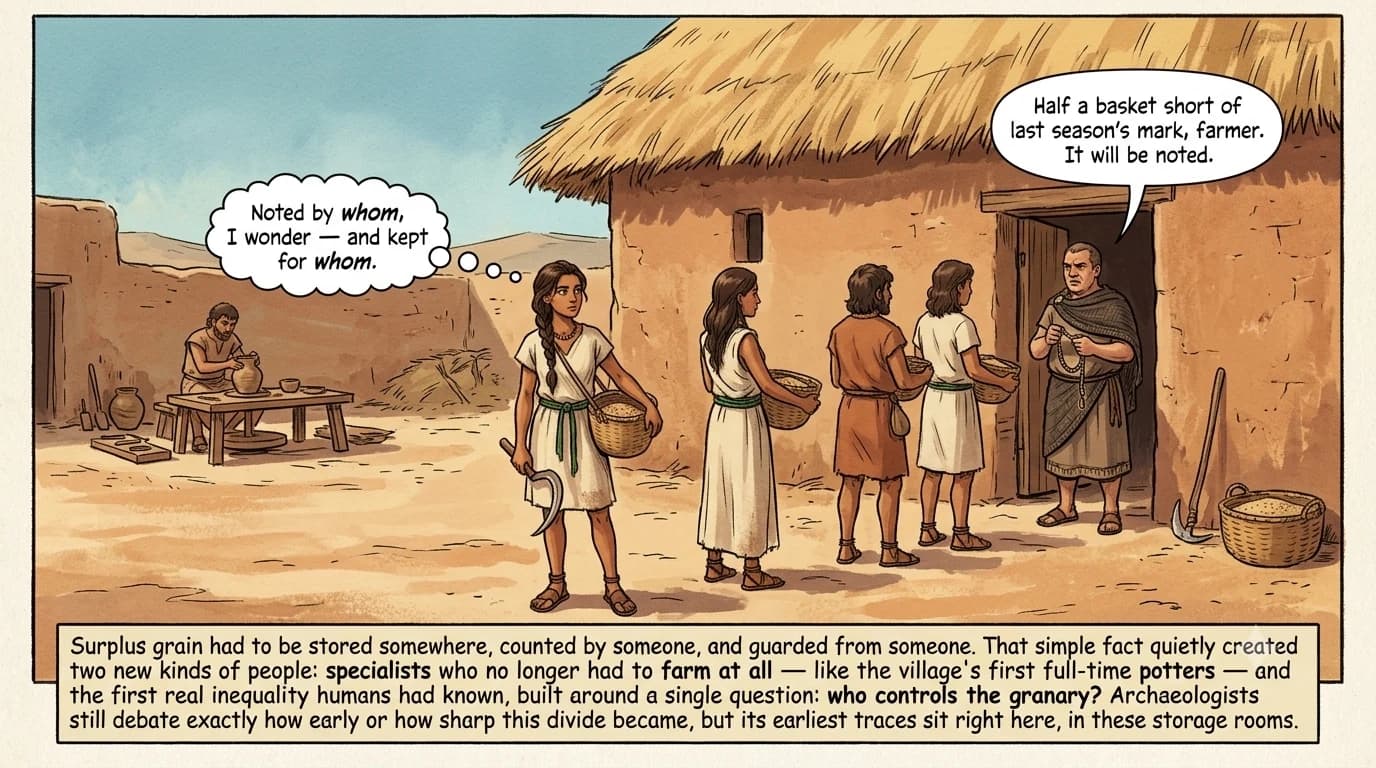
Villagers queue with baskets of grain outside a central mudbrick granary while an overseer marks tallies on a knotted cord; a potter works with clay in the background.
Surplus grain had to be stored somewhere, counted by someone, and guarded from someone. That simple fact quietly created two new kinds of people: specialists who no longer had to farm at all — like the village's first full-time potters — and the first real inequality humans had known, built around a single question: who controls the granary? Archaeologists still debate exactly how early or how sharp this divide became, but its earliest traces sit right here, in these storage rooms.
Granary Overseer: Half a basket short of last season's mark, farmer. It will be noted.
Nima: Noted by whom, I wonder — and kept for whom.
Panel 11
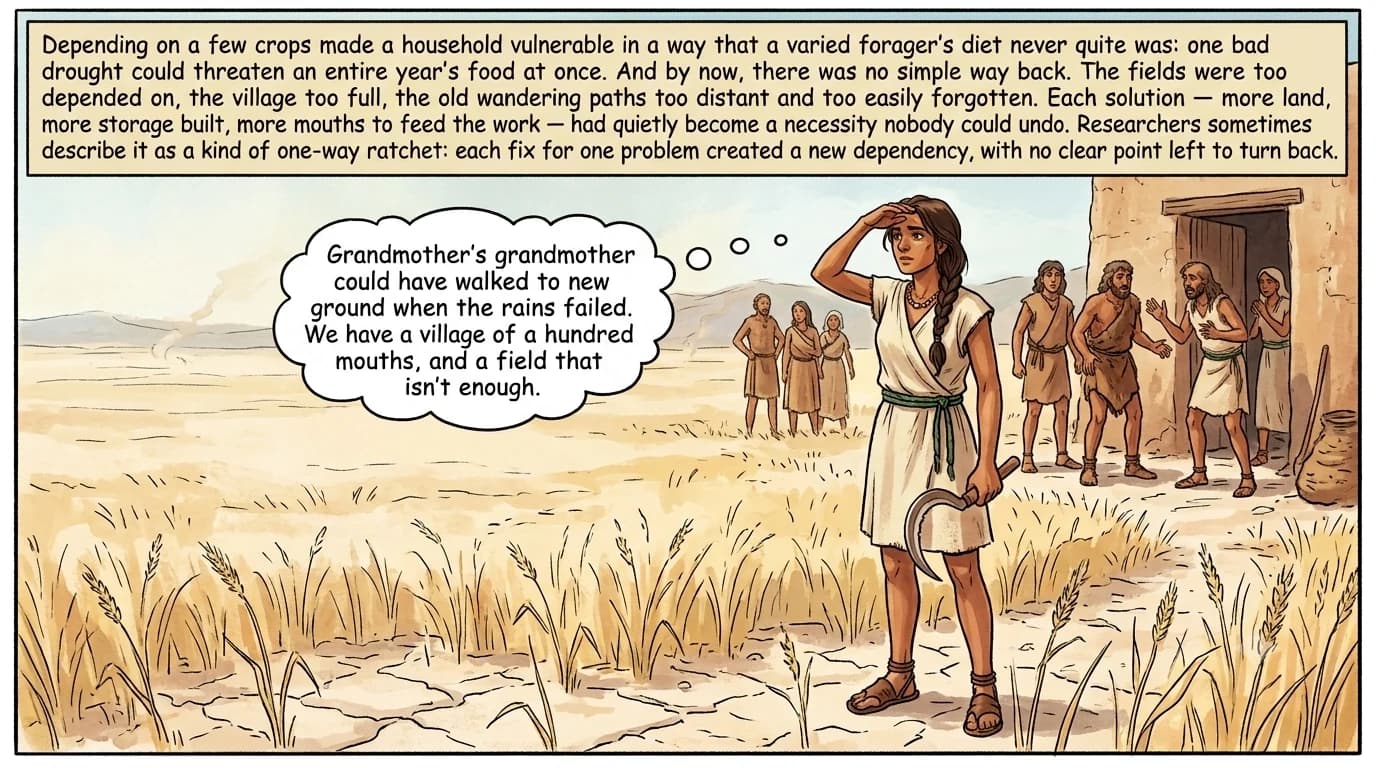
A woman stands at the edge of a drought-stricken field of cracked earth and stunted barley, looking toward distant hills, while worried villagers gather around a half-empty granary behind her.
Depending on a few crops made a household vulnerable in a way that a varied forager's diet never quite was: one bad drought could threaten an entire year's food at once. And by now, there was no simple way back. The fields were too depended on, the village too full, the old wandering paths too distant and too easily forgotten. Each solution — more land cleared, more storage built, more mouths to feed the work — had quietly become a necessity nobody could undo. Researchers sometimes describe it as a kind of one-way ratchet: each fix for one problem created a new dependency, with no clear point left to turn back.
Nima: Grandmother's grandmother could have walked to new ground when the rains failed. We have a village of a hundred mouths, and a field that isn't enough.
Panel 12
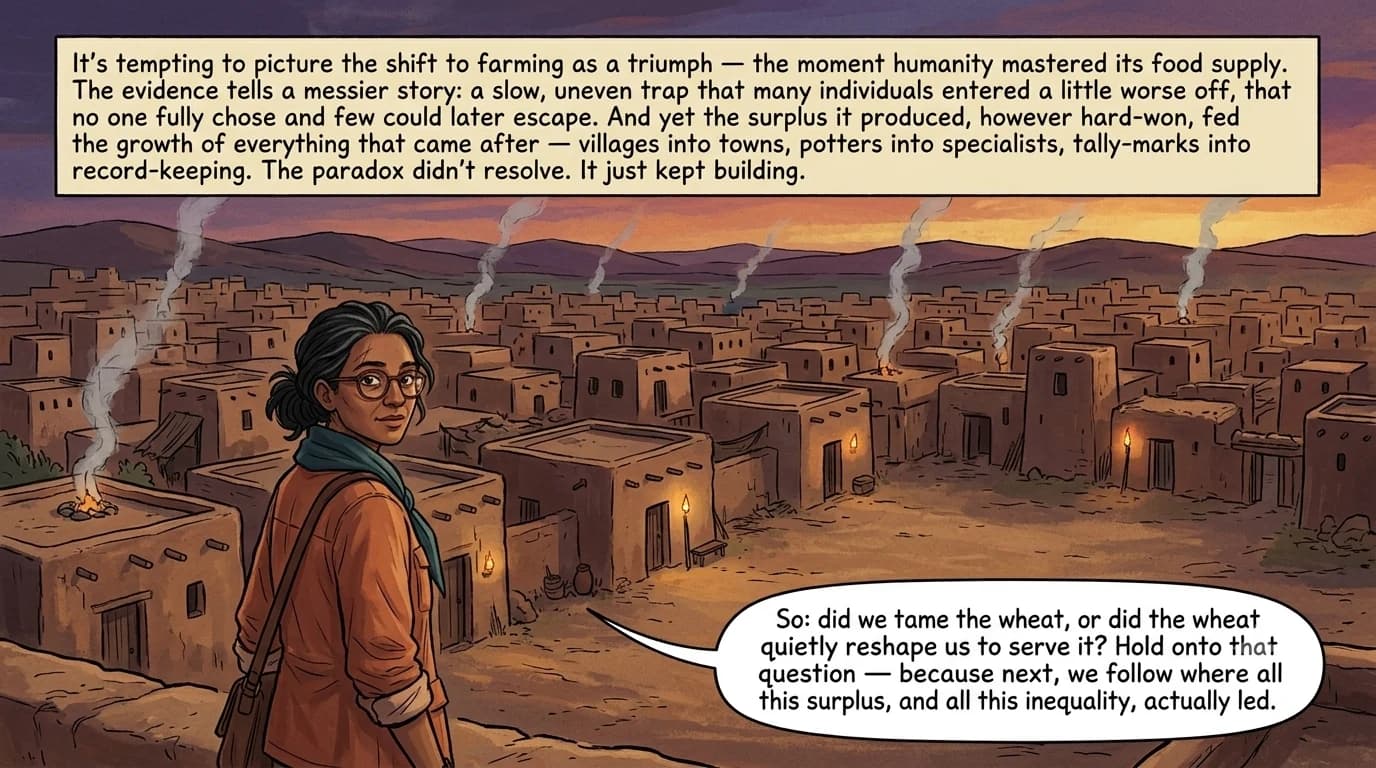
A field anthropologist stands at dusk overlooking a sprawling Neolithic village of close-packed mudbrick rooftops with smoke rising from many cook-fires, addressing the viewer.
It's tempting to picture the shift to farming as a triumph — the moment humanity mastered its food supply. The evidence tells a messier story: a slow, uneven trap that many individuals entered a little worse off, that no one fully chose and few could later escape. And yet the surplus it produced, however hard-won, fed the growth of everything that came after — villages into towns, potters into specialists, tally-marks into record-keeping. The paradox didn't resolve. It just kept building.
Kessa: So: did we tame the wheat, or did the wheat quietly reshape us to serve it? Hold onto that question — because next, we follow where all this surplus, and all this inequality, actually led.