The Human Story · Chapter 3: Imagined Orders
Cover
The Human Story · Chapter 3
Imagined Orders
How money, law, and gods hold a city of strangers together
As farming surpluses swelled into the first cities, humans faced a new problem: how do tens of thousands of strangers cooperate at all? Follow Ishara, a temple scribe in an early Mesopotamian city, as she presses the marks that turn grain, debt, and law into shared fictions powerful enough to bind a civilization — and sometimes bind a person.
12 panels · ~6 min read
Panel 1
Panel 2
Panel 3
Panel 4
Panel 5
Panel 6
Panel 7
Panel 8
Panel 9
Panel 10
Panel 11
Panel 12
Read chapter text: Imagined Orders
As farming surpluses swelled into the first cities, humans faced a new problem: how do tens of thousands of strangers cooperate at all? Follow Ishara, a temple scribe in an early Mesopotamian city, as she presses the marks that turn grain, debt, and law into shared fictions powerful enough to bind a civilization — and sometimes bind a person.
Panel 1
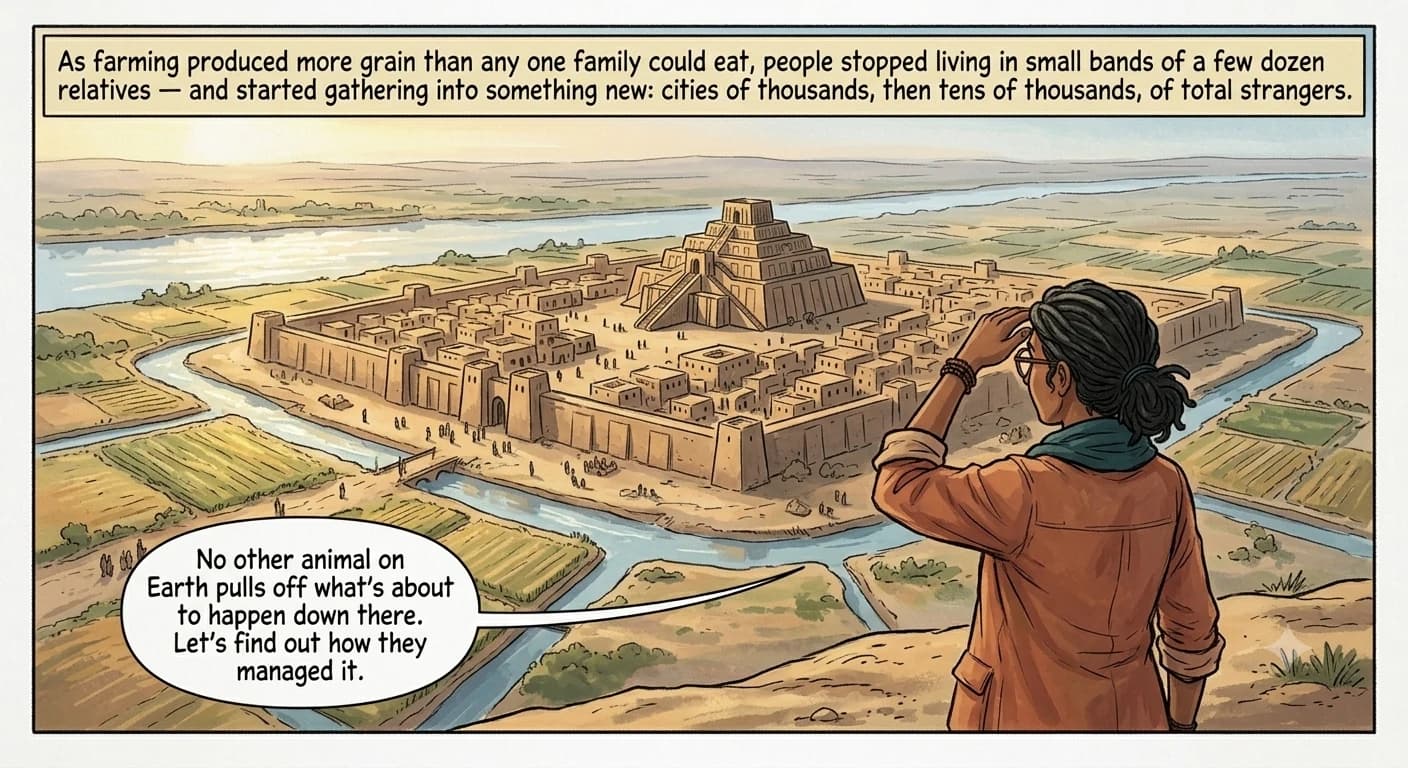
A guide figure looks out at dawn over a sprawling mud-brick city with a stepped temple tower, surrounded by irrigated fields and canals, its streets already filling with people.
As farming produced more grain than any one family could eat, people stopped living in small bands of a few dozen relatives — and started gathering into something new: cities of thousands, then tens of thousands, of total strangers.
Kessa: No other animal on Earth pulls off what's about to happen down there. Let's find out how they managed it.
Panel 2
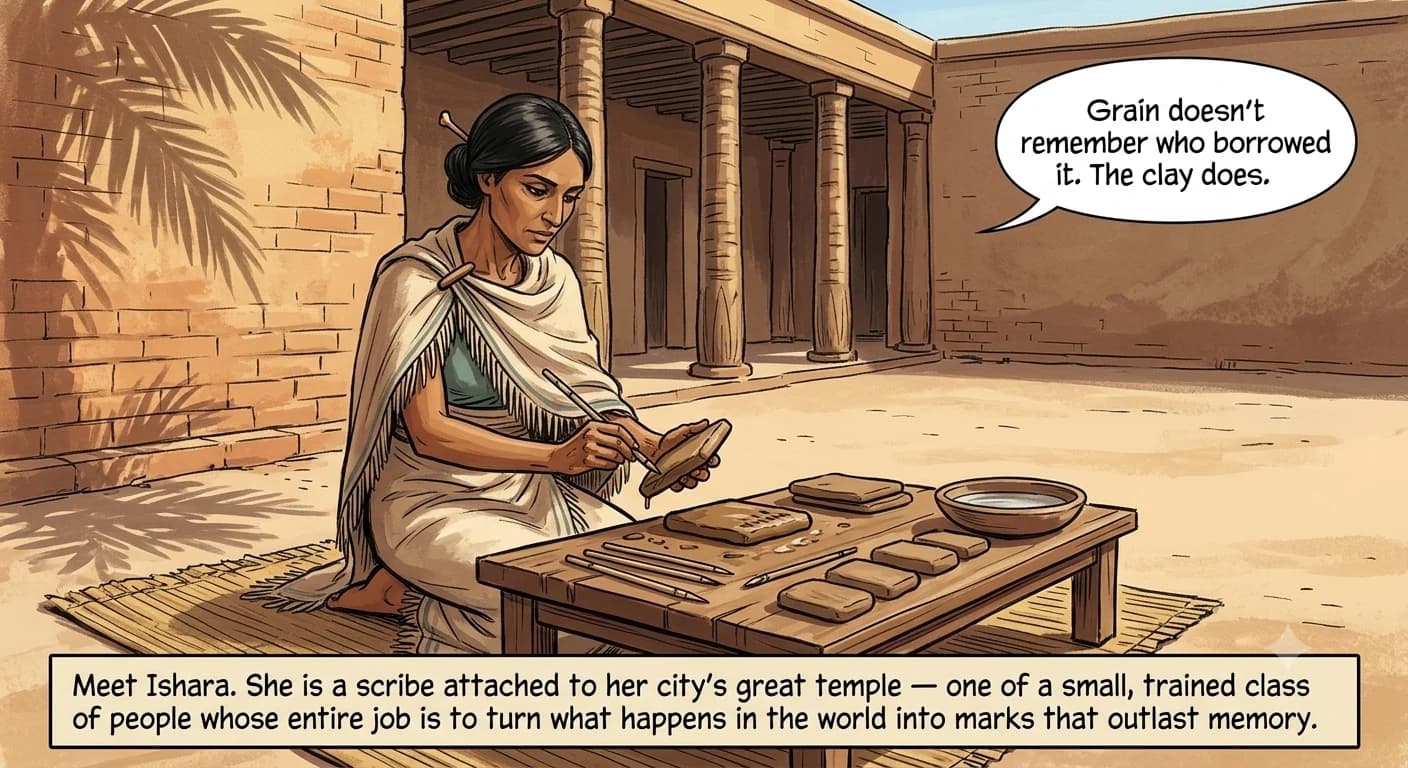
A temple scribe kneels at a low table in a sunlit courtyard, pressing a reed stylus into a wet clay tablet beside a row of other tablets and a bundle of reed styluses.
Meet Ishara. She is a scribe attached to her city's great temple — one of a small, trained class of people whose entire job is to turn what happens in the world into marks that outlast memory.
Ishara: Grain doesn't remember who borrowed it. The clay does.
Panel 3
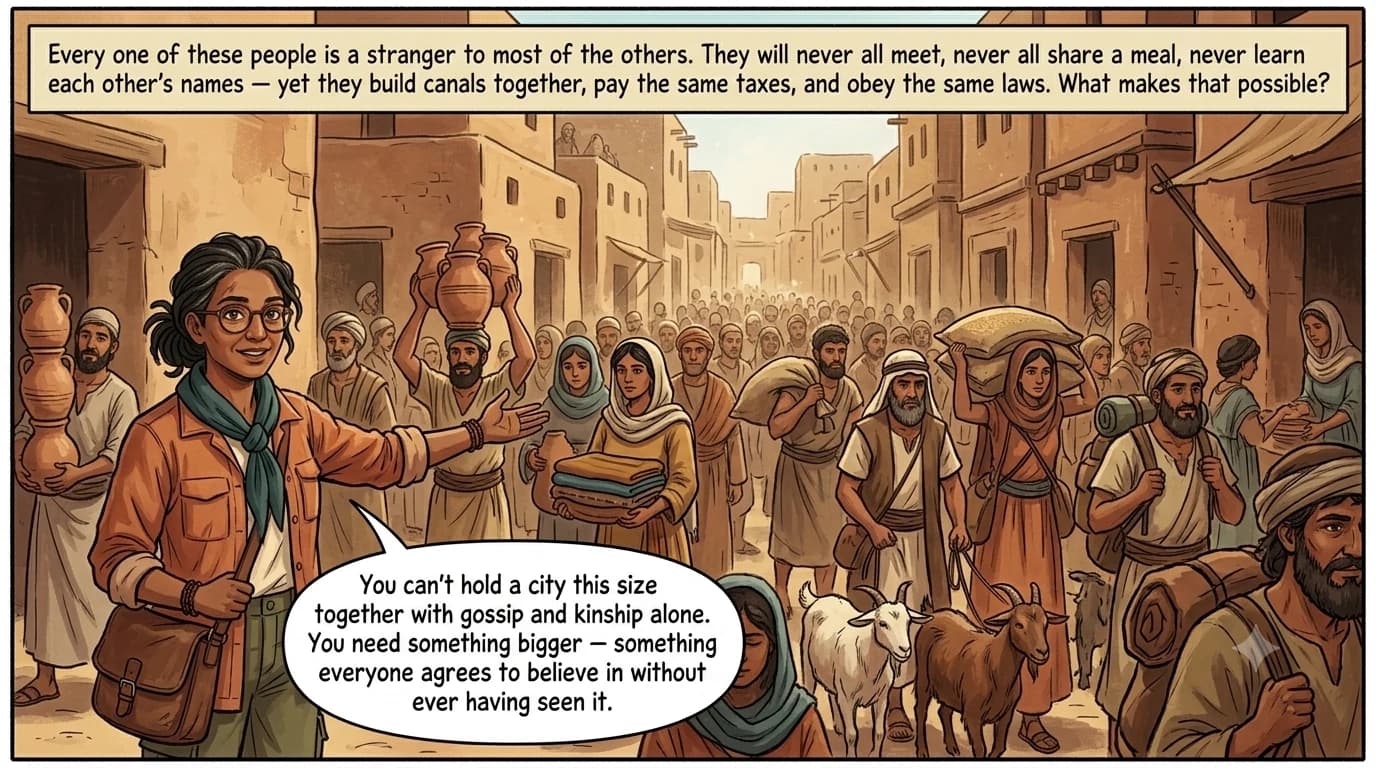
A crowded city market street full of potters, weavers, porters, and travelers from different regions, all strangers to one another, with a guide figure gesturing at the bustling crowd.
Every one of these people is a stranger to most of the others. They will never all meet, never all share a meal, never learn each other's names — yet they build canals together, pay the same taxes, and obey the same laws. What makes that possible?
Kessa: You can't hold a city this size together with gossip and kinship alone. You need something bigger — something everyone agrees to believe in without ever having seen it.
Panel 4
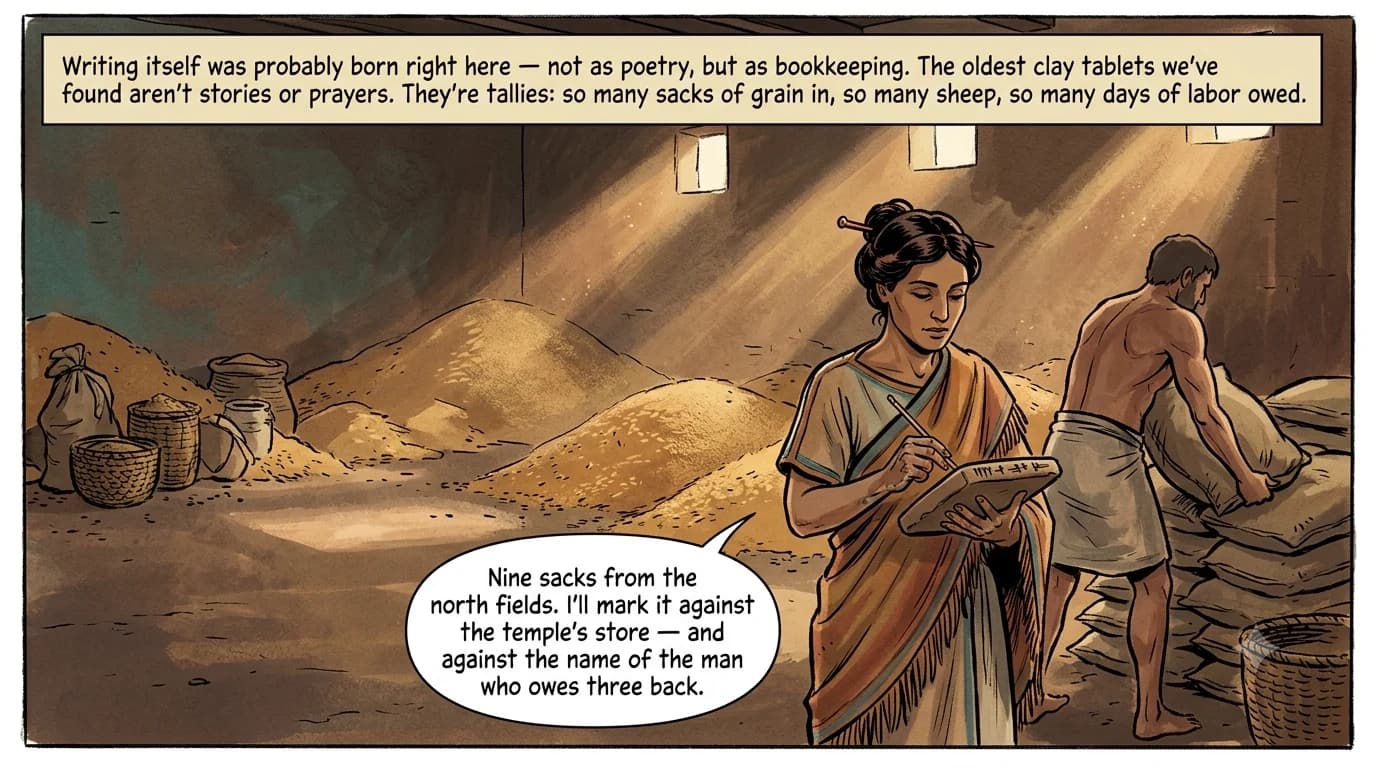
A temple scribe stands beside towering mounds of stored grain, pressing tally marks into a wet clay tablet as a laborer carries a grain sack past her.
Writing itself was probably born right here — not as poetry, but as bookkeeping. The oldest clay tablets we've found aren't stories or prayers. They're tallies: so many sacks of grain in, so many sheep, so many days of labor owed.
Ishara: Nine sacks from the north fields. I'll mark it against the temple's store — and against the name of the man who owes three back.
Panel 5
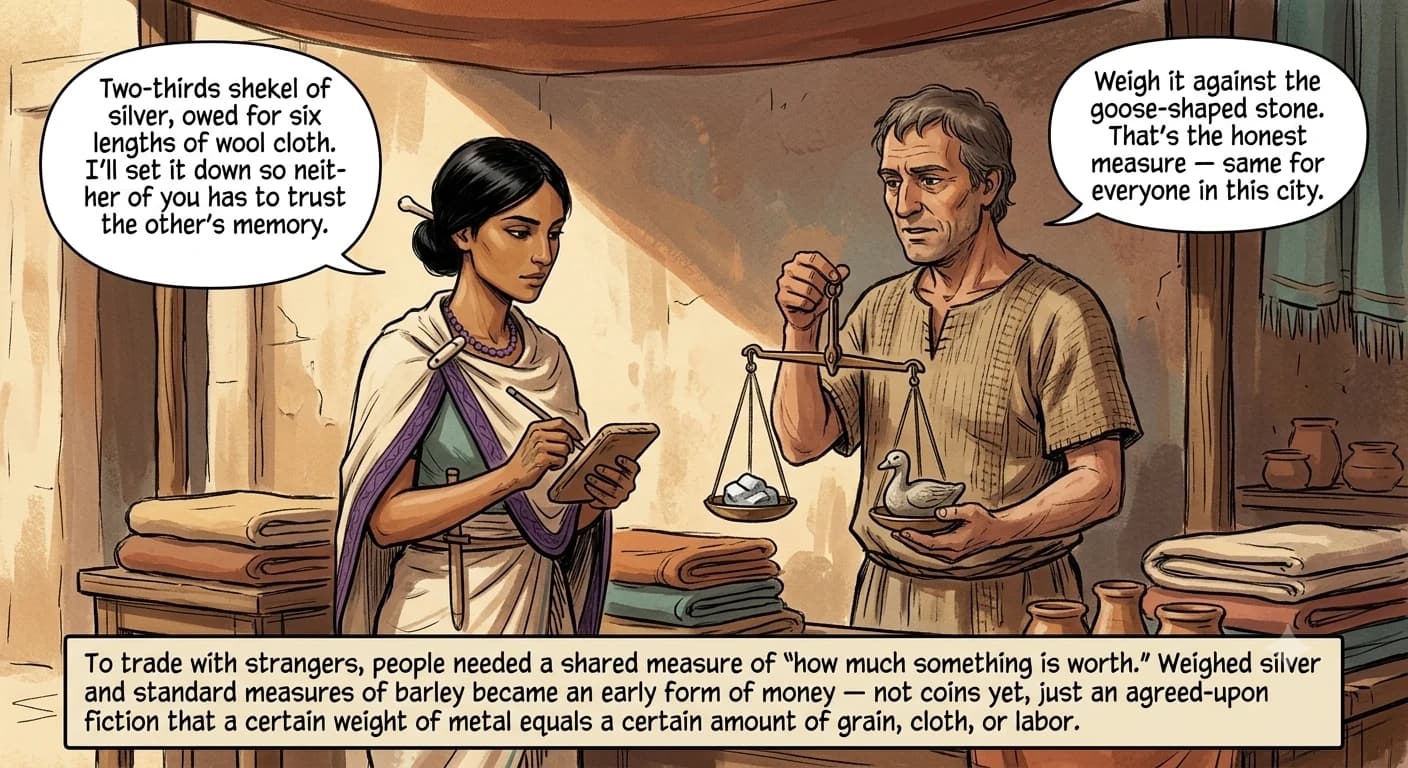
A merchant weighs a lump of silver on a small balance scale against a carved stone weight while a temple scribe records the transaction on a clay tablet.
To trade with strangers, people needed a shared measure of "how much something is worth." Weighed silver and standard measures of barley became an early form of money — not coins yet, just an agreed-upon fiction that a certain weight of metal equals a certain amount of grain, cloth, or labor.
Merchant: Weigh it against the goose-shaped stone. That's the honest measure — same for everyone in this city.
Ishara: Two-thirds shekel of silver, owed for six lengths of wool cloth. I'll set it down so neither of you has to trust the other's memory.
Panel 6
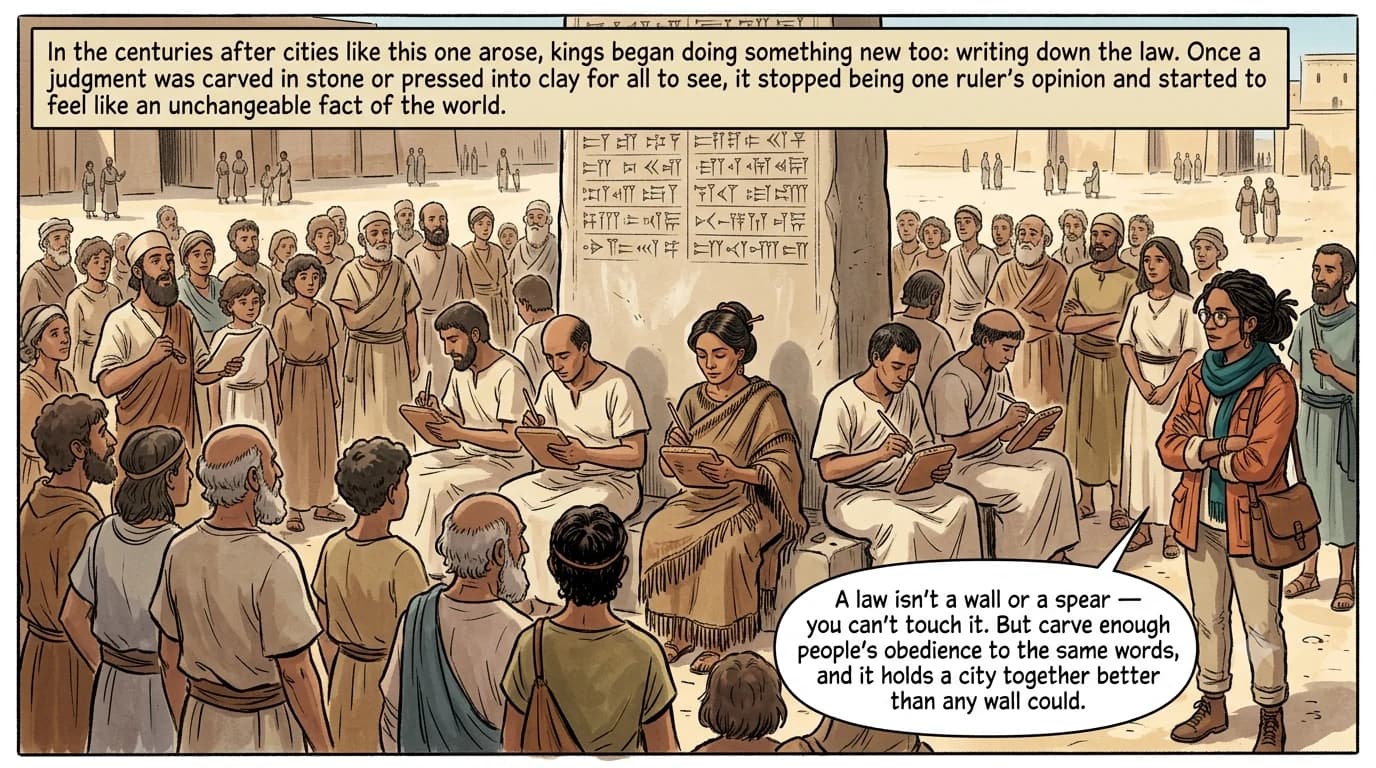
A row of scribes, including Ishara, copy a king's proclamation onto tablets and a standing carved stone in a public square, while a crowd gathers to listen and a guide figure observes from the edge.
In the centuries after cities like this one arose, kings began doing something new too: writing down the law. Once a judgment was carved in stone or pressed into clay for all to see, it stopped being one ruler's opinion and started to feel like an unchangeable fact of the world.
Kessa: A law isn't a wall or a spear — you can't touch it. But carve enough people's obedience to the same words, and it holds a city together better than any wall could.
Panel 7
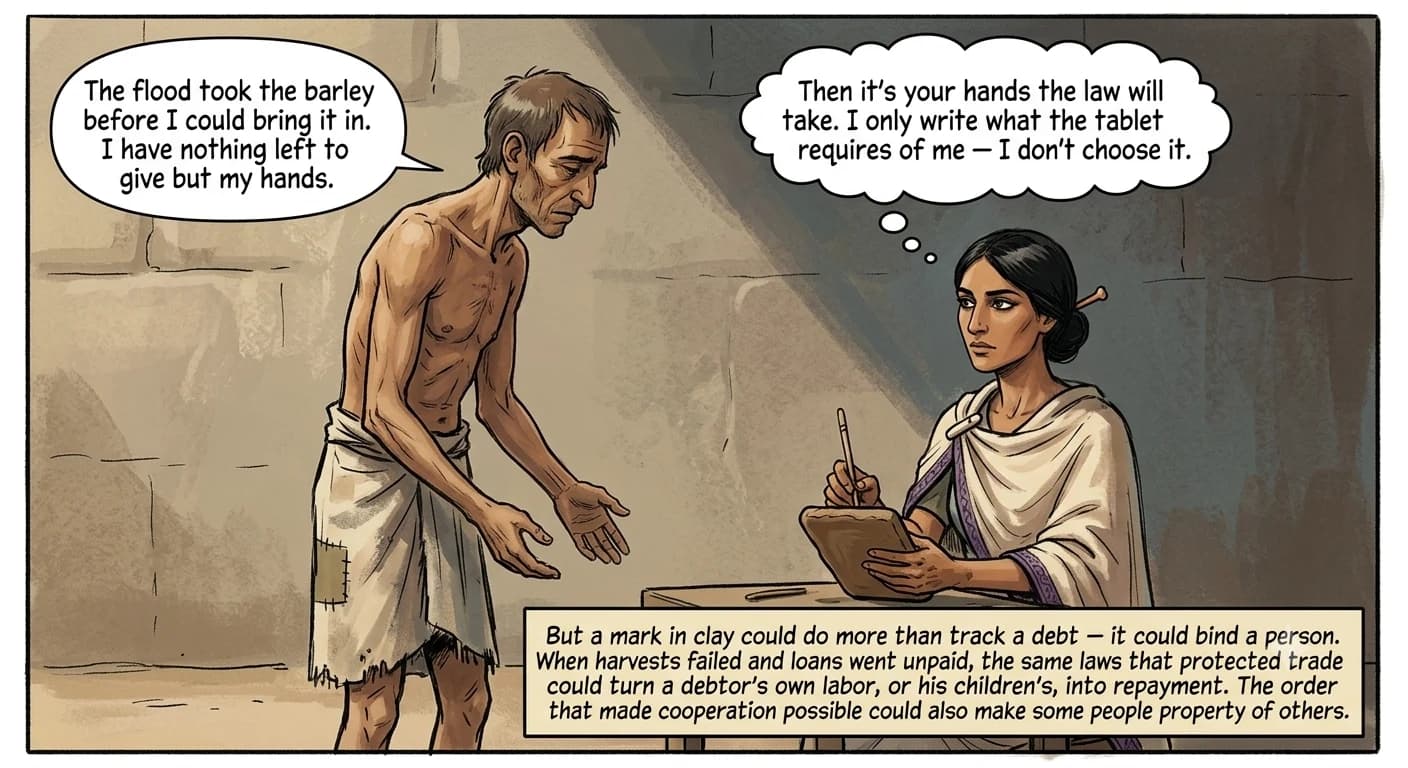
A gaunt farmer stands before a temple scribe's table, unable to pay a grain debt, as she holds her stylus poised over a clay tablet, about to record his labor as bonded repayment.
But a mark in clay could do more than track a debt — it could bind a person. When harvests failed and loans went unpaid, the same laws that protected trade could turn a debtor's own labor, or his children's, into repayment. The order that made cooperation possible could also make some people property of others.
Farmer: The flood took the barley before I could bring it in. I have nothing left to give but my hands.
Ishara: Then it's your hands the law will take. I only write what the tablet requires of me — I don't choose it.
Panel 8
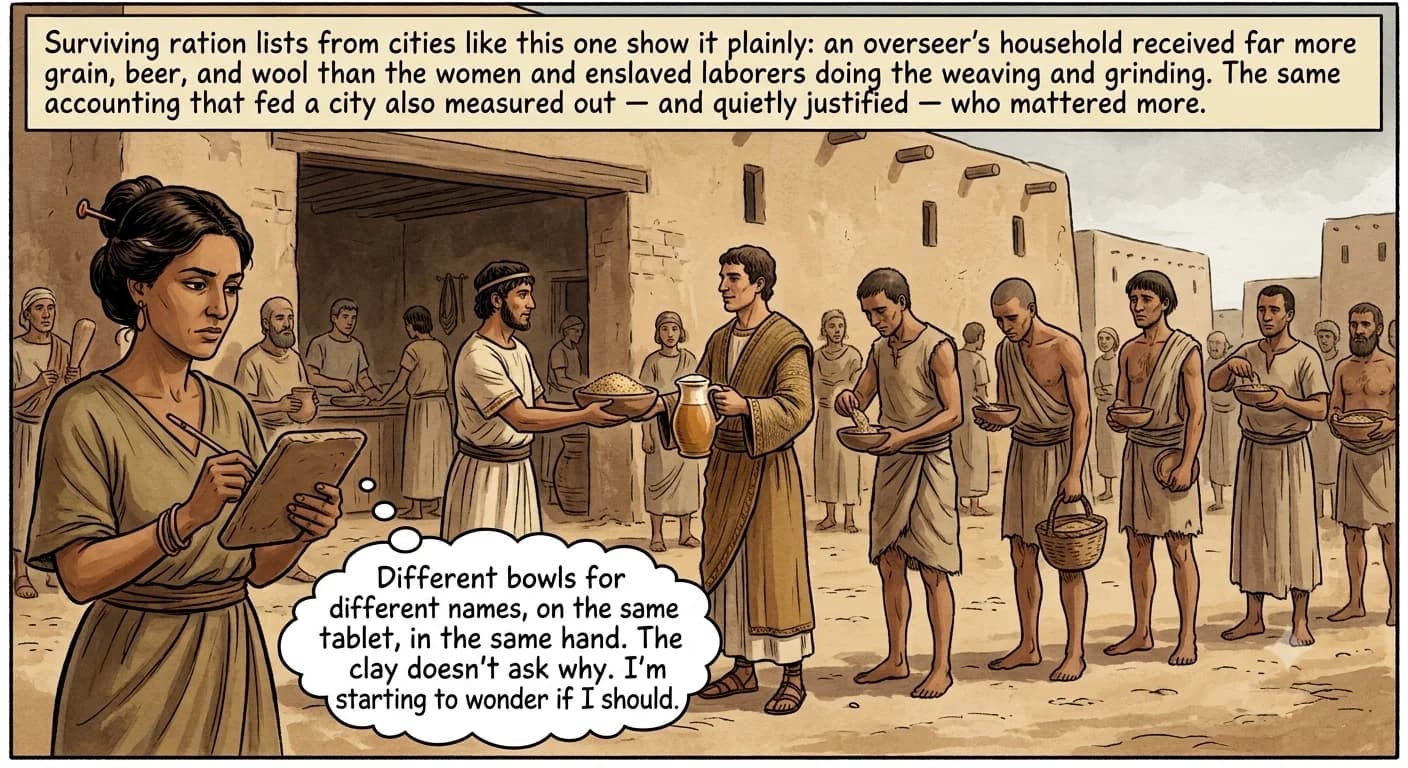
A ration line outside a workshop where overseers receive generous portions of grain, beer, and wool while ordinary laborers receive noticeably smaller shares, as a scribe checks names off a list.
Surviving ration lists from cities like this one show it plainly: an overseer's household received far more grain, beer, and wool than the women and enslaved laborers doing the weaving and grinding. The same accounting that fed a city also measured out — and quietly justified — who mattered more.
Ishara: Different bowls for different names, on the same tablet, in the same hand. The clay doesn't ask why. I'm starting to wonder if I should.
Panel 9
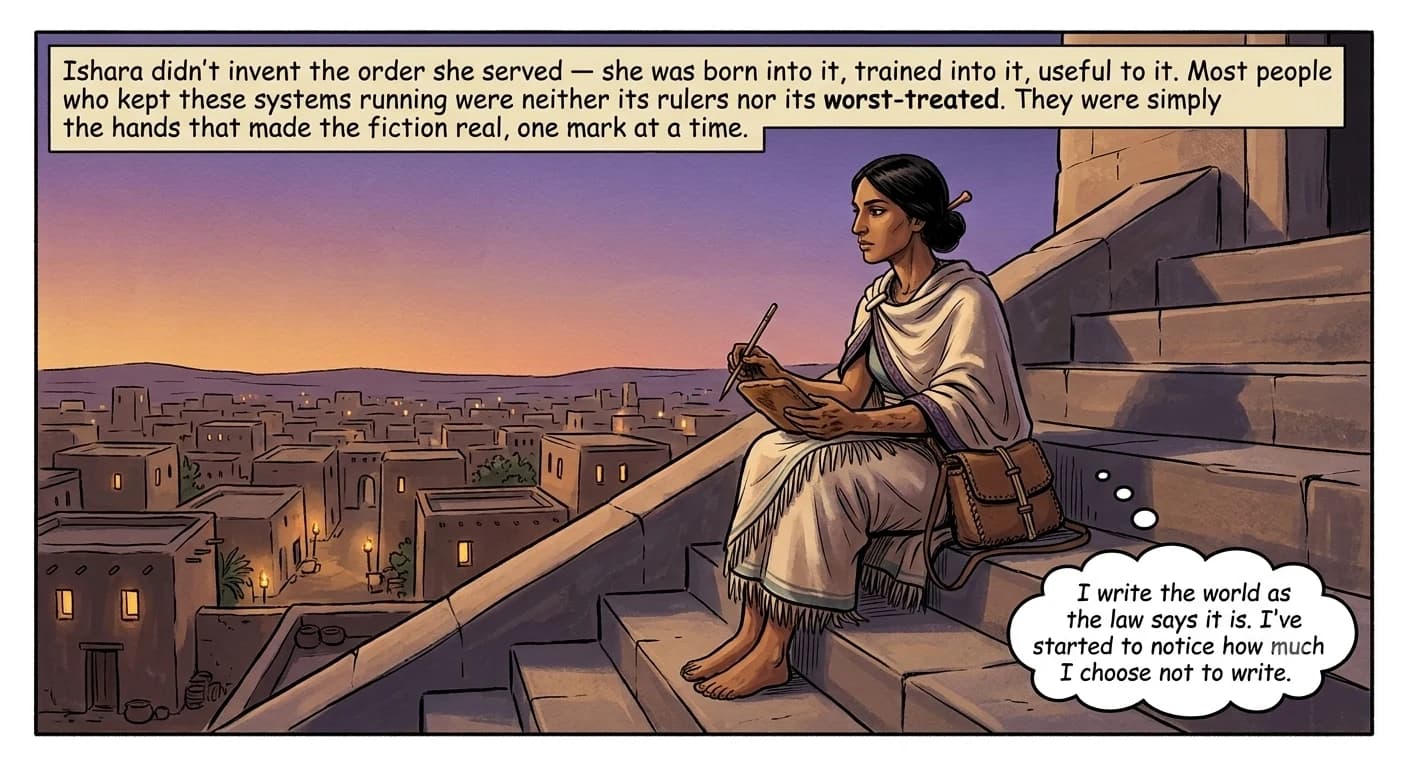
A temple scribe sits alone on temple steps at dusk, her satchel of clay tablets beside her, looking out over the lamplit city while turning a tablet over in her hands.
Ishara didn't invent the order she served — she was born into it, trained into it, useful to it. Most people who kept these systems running were neither its rulers nor its worst-treated. They were simply the hands that made the fiction real, one mark at a time.
Ishara: I write the world as the law says it is. I've started to notice how much I choose not to write.
Panel 10
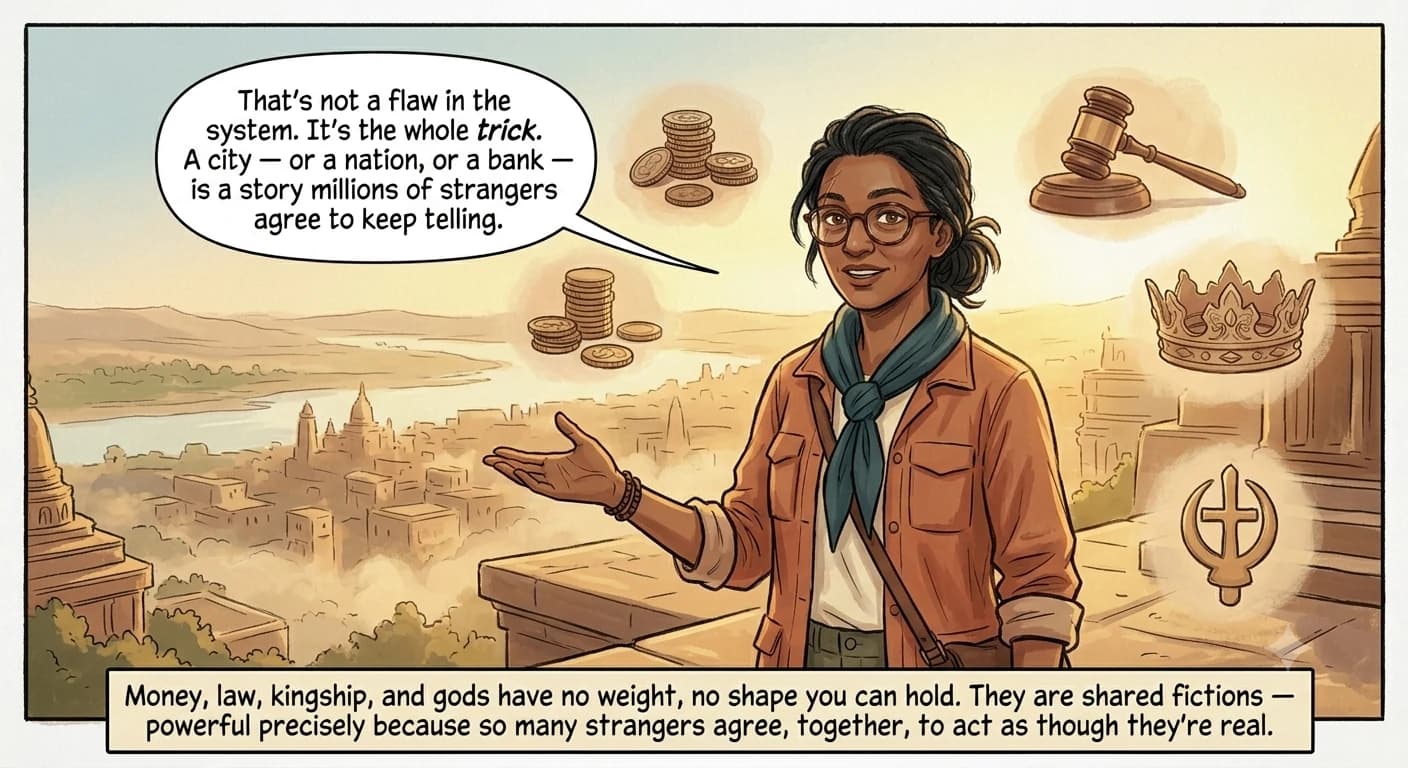
A guide figure stands atop temple steps at golden hour overlooking the city, surrounded by faint painterly vignettes of coins, a courtroom gavel, a crown, and a religious symbol.
Money, law, kingship, and gods have no weight, no shape you can hold. They are shared fictions — powerful precisely because so many strangers agree, together, to act as though they're real.
Kessa: That's not a flaw in the system. It's the whole trick. A city — or a nation, or a bank — is a story millions of strangers agree to keep telling.
Panel 11
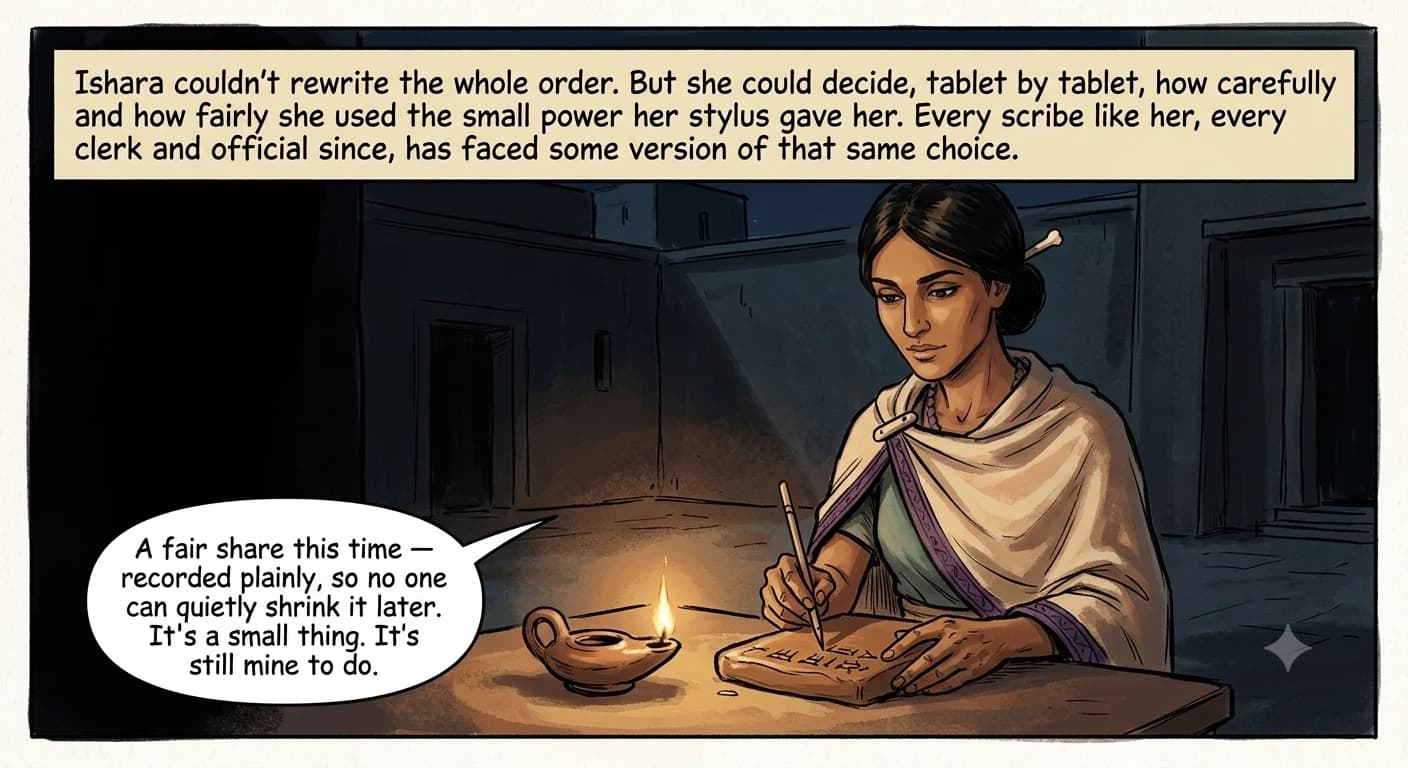
By lamplight at night, a temple scribe carefully presses a final mark into a fresh clay tablet, recording a fair grain allotment for a widow's household.
Ishara couldn't rewrite the whole order. But she could decide, tablet by tablet, how carefully and how fairly she used the small power her stylus gave her. Every scribe like her, every clerk and official since, has faced some version of that same choice.
Ishara: A fair share this time — recorded plainly, so no one can quietly shrink it later. It's a small thing. It's still mine to do.
Panel 12
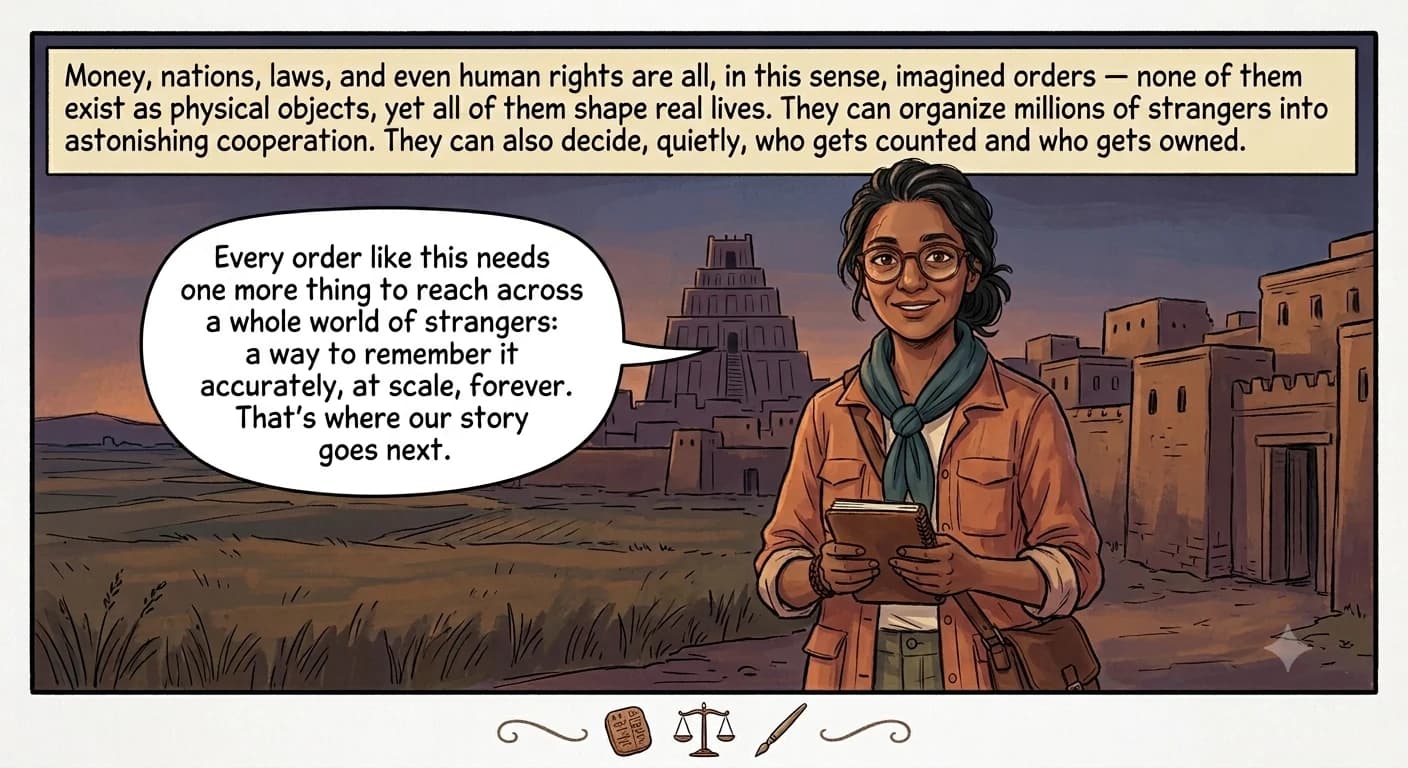
A guide figure stands at the edge of the ancient city at dusk, the temple tower silhouetted behind her, closing a field notebook and looking toward the reader, with small decorative icons of a clay tablet, a balance scale, and a stylus along the panel's edge.
Money, nations, laws, and even human rights are all, in this sense, imagined orders — none of them exist as physical objects, yet all of them shape real lives. They can organize millions of strangers into astonishing cooperation. They can also decide, quietly, who gets counted and who gets owned.
Kessa: Every order like this needs one more thing to reach across a whole world of strangers: a way to remember it accurately, at scale, forever. That's where our story goes next.