The Human Story · Chapter 5: The Scientific Revolution
Cover
The Human Story · Chapter 5
The Scientific Revolution
How a simple admission — 'we do not know' — set off five centuries of discovery, invention, and conquest
About 500 years ago, a new habit of mind took hold: admitting what we didn't know, then going to find out. Follow an apprentice-naturalist as he learns to trust careful observation over old authority — and discovers that the same curiosity that mapped the world also helped conquer it.
12 panels · ~6 min read
Panel 1
Panel 2
Panel 3
Panel 4
Panel 5
Panel 6
Panel 7
Panel 8
Panel 9
Panel 10
Panel 11
Panel 12
Read chapter text: The Scientific Revolution
About 500 years ago, a new habit of mind took hold: admitting what we didn't know, then going to find out. Follow an apprentice-naturalist as he learns to trust careful observation over old authority — and discovers that the same curiosity that mapped the world also helped conquer it.
Panel 1
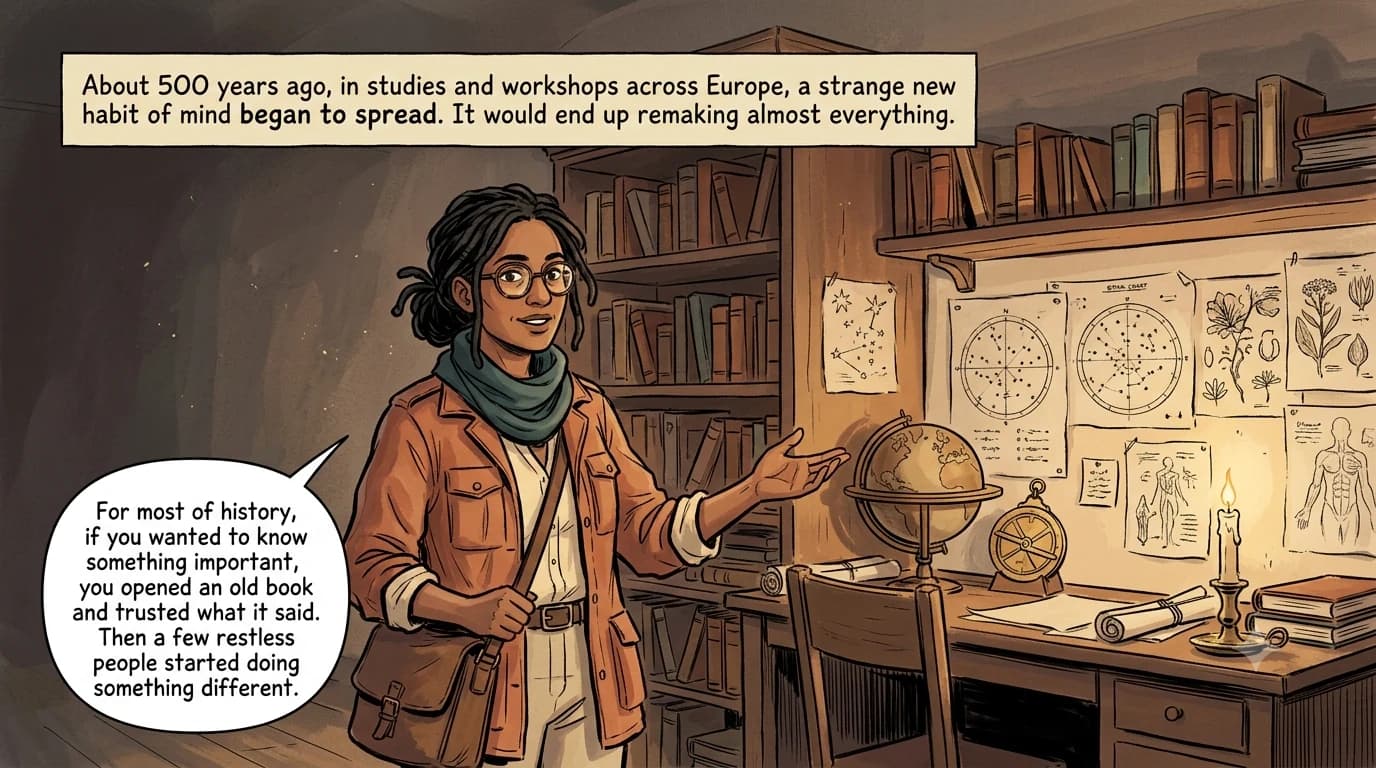
A guide figure gestures toward a candlelit 1600s scholar's study crammed with books, star charts, a globe, and an astrolabe.
About 500 years ago, in studies and workshops across Europe, a strange new habit of mind began to spread. It would end up remaking almost everything.
Kessa: For most of history, if you wanted to know something important, you opened an old book and trusted what it said. Then a few restless people started doing something different.
Panel 2
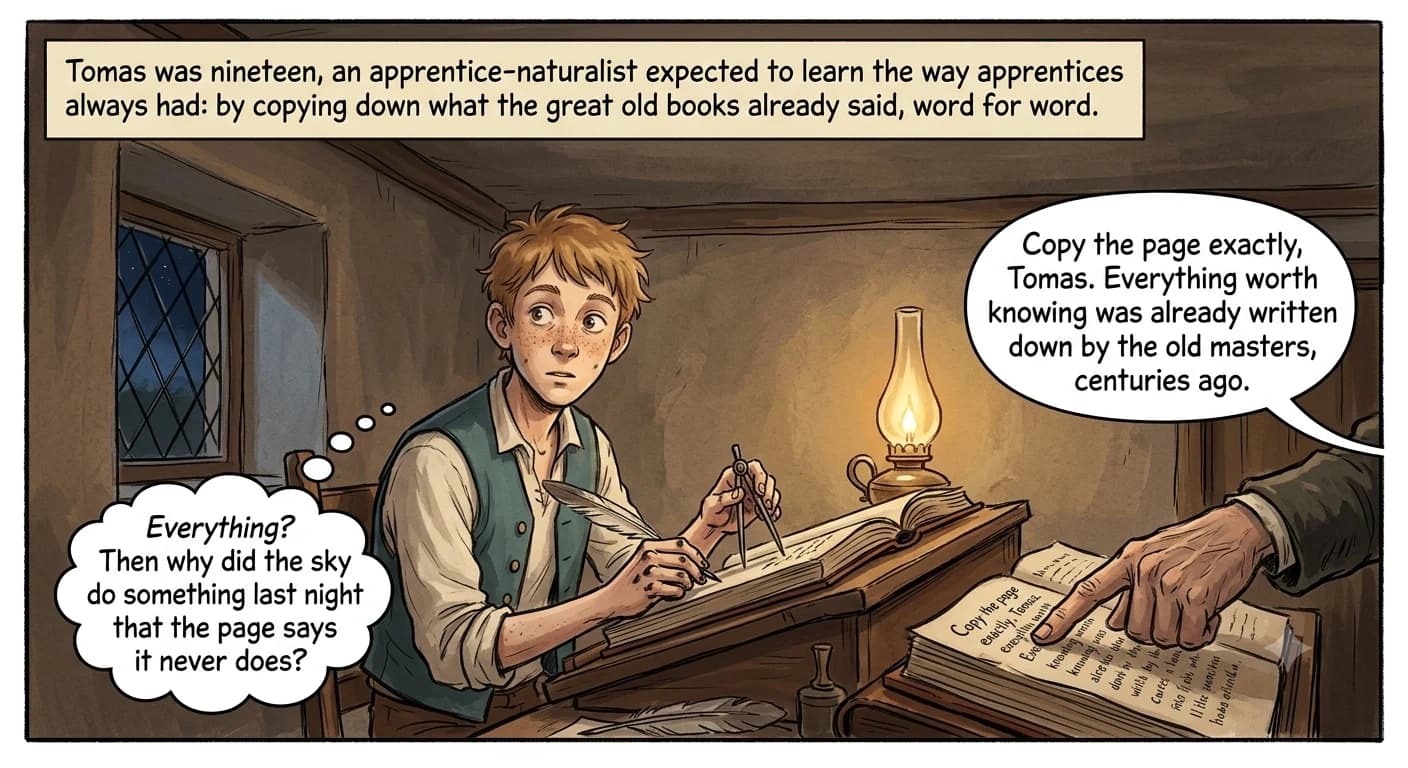
A young apprentice sits at a writing desk copying from an old book while an unseen tutor's hand points at the page; the apprentice glances toward a window instead.
Tomas was nineteen, an apprentice-naturalist expected to learn the way apprentices always had: by copying down what the great old books already said, word for word.
Tutor: Copy the page exactly, Tomas. Everything worth knowing was already written down by the old masters, centuries ago.
Tomas: Everything? Then why did the sky do something last night that the page says it never does?
Panel 3
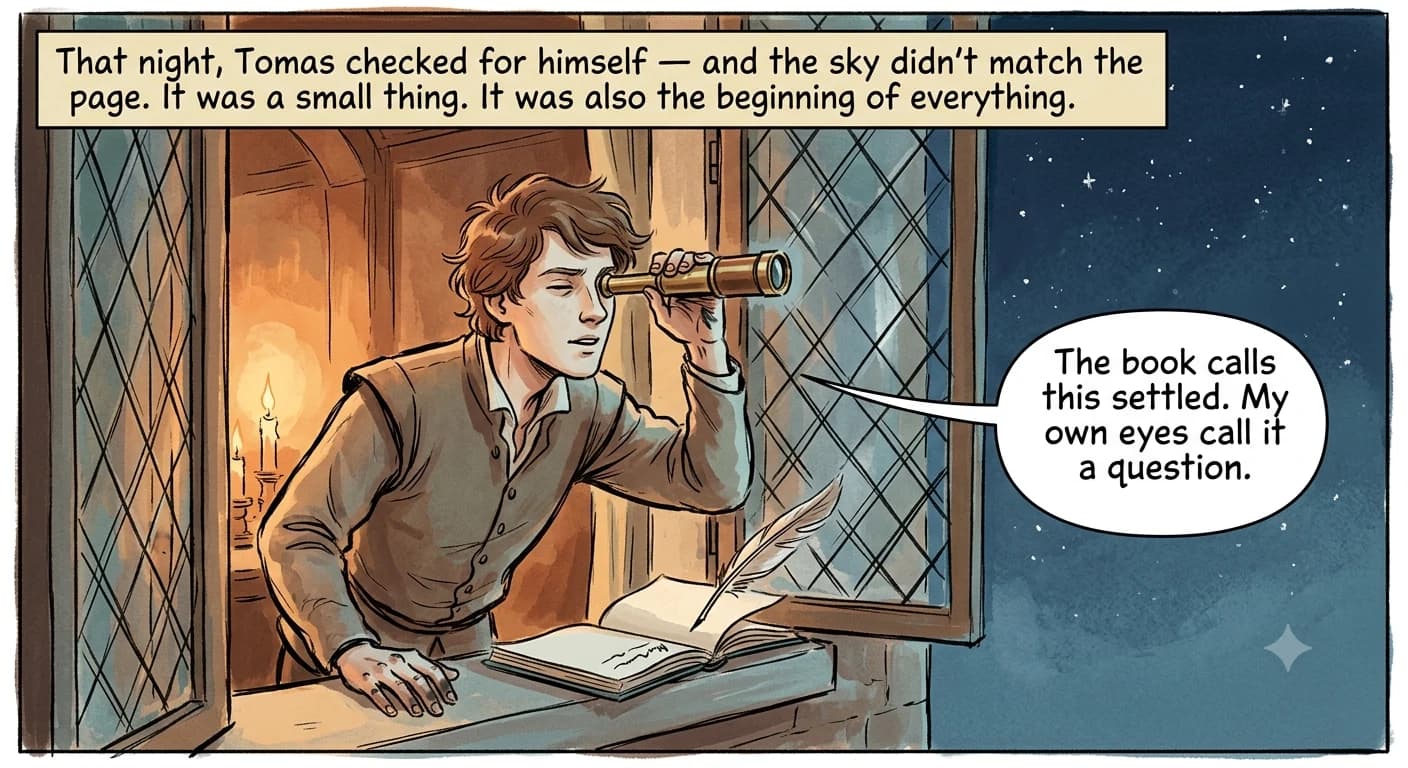
A young apprentice leans out of a window at night, peering through a small brass spyglass at the sky, an open notebook resting on the sill beside him.
That night, Tomas checked for himself — and the sky didn't match the page. It was a small thing. It was also the beginning of everything.
Tomas: The book calls this settled. My own eyes call it a question.
Panel 4
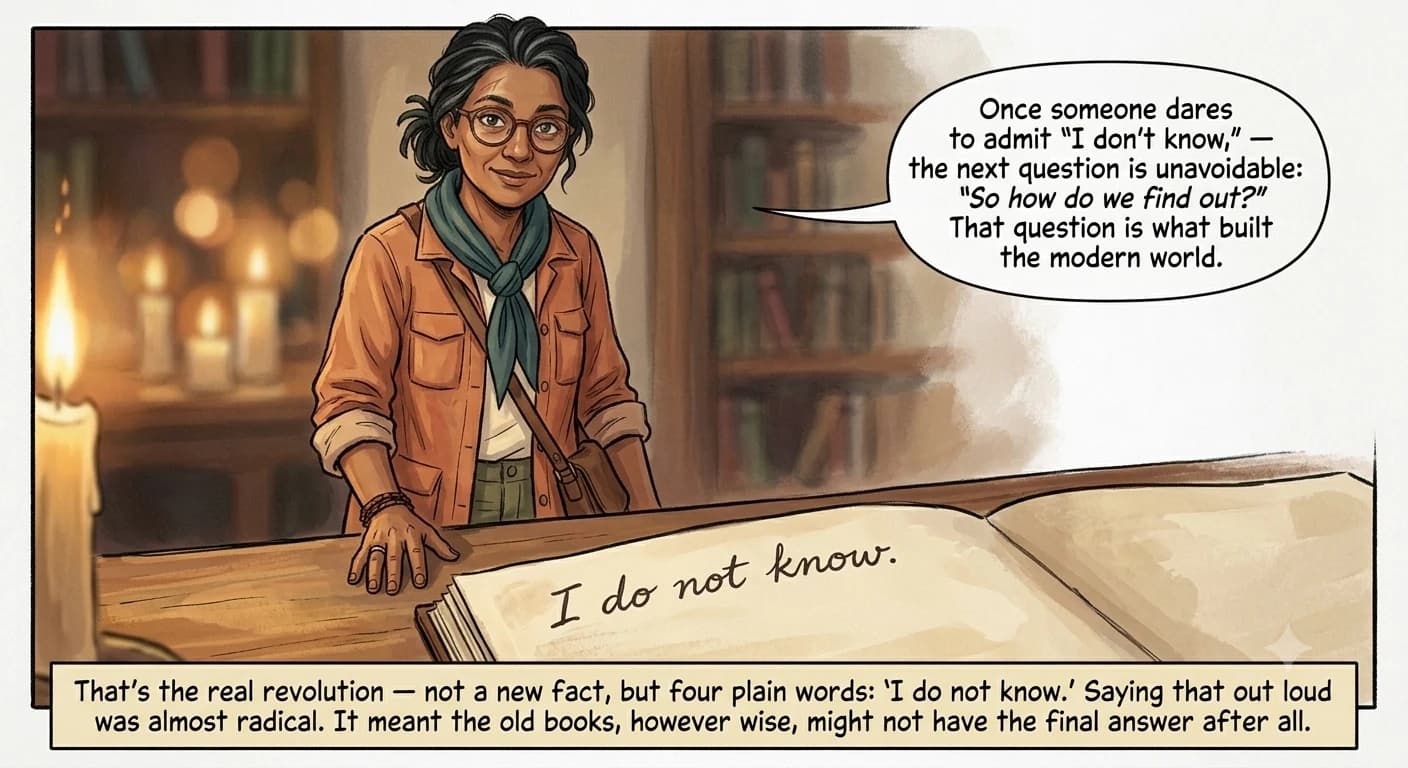
A close-up of a handwritten journal page reading 'I do not know,' with a guide figure standing just behind it, addressing the reader.
That's the real revolution — not a new fact, but four plain words: 'I do not know.' Saying that out loud was almost radical. It meant the old books, however wise, might not have the final answer after all.
Kessa: Once someone dares to admit 'I don't know,' the next question is unavoidable: 'So how do we find out?' That question is what built the modern world.
Panel 5
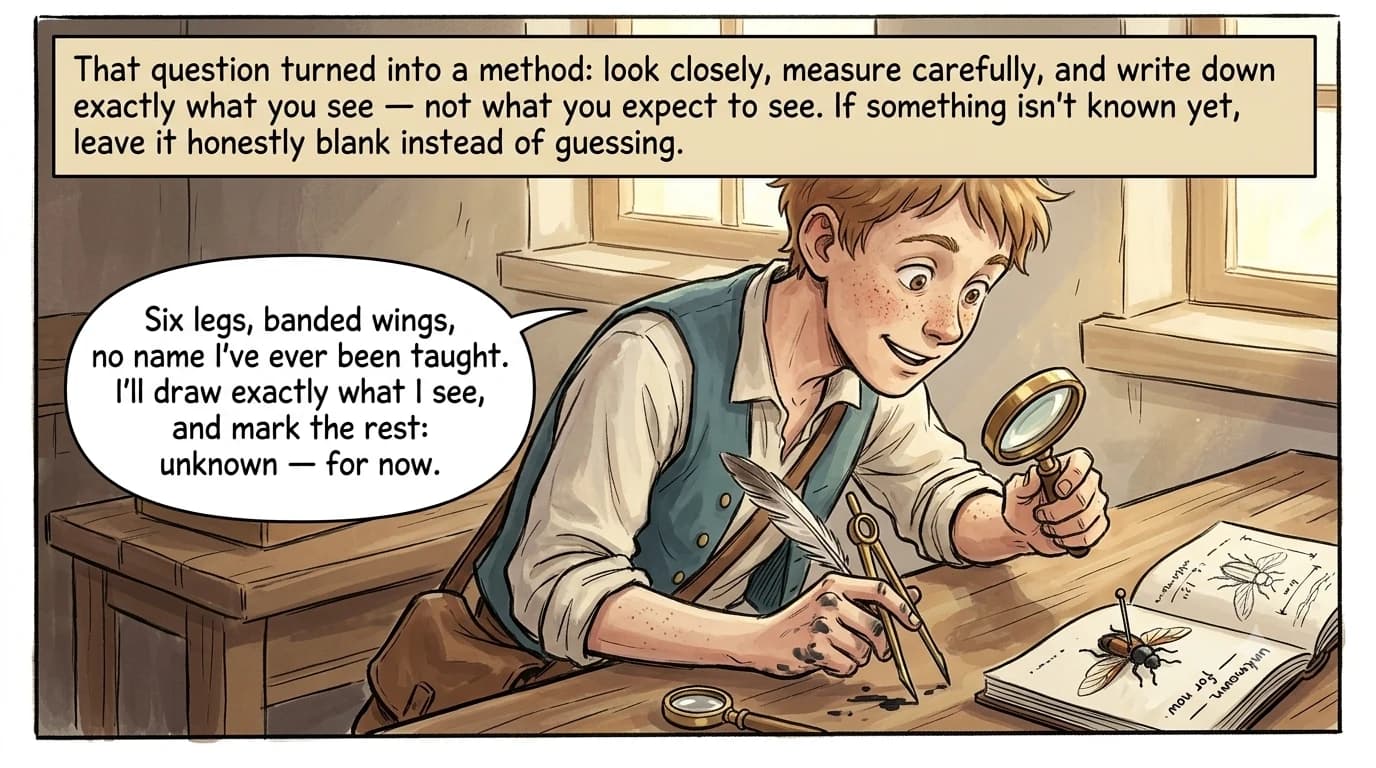
A young apprentice leans over a workbench, carefully sketching and measuring a beetle specimen under a hand lens in his notebook.
That question turned into a method: look closely, measure carefully, and write down exactly what you see — not what you expect to see. If something isn't known yet, leave it honestly blank instead of guessing.
Tomas: Six legs, banded wings, no name I've ever been taught. I'll draw exactly what I see, and mark the rest: unknown — for now.
Panel 6
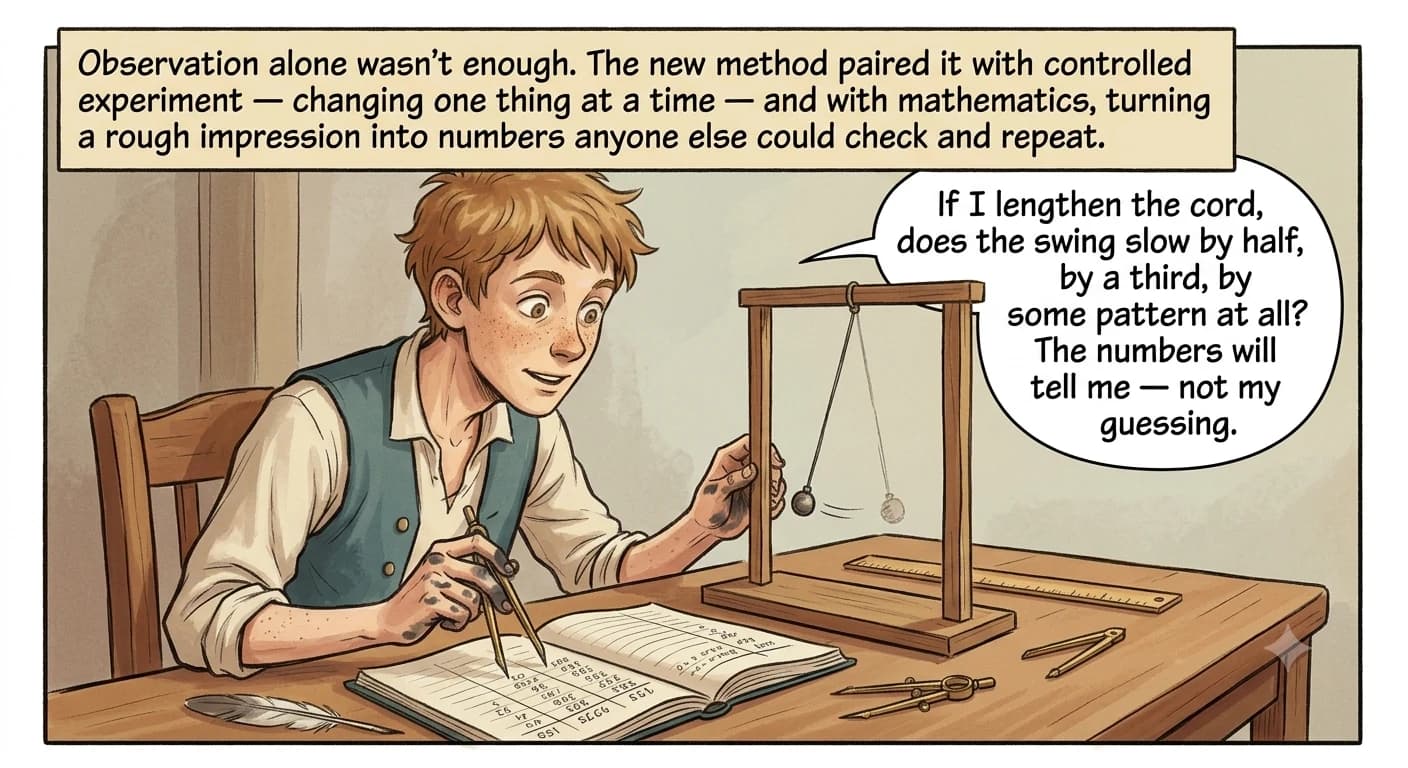
A young apprentice studies a small swinging pendulum on a tabletop, dividers and a ruler beside him, recording a table of numbers in his notebook.
Observation alone wasn't enough. The new method paired it with controlled experiment — changing one thing at a time — and with mathematics, turning a rough impression into numbers anyone else could check and repeat.
Tomas: If I lengthen the cord, does the swing slow by half, by a third, by some pattern at all? The numbers will tell me — not my guessing.
Panel 7
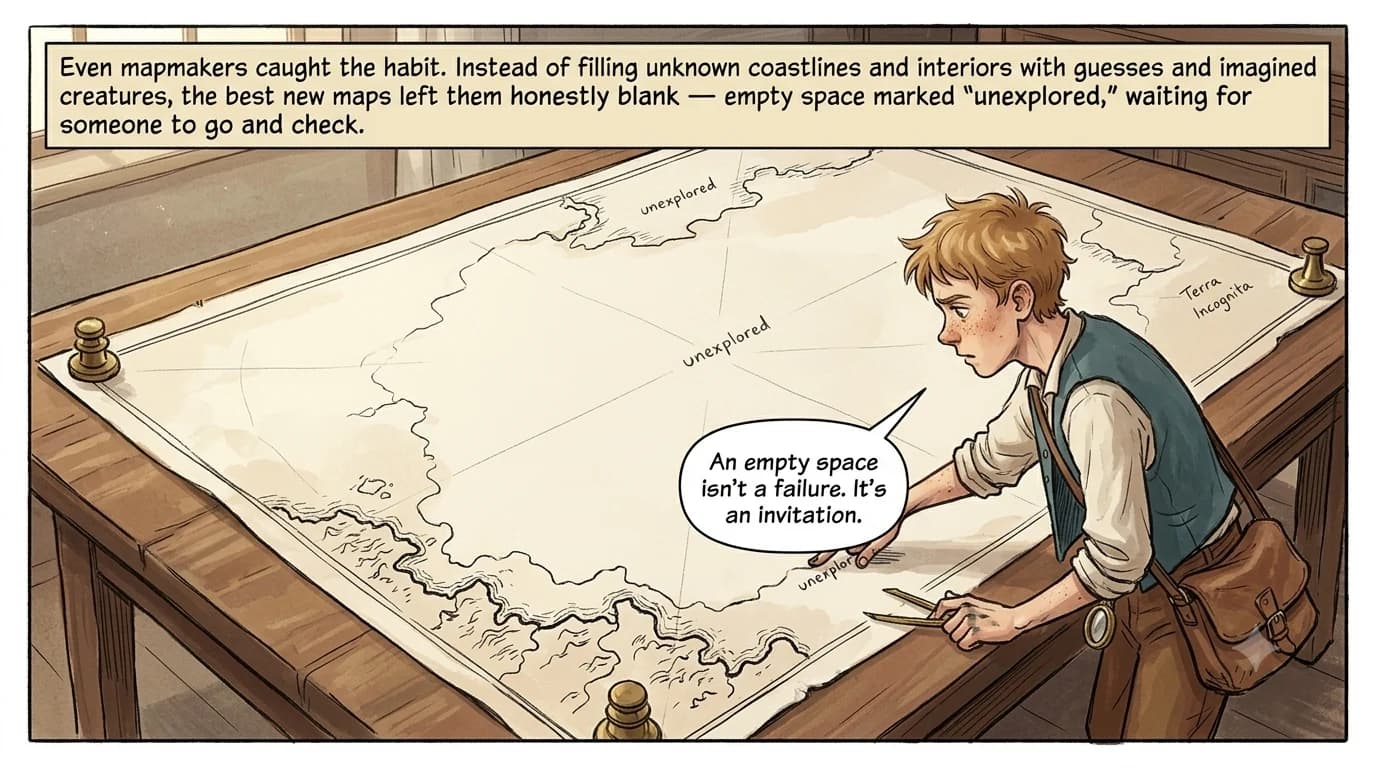
A young apprentice leans over a large hand-drawn map on a table, tracing a deliberately blank, unexplored region with his finger.
Even mapmakers caught the habit. Instead of filling unknown coastlines and interiors with guesses and imagined creatures, the best new maps left them honestly blank — empty space marked 'unexplored,' waiting for someone to go and check.
Tomas: An empty space isn't a failure. It's an invitation.
Panel 8
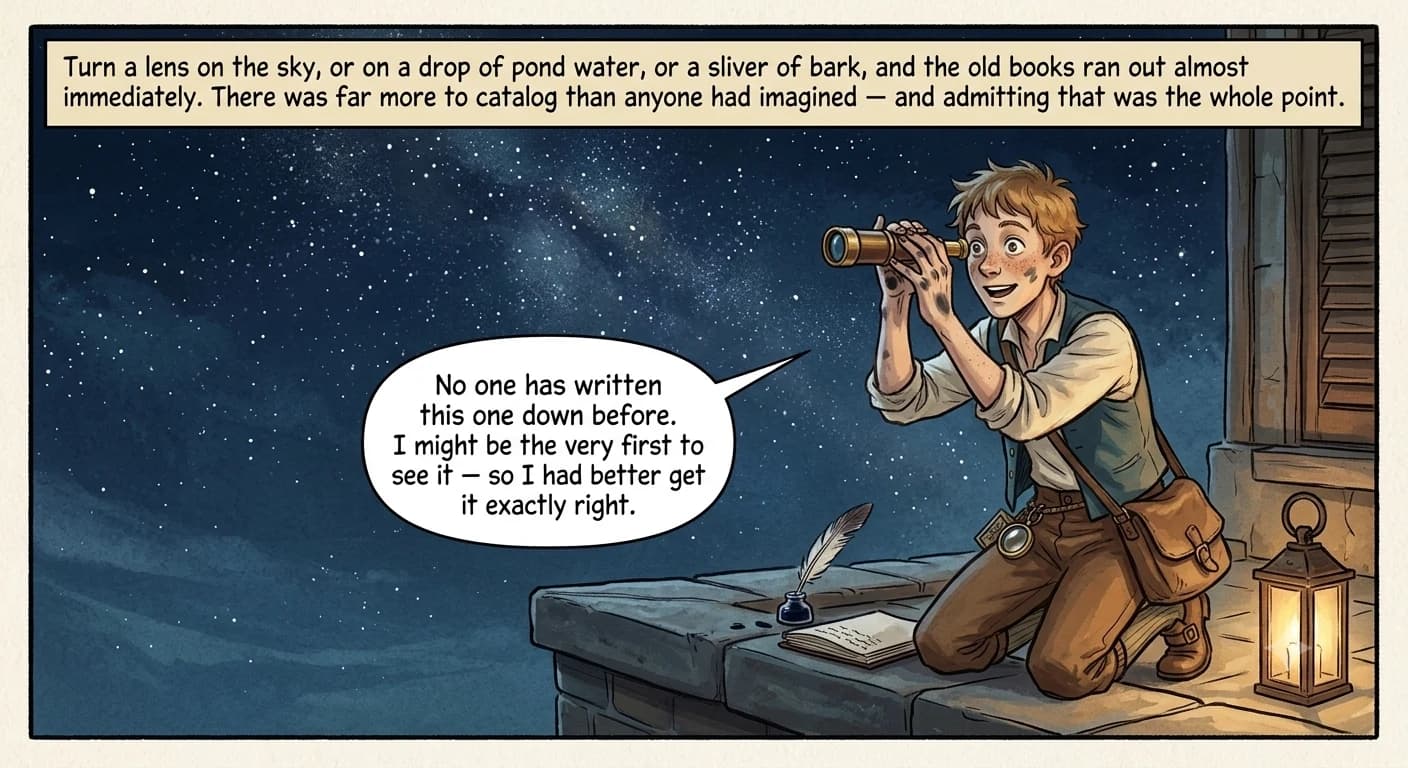
A young apprentice on a rooftop at night peers through a small brass spyglass at the star-filled sky, notebook balanced beside him.
Turn a lens on the sky, or on a drop of pond water, or a sliver of bark, and the old books ran out almost immediately. There was far more to catalog than anyone had imagined — and admitting that was the whole point.
Tomas: No one has written this one down before. I might be the very first to see it — so I had better get it exactly right.
Panel 9
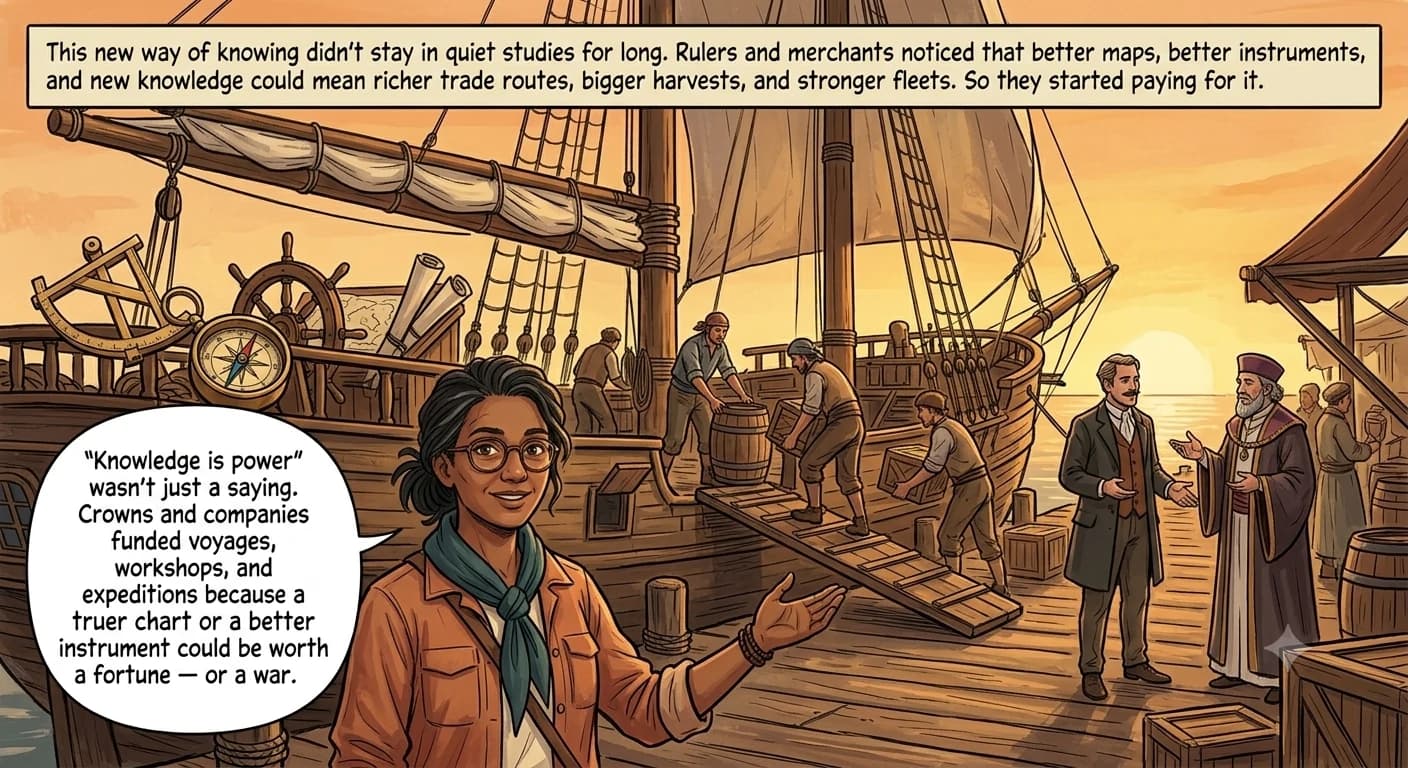
A busy harbor scene with a ship being loaded and fitted with navigation instruments, a merchant and an official gesturing toward it, while a guide figure addresses the viewer from the dock.
This new way of knowing didn't stay in quiet studies for long. Rulers and merchants noticed that better maps, better instruments, and new knowledge could mean richer trade routes, bigger harvests, and stronger fleets. So they started paying for it.
Kessa: 'Knowledge is power' wasn't just a saying. Crowns and companies funded voyages, workshops, and expeditions because a truer chart or a better instrument could be worth a fortune — or a war.
Panel 10
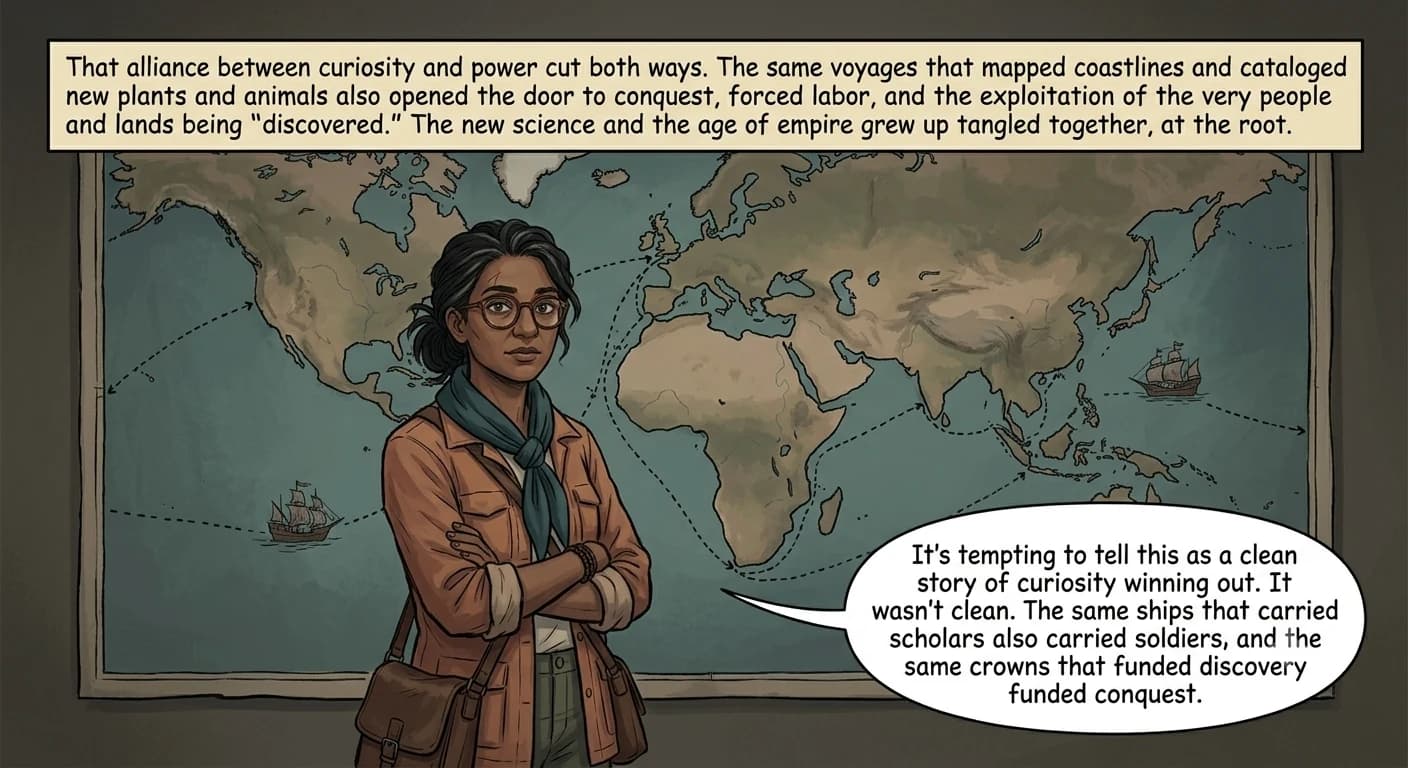
A guide figure stands with arms crossed before a large wall map showing voyage routes stretching from Europe toward distant coastlines, her expression thoughtful and somber.
That alliance between curiosity and power cut both ways. The same voyages that mapped coastlines and cataloged new plants and animals also opened the door to conquest, forced labor, and the exploitation of the very people and lands being 'discovered.' The new science and the age of empire grew up tangled together, at the root.
Kessa: It's tempting to tell this as a clean story of curiosity winning out. It wasn't clean. The same ships that carried scholars also carried soldiers, and the same crowns that funded discovery funded conquest.
Panel 11
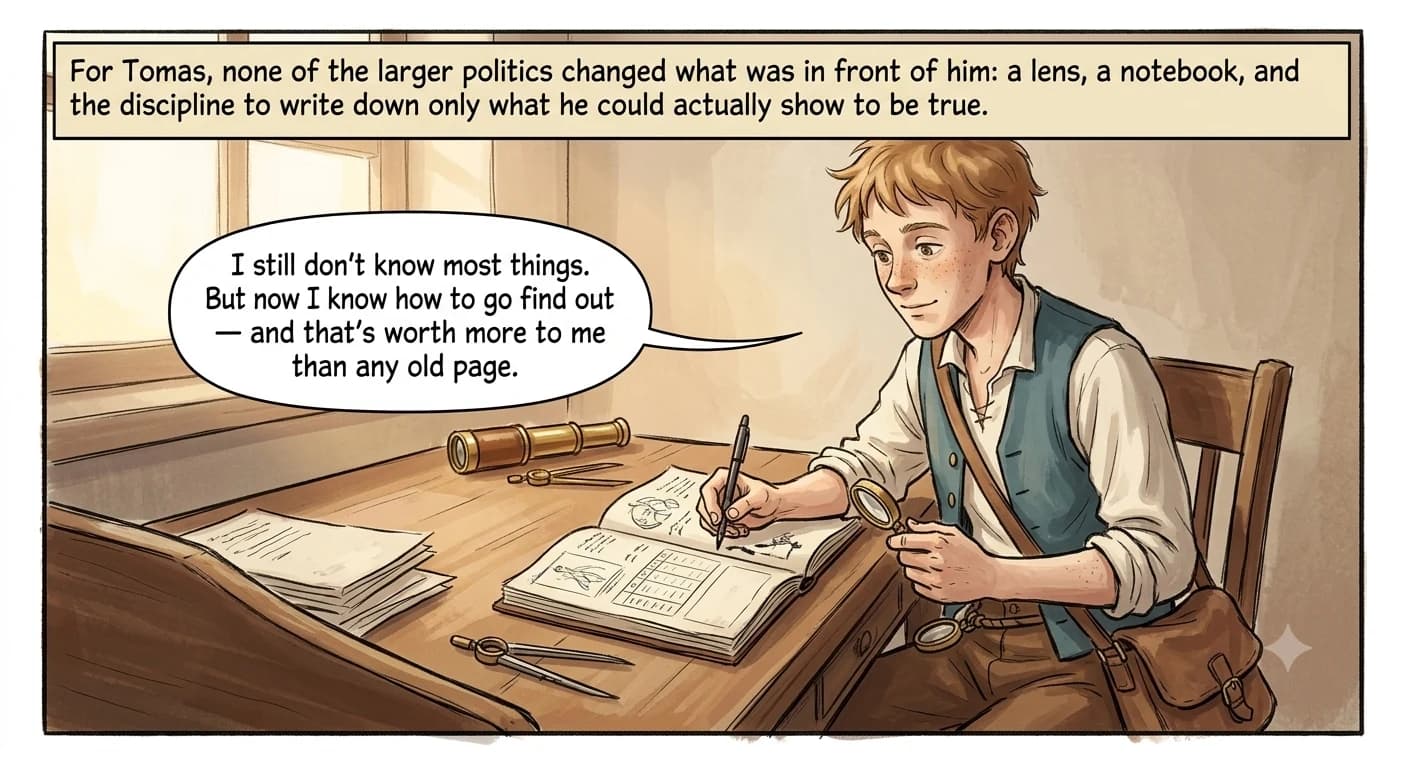
A young apprentice sits at his desk in morning light, writing steadily in a well-used notebook filled with sketches and tables, his brass spyglass and dividers resting nearby.
For Tomas, none of the larger politics changed what was in front of him: a lens, a notebook, and the discipline to write down only what he could actually show to be true.
Tomas: I still don't know most things. But now I know how to go find out — and that's worth more to me than any old page.
Panel 12
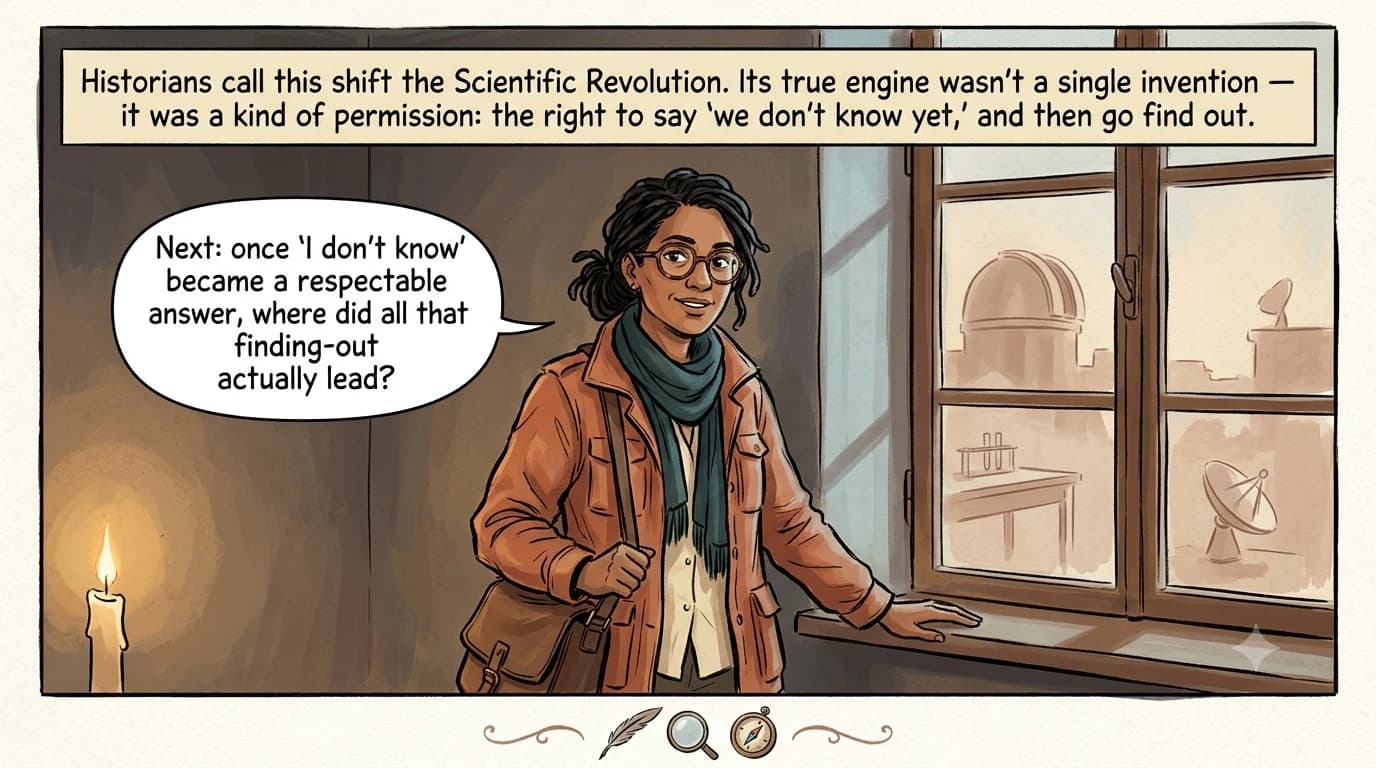
A guide figure stands in a candlelit study beside a window showing faint modern silhouettes of scientific instruments, with small decorative icons of a quill, a lens, and a compass along the panel's edge.
Historians call this shift the Scientific Revolution. Its true engine wasn't a single invention — it was a kind of permission: the right to say 'we don't know yet,' and then go find out.
Kessa: Next: once 'I don't know' became a respectable answer, where did all that finding-out actually lead?