The Human Story · Chapter 6: The Anthropocene
Cover
The Human Story · Chapter 6
The Anthropocene
Two centuries that turned one clever animal into a force of nature
In the blink of an eye by evolutionary standards, humans went from campfires to satellites — and became a force that reshapes the planet itself. Follow Ada and Kessa to the edge of now, and the open question waiting on the other side.
12 panels · ~6 min read
Panel 1
Panel 2
Panel 3
Panel 4
Panel 5
Panel 6
Panel 7
Panel 8
Panel 9
Panel 10
Panel 11
Panel 12
Read chapter text: The Anthropocene
In the blink of an eye by evolutionary standards, humans went from campfires to satellites — and became a force that reshapes the planet itself. Follow Ada and Kessa to the edge of now, and the open question waiting on the other side.
Panel 1
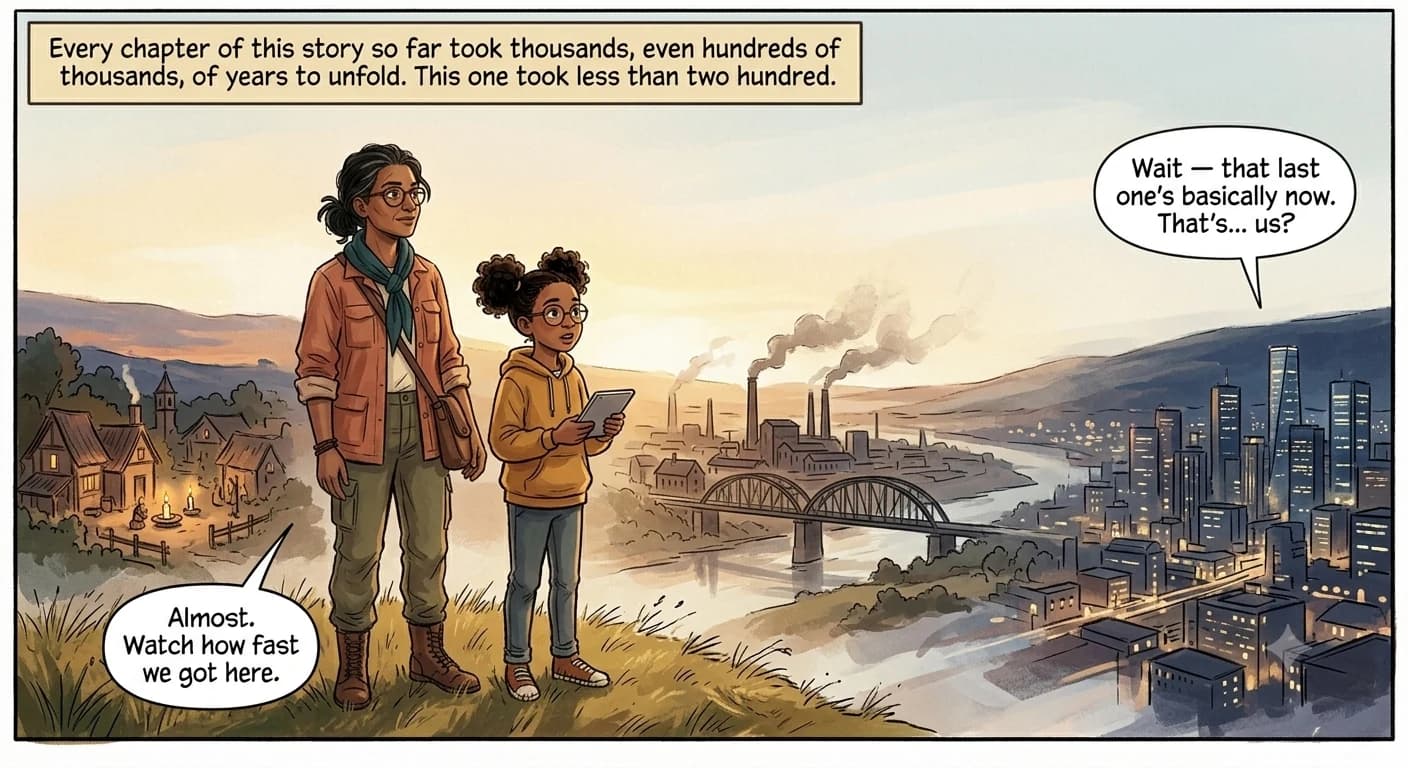
A guide and a present-day kid stand on a hilltop at dawn watching three painted scenes dissolve into one another — a candlelit village, a smoke-stacked industrial town, and a glittering modern city.
Every chapter of this story so far took thousands, even hundreds of thousands, of years to unfold. This one took less than two hundred.
Ada: Wait — that last one's basically now. That's... us?
Kessa: Almost. Watch how fast we got here.
Panel 2
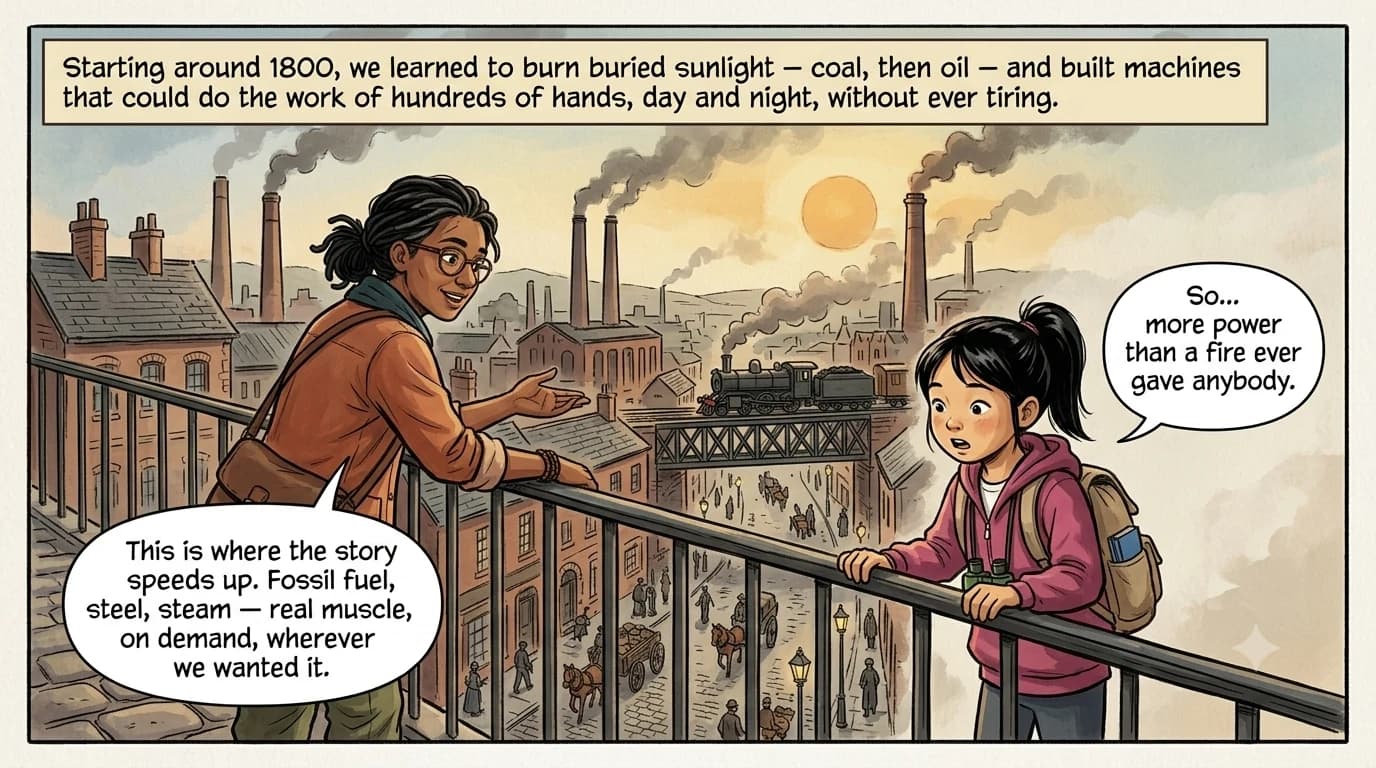
A guide and a present-day kid lean on a footbridge overlooking a smoky early-industrial town of brick factories, tall chimneys, and a steam locomotive crossing an iron bridge.
Starting around 1800, we learned to burn buried sunlight — coal, then oil — and built machines that could do the work of hundreds of hands, day and night, without ever tiring.
Kessa: This is where the story speeds up. Fossil fuel, steel, steam — real muscle, on demand, wherever we wanted it.
Ada: So... more power than a fire ever gave anybody.
Panel 3
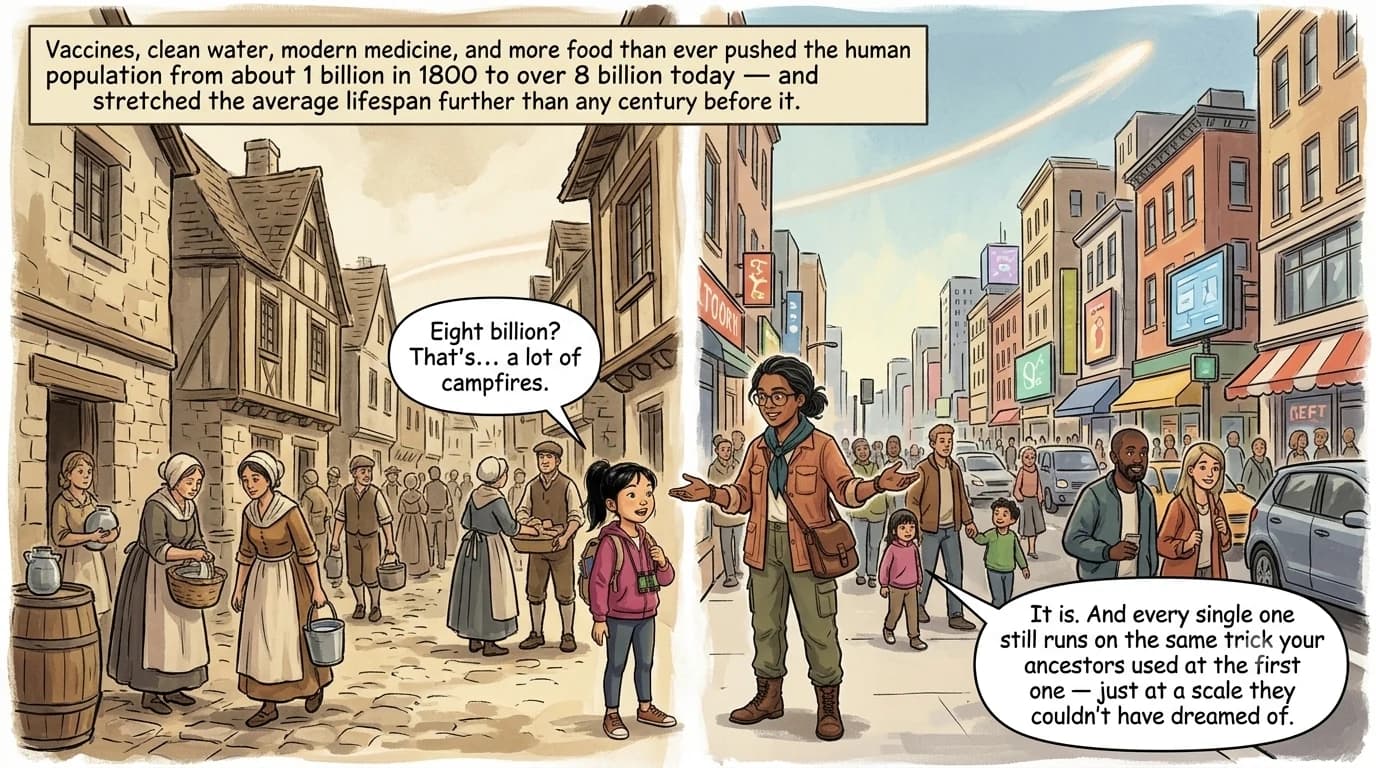
A split scene showing a crowded 1800s village street on one side and a bustling modern city street full of diverse people on the other, with a faint rising curve arcing across the sky above both, and a guide and a present-day kid standing at the seam between them.
Vaccines, clean water, modern medicine, and more food than ever pushed the human population from about 1 billion in 1800 to over 8 billion today — and stretched the average lifespan further than any century before it.
Ada: Eight billion? That's... a lot of campfires.
Kessa: It is. And every single one still runs on the same trick your ancestors used at the first one — just at a scale they couldn't have dreamed of.
Panel 4
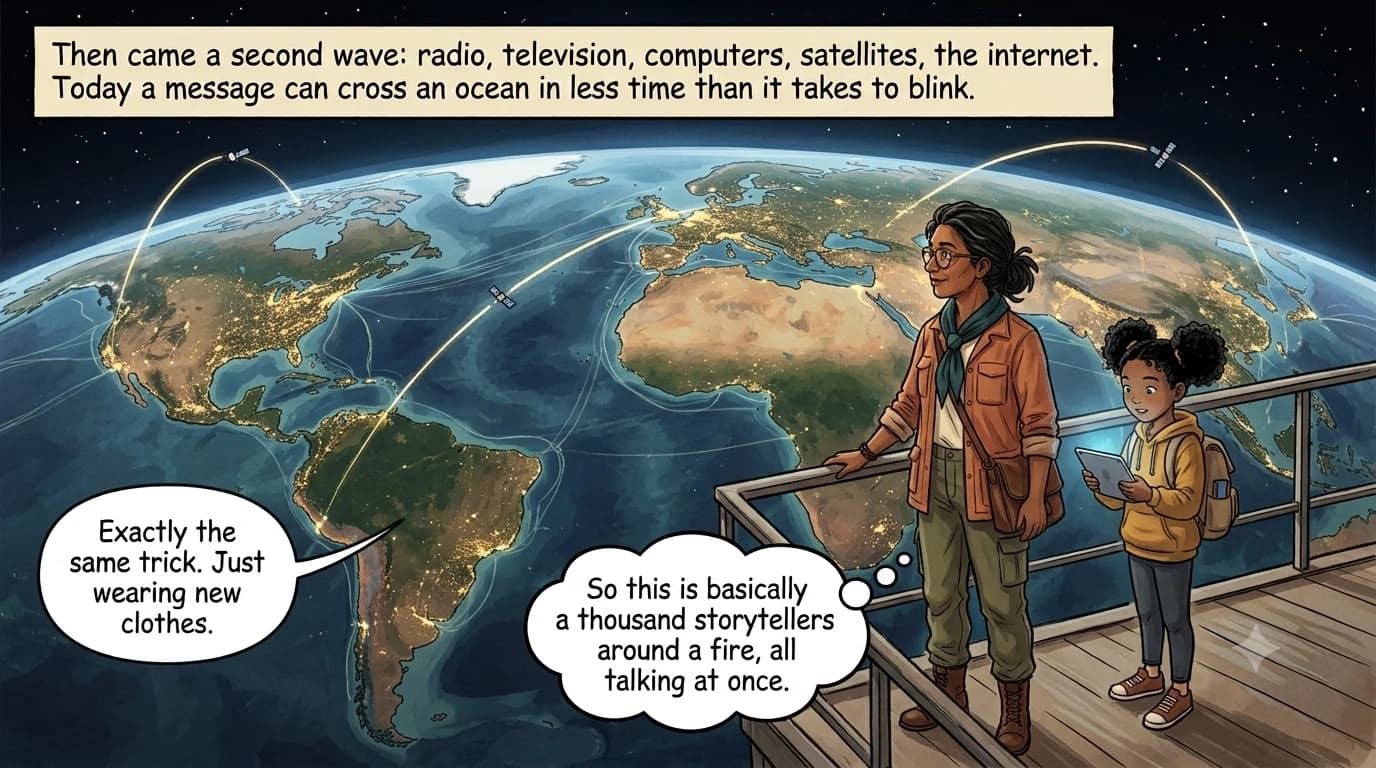
A guide and a present-day kid with a glowing tablet stand on an overlook platform gazing at a painted view of Earth's curve at night, webbed with city lights, satellite trails, and glowing undersea data cables.
Then came a second wave: radio, television, computers, satellites, the internet. Today a message can cross an ocean in less time than it takes to blink.
Ada: So this is basically a thousand storytellers around a fire, all talking at once.
Kessa: Exactly the same trick. Just wearing new clothes.
Panel 5
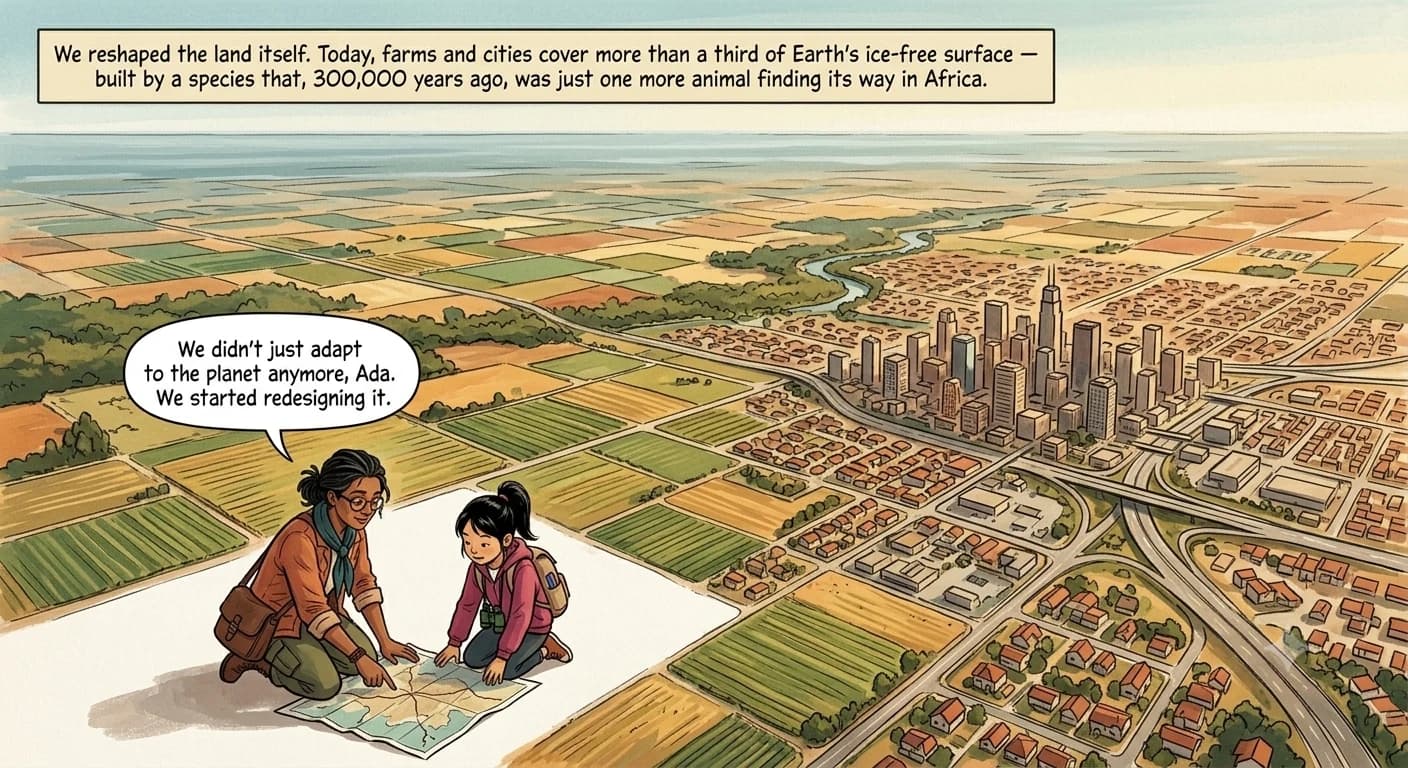
An aerial painted view of farmland grids, suburbs, highways, and city clusters stretching to the horizon, with a guide and a present-day kid studying a folded map together in the foreground corner.
We reshaped the land itself. Today, farms and cities cover more than a third of Earth's ice-free surface — built by a species that, 300,000 years ago, was just one more animal finding its way in Africa.
Kessa: We didn't just adapt to the planet anymore, Ada. We started redesigning it.
Panel 6
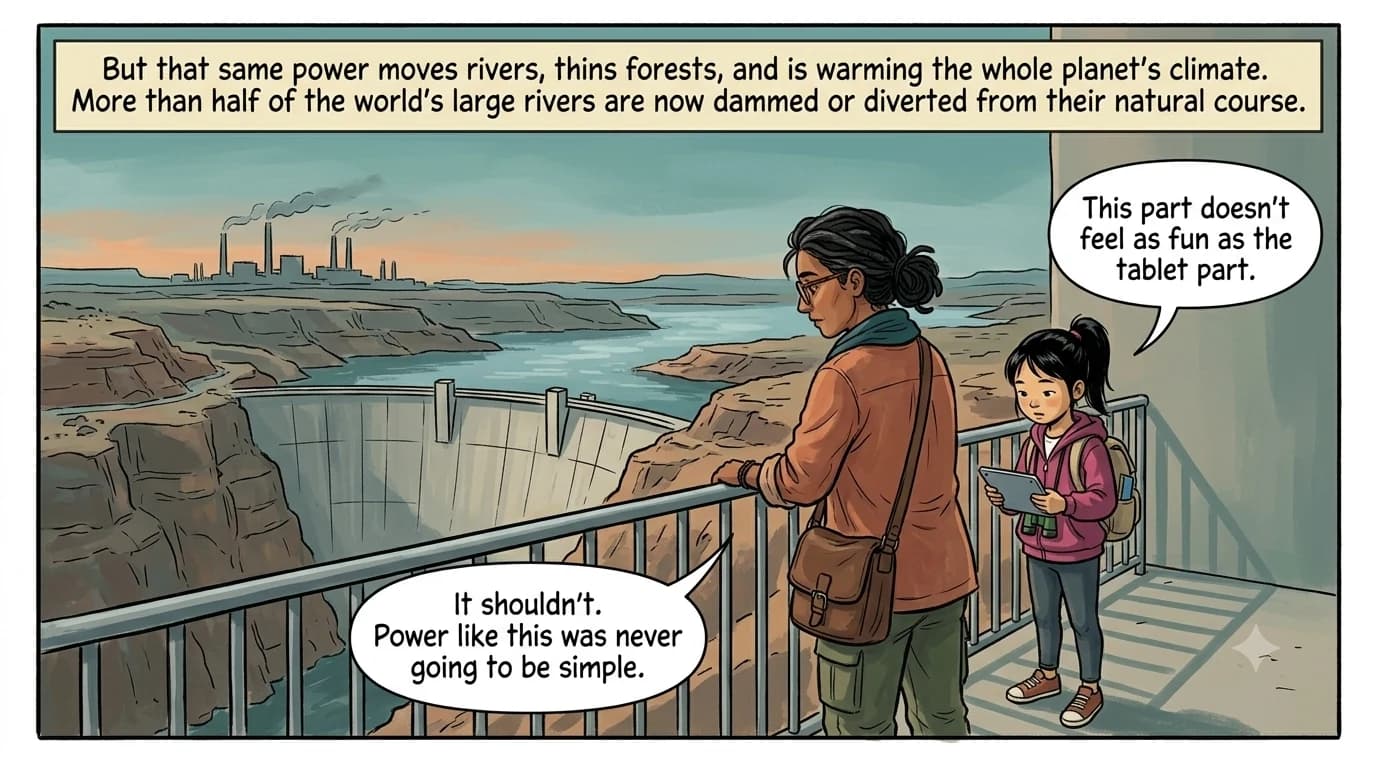
A guide and a present-day kid stand at a railing overlooking a massive concrete dam holding back a once-wild river, with hazy factory smoke tinting the distant sky.
But that same power moves rivers, thins forests, and is warming the whole planet's climate. More than half of the world's large rivers are now dammed or diverted from their natural course.
Ada: This part doesn't feel as fun as the tablet part.
Kessa: It shouldn't. Power like this was never going to be simple.
Panel 7
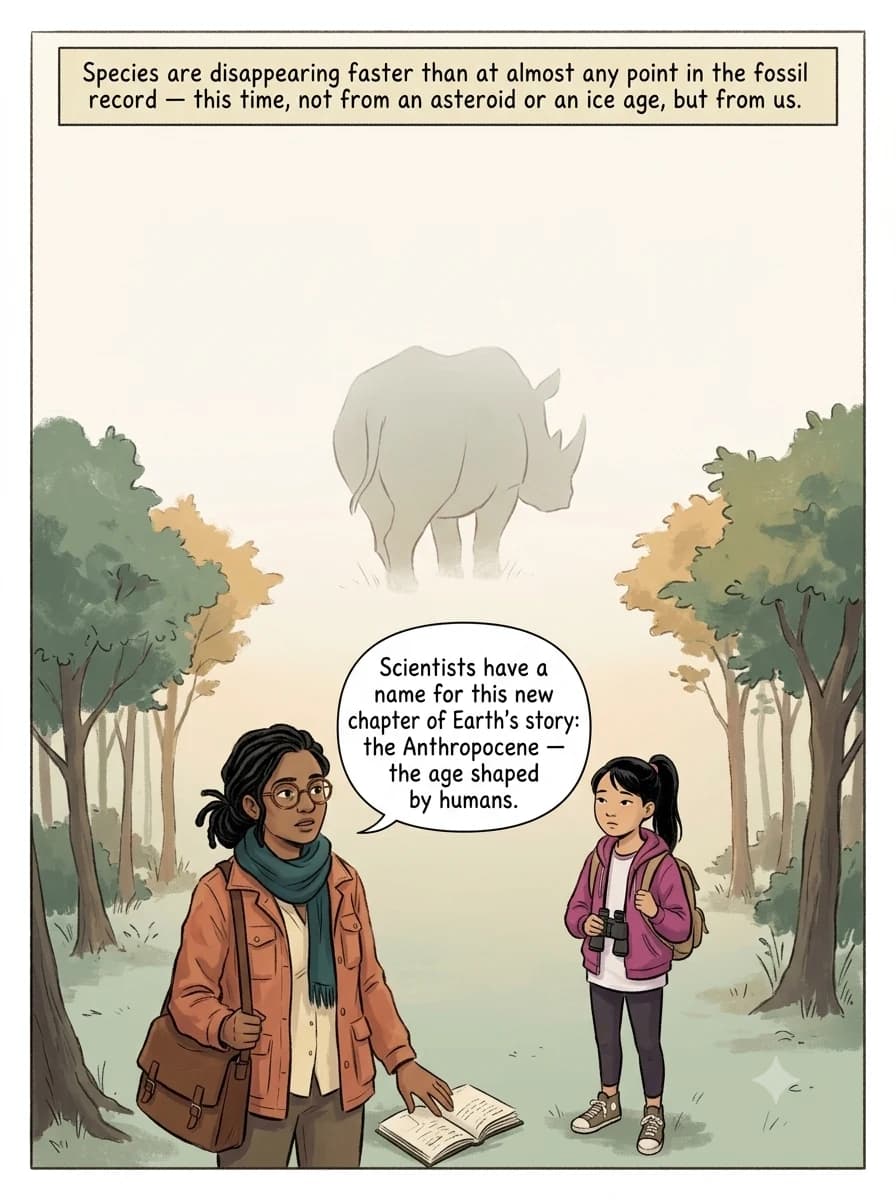
The silhouette of an endangered animal fades into blank space at the edge of a shrinking forest, while a guide and a present-day kid stand nearby watching solemnly.
Species are disappearing faster than at almost any point in the fossil record — this time, not from an asteroid or an ice age, but from us.
Kessa: Scientists have a name for this new chapter of Earth's story: the Anthropocene — the age shaped by humans.
Panel 8
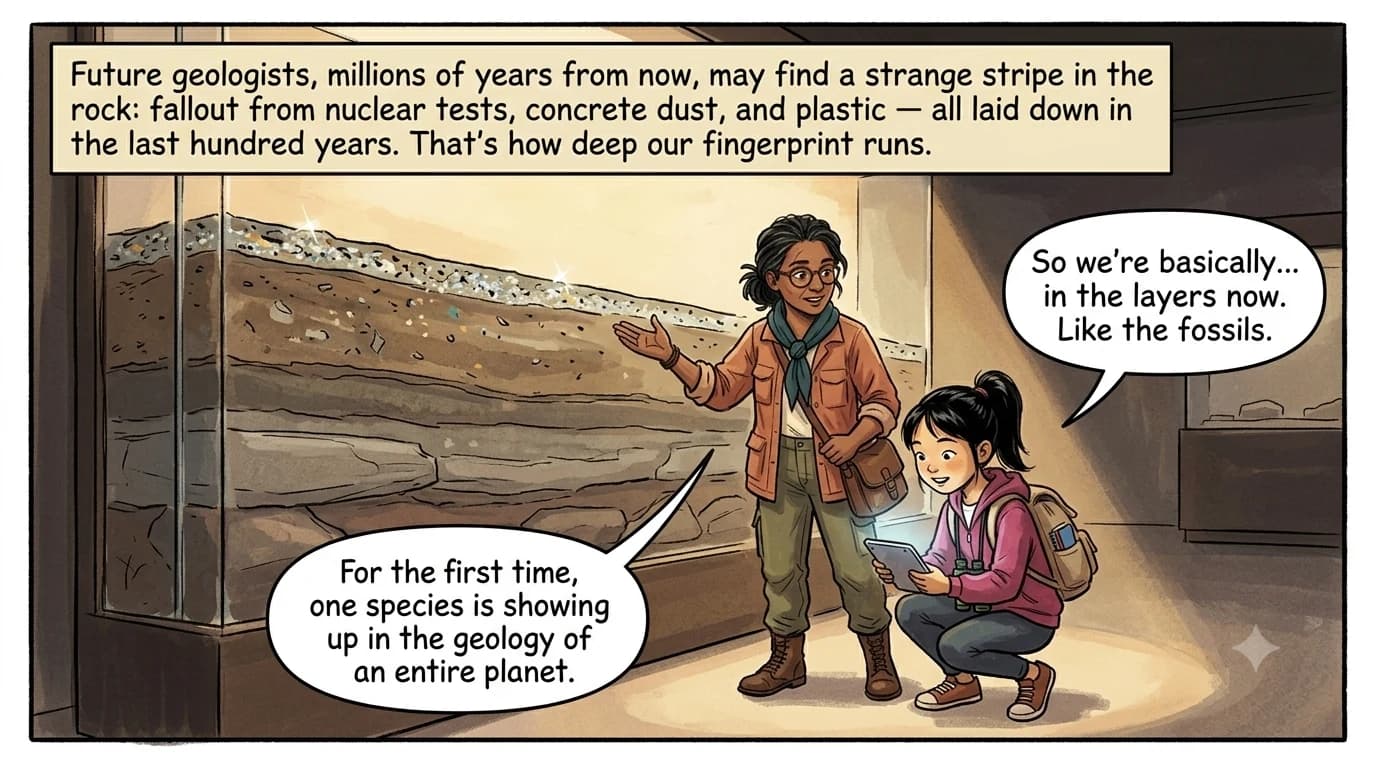
A museum-style cutaway display of layered rock strata, its thin topmost band glinting with flecks of plastic and concrete dust, with a guide gesturing at it while a present-day kid crouches close with a glowing tablet.
Future geologists, millions of years from now, may find a strange stripe in the rock: fallout from nuclear tests, concrete dust, and plastic — all laid down in just the last hundred years. That's how deep our fingerprint runs.
Ada: So we're basically... in the layers now. Like the fossils.
Kessa: For the first time, one species is showing up in the geology of an entire planet.
Panel 9
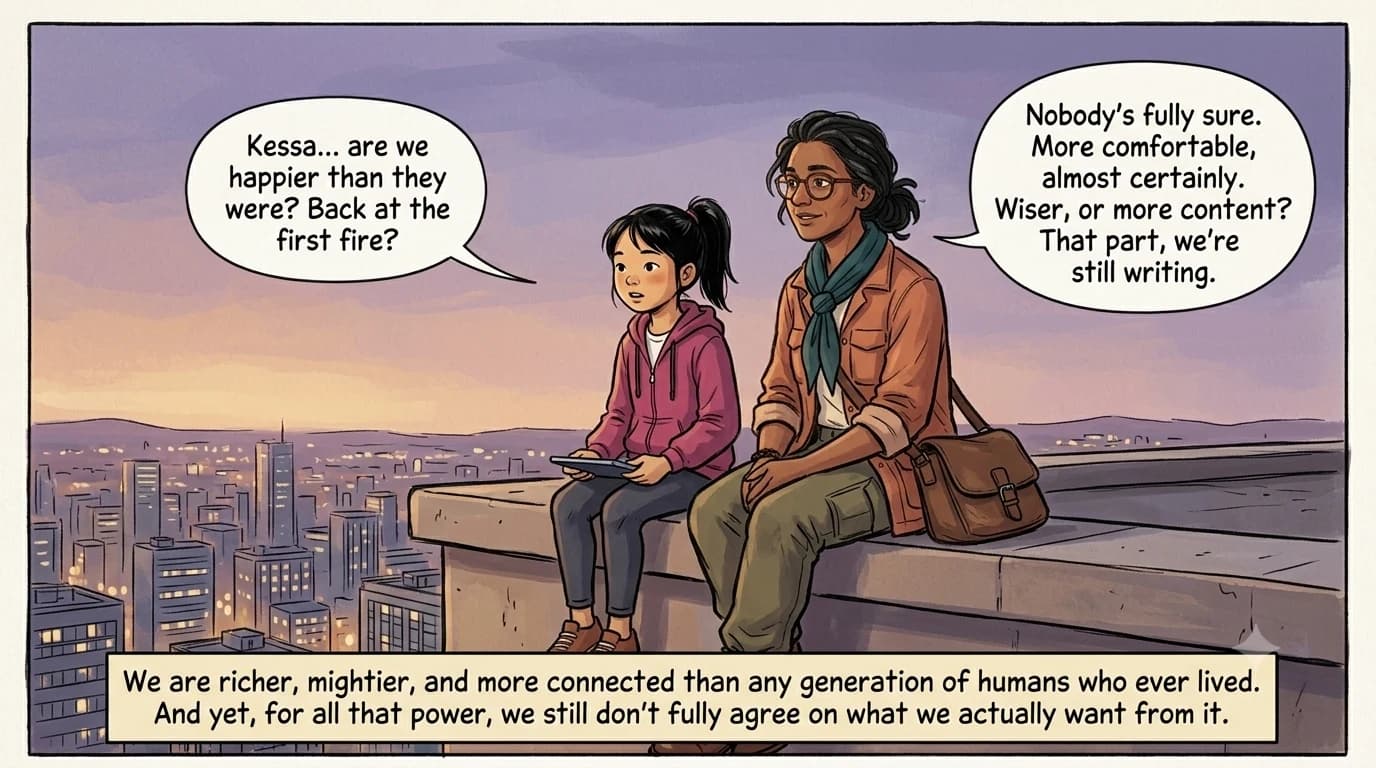
A guide and a present-day kid sit side by side on a rooftop ledge at dusk, looking out over a glittering modern city below in a quiet, contemplative moment.
We are richer, mightier, and more connected than any generation of humans who ever lived. And yet, for all that power, we still don't fully agree on what we actually want from it.
Ada: Kessa... are we happier than they were? Back at the first fire?
Kessa: Nobody's fully sure. More comfortable, almost certainly. Wiser, or more content? That part, we're still writing.
Panel 10
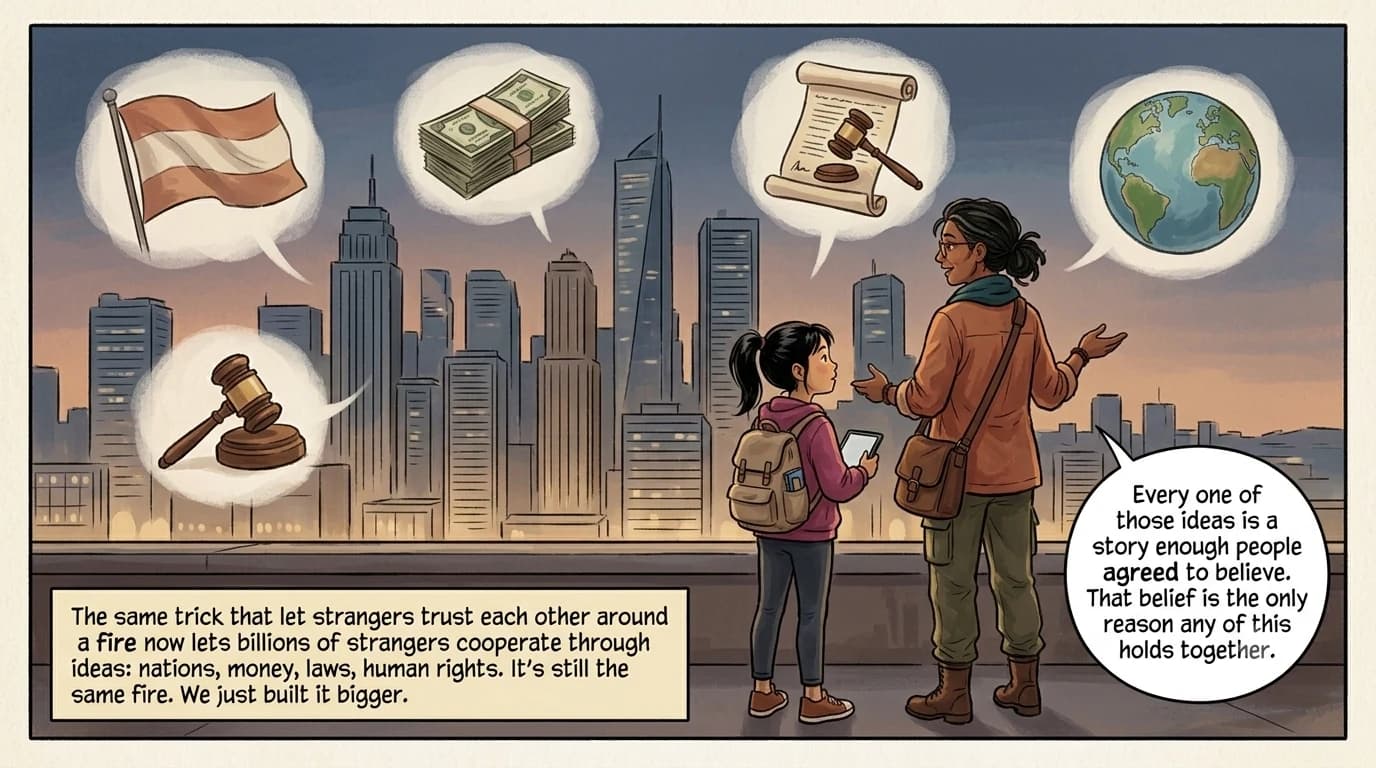
A guide and a present-day kid stand together as a modern city skyline below them is overlaid with faint painterly icons of a flag, banknotes, a scroll and gavel, and a small globe, drifting like painted memories.
The same trick that let strangers trust each other around a fire now lets billions of strangers cooperate through ideas: nations, money, laws, human rights. It's still the same fire. We just built it bigger.
Kessa: Every one of those ideas is a story enough people agreed to believe. That belief is the only reason any of this holds together.
Panel 11
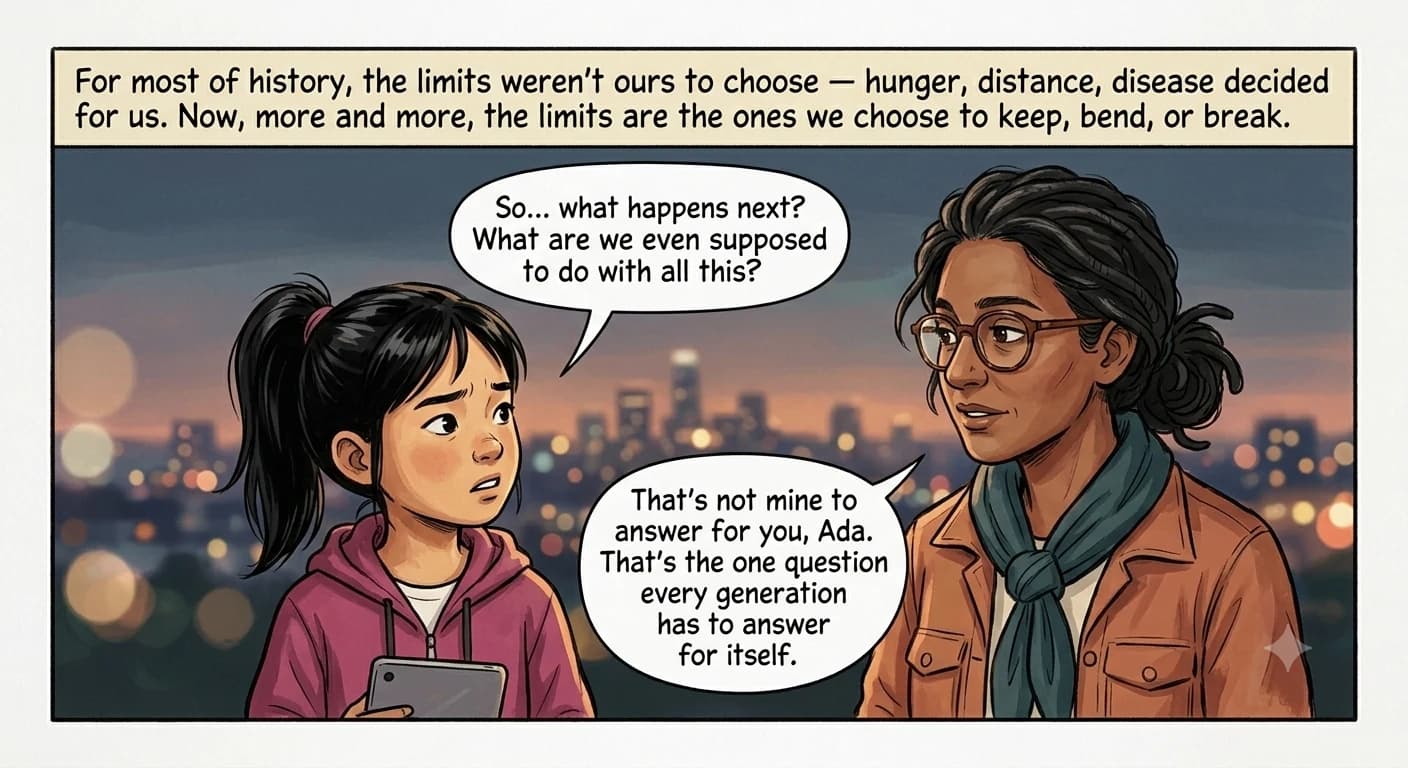
A close two-shot of a guide and a present-day kid facing each other on a rooftop overlook at dusk, city lights twinkling softly out of focus below them.
For most of history, the limits weren't ours to choose — hunger, distance, disease decided for us. Now, more and more, the limits are the ones we choose to keep, bend, or break.
Ada: So... what happens next? What are we even supposed to do with all this?
Kessa: That's not mine to answer for you, Ada. That's the one question every generation has to answer for itself.
Panel 12
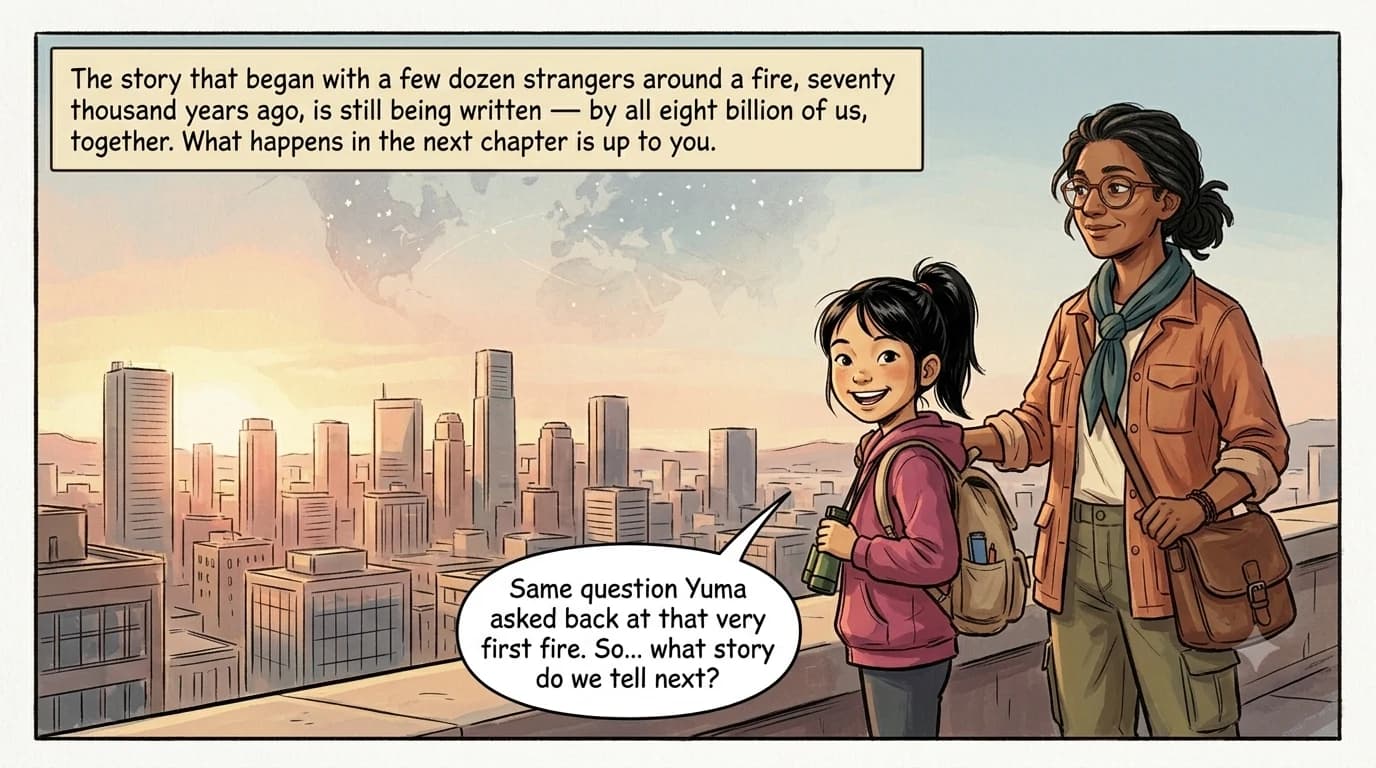
Dawn breaks in warm light over a modern city skyline as a guide and a present-day kid stand at an overlook's edge; the kid turns to smile warmly and directly at the viewer, with a faint ghosted echo of a star-strewn painted map in the brightening sky above the skyline.
The story that began with a few dozen strangers around a fire, seventy thousand years ago, is still being written — by all eight billion of us, together. What happens in the next chapter is up to you.
Ada: Same question Yuma asked back at that very first fire. So... what story do we tell next?