The Human Story · Chapter 4: The Unification of Humankind
Cover
The Human Story · Chapter 4
The Unification of Humankind
How coin, empire, and belief stitched thousands of small worlds into one
For most of history, humanity lived in thousands of separate small worlds. Follow a long-distance trader across dusty roads and crowded ports as money, empires, and universal beliefs slowly — and not always gently — merge them into one.
12 panels · ~6 min read
Panel 1
Panel 2
Panel 3
Panel 4
Panel 5
Panel 6
Panel 7
Panel 8
Panel 9
Panel 10
Panel 11
Panel 12
Read chapter text: The Unification of Humankind
For most of history, humanity lived in thousands of separate small worlds. Follow a long-distance trader across dusty roads and crowded ports as money, empires, and universal beliefs slowly — and not always gently — merge them into one.
Panel 1
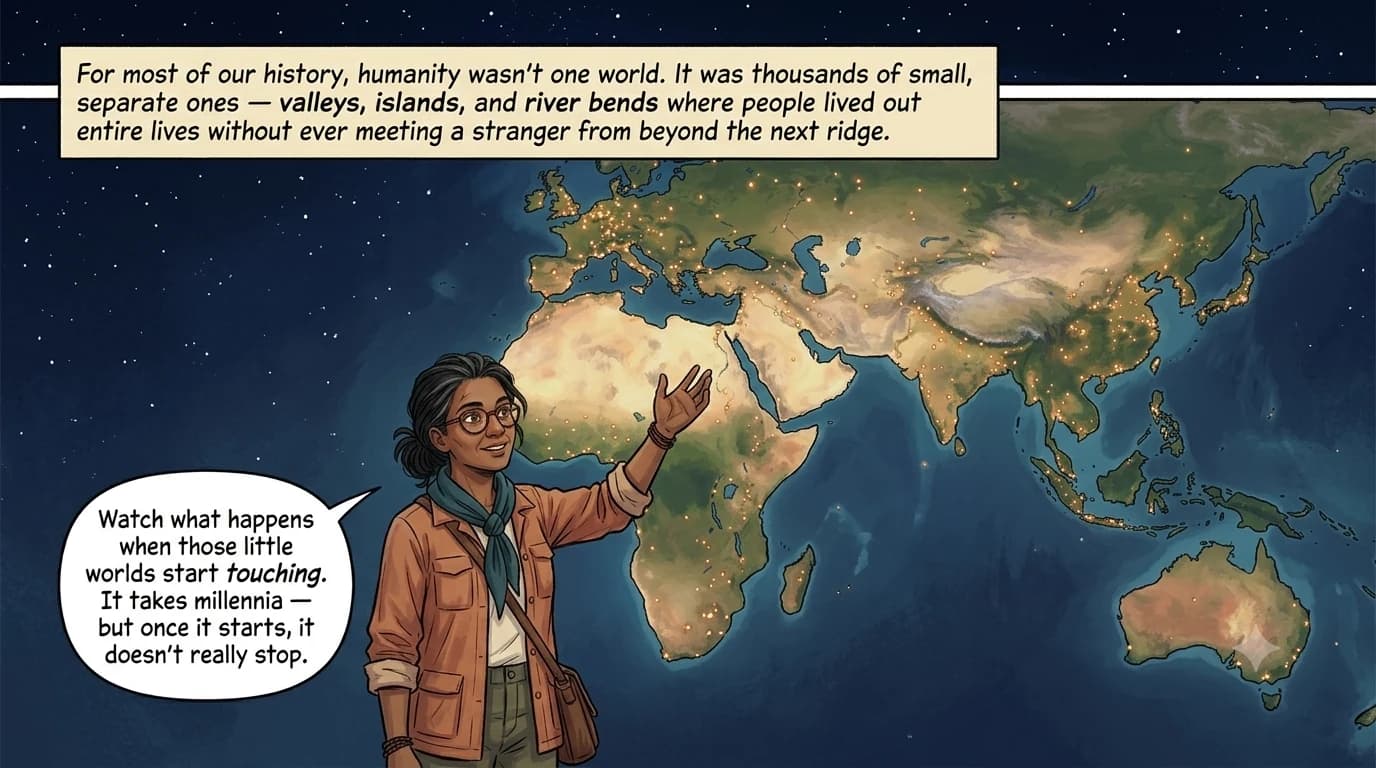
A guide figure stands beside a glowing painterly map of the ancient world scattered with hundreds of tiny, separate firelit dots representing isolated human communities.
For most of our history, humanity wasn't one world. It was thousands of small, separate ones — valleys, islands, and river bends where people lived out entire lives without ever meeting a stranger from beyond the next ridge.
Kessa: Watch what happens when those little worlds start touching. It takes millennia — but once it starts, it doesn't really stop.
Panel 2
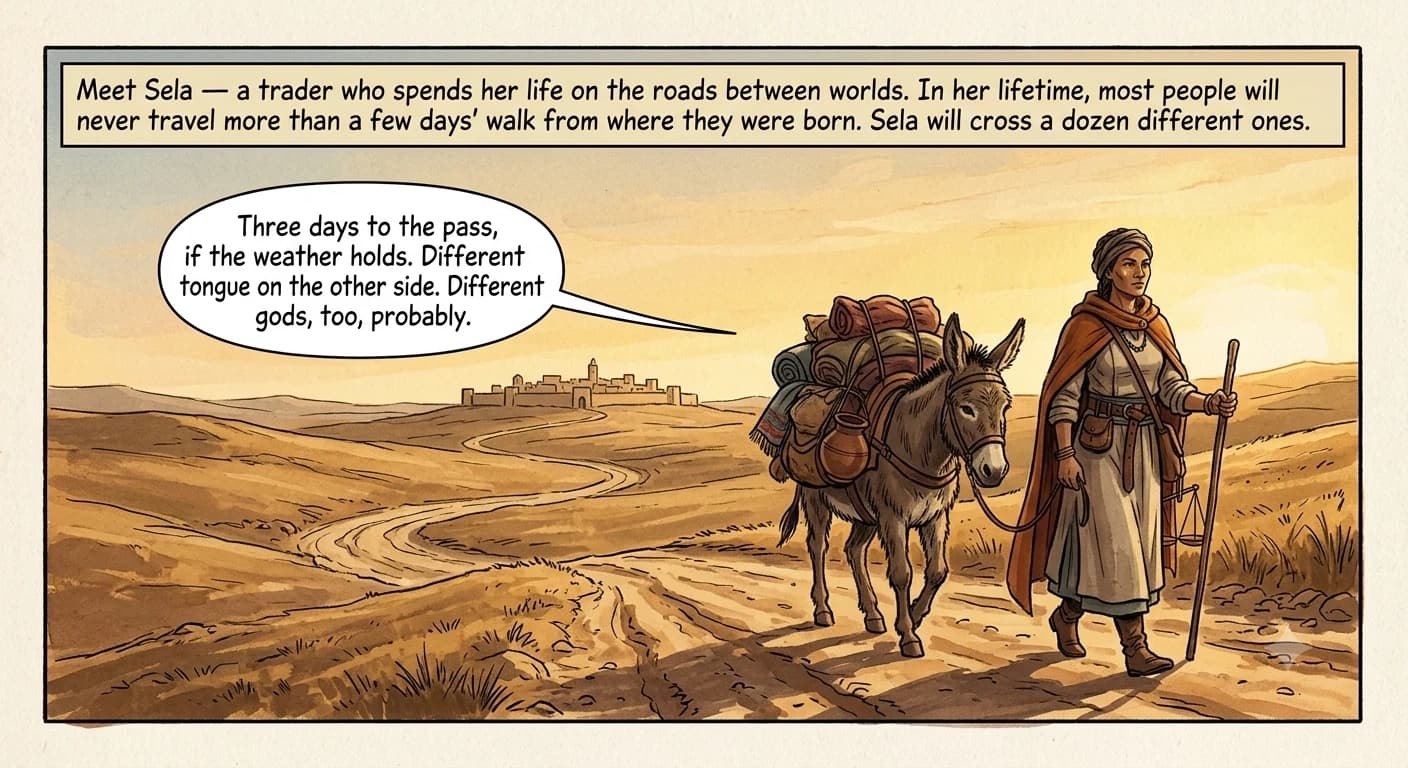
A weathered trader walks beside a laden pack donkey along a long, dusty caravan road at dawn, heading toward a distant hill town.
Meet Sela — a trader who spends her life on the roads between worlds. In her lifetime, most people will never travel more than a few days' walk from where they were born. Sela will cross a dozen different ones.
Sela: Three days to the pass, if the weather holds. Different tongue on the other side. Different gods, too, probably.
Panel 3
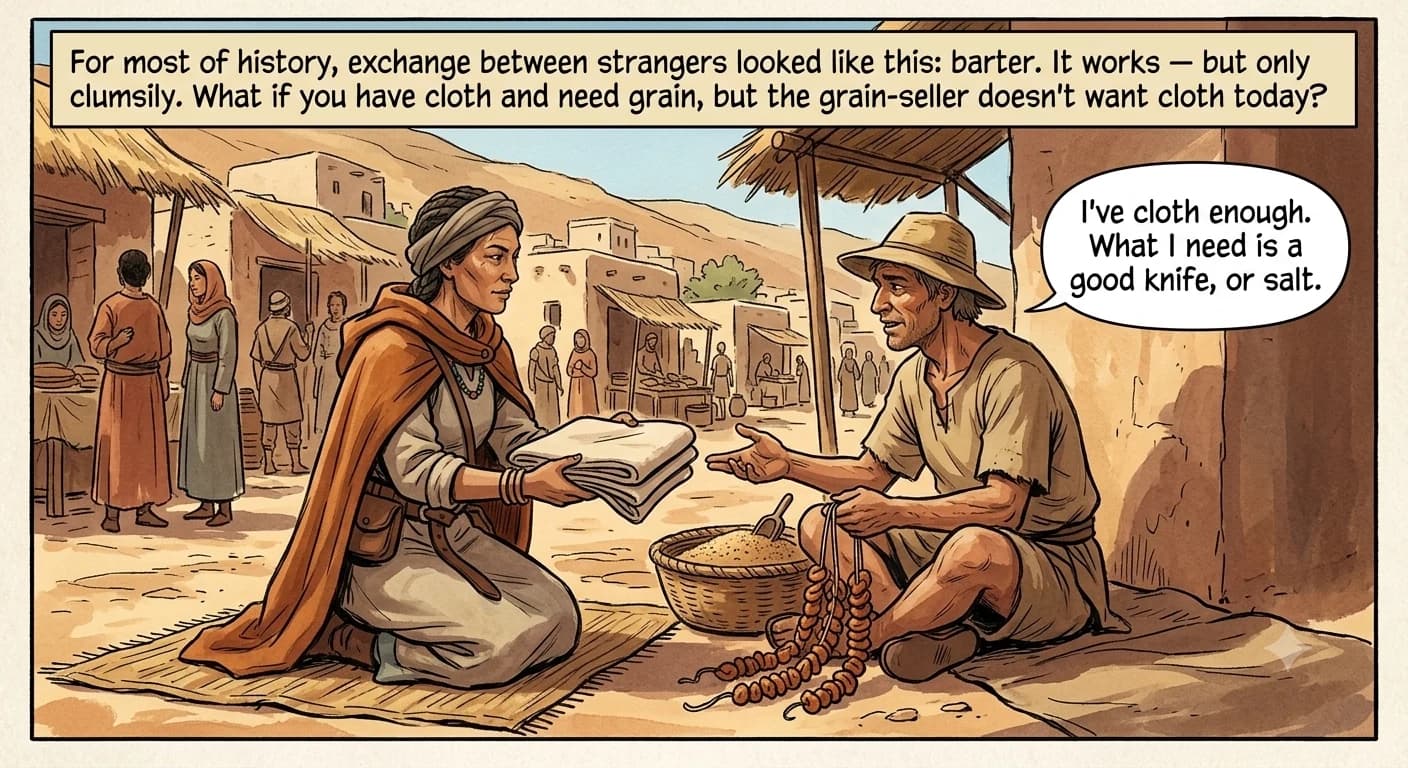
A trader kneels across a woven mat from a village farmer, bartering a bolt of cloth for a basket of grain and dried fruit at a small hillside market.
For most of history, exchange between strangers looked like this: barter. It works — but only clumsily. What if you have cloth and need grain, but the grain-seller doesn't want cloth today?
Farmer: I've cloth enough. What I need is a good knife, or salt.
Panel 4
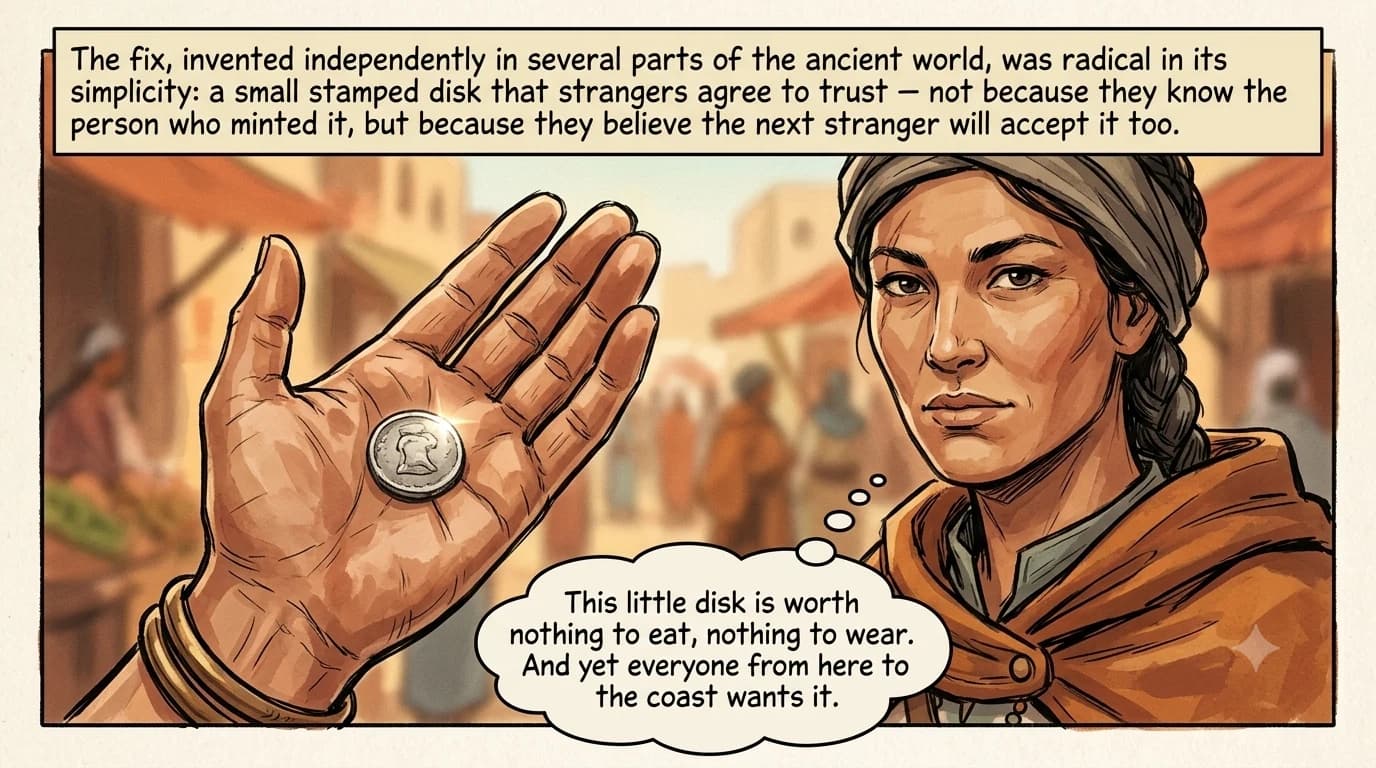
Close-up of a trader's open palm holding a single worn silver coin stamped with a simple image, with a market blurred in the background.
The fix, invented independently in several parts of the ancient world, was radical in its simplicity: a small stamped disk that strangers agree to trust — not because they know the person who minted it, but because they believe the next stranger will accept it too.
Sela: This little disk is worth nothing to eat, nothing to wear. And yet everyone from here to the coast wants it.
Panel 5
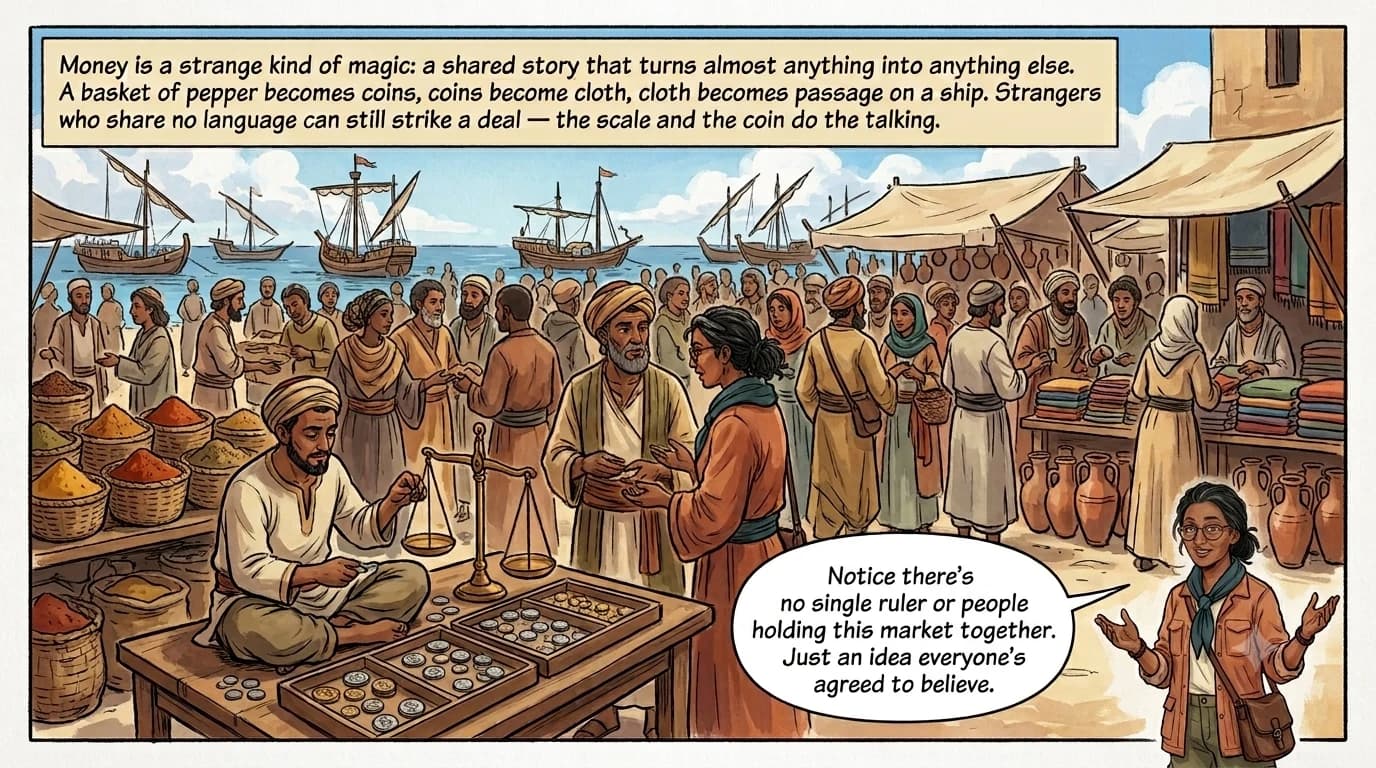
A busy ancient port market with mixed crowds of different regional dress haggling over spices, dyed cloth, and amphorae, while a money-changer weighs coins from different lands on a balance scale.
Money is a strange kind of magic: a shared story that turns almost anything into anything else. A basket of pepper becomes coins, coins become cloth, cloth becomes passage on a ship. Strangers who share no language can still strike a deal — the scale and the coin do the talking.
Kessa: Notice there's no single ruler or people holding this market together. Just an idea everyone's agreed to believe.
Panel 6
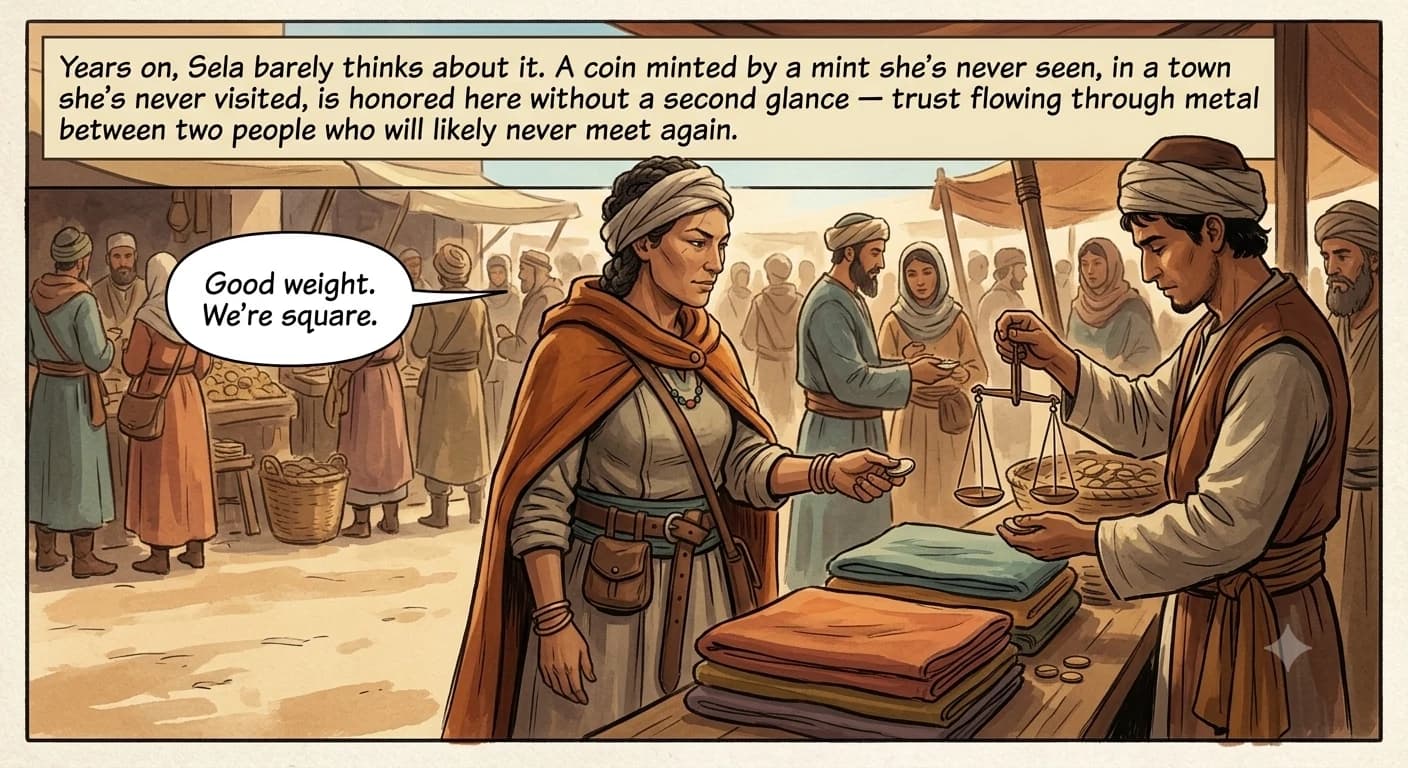
A trader hands a single coin to a stranger's cloth stall in a busy port, a quick and confident wordless transaction replacing the slower work of barter.
Years on, Sela barely thinks about it. A coin minted by a mint she's never seen, in a town she's never visited, is honored here without a second glance — trust flowing through metal between two people who will likely never meet again.
Sela: Good weight. We're square.
Panel 7
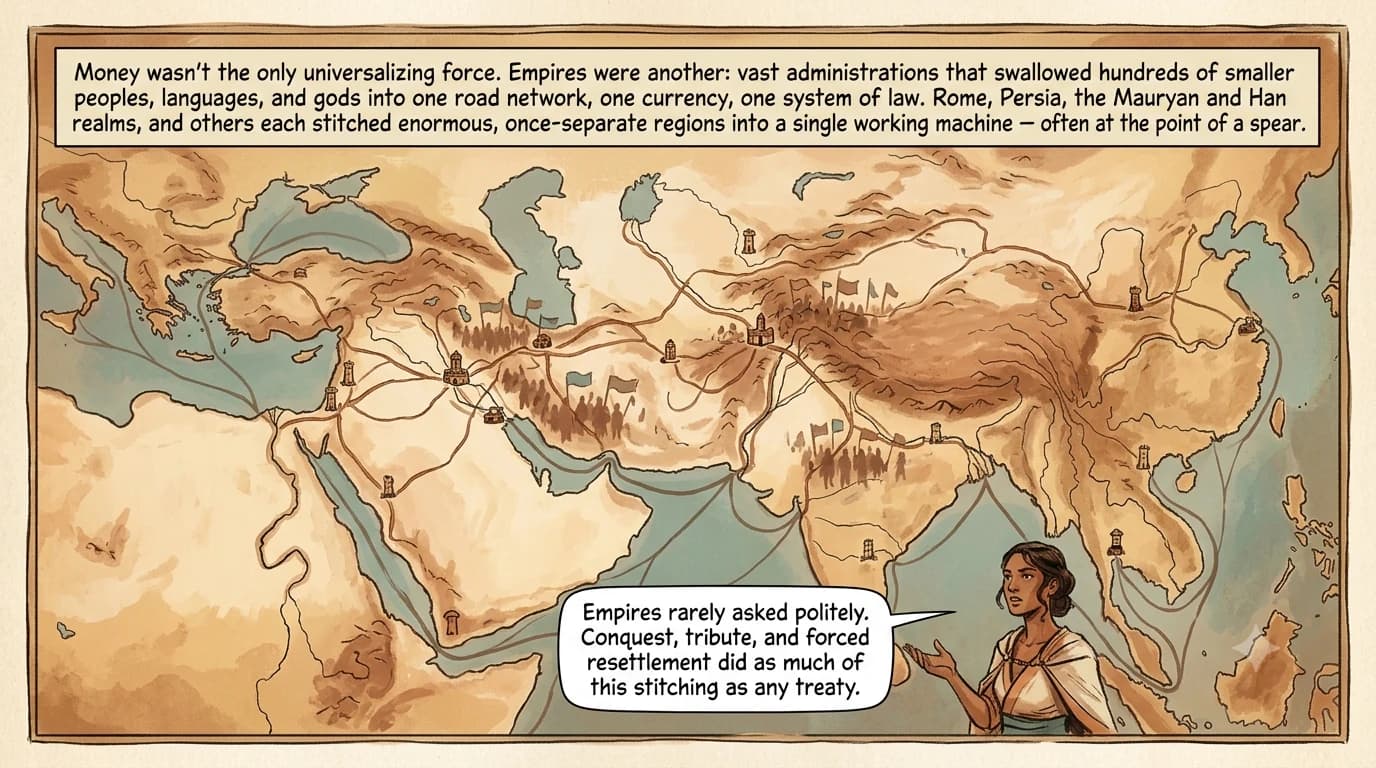
A stylized painterly map showing an ancient empire's road and sea-lane network, watchtowers, and garrisons fanning out from central hubs and absorbing many smaller surrounding regions.
Money wasn't the only universalizing force. Empires were another: vast administrations that swallowed hundreds of smaller peoples, languages, and gods into one road network, one currency, one system of law. Rome, Persia, the Mauryan and Han realms, and others each stitched enormous, once-separate regions into a single working machine — often at the point of a spear.
Kessa: Empires rarely asked politely. Conquest, tribute, and forced resettlement did as much of this stitching as any treaty.
Panel 8
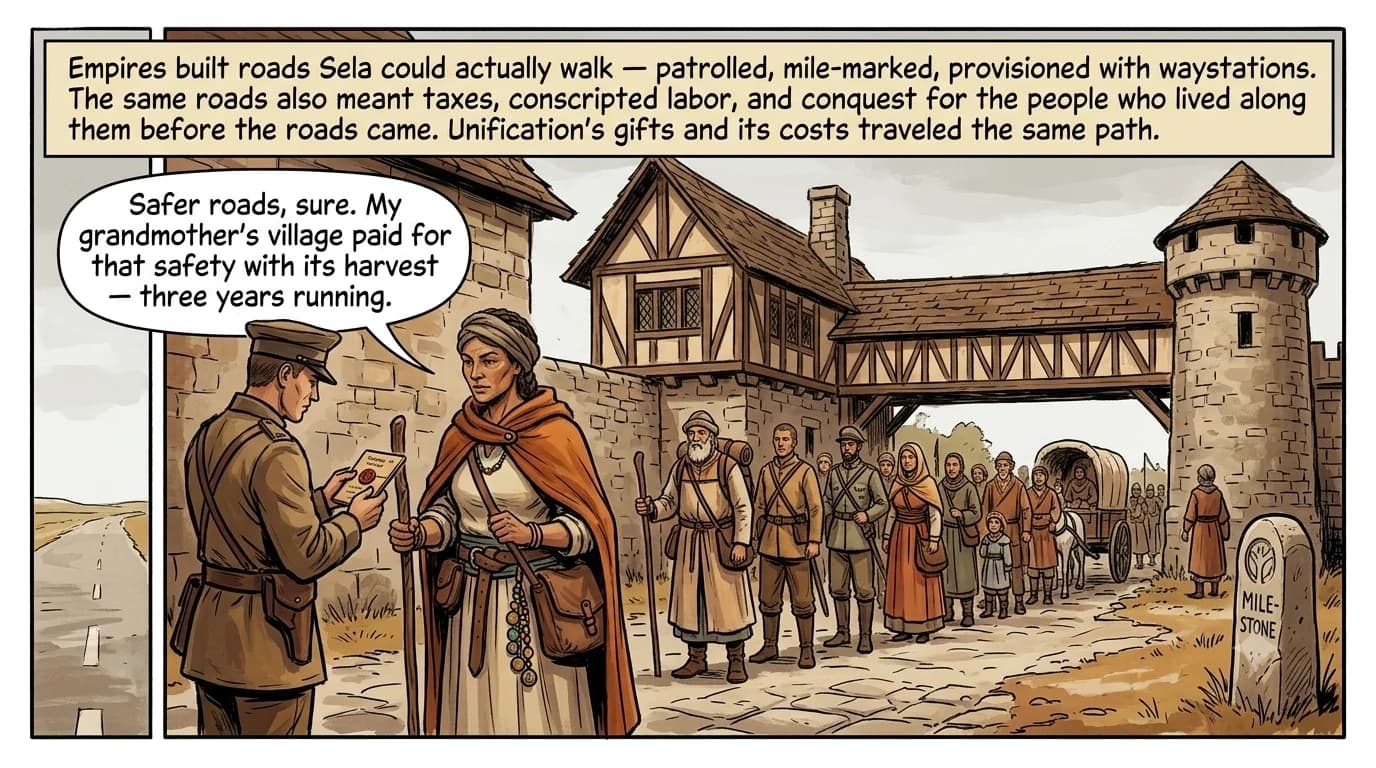
A trader waits at a garrisoned road checkpoint where a soldier checks travel permits, behind a long line of visibly different travelers — pilgrims, soldiers, merchants, and families.
Empires built roads Sela could actually walk — patrolled, mile-marked, provisioned with waystations. The same roads also meant taxes, conscripted labor, and conquest for the people who lived along them before the roads came. Unification's gifts and its costs traveled the same path.
Sela: Safer roads, sure. My grandmother's village paid for that safety with its harvest — three years running.
Panel 9
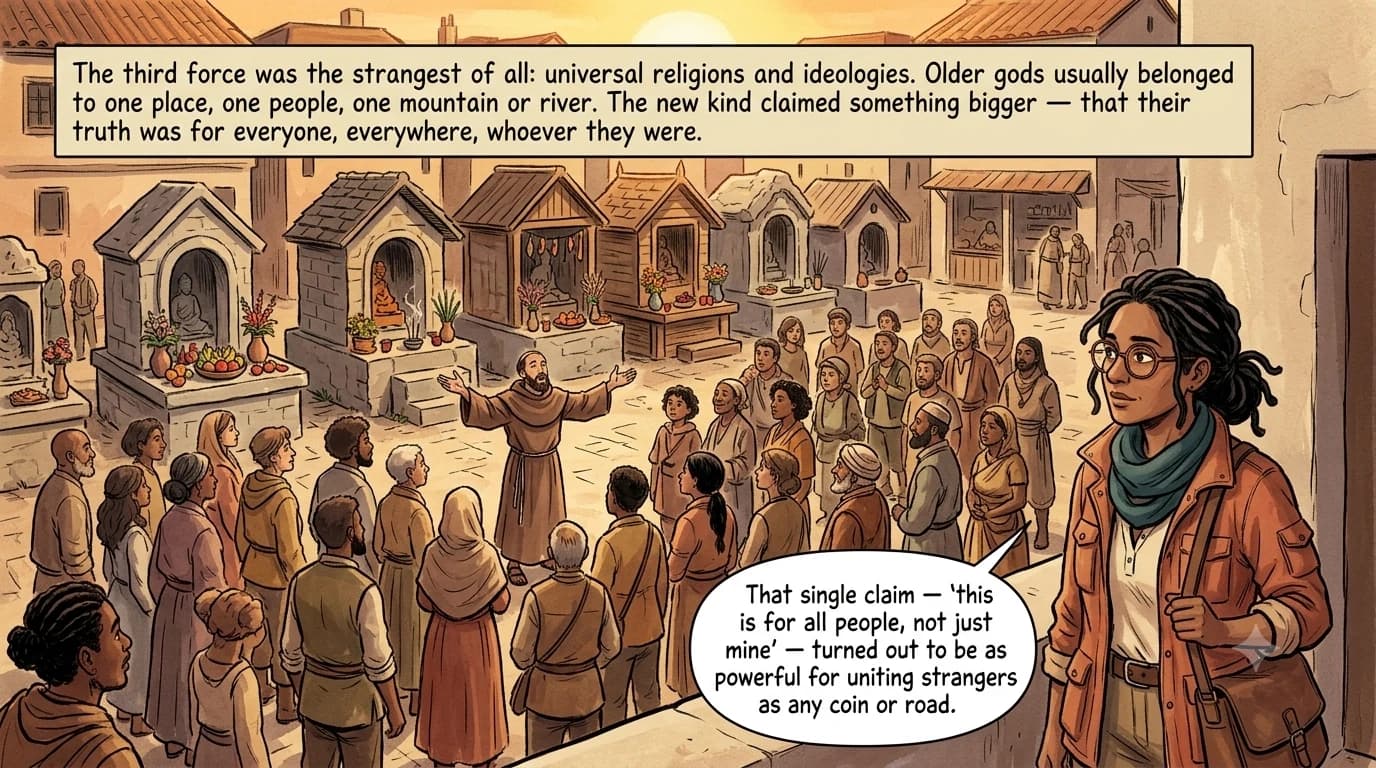
A crowded harbor-town shrine district with several small local shrines beside a diverse crowd gathered around a traveling preacher addressing people of many different origins.
The third force was the strangest of all: universal religions and ideologies. Older gods usually belonged to one place, one people, one mountain or river. The new kind claimed something bigger — that their truth was for everyone, everywhere, whoever they were.
Kessa: That single claim — 'this is for all people, not just mine' — turned out to be as powerful for uniting strangers as any coin or road.
Panel 10
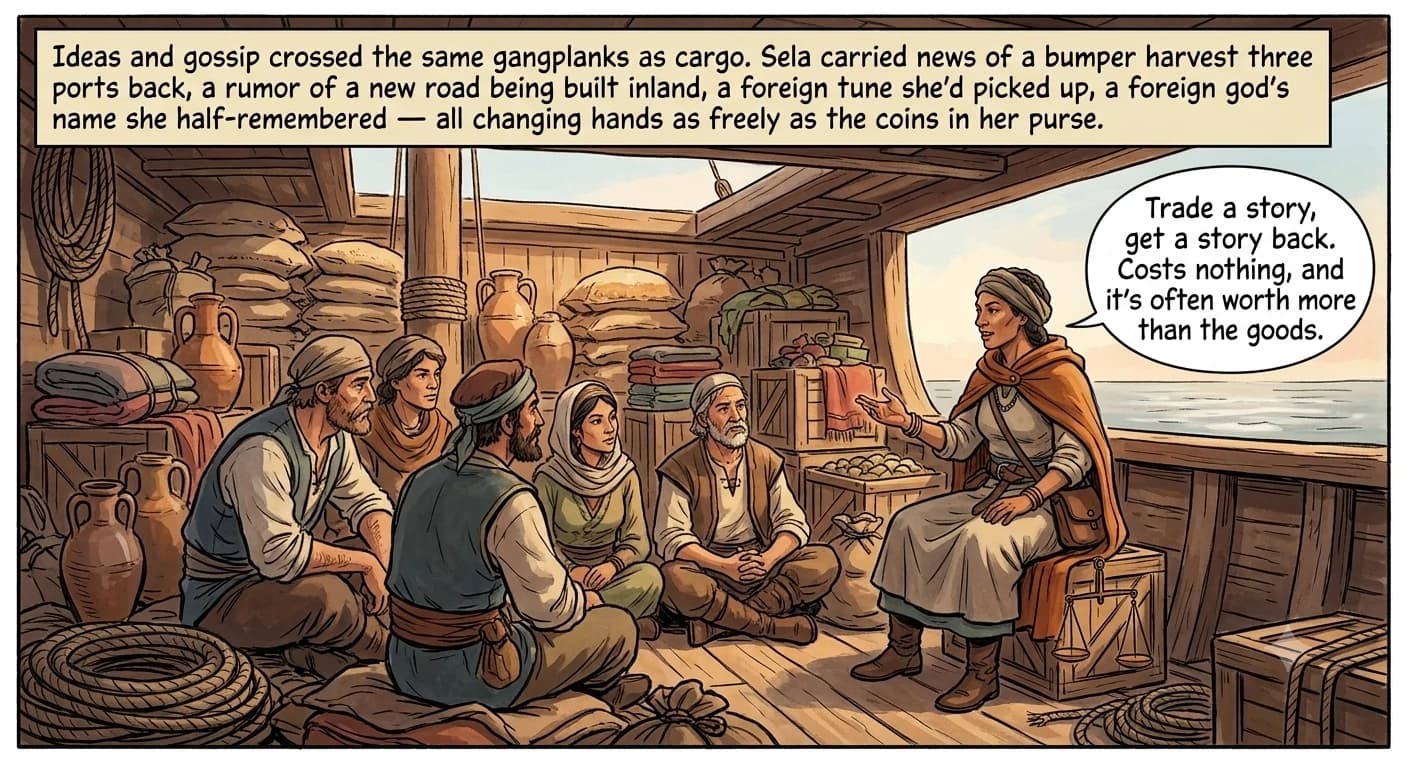
A trader sits among sailors and passengers of different origins on a small loaded trading ship, exchanging stories and news alongside sacks of grain and bolts of cloth.
Ideas and gossip crossed the same gangplanks as cargo. Sela carried news of a bumper harvest three ports back, a rumor of a new road being built inland, a foreign tune she'd picked up, a foreign god's name she half-remembered — all changing hands as freely as the coins in her purse.
Sela: Trade a story, get a story back. Costs nothing, and it's often worth more than the goods.
Panel 11
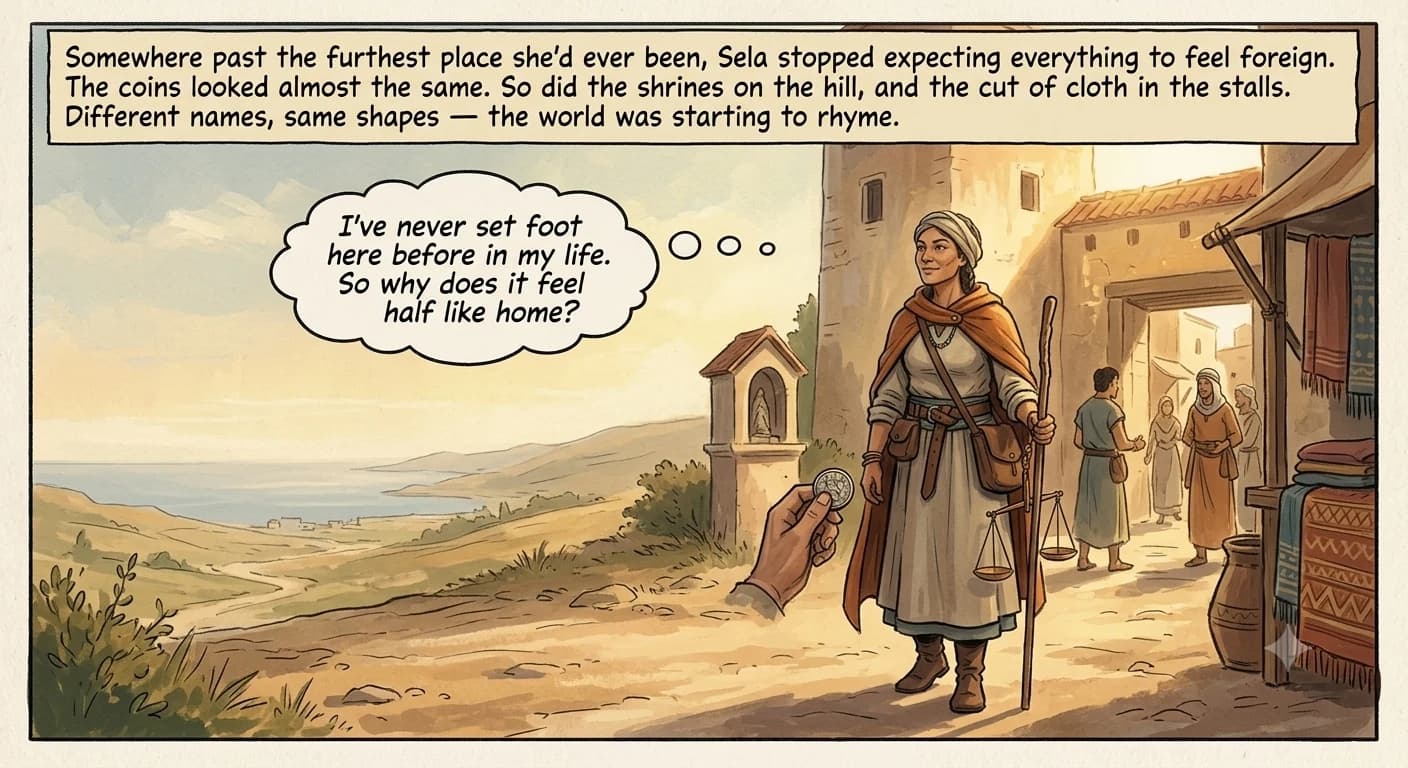
A trader pauses at the edge of an unfamiliar foreign port town, recognizing a familiar coin design, shrine shape, and cloth pattern that echo places far from where she started.
Somewhere past the furthest place she'd ever been, Sela stopped expecting everything to feel foreign. The coins looked almost the same. So did the shrines on the hill, and the cut of cloth in the stalls. Different names, same shapes — the world was starting to rhyme.
Sela: I've never set foot here before in my life. So why does it feel half like home?
Panel 12
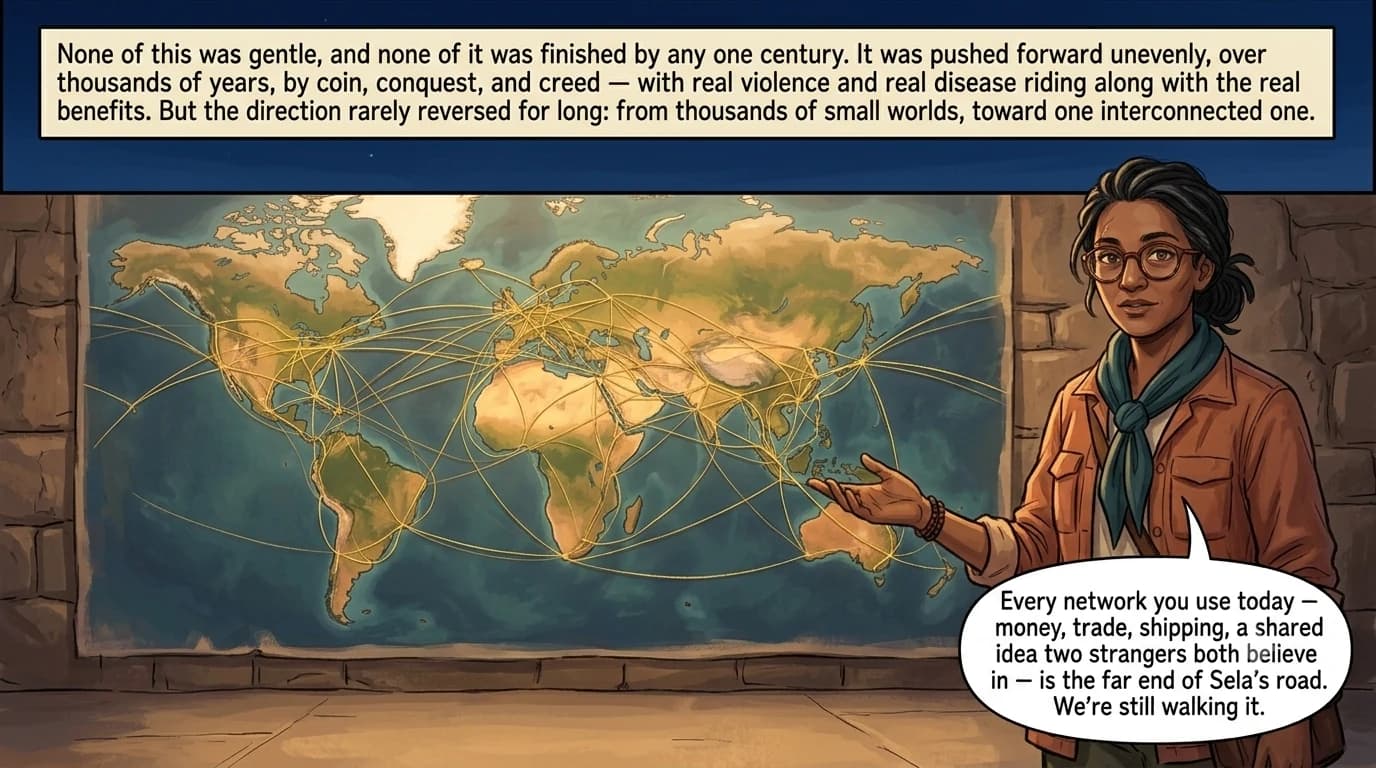
A guide figure stands before a glowing world map crisscrossed with shipping lanes and connecting threads linking every continent, echoing the scattered firelit dots from the chapter's opening panel now fully joined.
None of this was gentle, and none of it was finished by any one century. It was pushed forward unevenly, over thousands of years, by coin, conquest, and creed — with real violence and real disease riding along with the real benefits. But the direction rarely reversed for long: from thousands of small worlds, toward one interconnected one.
Kessa: Every network you use today — money, trade, shipping, a shared idea two strangers both believe in — is the far end of Sela's road. We're still walking it.