The Human Story · Chapter 1: The Cognitive Revolution
Cover
The Human Story · Chapter 1
The Cognitive Revolution
How gossip, ghosts, and shared stories rewired human destiny
Around 70,000 years ago, something changed in the way Homo sapiens thought and talked. This chapter follows one band through the night everything shifted — and traces the same idea all the way to today.
13 panels · ~6 min read
Panel 1
Panel 2
Panel 3
Panel 4
Panel 5
Panel 6
Panel 7
Panel 8
Panel 9
Panel 10
Panel 11
Panel 12
Panel 13
Read chapter text: The Cognitive Revolution
Around 70,000 years ago, something changed in the way Homo sapiens thought and talked. This chapter follows one band through the night everything shifted — and traces the same idea all the way to today.
Panel 1
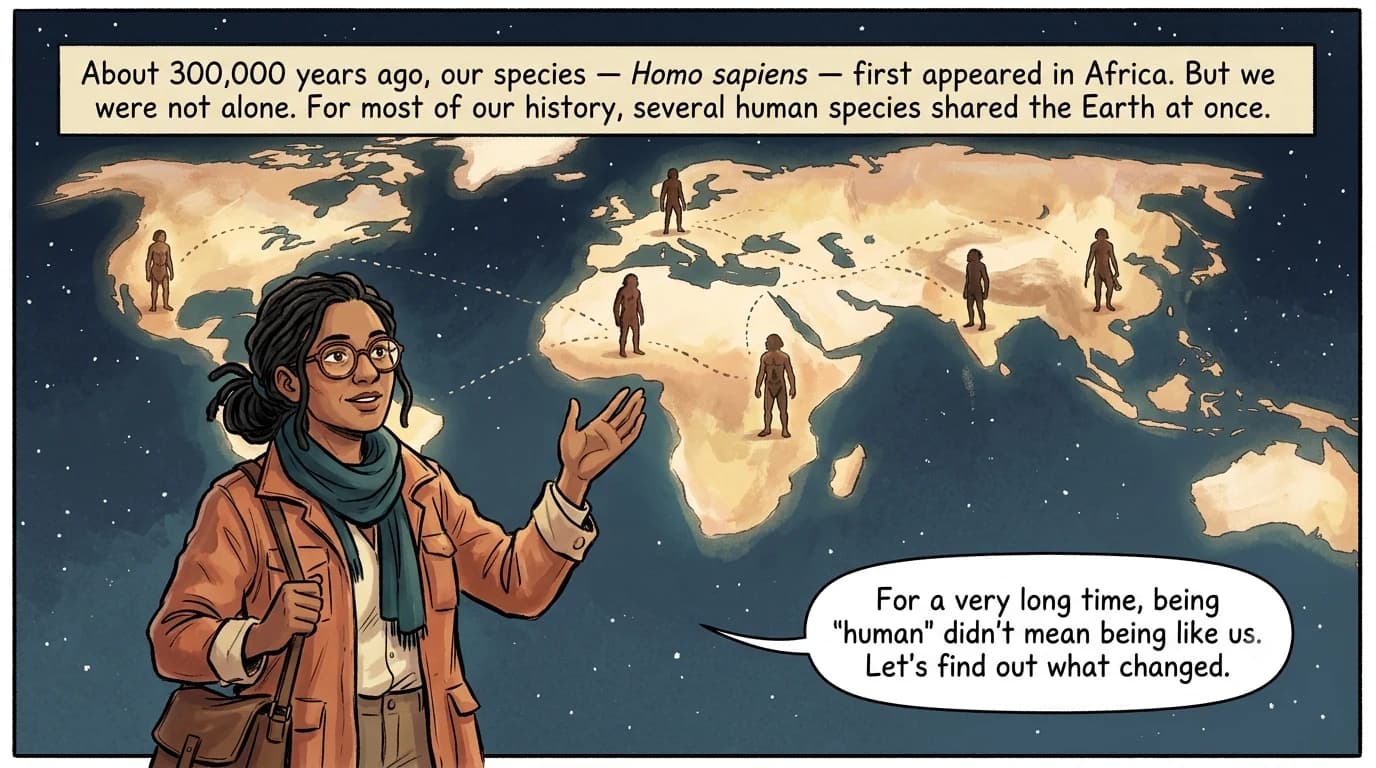
A guide figure gestures toward a glowing painted map of Africa and Eurasia at night, dotted with the silhouettes of several different ancient human species and the travel lines connecting them.
About 300,000 years ago, our species — Homo sapiens — first appeared in Africa. But we were not alone. For most of our history, several human species shared the Earth at once.
Kessa: For a very long time, being “human” didn’t mean being like us. Let’s find out what changed.
Panel 2
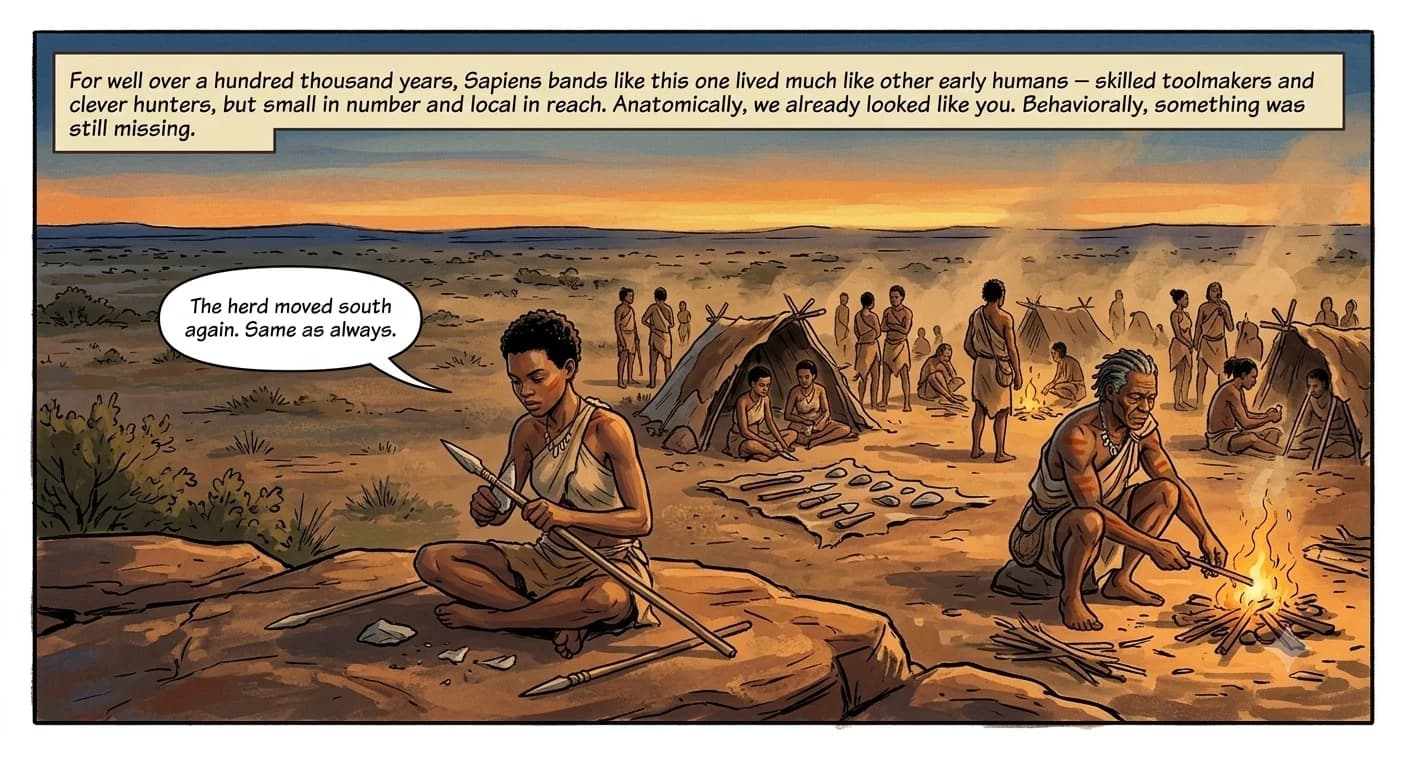
A small band of early Homo sapiens make camp at sunset in a semi-arid African landscape; a young woman sharpens a wooden point while an elder tends a fire nearby.
For well over a hundred thousand years, Sapiens bands like this one lived much like other early humans — skilled toolmakers and clever hunters, but small in number and local in reach. Anatomically, we already looked like you. Behaviorally, something was still missing.
Aro: The herd moved south again. Same as always.
Panel 3
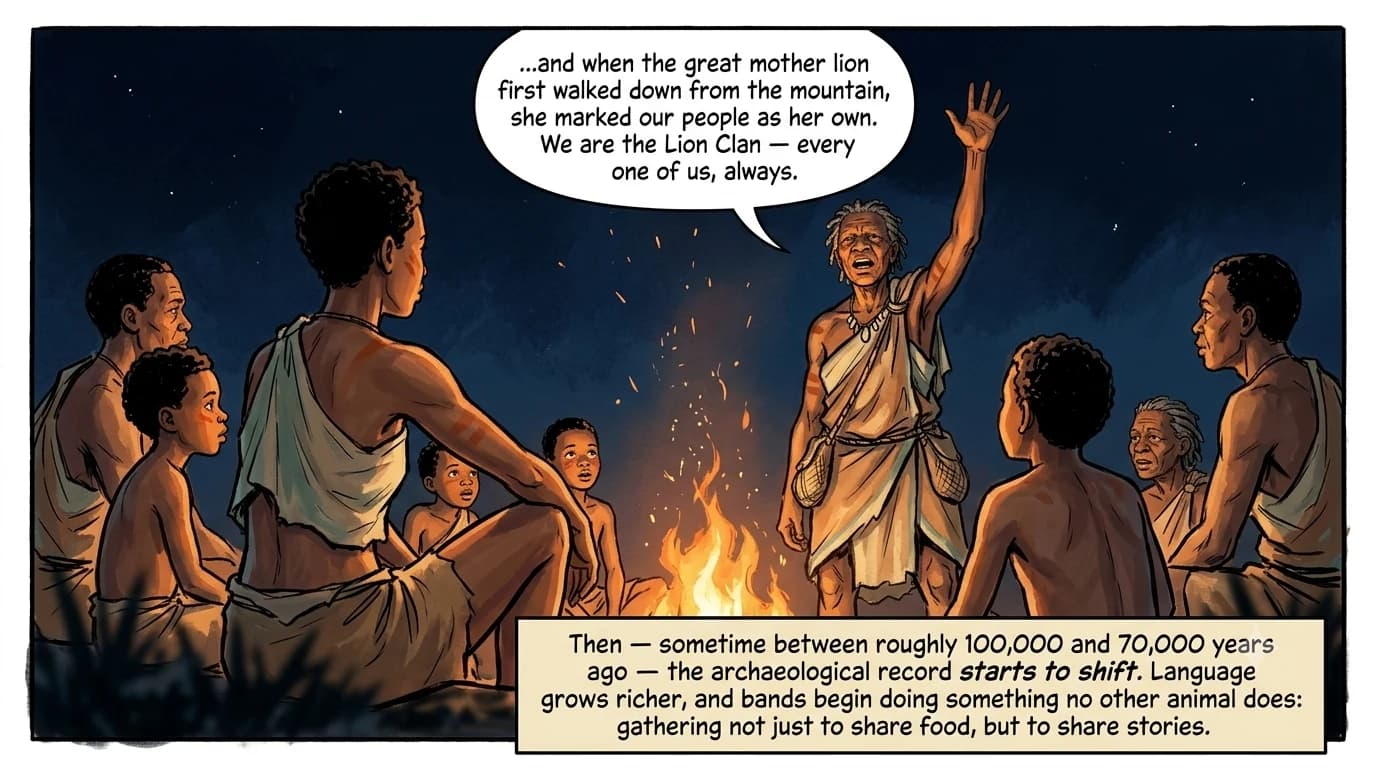
An elder stands and tells an animated story to a band gathered tightly around a night campfire, hands raised dramatically, firelit faces watching intently.
Then — sometime between roughly 100,000 and 70,000 years ago — the archaeological record starts to shift. Language grows richer, and bands begin doing something no other animal does: gathering not just to share food, but to share stories.
Yuma: …and when the great mother lion first walked down from the mountain, she marked our people as her own. We are the Lion Clan — every one of us, always.
Panel 4
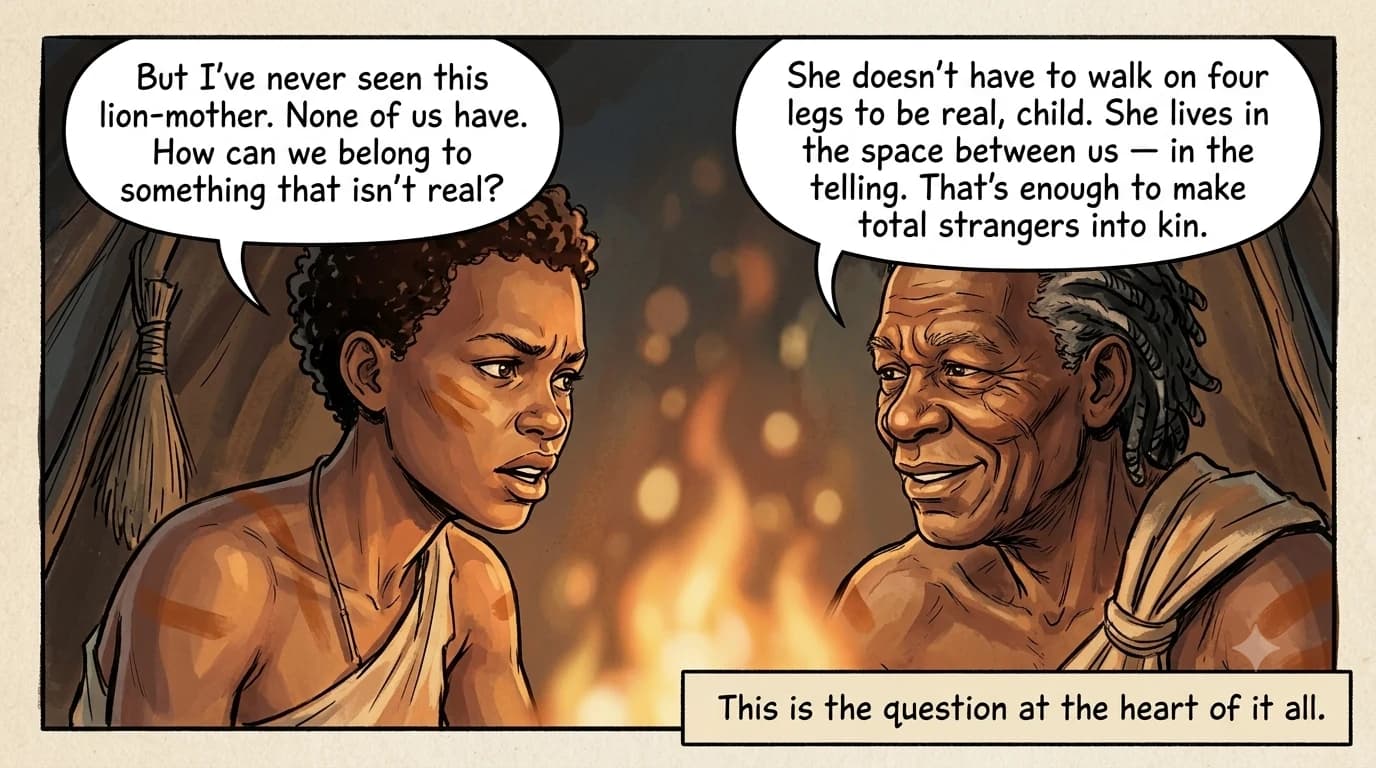
A close two-shot of a young woman leaning toward an elder by the firelight, her brow furrowed in question while the elder smiles knowingly back at her.
This is the question at the heart of it all.
Aro: But I’ve never seen this lion-mother. None of us have. How can we belong to something that isn’t real?
Yuma: She doesn’t have to walk on four legs to be real, child. She lives in the space between us — in the telling. That’s enough to make total strangers into kin.
Panel 5
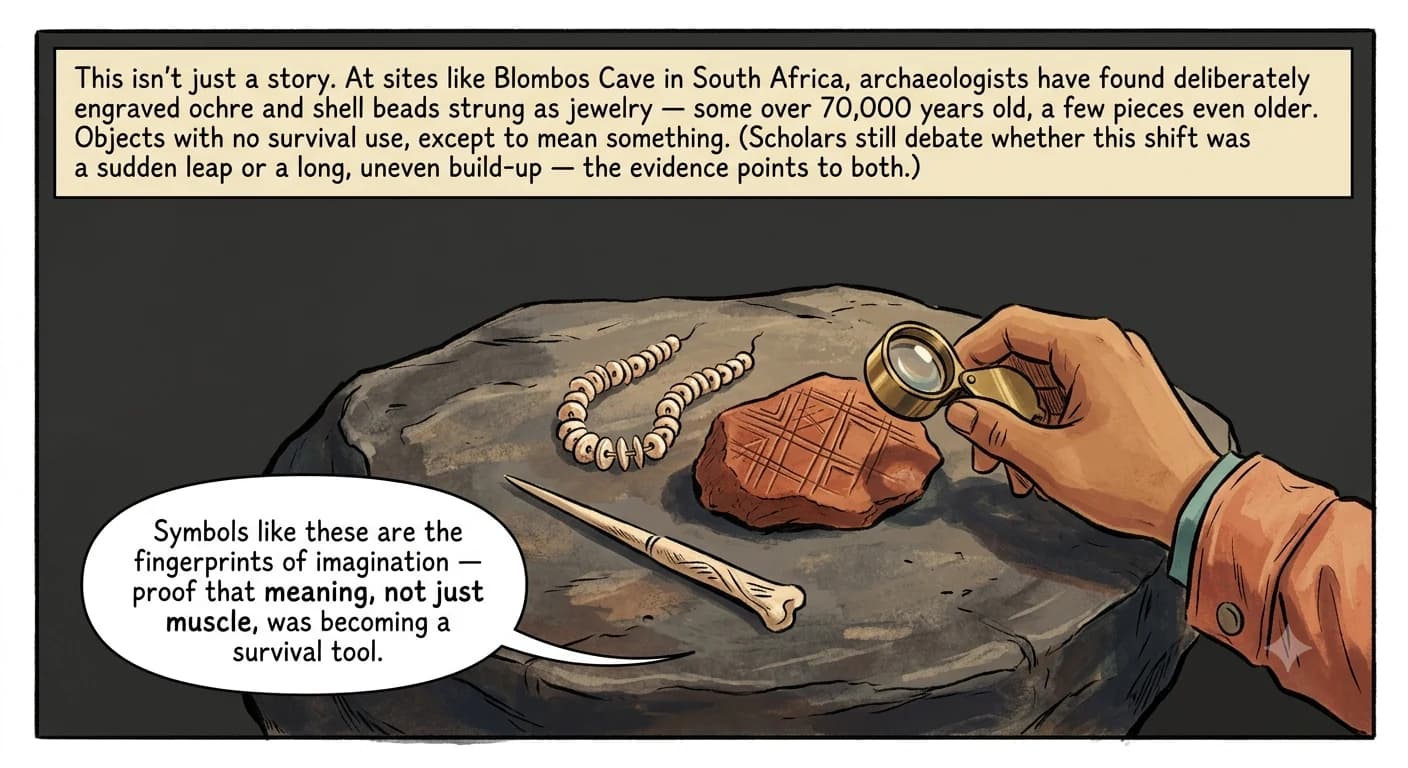
Close-up still life of an ancient engraved ochre slab with a cross-hatched pattern, a strand of small shell beads, and a carved bone tool resting on rock, with a hand holding a magnifying lens entering the frame.
This isn't just a story. At sites like Blombos Cave in South Africa, archaeologists have found deliberately engraved ochre and shell beads strung as jewelry — some over 70,000 years old, a few pieces even older. Objects with no survival use, except to mean something. (Scholars still debate whether this shift was a sudden leap or a long, uneven build-up — the evidence points to both.)
Kessa: Symbols like these are the fingerprints of imagination — proof that meaning, not just muscle, was becoming a survival tool.
Panel 6
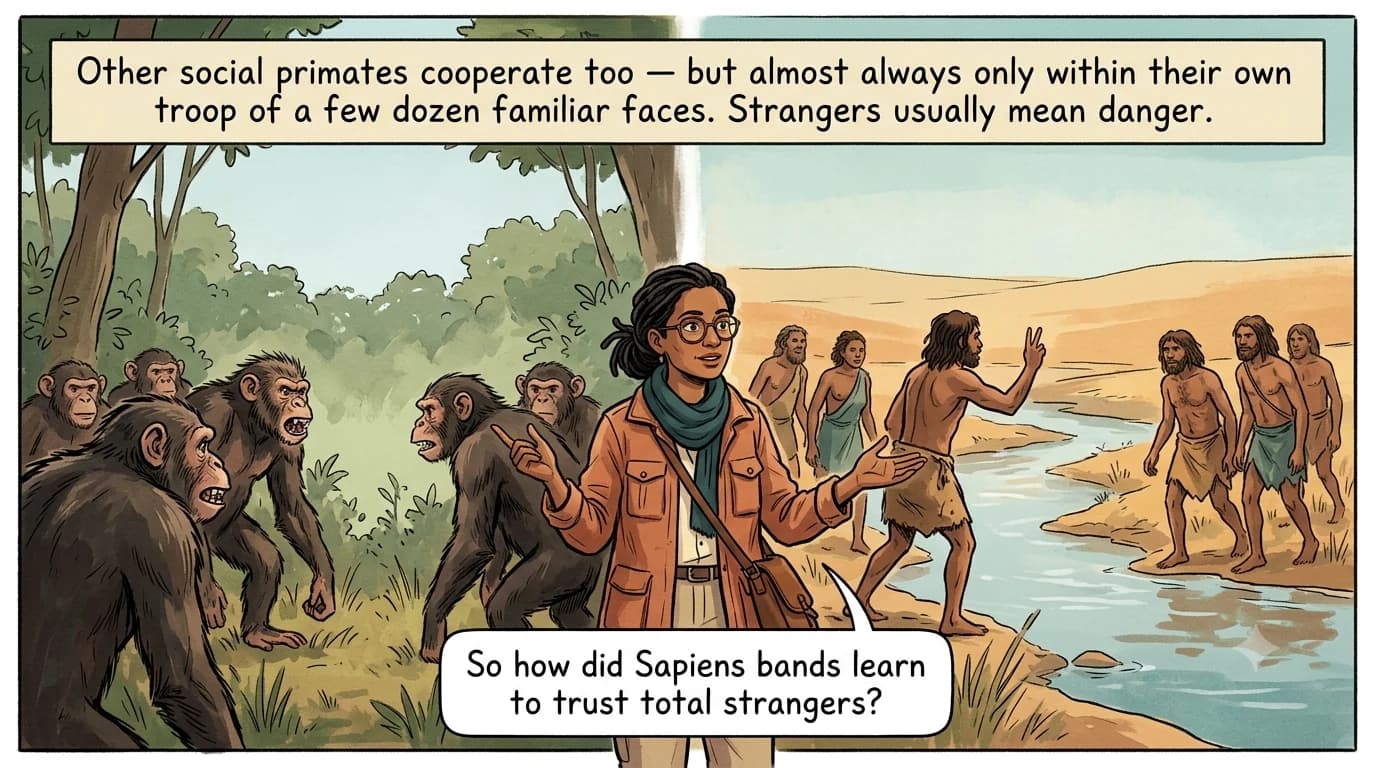
A split panel: on the left, chimpanzees bare teeth at a rival troop across a forest boundary; on the right, two bands of early humans cautiously approach each other across a river, with a guide figure standing at the dividing line between the two halves.
Other social primates cooperate too — but almost always only within their own troop of a few dozen familiar faces. Strangers usually mean danger.
Kessa: So how did Sapiens bands learn to trust total strangers?
Panel 7
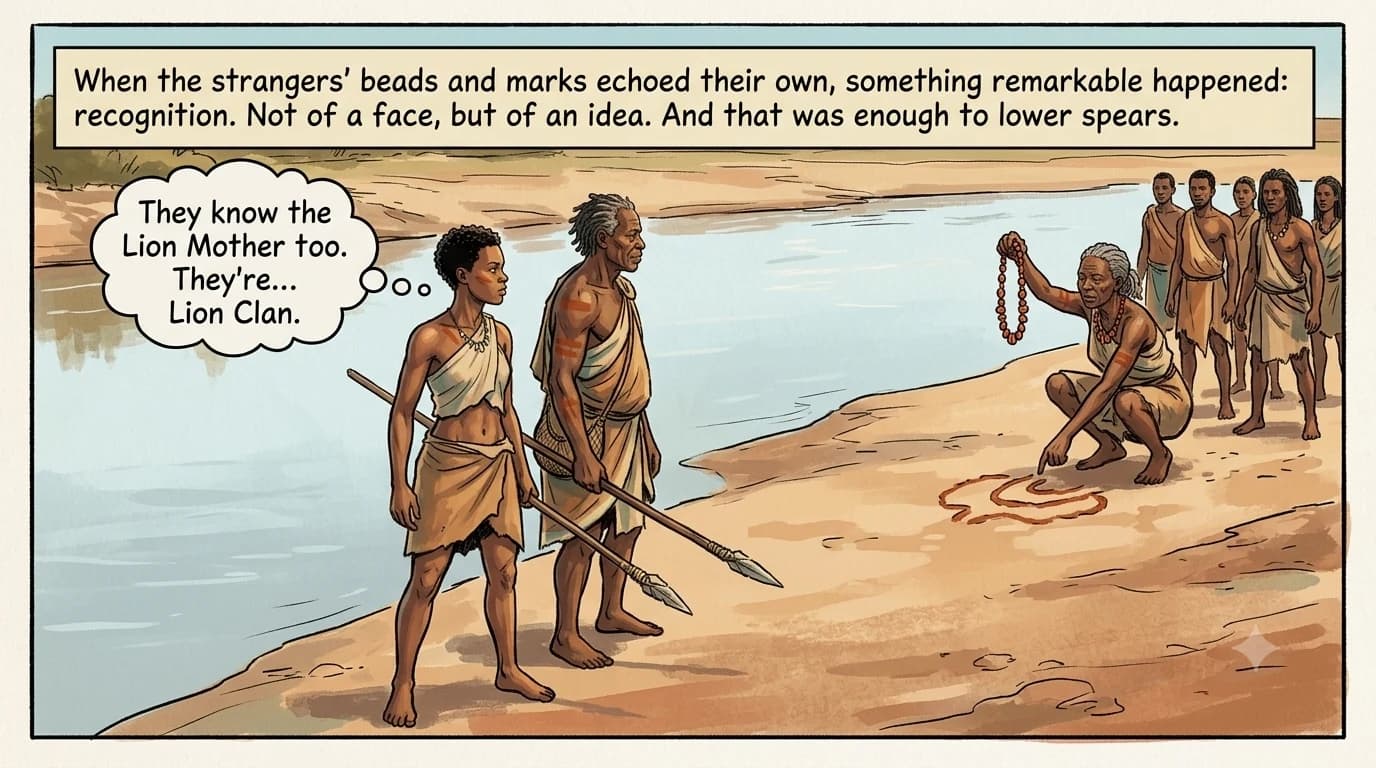
Two unfamiliar bands of early humans meet cautiously at a shallow river; an elder from one band lifts a shell-bead necklace matching the other band's, and the tension between them visibly eases.
When the strangers' beads and marks echoed their own, something remarkable happened: recognition. Not of a face, but of an idea. And that was enough to lower spears.
Aro: They know the Lion Mother too. They're… Lion Clan.
Panel 8
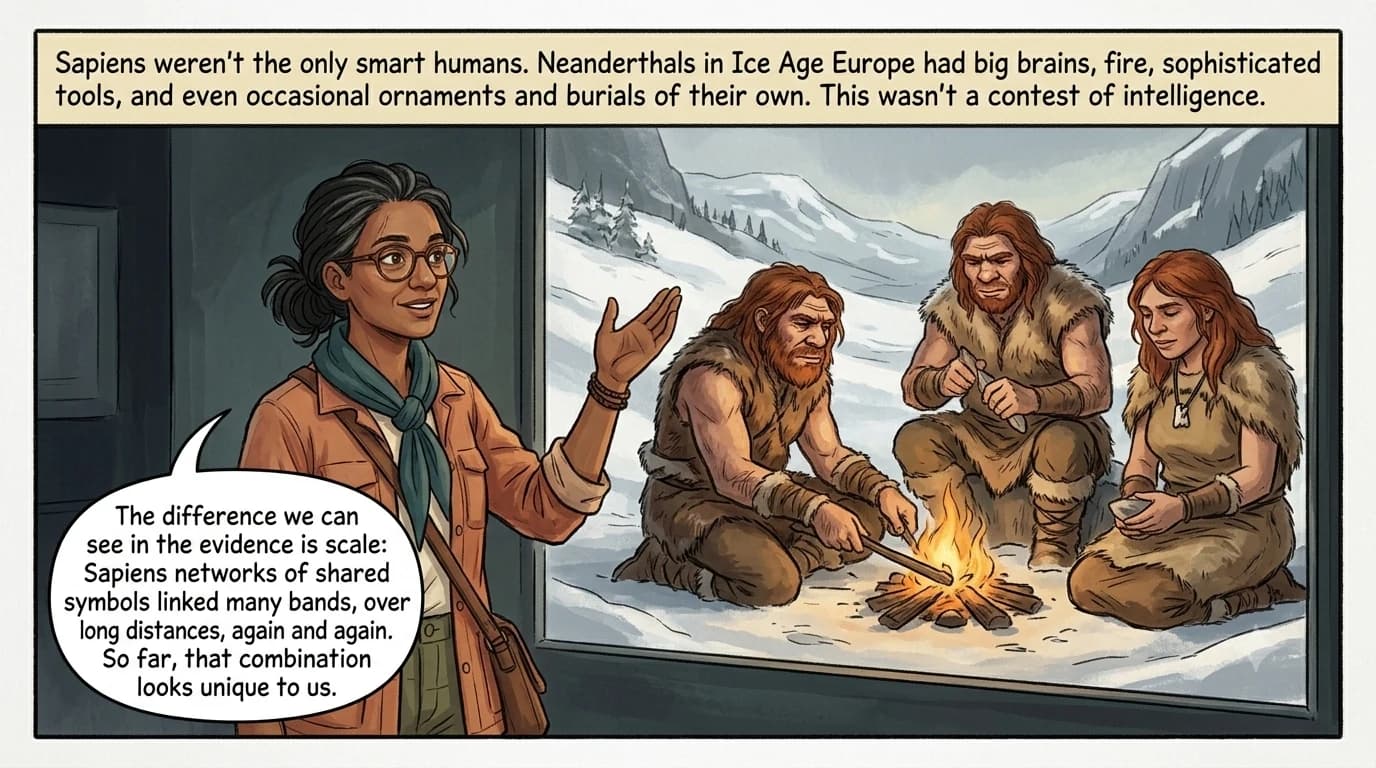
A guide figure stands beside a museum-style diorama of a Neanderthal family group tending a fire in an Ice Age European landscape, one wearing a simple pigment-marked bone pendant.
Sapiens weren't the only smart humans. Neanderthals in Ice Age Europe had big brains, fire, sophisticated tools, and even occasional ornaments and burials of their own. This wasn't a contest of intelligence.
Kessa: The difference we can see in the evidence is scale: Sapiens networks of shared symbols linked many bands, over long distances, again and again. So far, that combination looks unique to us.
Panel 9
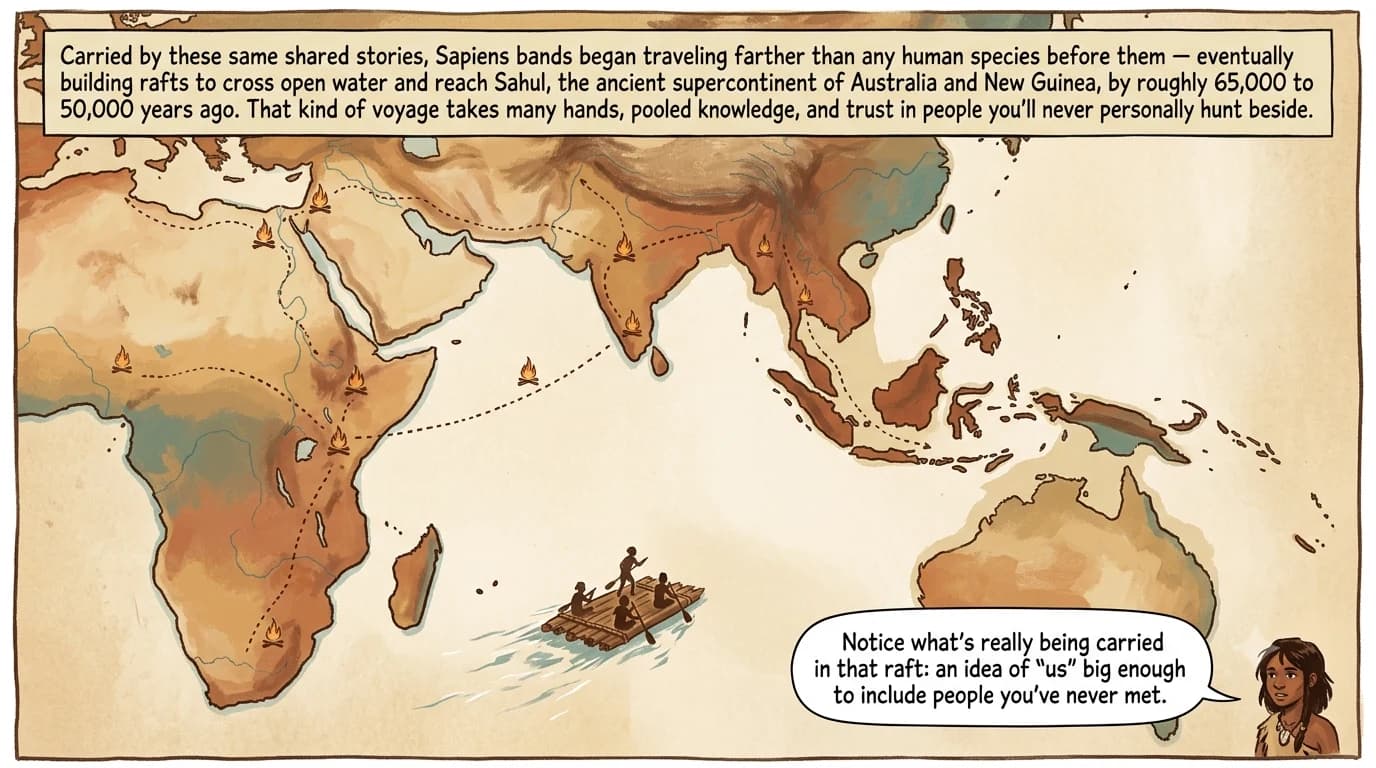
A stylized painterly map showing migration routes of early humans from Africa across Asia and by raft to ancient Australia and New Guinea, with small campfire icons marking settlements along the routes.
Carried by these same shared stories, Sapiens bands began traveling farther than any human species before them — eventually building rafts to cross open water and reach Sahul, the ancient supercontinent of Australia and New Guinea, by roughly 65,000 to 50,000 years ago. That kind of voyage takes many hands, pooled knowledge, and trust in people you'll never personally hunt beside.
Kessa: Notice what's really being carried in that raft: an idea of “us” big enough to include people you've never met.
Panel 10
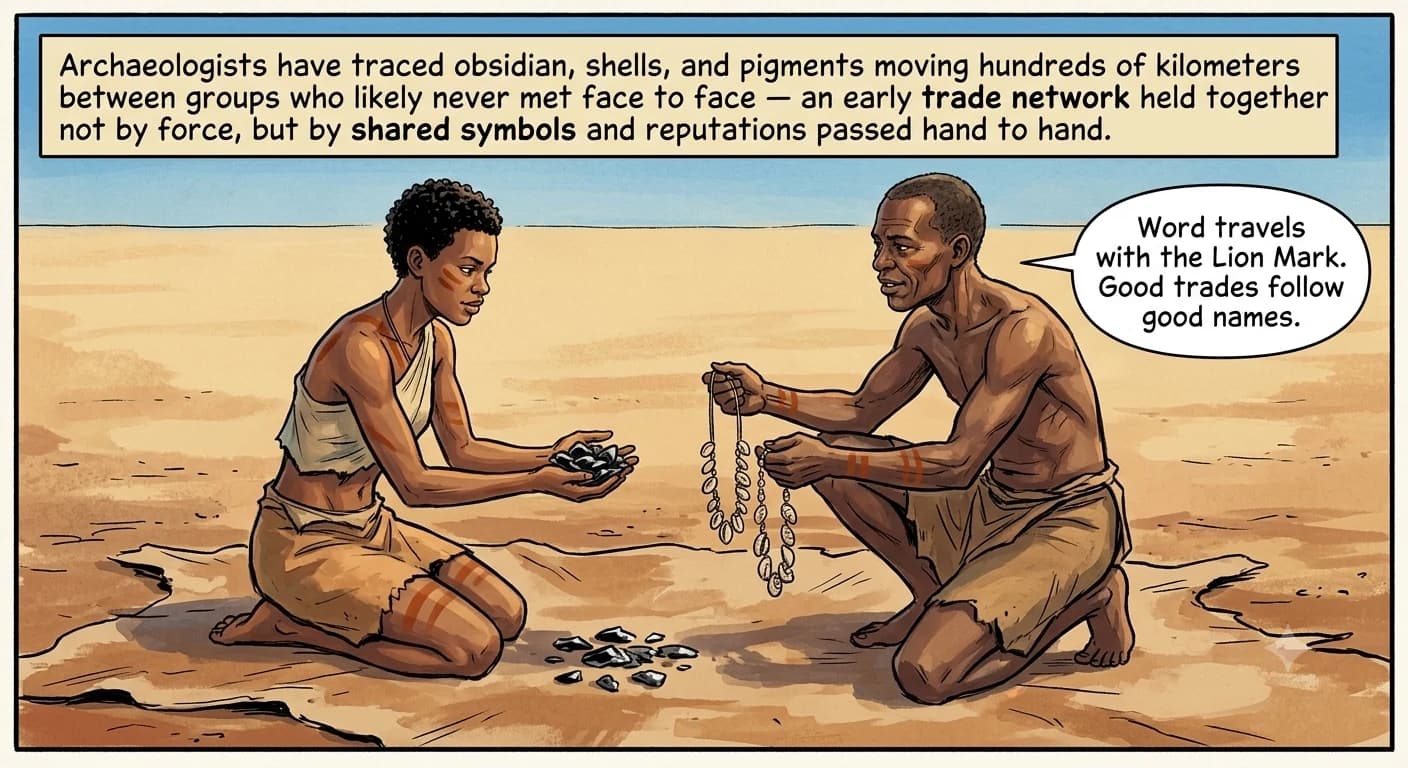
Two early humans kneel across a hide mat, exchanging dark obsidian flakes for a shell necklace, both marked with matching ochre clan symbols on their skin.
Archaeologists have traced obsidian, shells, and pigments moving hundreds of kilometers between groups who likely never met face to face — an early trade network held together not by force, but by shared symbols and reputations passed hand to hand.
Trader: Word travels with the Lion Mark. Good trades follow good names.
Panel 11
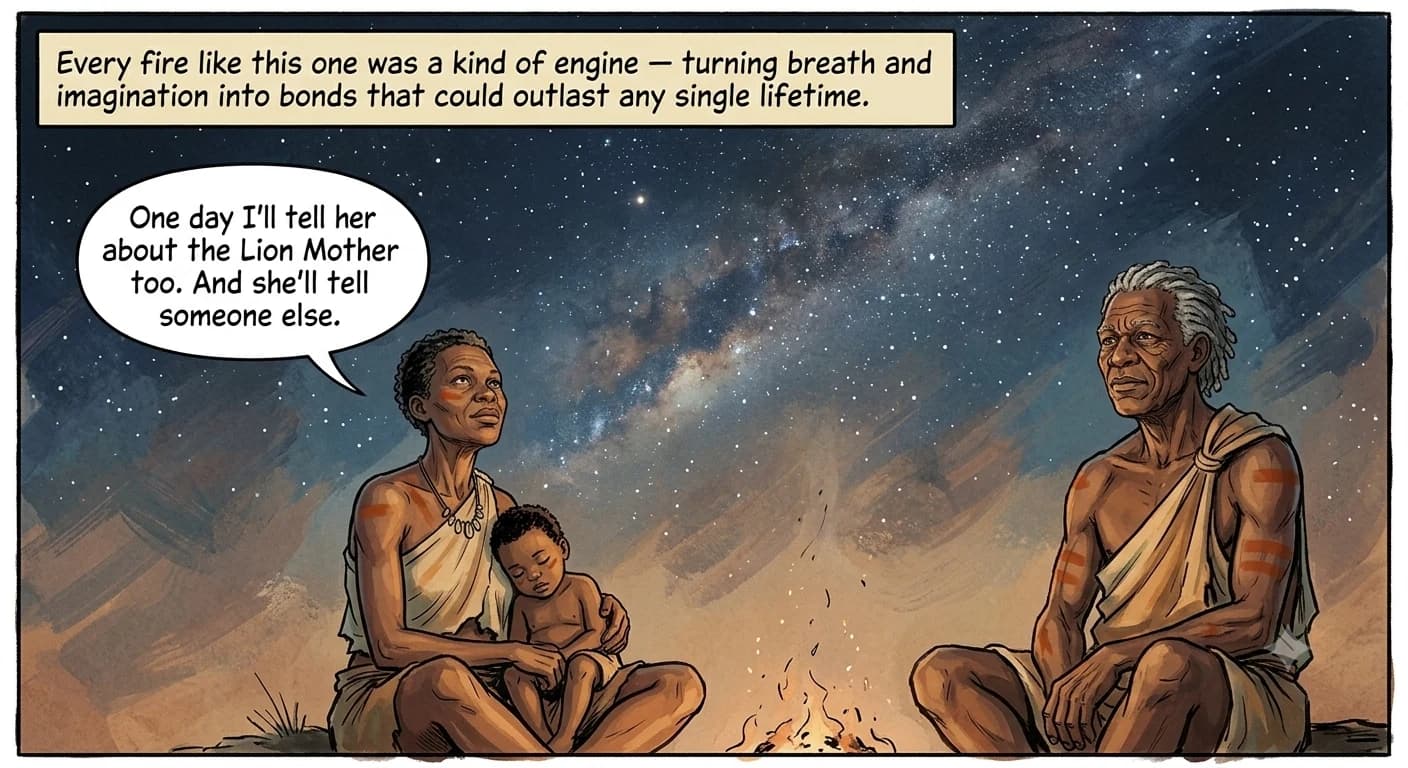
An older woman sits with a small child on her lap beside an aged elder under a brilliant starry night sky, the campfire beside them burned down to embers.
Every fire like this one was a kind of engine — turning breath and imagination into bonds that could outlast any single lifetime.
Aro: One day I'll tell her about the Lion Mother too. And she'll tell someone else.
Panel 12
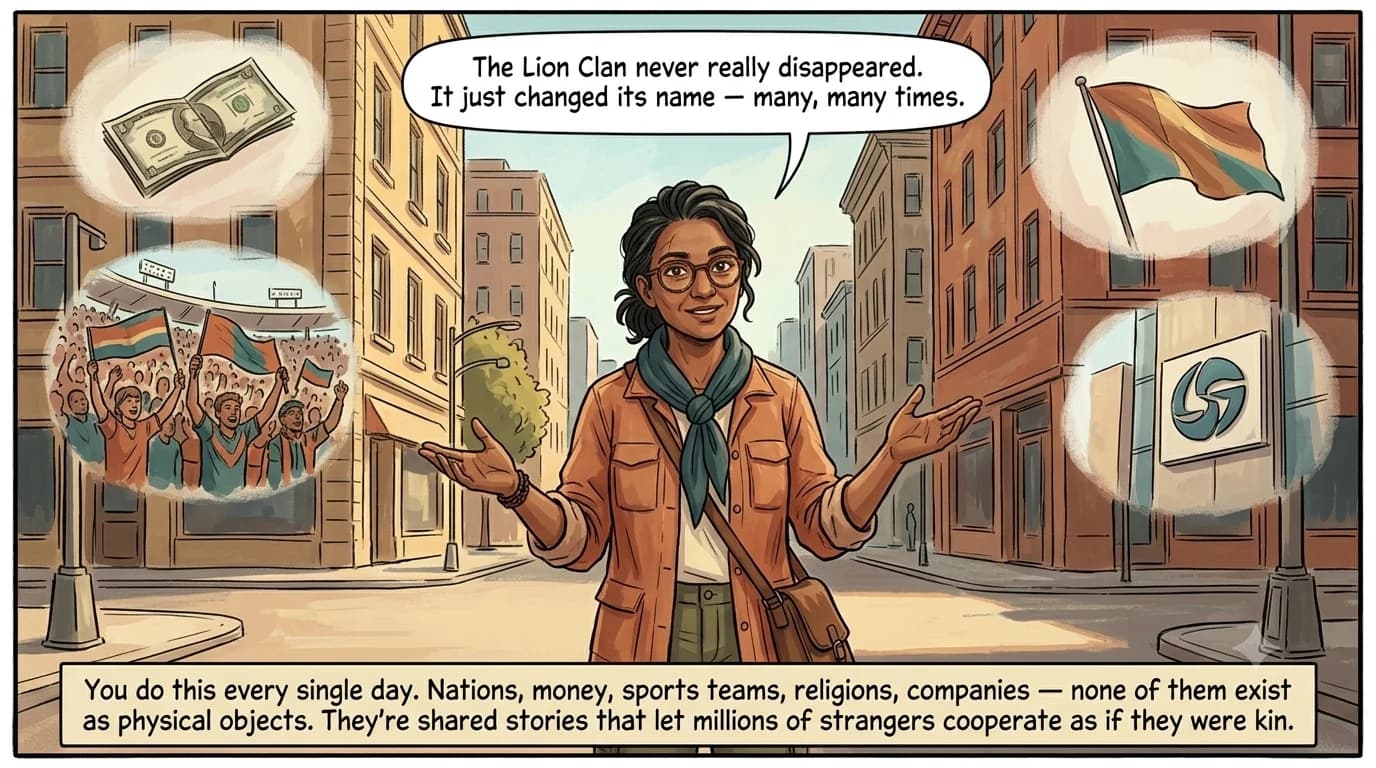
A guide figure stands on a modern city street corner surrounded by faint painterly vignettes of a banknote, a stadium crowd, a flag, and a company logo, echoing the earlier prehistoric campfire scenes.
You do this every single day. Nations, money, sports teams, religions, companies — none of them exist as physical objects. They're shared stories that let millions of strangers cooperate as if they were kin.
Kessa: The Lion Clan never really disappeared. It just changed its name — many, many times.
Panel 13
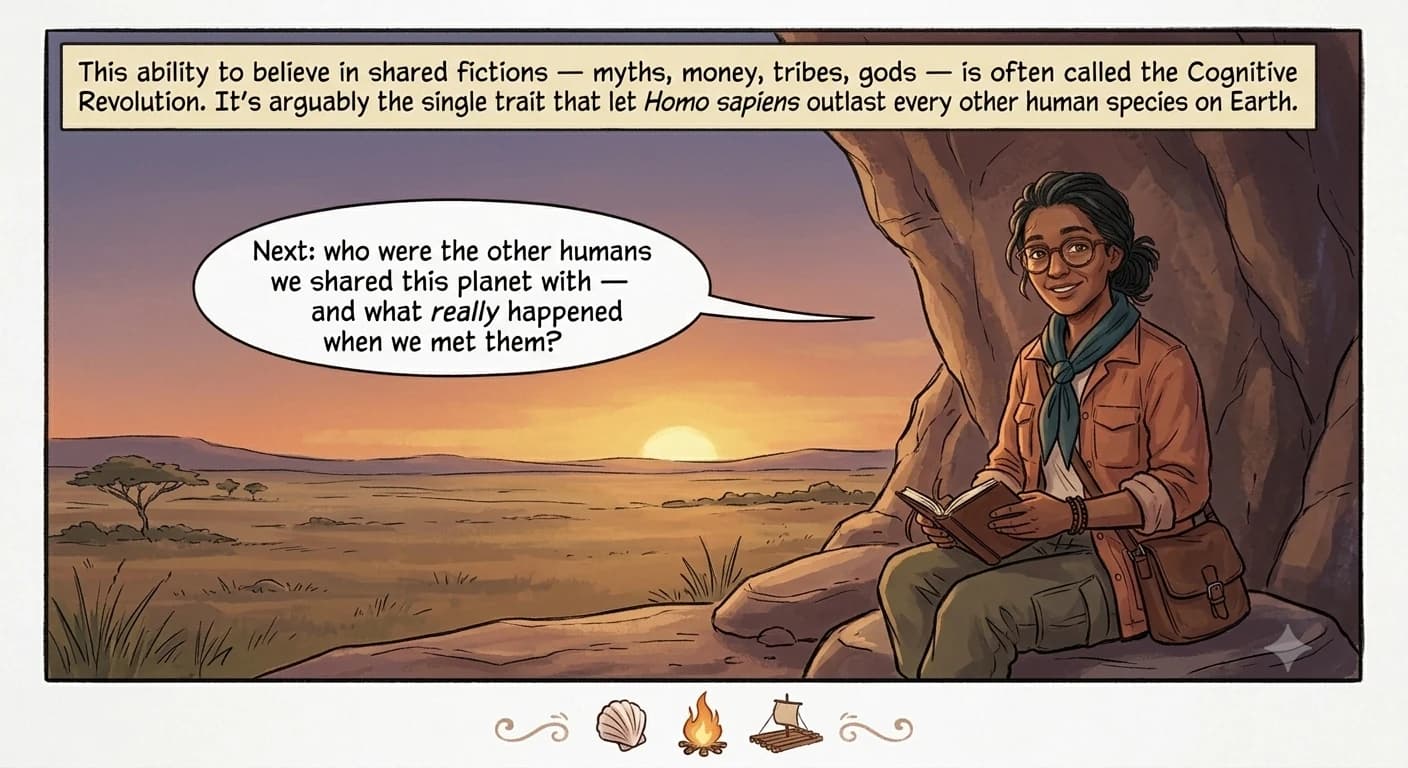
A guide figure closes a field notebook while sitting at the mouth of a cave at dusk, looking warmly toward the reader, with small decorative icons of a bead, a flame, and a raft along the panel's edge.
This ability to believe in shared fictions — myths, money, tribes, gods — is often called the Cognitive Revolution. It's arguably the single trait that let Homo sapiens outlast every other human species on Earth.
Kessa: Next: who were the other humans we shared this planet with — and what really happened when we met them?